Integration Cloud Service Use Case: Closed Loop Order Management Sven Bernhardt, Alexander Däubler, and Cornelia Spanner
May 21, 2017 Leave a comment
 Introduction
Integrating distributed systems with each other has been a challenge for many years. In the context of digital transformation, companies are using more and more Software as a Service (SaaS) applications to address standard processes, so that they can focus on improving and evolving the core business. This means even more complexity in integration, since cloud and on-premise systems need to be integrated.
There are three typical integration scenarios:
- On-premise to on-premise: Integration is done on-premise, based on, for example, Oracle SOA Suite
- On-premise to cloud: Integration is done in the cloud (e.g., using ICS) or on an on-premise integration platform
- Cloud to cloud: Integration is done in the cloud
The arising integration challenges can be addressed by either hybrid cloud integration or a full Integration Platform as a Service (iPaaS) approach, depending on a company’s center of gravity:
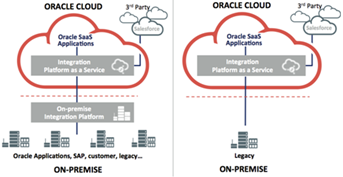
A hybrid approach (left) should be chosen if both cloud and on-premise applications must be integrated.
In a full iPaaS scenario (right), most of the integrations need to be done between cloud-based applications, because the center of gravity has moved to the cloud. The need for integrations with on-premise applications is low, because there are usually only a few legacy applications still hosted on-premise.
Oracle Integration Cloud Service (ICS) is a complete and strategic cloud-based integration platform that can be used in the context of a hybrid approach as well as when taking a full iPaaS approach. Using ICS, the definition of integrations comes to a new level. Pre-built integrations available through Oracle Cloud Marketplace that implement common integration scenarios can be used as a basis for new integrations and adapted to specific user needs. For data mappings, recommendations are shown based on knowledge derived from the same mappings done by other users. In conjunction with a very clearly structured and intuitive UI, which also enables non-technical users to define integrations between systems and applications, new integrations can be created rapidly and efficiently.
One key differentiator of Oracle ICS with respect to its competitors is that cloud-to-on-premise integrations are done using a lightweight agent concept. The so-called “connectivity agent” has to be hosted and deployed on premise, ensuring communication between ICS and the on-premise applications, without the need to open firewall ports. Read the complete article here.
For regular information on Oracle SOA Suite become a member in the SOA & BPM Partner Community for registration please visit www.oracle.com/goto/emea/soa (OPN account required) If you need support with your account please contact the Oracle Partner Business Center.
 Blog
Blog  Twitter
  LinkedIn
 ![image[7][2][2][2]](https://paascommunity.com/wp-content/uploads/2013/04/image7222.png?w=20&h=20 "image[7][2][2][2]") Facebook
Facebook ![clip_image002[8][4][2][2][2]](https://paascommunity.com/wp-content/uploads/2013/04/clip_image00284222.jpg?w=26&h=23 "clip_image002[8][4][2][2][2]") Wiki
Wiki
Technorati Tags: SOA Community,Oracle SOA,Oracle BPM,OPN,Jürgen Kress
 About Jürgen Kress

 PaaS Community Blog