PCS and Correlations: the next big thing cavemen already used… by Martien van den Akker
May 13, 2018 Leave a comment
You can use BPM, BPEL or Workflow to orchestrate or direct regular processes to get a job done from the beginning through a certain flow with a few decision-points, alternate and parallel flows to the end. A common use that is fine and usefull for most projects. And it can be seen as the driver for software companies to develop process/workflow engines.
However, there are cases that one process spawns off multiple other process instances that are some how related to one particular business case, involved person, or a uniquely distinguishable entity. And often those processes have to interact, with each other. For instance, this year in Split I came up with an idea for a role playing advanture game using chatbots and PCS. Each player would initiate a PCS instance, that when interacting with each other can detect if players meet each other at a certain location.
Correlation Sets are key here…
Right after the acquisition of Collaxa in 2004, in my Oracle Consulting era, I got the chance to be a BPEL trainer for Oracle University, doing several trainings for a few bigger consulting companies in the Netherlands. One of the subjects was about Asynchronous Processes and how the Process Manager used WS-Addressing to correlate the response to the running instance that sent out the request. But together with that Correlation Sets were mentioned. And I did not understand it: why would you need Correlation Sets when the Process Manager handles it all transparently using WS-Addressing? Otherwise put: it was time for me to do some projects.
PCS, BPM Suite and SOA Suite share the same process engine that originated from the early BPEL Process Engine. And as you can detect from my anecdote: Correlation Sets are key in this story. And this functionality is around from the medieval ages. In fact, recently they discovered char-coal drawings in a cave in France, indicating that people form pre-historic times already used Correlation Sets in their BPEL’s…
Prototype this…
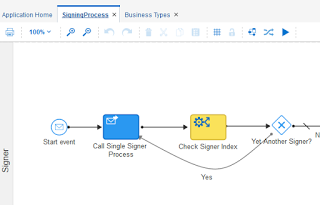
Let’s say you have a customer that is a large company with several responsible participants that are allowed to sign the contract. Some of them are full-authorised signers, while others only have partial authorisation. So either one of the fully authorised participants signs, which would complete the contract, or some of the partial signers have signed that pass the contract over the signing threshold.
For this case we keep it simple: either one of the full authorised participant should have signed or all of the partial signers should have signed. But we’ll handle this in a (set of) business rule(s), so it can be made more complex to resemble real-world cases. Read the complete article here.
For regular information on business process management and integration become a member in the SOA & BPM Partner Community for registration please visit www.oracle.com/goto/emea/soa (OPN account required) If you need support with your account please contact the Oracle Partner Business Center.
 Blog
Blog  Twitter
  LinkedIn
 ![image[7][2][2][2]](https://paascommunity.com/wp-content/uploads/2013/04/image7222.png?w=20&h=20 "image[7][2][2][2]") Facebook
Facebook ![clip_image002[8][4][2][2][2]](https://paascommunity.com/wp-content/uploads/2013/04/clip_image00284222.jpg?w=26&h=23 "clip_image002[8][4][2][2][2]") Wiki
Wiki
Technorati Tags: SOA Community,Oracle SOA,Oracle BPM,OPN,Jürgen Kress
 About Jürgen Kress

 PaaS Community Blog