Recursion in XSLT by Martien van den Akker
July 24, 2019 Leave a comment
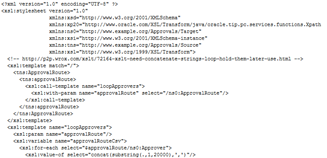
Last week I helped someone on the Oracle community forums with transforming a comma separated string to a list of elements. He needed this to process each element in BPM Suite, but it is a use case that can come around in SOA Suite or even in Oracle Integration Cloud.
You would think that you could do something like a for-each and trimming the element from the variable.
Recursion
One typical thing with XSLT is that variables are immutable. That means that you can declare a variable and assign a value to it, but you cannot change it. So it is not possible to assign a new value to a variable based on a substring of that same variable.
To circumvent this, you should implement a template that conditionally calls itself until an end-condition is met. This is a typical algorithm called recursion. Recursion is a way of implementing a function that calls itself, for example to calculate the faculty of a number. Recursion can help circumventing the immutability of variables, because with every call to the function you can pass (a) calculated and thus different value(s) through the parameter(s).
I wrote about this earlier, but last week a co-worker asked a similar question, but just the other way around: transforming a list into a comma separated string. So, apparently it’s time to write an article about it. Read the complete article here.
For regular information on Oracle PaaS become a member in the SOA & BPM Partner Community for registration please visit www.oracle.com/goto/emea/soa (OPN account required) If you need support with your account please contact the Oracle Partner Business Center.
 Blog
Blog  Twitter
  LinkedIn
 ![image[7][2][2][2]](https://paascommunity.com/wp-content/uploads/2013/04/image7222.png?w=20&h=20 "image[7][2][2][2]") Facebook
Facebook ![clip_image002[8][4][2][2][2]](https://paascommunity.com/wp-content/uploads/2013/04/clip_image00284222.jpg?w=26&h=23 "clip_image002[8][4][2][2][2]") Wiki
Wiki
Technorati Tags: SOA Community,Oracle SOA,Oracle BPM,OPN,Jürgen Kress
 About Jürgen Kress

 PaaS Community Blog