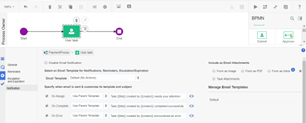
Jarvis Pizzeria: Input and Output Storage of Decision Model Invokes by Marcel van de Glind

image

In this blog we describe a way to store the Input and Output of Decision Model Invokes (in JSON format).

From an administrative point of view, we at Jarvis believe it is important that we can always see how we have achieved certain results. In this case this means that we want to know with which variables the Decision Model was invoked and what the outcomes were. How we do this is subject of this blog.

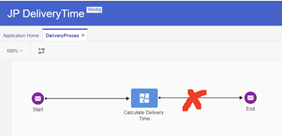
Saving the results is e.g. possible after performing the ‘Calculate Delivery Time’ integration in the Process. However, we have chosen to do this in the integration that we have already created (Managing DM Masterdata Validity Period) so that the process is not polluted with this technical step. As will appear later in this blog, we have to slightly update the payload of the call. The integration looks like this at the end of this previous blog. Read the complete article here.

PaaS Partner Community

For regular information on Oracle PaaS become a member in the PaaS (Integration & Process) Partner Community please register here.

clip_image003 Blog clip_image005 Twitter clip_image004 LinkedIn image[7][2][2][2] Facebook clip_image002[8][4][2][2][2] Wiki

Technorati Tags: SOA Community,Oracle SOA,Oracle BPM,OPN,Jürgen Kress
Microprocess Considerations by Jan Kettenis

image

In this article I discuss some considerations when applying the Microprocess Architecture, and how those can impact the design of the process.
As pointed out in the article about the Microprocess Architecture, one should carefully consider if this is the right architecture for the process application to create. Considering the implications (for example one single business process can end up comprising multiple process applications) it should not be considered to be a "one-size fits all" kind of architecture.
Guidelines that can help you to determine if and where is a fit, are the following:

  1. Do process instances have a longer time span during which one must be able to migrate it (in one way or another) to a newer version?
  2. Is the process expected to change often, implying multiple versions will be active at the same time?
  3. Does it concern a complex business process, where business functions can be executed isolated from each other?

Are multiple business units involved in the flow? Read the complete article here

PaaS Partner Community

For regular information on Oracle PaaS become a member in the PaaS (Integration & Process) Partner Community please register here.

clip_image003 Blog clip_image005 Twitter clip_image004 LinkedIn image[7][2][2][2] Facebook clip_image002[8][4][2][2][2] Wiki

Technorati Tags: SOA Community,Oracle SOA,Oracle BPM,OPN,Jürgen Kress

Jarvis Pizzeria:ORDS-CRUD Generator by Marcel van de Glind

imageThe Auto REST feature allows you to quickly set up REST services on your ORDS enabled database. This feature allows users wanting to quickly enable database objects and run basic queries. Users wanting more complex operations will need the Full REST development setup.

In order to use the Auto REST functionality, only a few actions are required. Although the amount of work when using the Full REST option is not too bad, it is still considerably more than with Auto REST.

To reduce the effort difference between Auto REST and Full REST, fellow Jarvis owner Rick has developed an ORDS-CRUD generator. With the help of this tool it is possible to generate CRUD templates for REST enabled resources (e.g. an address table).

The tool is available in a VBCS and a JSFiddle variant. Read the complete article here.

PaaS Partner Community

For regular information on Oracle PaaS become a member in the PaaS (Integration & Process) Partner Community please register here.

clip_image003 Blog clip_image005 Twitter clip_image004 LinkedIn image[7][2][2][2] Facebook clip_image002[8][4][2][2][2] Wiki

Technorati Tags: SOA Community,Oracle SOA,Oracle BPM,OPN,Jürgen Kress
Jarvis Pizzeria: How to manage Masterdata of a DM (part 1) by Marcel van de Glind

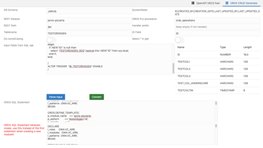
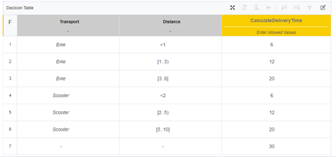
imageWe have implemented the decision table below in a Decision Model (see Using a DM in PCS) and we have made the Decision Model accessible through an integration (see Using a DM in ICS). But now let’s look at the data in this table.

Suppose that it turns out that deliveries by scooter at distances above 5 Km turn out to be faster than expected (because this is usually outside built-up areas, where there is less traffic).

For this we have to adjust the CalculateDeliveryTime in line 6 of the table from 20 to e.g. 18. Once this is done we must activate a new snapshot. Because the integration of the previous blog refers to the LATEST snaphot version, no further adjustments are needed. The Decision integration can be used unchanged.

Changing the CalculateDeliveryTime, but also the Distance range are data where we can imagine that they will change regularly. The question is whether we want to reactivate the Decision for each adjustment?

If the answer to this question is “No”, we must see if this can be done differently. Is there an alternative? “Yes” there is. We will explain that further in the remainder of this blog.

The first thing we do is take a closer look at the decision table. Read the complete article here.

PaaS Partner Community

For regular information on Oracle PaaS become a member in the PaaS (Integration & Process) Partner Community please register here.

clip_image003 Blog clip_image005 Twitter clip_image004 LinkedIn image[7][2][2][2] Facebook clip_image002[8][4][2][2][2] Wiki

Technorati Tags: SOA Community,Oracle SOA,Oracle BPM,OPN,Jürgen Kress
Jarvis Pizzeria: Using a DM in ICS by Marcel van de Glind

image

In This blog is a follow up of Using a DM in PCS, but can also be read as a separate item. The previous blog we showed how to embed a Decision in PCS. We described how the hard-coded relationship between a Decision and Process (PCS) can be prevented by using an ICS integration. In this blog we describe step by step how this integration can be developed.

ICS Integration

The integration can be divided into the following steps:

  1. Get the endpoint of the Decision Service
  2. Create the invoke Connector
  3. Create the Integration
  4. Activate the Integration
  5. Test the Integration (using postman)
  6. PCS adjustment to invoke the Integration

Get the endpoint of the Decision Service

We start by making the Decision available in ICS by defining a connector for it. For this we must first determine the REST endpoint of the Decision. Todo this follow the steps below:

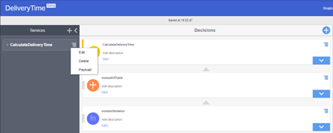
    • Open the Decision. Then select the operation that you want to access under Services. In this case, calculateDeliveryTime.
    • Then select the option ‘Payload’ from the hamburger menu.
    • Read the complete article here.

PaaS Partner Community

For regular information on Oracle PaaS become a member in the PaaS (Integration & Process) Partner Community please register here.

clip_image003 Blog clip_image005 Twitter clip_image004 LinkedIn image[7][2][2][2] Facebook clip_image002[8][4][2][2][2] Wiki

Technorati Tags: SOA Community,Oracle SOA,Oracle BPM,OPN,Jürgen Kress
Oracle Integration Process release March 2020

What’s New for Oracle Integration? Learn about the new and changed features of Oracle Integration Process Features:

image

Feature

Description

Published

Header support in SOAP connectors

You can use headers specified in the WSDL of a SOAP connector to create data inputs and outputs during data association.

See Use SOAP Headers in Data Asoociations in Using Processes in Oracle Integration.

March 23

Web form events

We added the following enhancements:

· Support for looping, enabling you to execute the same action multiple times in a form control.

See Examples of Loops in Forms in Using Processes in Oracle Integration.

· Dynamically populate information about a current logged in user’s data such as name, email, user id and so on in forms using the Current Logged in User Data function.

See Example of Current Logged in User Data Function in Using Processes in Oracle Integration.

March 23

New translation framework for multi language support

We added support for human task title and action localization and overall process application localization.

See Localize Applications in Using Processes in Oracle Integration.

March 23

Micro process

Dynamically discover active BPMN processes in other process applications, for cross-application process reuse.

See Create and Use Micro Processes in Using Processes in Oracle Integration.

March 23

For details please see here.

PaaS Partner Community

For regular information on Oracle PaaS become a member in the PaaS (Integration & Process) Partner Community please register here.

clip_image003 Blog clip_image005 Twitter clip_image004 LinkedIn image[7][2][2][2] Facebook clip_image002[8][4][2][2][2] Wiki

Technorati Tags: SOA Community,Oracle SOA,Oracle BPM,OPN,Jürgen Kress
Jarvis Pizzeria Serves cookies pizza by Marcel van de Glind

image

This blog is a summary of the original blog as described on the blog of my Jarvis colleague RickWe proudly present a new flavor in our assortment: Cookies Pizza. Using cookies to save user preferences / user input from the UI..

Rick’s post will be looking into two examples of using cookies when baking pizza. The first is a hard save of information through a save and get button of a webpage, the second is on the fly saving of information on a webpage (saving fields locally in cookies so a user can leave and re-enter a page without losing data). This post will also include dynamically showing and hiding table columns, as well as using the afterNavigate event. Read the complete article here.

PaaS Partner Community

For regular information on Oracle PaaS become a member in the PaaS (Integration & Process) Partner Community please register here.

clip_image003 Blog clip_image005 Twitter clip_image004 LinkedIn image[7][2][2][2] Facebook clip_image002[8][4][2][2][2] Wiki

Technorati Tags: SOA Community,Oracle SOA,Oracle BPM,OPN,Jürgen Kress

The Process Group Pattern by Jan Kettenis

image

This article describes the Process Group Pattern, which can be used to correlate process or integration instances that all support the same business process. It is also one of patterns supporting the Microprocess Architecture.

Updated on 2019-09-16 to include screenshot of processes in Workspace.

For a somewhat more complex process, and especially when applying the MicroprocessArchitecture, you may have more than one process and probably several integration applications that make up the implementation of one single business process. This implies that when executing a business process there will be 2 or more instances of the process, and integration applications. Now how can a business user or Applications Administrator correlate all these instances to monitor the flow of the business process?

The on-premise Oracle BPM Suite (and SOA Suite) has the concept of "flowId" which is an id that is generated by the BPM engine at the start of the first instance and then "passed on" from one instance to the other. Using Enterprise Manager, by means of the flowId one can easily follow how one process or integration calls the other, and by putting it in the process or integration instance title, also in the Workspace. The Oracle Integration Cloud (OIC) does not have the concept of flowId, as least not yet. Now what to do? Here comes the Process Group Instance to the rescue. Read the complete article here.

PaaS Partner Community

For regular information on Oracle PaaS become a member in the PaaS (Integration & Process) Partner Community please register here.

clip_image003 Blog clip_image005 Twitter clip_image004 LinkedIn image[7][2][2][2] Facebook clip_image002[8][4][2][2][2] Wiki

Technorati Tags: SOA Community,Oracle SOA,Oracle BPM,OPN,Jürgen Kress

Jarvis Pizzeria blog refresh part 3 of 3 by Marcel van de Glind

imageIn this blog I do a quick refresh of the third (and last) batch of 13 Jarvis Pizzeria blog posts (note: the different headers in this blog contain a link to the actual blog).

27. Jarvis Pizzeria in Case Management Style

The core of this post concerns the release of Oracle Integration Cloud, the bundling of Process Cloud Service (PCS), Integration Cloud Service (ICS) and Visual Builder Cloud Service (VBCS). and the addition of Dynamic Processes to PCS.

Recently Rick Kelder, my new Jarvis Pizzeria partner, wrote an extensive blog about the status of OIC according to his opinion (oic-oracle-integration-cloud-what-is-it?).

28. Getting Started with Dynamic Processes (ACM)

This introductory blog consists of an overview of the different parts of Dynamic Processes. This is done via the default sample tour of Oracle PCS.

29. Setting up the Dynamic Process

In this blog we set the skeleton for the Pizzeria Dynamic Process. We define the different phase, activities, tasks and milestones.

Besides that we found out that the standard Oracle example tour cannot be saved as a starting point for further work. However, the save button is available, suggesting that this is possible. Oracle this is a bit confusing.

30. The logic underneath the Dynamic Process

In this blog we connect processes and task to the activities created in the skeleton of the dynamic process of the previous blog.

We show how things look-like on runtime for running and also completed instances. OIC gives a good out of the box representation of the dynamic process. We can work on the process within the OIC and have an overview of what happened with the process. We see the progression, stages, activities and can drill in the audit trail. Read the complete article here

PaaS Partner Community

For regular information on Oracle PaaS become a member in the PaaS (Integration & Process) Partner Community please register here.

clip_image003 Blog clip_image005 Twitter clip_image004 LinkedIn image[7][2][2][2] Facebook clip_image002[8][4][2][2][2] Wiki

Technorati Tags: SOA Community,Oracle SOA,Oracle BPM,OPN,Jürgen Kress

Jarvis Pizzeria blog refresh part 2 of 3 by Marcel van de Glind

image

In this blog I do a quick refresh of the second 13 Jarvis Pizzeria blog posts
(note: the different headers in this blog contain a link to the actual blog).

14. Using an imported XSD in PCS

In this post we make an attempt to use an imported XSD containing a complex type in a web form. It is possible to ‘use’ the type, but things are not working very well (as described in the blog). In the current version (19.3.2) this works even less good. It is no longer possible to save the web form. The following error appears.

At various places in OIC the tooling has quite a bit of trouble with data types, and that in particular with complex data types but also with simple data types, not everything goes smoothly. These are generally not insurmountable issues, but in my opinion Oracle still has some work to do.

15. Testing in PCS against the Development or Production environment

In this post, testing in PCS is discussed for both the test and the production modes. In an earlier post we have already shown how a PCS process can be started from postman via a rest call (Using the REST interface to start a Process).
In this blog we show how this rest call must be adjusted to distinguish between a call in test or production modes. In a nutshell: we need to set the ‘pcs_mode’ param in the request header and give it the value ‘dev’.

16. Handling SOAP Faults in PCS

In this blog post we show how PCS deals with SOAP errors in the following two situations: the out of the box fault policies ON and OFF.

Are there any scenarios conceivable where a developer should turn off the fault policies? The disadvantage of turning on fault-policies is that the fault policies are turned on for the entire application. If one – for whatever reason – wants to build a proprietary error handling framework than this feature should be turned off.

For example, in the situation that an email has to be sent to one of our customers (like an order confirmation), and the process fails for some reason we do not want to use the retry policy of the default error handling, because that could mean that we send the same email 4 times to the customer. Isolating such functionality in a separate dedicated application is preferred in this case. Read the complete article here

PaaS Partner Community

For regular information on Oracle PaaS become a member in the PaaS (Integration & Process) Partner Community please register here.

clip_image003 Blog clip_image005 Twitter clip_image004 LinkedIn image[7][2][2][2] Facebook clip_image002[8][4][2][2][2] Wiki

Technorati Tags: SOA Community,Oracle SOA,Oracle BPM,OPN,Jürgen Kress