Oracle Fusion Middleware 12c (12.2.1.3.0) Released

We are proud to announce the release of Oracle Fusion Middleware 12c (12.2.1.3.0). Media is available for download on the Oracle Technology Network (OTN), My Oracle Support (MOS) and the Oracle Software Delivery Cloud (OSDC). This includes the following products:  image

    •     Oracle SOA Suite and Business Process Management 12c (12.2.1.3.0)
    •     Oracle Stream Analytics 12c (12.2.1.3.0)
  •     Oracle Fusion Middleware WebLogic Server Plug-In 12c    (12.2.1.3.0)
  •     Oracle B2B and Healthcare 12c (12.2.1.3.0)
    •     Oracle Real-Time Integration Business Insight 12c (12.2.1.3.0)
    •     Oracle Service Bus 12c (12.2.1.3.0)
  •     Oracle WebLogic Server 12c (12.2.1.3.0)
  •     Oracle Access Manager Access SDK 12c (12.2.1.3.0)
  •      Oracle Business Intelligence 12c (12.2.1.3.0)
  •     Oracle Coherence 12c (12.2.1.3.0)
  •     Oracle Data Integrator 12c (12.2.1.3.0)
  •     Oracle Enterprise Data Quality 12c (12.2.1.3.0)
  •     Oracle Enterprise Pack for Eclipse 12c (12.2.1.3.0)
  •     Oracle Forms and Reports 12c (12.2.1.3.0)
  •     Oracle Fusion Middleware Infrastructure 12c (12.2.1.3.0)
  •     Oracle GoldenGate Studio 12c (12.2.1.3.0)
  •     Oracle HTTP Server 12c (12.2.1.3.0)
  •     Oracle Identity and Access Management 12c (12.2.1.3.0)
  •     Oracle Internet Directory 12c (12.2.1.3.0)
  •     Oracle JDeveloper Studio 12c (12.2.1.3.0)
  •     Oracle Managed File Transfer 12c (12.2.1.3.0)
  •     Oracle MapViewer 12c (12.2.1.3.0)
  •     Oracle TopLink 12c (12.2.1.3.0)
  •     Oracle Traffic Director 12c (12.2.1.3.0)
  •     Oracle Unified Directory 12c (12.2.1.3.0)
  •     Oracle WebCenter Content 12c (12.2.1.3.0)
  •     Oracle WebCenter Portal 12c (12.2.1.3.0)
  •     Oracle WebCenter Sites 12c (12.2.1.3.0)


Partner Resources (community membership required):

SOA & BPM Partner Community

For regular information on Oracle SOA Suite become a member in the SOA & BPM Partner Community for registration please visit www.oracle.com/goto/emea/soa (OPN account required) If you need support with your account please contact the Oracle Partner Business Center.

Blog Twitter LinkedIn image[7][2][2][2] Facebook clip_image002[8][4][2][2][2] Wiki

Technorati Tags: Fusion Middleware 12.2.1.3.0,SOA Suite 12c,BPM Suite 12c,Oracle,SOA Community,Oracle SOA,Oracle BPM,OPN,Jürgen Kress
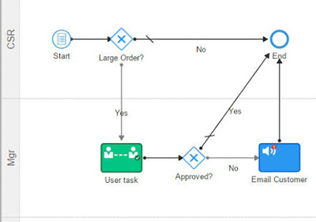
PCS 16.4.5 New Features incl. Quickstart Masters, Automated Archive & Purge, REST connectors… by Niall Commiskey

image

Lots of great new features, just in time for the Holiday Season.
Thanks to my colleague Kathryn L.
I will be adding to this post over time, so, currently, it is not an exhaustive list.

1. Ability to see Conversations in Tracking

Note: the second icon on the right, under the docs icon.

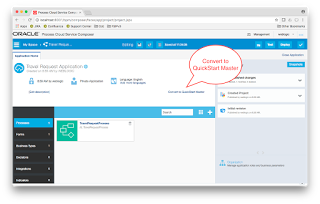
2. Quickstart Master new functionality

For those of you who have yet to meet a Quickstart Master – here’s a quick intro.

I take an existing process and convert it to a Quickstart Master. Read the complete article here.

SOA & BPM Partner Community

For regular information on Oracle SOA Suite become a member in the SOA & BPM Partner Community for registration please visit www.oracle.com/goto/emea/soa (OPN account required) If you need support with your account please contact the Oracle Partner Business Center.

Blog Twitter LinkedIn image[7][2][2][2] Facebook clip_image002[8][4][2][2][2] Wiki

Technorati Tags: SOA Community,Oracle SOA,Oracle BPM,OPN,Jürgen Kress
Templating in Process Cloud Service by Antonis Antoniou

image

Oracle Process Cloud Service released a new capability in the space of re-usability and templating called "QuickStart Master", a way to streamline application and process development by promoting your own applications as templates.

This feature is build on top of the existing QuickStart Apps capability, a very nice feature which part part of the very first release of Oracle PCS.
So let’s see how you can create a very simple application in Oracle Process Cloud Service and how you can promote it as a QuickStart app.
Create a new application in Oracle Process Cloud Service, give it a name and file it under a space (I’ve named it "Travel Request Application" under a custom space called "aantoniou").

Create also a sample process. For simplicity purposes I’ve created a process using the "Form" pattern and named it "TravelRequestProcess".Read the complete article here.

SOA & BPM Partner Community

For regular information on Oracle SOA Suite become a member in the SOA & BPM Partner Community for registration please visit www.oracle.com/goto/emea/soa (OPN account required) If you need support with your account please contact the Oracle Partner Business Center.

Blog Twitter LinkedIn image[7][2][2][2] Facebook clip_image002[8][4][2][2][2] Wiki

Technorati Tags: SOA Community,Oracle SOA,Oracle BPM,OPN,Jürgen Kress
Process Cloud Service: new features! By Lykle Thijssen

image

During Oracle Open World 2016, the latest release of Oracle Process Cloud Service got presented. The product has been making huge progress in all aspects, so here’s an overview of all the new and improved features.

Oracle Process Cloud Service

For those of you unfamiliar with the product: Oracle Process Cloud Service (PCS) is Oracle’s BPM solution for the cloud. While development on Oracle BPM Suite has pretty much come to an end, Oracle Process Cloud Service is the way forward and the platform for all new features related to Business Process Management. This meant that the product that was originally positioned as BPM for the citizen developer had to improve and mature to a full-blown BPM solution. It needs to support long running processes, improve its integration strategy and support case management, to mention some important subjects. While case management is not there yet, it will certainly come to Oracle Process Cloud Service and many other features are already there with the latest release.

Modelling Processes

As it used to be, modelling processes is done in the browser. This makes it easy for business and IT to collaborate on processes, because you only need an internet connection to get access. No need for development tools, code repositories and a powerful work station to get started. The main improvement in the process modelling is that Oracle has abandoned the usage of Flash. This makes the process modeller faster and easier to use, creating a far more pleasant and performant development experience.

Selecting integrations

When creating a Service Call, whether it’s synchronous or asynchronous, you can now select an Integration from Oracle Integration Cloud Service. Obviously, this is much more practical than dealing with WSDL imports and all the technical stuff related to that, but it also has a bigger meaning. It’s clearly showing that Integration Cloud Service has been strategically positioned as the way to go for process integrations. It’s putting the technical know-how of integration where it belongs, so you will no longer feel tempted to take that kind of complexity into a business process. Therefore, I strongly recommend following this approach as suggested by Oracle, instead of trying to work out your own integrations in PCS. Use these products for their purpose. Read the complete article here.

SOA & BPM Partner Community

For regular information on Oracle SOA Suite become a member in the SOA & BPM Partner Community for registration please visit www.oracle.com/goto/emea/soa (OPN account required) If you need support with your account please contact the Oracle Partner Business Center.

Blog Twitter LinkedIn image[7][2][2][2] Facebook clip_image002[8][4][2][2][2] Wiki

Technorati Tags: SOA Community,Oracle SOA,Oracle BPM,OPN,Jürgen Kress
Are your SOA and BPM composite deployments ready for Continuous Delivery? By Craig Barr

image

How do you automate continuous change to your environments consistently?

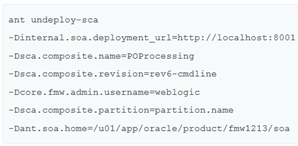
Consider a simple scenario. You have a Composite Application and you want to deploy it from Development/CI through to Production. Oracle provide a useful Apache Ant script for doing automated deployment of Composites with relative ease.

Now let’s consider the fact that multiple revisions of a single BPM or SOA Composite Application can be deployed side-by-side. You may choose for each change to be a new revision or for only major and breaking changes to be a new revision. Either way, your automation will probably need to consider retirement of Composite Application revisions over time. After all, you don’t want to have unused Composite Revisions hanging around in your Platform doing nothing but adding overhead.

Of course, Oracle also provide an Apache Ant script for doing automated undeployment of Composites. Unfortunately, it will fail if a composite is already undeployed. But, does this matter?

For me, this matter’s a lot. Let me explain and discuss some of the solutions for reliable Continuous Delivery of SOA and BPM Composites.

Don’t make me think

Automation should focus on taking a desired state and applying it to a target environment rather than performing a specific task which only works under certain strict conditions. In other words, an operator shouldn’t have to think too hard about whether their automated deployment is going to work, it should just work.

Idempotency

For automation to just work it should first be idempotent which means when executed with the same input more than once it should have no additional effect. Read the complete article here.

SOA & BPM Partner Community

For regular information on Oracle SOA Suite become a member in the SOA & BPM Partner Community for registration please visit www.oracle.com/goto/emea/soa (OPN account required) If you need support with your account please contact the Oracle Partner Business Center.

Blog Twitter LinkedIn image[7][2][2][2] Facebook clip_image002[8][4][2][2][2] Wiki

Technorati Tags: SOA Community,Oracle SOA,Oracle BPM,OPN,Jürgen Kress
Our Final Episode – Oracle Business Rules by SOA Mythbusters

image

We would like to give special thanks to our collaborators and friends Maggie Rosas and Miguel Ramirez. Without their hard work, contributions and insight, this article wouldn’t have been possible.

Introduction

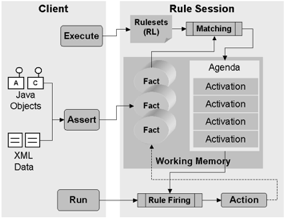
In this article, we will dive into the discussion of how and where Oracle Business Rules fits into a Service Oriented Architecture. Furthermore, OBR’s evolution along Oracle’s FMW stack will be revisited, as well as its importance, benefits and the best practices to implement this product based on our own experience.

In many customers / projects we have faced a lot of resistance spearheaded by inaccurate conclusions around OBR’s scope, capabilities, performance and overall reliability as a component of Oracle SOA Suite.

This kind of concerns, can frequently lead organizations to underestimate the tool’s potential or even to abandon its use altogether, selecting instead suboptimal alternatives for business rules implementation and management.

The Myth:

“Oracle Business Rules is not a relevant tool within the FMW Stack; it is also risky to use, unfriendly to the final user and difficult to position adequately in a SOA Architecture”

Let’s get started

First and foremost, let’s take a look at how any business rule engines may fit into a technological architecture based on service-orientation principles.

It is very important to take in account that from a theoretical / methodological standpoint, “Rules Centralization” is in fact an established SOA design pattern, related to both the “Orchestration” and “Enterprise Service Bus” compound patterns.

Rules Centralization is also one of the “Inventory Centralization Patterns”, along with Policy, Schema and Process Centralization. Read the complete article here.

SOA & BPM Partner Community

For regular information on Oracle SOA Suite become a member in the SOA & BPM Partner Community for registration please visit www.oracle.com/goto/emea/soa (OPN account required) If you need support with your account please contact the Oracle Partner Business Center.

Blog Twitter LinkedIn image[7][2][2][2] Facebook clip_image002[8][4][2][2][2] Wiki

Technorati Tags: SOA Community,Oracle SOA,Oracle BPM,OPN,Jürgen Kress

Matt Wright talks about their use of Oracle Process Cloud Service

image

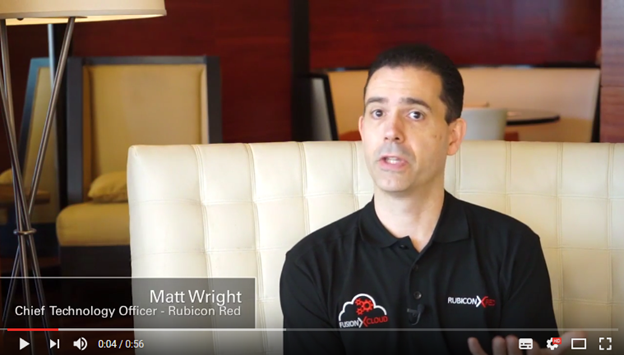
Rubicon Red’s CTO, Matt Wright talks about how the company is using Oracle Process Cloud Service to help it optimise its business process and become more efficient. Watch the video here.

SOA & BPM Partner Community

For regular information on Oracle SOA Suite become a member in the SOA & BPM Partner Community for registration please visit www.oracle.com/goto/emea/soa (OPN account required) If you need support with your account please contact the Oracle Partner Business Center.

Blog Twitter LinkedIn image[7][2][2][2] Facebook clip_image002[8][4][2][2][2] Wiki

Technorati Tags: SOA Community,Oracle SOA,Oracle BPM,OPN,Jürgen Kress
Private Application Deployments in Oracle Process Cloud Service – New Feature! by Antonis Antoniou

image

The latest Oracle Process Cloud Service release in September 2016 (v16.3.5) added the support of two important functionalities; the "Event Based Gateway" for process branching and "Correlations" for process communication.
These capabilities have been available for quite some time in Oracle’s Process Cloud Service counterpart, the Oracle BPM Suite and have been described in detail in two of my blog posts; "Correlations in Oracle BPM 12c" and "Oracle BPM 12c Gateways (Part 5 of 5): Event-based Gateway".

Even though the functional concept is the exactly the same, whether used in an Oracle BPM Suite process or an Oracle Process Cloud Service process, there are yet some small differences, especially with the "Event Based Gateway" in Oracle Process Cloud Service.
So in this blog post we will see, in detail, how you can use the "Event-Based Gateway"to implement divergence and branching in your processes using events generated from external processes. Process communication will be implemented using "Correlations". Read the complete article here.

SOA & BPM Partner Community

For regular information on Oracle SOA Suite become a member in the SOA & BPM Partner Community for registration please visit www.oracle.com/goto/emea/soa (OPN account required) If you need support with your account please contact the Oracle Partner Business Center.

Blog Twitter LinkedIn image[7][2][2][2] Facebook clip_image002[8][4][2][2][2] Wiki

Technorati Tags: SOA Community,Oracle SOA,Oracle BPM,OPN,Jürgen Kress
Editing Application Roles in Oracle Process Cloud Service by Lonneke Dikmans

image

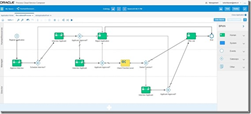
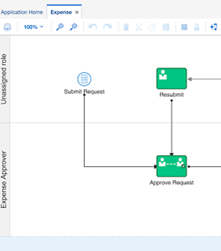
The other day I was working on my demo of Oracle Process Cloud Service (PCS) for UKOUG Apps 2016.  After creating the application, I wanted to start working on the process. My use case fits an out of the box pattern nicely, so I started with "Form Approval with Integration Pattern" and PCS created a default process for me; with two swimlanes and a number of activities. The resulting process is shown below.

Every PCS application is provisioned with three standard roles:

  1. Process Owner. Users with this role have access to process activity history, can take actions, alter the process flow etc. Process owners typically manage deployed business processes and use metric analysis tools such as dashboards to monitor the business process.
  2. Process Reviewer. This role gives access to process activity, but process reviewers can not take actions on tasks or alter tasks flows.  Process reviewers are not participating but typically responsible for reporting on current process instance status.
  3. Analytics Viewer. assigned this role can create and view business analytics dashboards associated with the specified application.

In this example, I don’t want to use these global application roles, I want two other roles: Read the complete article here.

SOA & BPM Partner Community

For regular information on Oracle SOA Suite become a member in the SOA & BPM Partner Community for registration please visit www.oracle.com/goto/emea/soa (OPN account required) If you need support with your account please contact the Oracle Partner Business Center.

Blog Twitter LinkedIn image[7][2][2][2] Facebook clip_image002[8][4][2][2][2] Wiki

Technorati Tags: SOA Community,Oracle SOA,Oracle BPM,OPN,Jürgen Kress

Live Demo: Oracle Process Cloud Service by Christopher Rausch – in German!

image

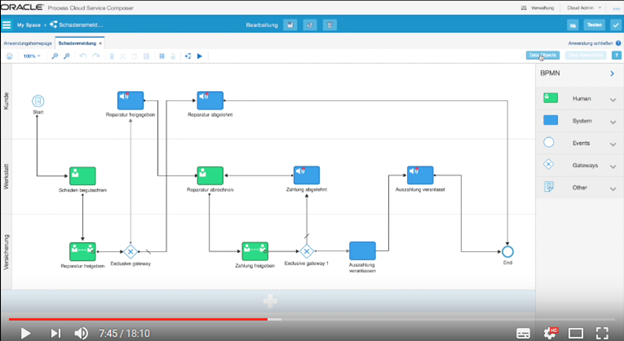
In der Live Demo erfahren Sie wie man mit Hilfe von Oracle Process Cloud Service einen Schadenmeldeprozess in einfachen Schritten schnell digitalisieren kann. Wir gliedern die Digitalisierung des Prozesses in 5 Arbeitsschritte: Das Prozessdesign, der Entwurf der Webformulare, die Definition der Datenverknüpfungen, die Definition der Logik und den Test. Watch the video here.

SOA & BPM Partner Community

For regular information on Oracle SOA Suite become a member in the SOA & BPM Partner Community for registration please visit www.oracle.com/goto/emea/soa (OPN account required) If you need support with your account please contact the Oracle Partner Business Center.

Blog Twitter LinkedIn image[7][2][2][2] Facebook clip_image002[8][4][2][2][2] Wiki

Technorati Tags: SOA Community,Oracle SOA,Oracle BPM,OPN,Jürgen Kress