Integration & Process Partner Community Newsletter December 2020

Dear PaaS Partner Community

As 2020 comes to an end finish the year with an Oracle certification. Enablement and certification are key to cloud success. At the Oracle Competence Center partners can attend free online classes and free online certifications: Oracle Application Integration Cloud Platform 2019 Sales Specialist and Oracle Application Integration Cloud Platform 2019 Solution Engineer Specialist. Additional we offer the latest implementation exam Oracle Cloud Platform Application Integration 2020 Specialist | 1Z0-1042-20 ($245 or free voucher).

Every month’s we offer a community webcast with the latest product updates. All webcasts are available on-demand including presentations in ppt format. Highlights include (community membership required):

· HCM Integration with Application Adapters

· ERP Integration with Application Adapters

· Netsuite Integration with Application Adapters

· Integration Update & New Features

· Connect, Innovate, Extend SaaS KickOff Webcast 2020

· Cloud Platform KickOff Webcast 2020

· How Process Workflow can extend the role of Integration

· Extend SaaS with Visual Builder Cloud Service

· Integration Insight

· Integrate SaaS

· SOA Cloud Service

Thanks to the community for sharing all the integration articles: Oracle Integration Playground permanent service for Partners free of charge! & Oracle Integration November 2020 Update for Technical Adapters & Oracle Integration Announcements On Home Page & Oracle Integration (OIC) – a holistic view & A Simple Guide to ERP Cloud Customer Creation through integration & Oracle Integration: ICS to OIC Migration with transition to ATP & OIC Log Management with VB Studio, OCI Bucket and OCI Logging Analytics & Recover unsaved changes for an Integration edit session & OIC Nov 20 Release – Data Retention & How to Invoke an OCI Function from the Oracle Integration Cloud & OIC – A Generic Invoke for Scheduled Jobs & Diagnostic logging ‘events’ and benefits of decoupled log-processors & OIC Nov 20 Release – Netsuite adapter New Features & NetSuite Integration Series: Part 2: Keep data in Sync between Oracle CX Sales (Engagement Cloud) and NetSuite & Track scheduled instances from submission & OIC – Oracle Field Service via REST.

In the process & innovation section we published an Process Cloud Service (PCS) Overview from Surbhi and how to connect PBCS applications with OAC.

For a short summery of our monthly key information watch the PaaS Partner Updates on YouTube. The December edition highlights the Oracle Digital Assistant newsletter and the on-demand partners community webinars. In this month’s community webcast Angelo Santagata will present how to extend SaaS solutions serverless. Please join the Extend Oracle SaaS with Cloud Native & Serverless Solutions – Partner Community Webcast December 16th, 2020

Want to publish your best practice article & news in the next community newsletter? Please feel free to send it via Twitter @soaCommunity #PaaSCommunity.

To read the newsletter please visit www.tinyurl.com/PaaSNewsDecember2020

Please like and share the newsletter at Twitter and LinkedIn.

PaaS Community Newsletter small December 2020

PaaS Partner Community

For regular information on Oracle PaaS become a member in the PaaS (Integration & Process) Partner Community please register here.

clip_image003 Blog clip_image005 Twitter clip_image004 LinkedIn image[7][2][2][2] Facebook clip_image002[8][4][2][2][2] Wiki

Technorati Tags: newsletter,SOA Community newsletter,SOA Community,Oracle,OPN,Jürgen Kress
Partner Community Webcasts on-demand

image

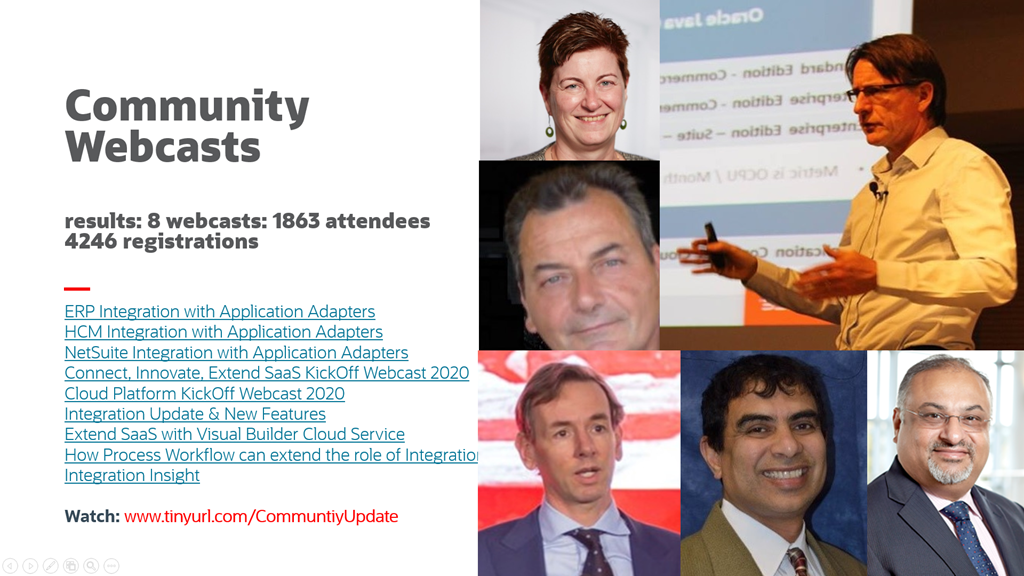
Take the opportunity to watch our community webcasts on-demand:

· Integration Update & New Features

· Chatbot Design best practices for Conversational UX

· Connect, Innovate, Extend SaaS KickOff Webcast 2020

· Cloud Platform KickOff Webcast 2020

· Netsuite Integration

· Integration Insight

· Innovate HCM with Chatbots

· ERP Integration with Application Adapters

· HCM Integration with Application Adapters

· Extend SaaS with Visual Builder Cloud Service

· Integration Adapters

· Integrate SaaS

· Digital Assistant Update

· SOA Cloud Service

· PaaS Overview Webcast

· Process Cloud Service Update

· Integrate ERP Cloud

· Integrate HCM Cloud

· Functions and Cloud Native

· Blockchain

· API Platform Cloud Service part 2

· 3rd Generation API Gateways part1

· Oracle JET

· Oracle Visual Builder Cloud Service

· Container Native Application Development Platform

For the latest information please visit Community Updates Wiki page (Community membership required).

PaaS Partner Community

For regular information on Oracle PaaS become a member in the PaaS (Integration & Process) Partner Community please register here.

clip_image003 Blog clip_image005 Twitter clip_image004 LinkedIn image[7][2][2][2] Facebook clip_image002[8][4][2][2][2] Wiki

Technorati Tags: SOA Community,Oracle SOA,Oracle BPM,OPN,Jürgen Kress

Fault handling in OIC by Jan Kettenis

image

This article discusses how fault handling in Integrations works for the Oracle Integration Cloud, and some best practices on how to use it, including consuming Integrations in Structured Processes.

Updated on August 6 2020 after discovering that in the explanation of Fault Return parts of the text were duplicated while others were missing.

Special thanks to Greg Mally of the Oracle A-Team for his valuable input.

As this is a lengthy article I will start with the conclusion including what I consider to be the best practices, so if you trust me you can stop right there

Best practice is to always put an Invoke activity in a Scope. In case you need to handle a fault in a specific way, it is sufficient to add a Default (Fault) Handler only, unless you need to handle different back-end faults differently.

In the Fault Handler use the Fault Return option to throw a fault coming from the back-end service to the consumer of the Integration for three reasons:

  1. It gives you maximum control over the way the fault is returned to the consumer. For example, only with Fault Return will you be able to return the HTTP 4xx or 5xx status code from the back-end service as-is to the consumer of a REST Integration.
  2. With that it allows you to wrap the fault from the back-end services in one single type of fault thrown to the consumer, making fault handling by the consumer as simple as possible. For example, in case of a modeled SOAP Fault returned to a Structured Process, it now suffices to add one single Boundary Error Event for the modeled fault to handle all business faults in the process.
  3. On the Monitoring tab the integration instance that handled the fault from the back-end service is itself flagged as “Succeeded” (instead of “Errored”), which strictly speaking is correct as the integration did what it had to do (don’t blame the messenger). After all, the actual fault happened in the back-end service. So instead of unnecessarily alarming the operator of OIC (which caused no issue), Operations should look at either the consumer or the back-end service to find out what went wrong.

In other words, Fault Return is the easiest way to return faults thrown by the back-end service(s) in a consistent way. This is can be very convenient for your consumer. Read the complete article here.

PaaS Partner Community

For regular information on Oracle PaaS become a member in the PaaS (Integration & Process) Partner Community please register here.

clip_image003 Blog clip_image005 Twitter clip_image004 LinkedIn image[7][2][2][2] Facebook clip_image002[8][4][2][2][2] Wiki

Technorati Tags: SOA Community,Oracle SOA,Oracle BPM,OPN,Jürgen Kress

OIC: Integration Pick action full-circle now with Process using it! By Jan Kettenis

image

This article describes how the Pick feature aka Multi-Operation Support for REST integrations now also is fully supported by Process applications.
More than a year ago the Pick action was introduced in OIC also known as Multi-Operation Support. Since then you can create REST integrations supporting multiple actions for one resource using one single URL. For example, you can have one single endpoint like …/ic/api/integration/v1/flows/rest/INT_GN_CASE_GROUPS/2.0/case-metadata/casegroups supporting a POST, GET, PUT and DELETE.

Apart from the fact that it is the de-facto standard for developing REST services to handle one single resource, it also is more convenient to have one single Integration that you can activate or deactivate instead of creating as many integrations as there are actions. Until the August 2020 release it was not yet supported by Process, but finally it is!! Now why would you want this? In short: because is easier and it performs better. Read the complete article here.

PaaS Partner Community

For regular information on Oracle PaaS become a member in the PaaS (Integration & Process) Partner Community please register here.

clip_image003 Blog clip_image005 Twitter clip_image004 LinkedIn image[7][2][2][2] Facebook clip_image002[8][4][2][2][2] Wiki

Technorati Tags: SOA Community,Oracle SOA,Oracle BPM,OPN,Jürgen Kress

Integration & Process Partner Community Newsletter November 2020

Dear PaaS Partner Community

The 12th edition of the Cloud Platform Partner Advisory Council will take place December 8th -10th 2020. In case you have implemented successful Oracle Integration in customer projects, It’s your opportunity to share your feedback with the Oracle Product Management team. We will discuss the product roadmaps & insights to support your customer success and to improve the Oracle cloud services.

For consultants who attend an Oracle Integration hands-on bootcamp we offer a permanent OIC Playground to continue learning and to become a certified expert.

The Oracle Integration November 2020 update is released. The introduction of quarterly updates allows you to choose your update window. Highlights of the latest release are Oracle Application Adapter improvements like cherry picking resources and 3rd party Adapter improvements like PayPal Adapter inbound support. Thanks to the community for sharing all the integration articles: How to use the OCI Object Storage from the Oracle Integration Cloud & Read ZIP files in Oracle Integration Cloud & Security Improvements for Database & FTP Adapters & A Simple Guide to Oracle HCM Data Loader (HDL) Job Support in Oracle HCM Cloud Adapter & OIC Connectivity Agent & Integration, Process & Insight – Netsuite Data Sync Use Case & Create an XML file in Oracle Integration Cloud & OIC REST API for Lookups & Copy files from one SFTP to another in OIC & Announcing Oracle SOA Suite on Containers & Kubernetes for Production Workloads

In the process & innovation section Kalyn published advanced filtering options in process forms. Thanks to Lalitha for the article on Business Process Automation using Oracle Process Cloud Service.

For a short summery of our monthly key information watch the PaaS Partner Updates on YouTube. The November edition highlights the Gartner Magic Quadrant and the Partner Advisory Council. In this month’s community webcast Chris Peytier will present how to extend SaaS solutions. Please join the How Process Workflow can extend the role of integration Partner Community Webcast November 24th 2020.

Want to publish your best practice article & news in the next community newsletter? Please feel free to send it via Twitter @soaCommunity #PaaSCommunity.

To read the newsletter please visit www.tinyurl.com/PaaSNewsNovember2020

Please like and share the newsletter at Twitter and LinkedIn.

PaaS Community Newsletter small November 2020

PaaS Partner Community

For regular information on Oracle PaaS become a member in the PaaS (Integration & Process) Partner Community please register here.

clip_image003 Blog clip_image005 Twitter clip_image004 LinkedIn image[7][2][2][2] Facebook clip_image002[8][4][2][2][2] Wiki

Technorati Tags: newsletter,SOA Community newsletter,SOA Community,Oracle,OPN,Jürgen Kress

Oracle Process Cloud – linking to a process instance by Niall Commiskey

image

Use case here – Customer wants a process creator to be notified when a process has completed. In this case, an email containing a link to the process history in Workspace. The link should bring me here – The link has the following format. I try this out with the my instance id – Now to my process – not the most complex of processes, I’m sure you will agree. Read the complete article here.

PaaS Partner Community

For regular information on Oracle PaaS become a member in the PaaS (Integration & Process) Partner Community please register here.

clip_image003 Blog clip_image005 Twitter clip_image004 LinkedIn image[7][2][2][2] Facebook clip_image002[8][4][2][2][2] Wiki

Technorati Tags: SOA Community,Oracle SOA,Oracle BPM,OPN,Jürgen Kress

Understand Decision Model Views

image

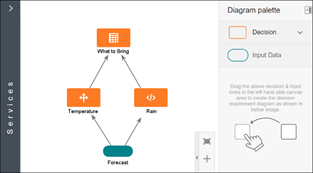
In Processes, you can work on a decision model using either the graph view or the list view. When you create a new decision model, you’re presented with the graph view by default. You can switch to the list view and vice versa using the Menu button in the toolbar.

Note: The decision models that you’ve created previously will continue to use the list view as the default view. If you switch to the graph view, you’ll need to redefine the relationships between decisions and input data elements. Similarly, you’ll have to redefine the order of the decisions if you switch from the graph view to the list view.

Topics:

· Graph View

· List View

Graph View

In the graph view, you can create decision requirement diagrams (DRD), in accordance with the DMN standard, to visually represent your decision models.

In decision modeling, a decision requirement graph (DRG) is a self-contained representation of an entire domain of decision-making that displays the important elements in the domain and the relationships between the elements. Whereas, a decision requirement diagram typically depicts a specific view of a DRG; the view depicted can either be partial or complete.

Processes currently supports one DRD per decision model. The following table lists all the available DRD components, which you can use to create your decision models.  Read the complete article here.

PaaS Partner Community

For regular information on Oracle PaaS become a member in the PaaS (Integration & Process) Partner Community please register here.

clip_image003 Blog clip_image005 Twitter clip_image004 LinkedIn image[7][2][2][2] Facebook clip_image002[8][4][2][2][2] Wiki

Technorati Tags: SOA Community,Oracle SOA,Oracle BPM,OPN,Jürgen Kress

Use Oracle Integration to Add Attachments to a Process Instance

Use Oracle Integration to Add Attachments to a Process Instance by Bogdan Eremiaimage

The other day it came to my attention that it’s not really straightforward to add attachments to an Oracle Process Instance using the REST API.

One reason for this is that it requires multipart/mixed media type for the request body message format, and producing this kind format is not so common for JavaScript clients. The JS clients are more used to working with multipart/form-data, the de-facto standard for form-based file upload in HTML.

One way of overcoming this is to use Oracle Integration Cloud (OIC) between the JS client and Process REST API. OIC has a REST Technology Adapter that supports sending/receiving attachments in both multipart/mixed and multipart/form-data media types. The goal is to shape in OIC a REST interface that accepts multipart/form-data, to do a translation into multipart/mixed (alongside with other transformations/actions if required) and to call the Process REST API. Below are the main steps for achieving this.

1. Create a REST Connection in OIC for Process REST API.

Go to OIC Homepage > Designer > Connections to create a new connection by selecting the REST Adapter. Read the complete article here.

PaaS Partner Community

For regular information on Oracle PaaS become a member in the PaaS (Integration & Process) Partner Community please register here.

clip_image003 Blog clip_image005 Twitter clip_image004 LinkedIn image[7][2][2][2] Facebook clip_image002[8][4][2][2][2] Wiki

Technorati Tags: SOA Community,Oracle SOA,Oracle BPM,OPN,Jürgen Kress

OIC: Identity Propagation In Structured Process by Jan Kettenis

image

When a process calls a service you sometimes have a requirement that some user identity needs to be propagated to the service call. This article describes how you can propagate the identity (but alas not the principle) of a user on behalf of whom a service call is executed. When calling a service in a structured process you sometimes must pass on the identity of the user that called the service. This could be the case when that service call is done to a SaaS application and it is required to track on behalf of whom that service is called. The identity (user name) only is not enough when authentication must happen using the principle (security token) of the user, but there are applications that can handle this using some combination of a system user (or client id plus secret) with an on behalf of user. And there are situations where having an on behalf of user only is enough, like when storing data in a database table with audit columns (you don’t want all the end users also to be database users so passing on the user’s principle to the DB would not make sense).
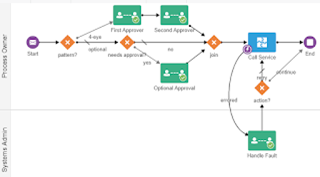
It is not always trivial who that on behalf of user should be. Take for example the following process model: Read the complete article here.

PaaS Partner Community

For regular information on Oracle PaaS become a member in the PaaS (Integration & Process) Partner Community please register here.

clip_image003 Blog clip_image005 Twitter clip_image004 LinkedIn image[7][2][2][2] Facebook clip_image002[8][4][2][2][2] Wiki

Technorati Tags: SOA Community,Oracle SOA,Oracle BPM,OPN,Jürgen Kress

Integration & Process Partner Community Newsletter September 2020

Dear Partner Community,

Welcome to community newsletter in Redwood design. Oracle launched the new cooperate design during Oracle OpenWorld 2019. Please share your feedback via twitter #PaaSCommunity. This year Oracle OpenWorld will be a series of virtual summits, we offer SaaS integration hands-on webtrainings across the globe including Europe, Brazil, India, Asia and US & Canada. Additional a free on-demand SOA Modernization Overview guided learning path including free online assessment is available.

The August release of Oracle Integration Cloud is available, new features include a new home page, new accelerators and recipes, PayPal, AS2 and streaming adapters, join our community webcast to learn more and see live demos. Thanks to the community for sharing all the integration articles: Real Time Item Synchronization using Oracle Integration & PGP Encryption/Decryption using Stage: OIC & How to use the new Import/Export feature in Oracle Integration & Integration Properties & Integration b/w Oracle Engagement Cloud, Oracle CPQ & Oracle EBS & OIC – Syncing Netsuite customers and contacts with Eloqua & Automating End to End Bulk Export from Oracle ERP Cloud using Oracle Integration (Part 1- ERP Cloud Callback) & Manage User & Roles Oracle Integration Cloud & OIC – Design Time variables – August Release New Feature & Invoking One Integration From Another Call Integration Action Step by Step & OIC – SurveyMonkey 2 Netsuite Synchronisation & OIC DB Adapter – some more adventures & Embedded File Server (SFTP) in Oracle Integration & The magic of CorrelationSets & Silently Install SOA QuickStart Revised.

In the process & innovation section we published two articles from Jan Kettenis on OIC: Integration Pick action full-circle now with Process using it! and Fault handling in OIC.

For a short summery of our monthly key information watch the PaaS Partner Updates on YouTube. The September edition highlights joint marketing campaigns and chatbot & integration hands-on partner bootcamps. This month’s community webcast will be an Integration Cloud update by Niall Commiskey. Please join Integration New Features PaaS Partner Community Webcast September 29th 2020.

Want to publish your best practice article & news in the next community newsletter? Please feel free to send it via Twitter @soaCommunity #PaaSCommunity.

To read the newsletter please visit www.tinyurl.com/PaaSNewsSeptember2020

Please like and share the newsletter at Twitter and LinkedIn

PaaS Community Newsletter September 2020

PaaS Partner Community

For regular information on Oracle PaaS become a member in the PaaS (Integration & Process) Partner Community please register here.

clip_image003 Blog clip_image005 Twitter clip_image004 LinkedIn image[7][2][2][2] Facebook clip_image002[8][4][2][2][2] Wiki

Technorati Tags: newsletter,SOA Community newsletter,SOA Community,Oracle,OPN,Jürgen Kress