Jarvis Pizzeria: Setting up the Dynamic Process by Richard Olrichs & Marcel van de Glind & Marc Kuijpers

image


In this blog we will implement a first version of the preparation of an order using a dynamic process. We continue where blog one stopped. The imported order process is extended with an example dynamic process.

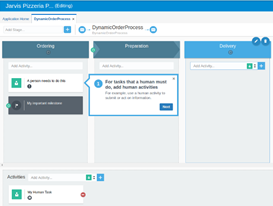
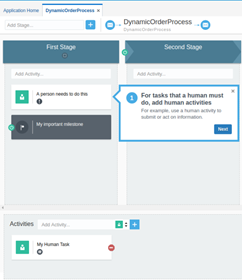
We open the DynamicOrderProcess, which should still contains the example. We will build this so that it contains the Pizza ordering process. However, when opening the Process, we can see that the example is no longer there. Apparently, the example is not saved, maybe because we did not make any changes to it? Let’s create the example again, and then change it immediately.
The first step we take to make it our own is to define the stages. Rename the ‘First Stage’ in ‘Ordering’. The ‘Second Stage’ in ‘Preparation’ and add another third stage ‘Delivery’.
For changing the name of a stage, select the pencil in the title bar to get to to properties.
In there change the name. Use the add icon just above the pencil to add the third stage.

Now let’s save our changes and see what happens to this modified ‘example’. We close the Dynamic process, and then open it again.
However, our changes have disappeared as well. The whole example is gone once again. How is that possible? Is something thoroughly wrong with the application or is an example application just an example, and can it not be saved? Anyway, it is good to realize the example application is there as an example and not like a QuickStart application. Read the complete article here.

PaaS Partner Community

For regular information on Oracle PaaS become a member in the SOA & BPM Partner Community for registration please visit www.oracle.com/goto/emea/soa (OPN account required) If you need support with your account please contact the Oracle Partner Business Center.

Blog Twitter LinkedIn image[7][2][2][2] Facebook clip_image002[8][4][2][2][2] Wiki

Technorati Tags: SOA Community,Oracle SOA,Oracle BPM,OPN,Jürgen Kress
Jarvis Pizzeria: Getting Started with Dynamic Processes (ACM) by Richard Olrichs & Marcel van de Glind & Marc Kuijpers

image

Getting started with the new integration cloud, the cloud that brings ICS, VBCS and PCS together. But it also includes the introduction of dynamic processes, Oracle’s new approach for adaptive case management. This introductory blog consists mainly of an overview of the different parts of dynamic processes. In addition, some differences between PCS and the Integration Cloud are discussed.

First step: import the Jarvis Pizza Preparation application. The location of this menu option is changed but the functionality is not. So we do this in two quick steps. Read the complete article here.


PaaS Partner Community

For regular information on Oracle PaaS become a member in the SOA & BPM Partner Community for registration please visit www.oracle.com/goto/emea/soa (OPN account required) If you need support with your account please contact the Oracle Partner Business Center.

Blog Twitter LinkedIn image[7][2][2][2] Facebook clip_image002[8][4][2][2][2] Wiki

Technorati Tags: SOA Community,Oracle SOA,Oracle BPM,OPN,Jürgen Kress
Jarvis Pizzeria in Case Management Style by Richard Olrichs & Marcel van de Glind & Marc Kuijpers

image

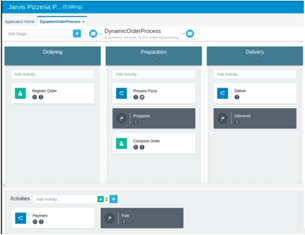
As our business grows and our digitalization kicks in, it is time to reevaluate our process setup. We are happy with our processes in Process Cloud, they are easy to set up and we can manage our process from Ordering a Pizza al the way through to delivery.

However as with any BPMN, this a very structured process. Sometimes we require a bit more flexibility.

We had a good chat with our friends from Oracle and we were very pleased to hear that our wish to become more flexible aligned with their plans for PCS. We were thinking towards a Case Management solution for our pizzas and got a very satisfying answer.

In October 2017, Oracle released the Oracle Integration Cloud (OIC), not to be confused with the Integration Cloud Service (ICS). The Integration Cloud brings together several Low Code products. VBCS, Visual Builder Cloud Service, for developing user interfaces, ICS, Integration Cloud Service, for creating your integrations in the Oracle Cloud. Stream Analytics, for smart analytics on your integrations & processes. And last, but certainly not least PCS, Process Cloud Service, that in their new release includes Dynamic Processes. These Dynamic Processes have a lot of Case Management features and have a notation that feels a lot and reminds us of CMMN. Read the complete article here.


PaaS Partner Community

For regular information on Oracle PaaS become a member in the SOA & BPM Partner Community for registration please visit www.oracle.com/goto/emea/soa (OPN account required) If you need support with your account please contact the Oracle Partner Business Center.

Blog Twitter LinkedIn image[7][2][2][2] Facebook clip_image002[8][4][2][2][2] Wiki

Technorati Tags: SOA Community,Oracle SOA,Oracle BPM,OPN,Jürgen Kress
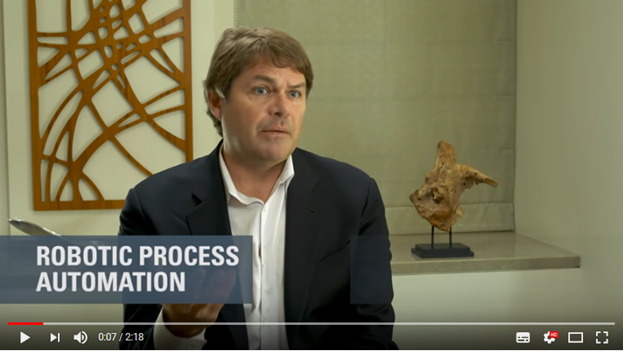
UiPath on Track to AI with Oracle Integration Cloud and RPA

image


UiPath, a leading Robotic Process Automation (RPA) provider, is helping clients find practical paths to AI with Oracle Integration Cloud. The future belongs to the fast and orchestrating robot and human workers is the best next step. Watch the video here. For additional information please see here.

PaaS Partner Community

For regular information on Oracle PaaS become a member in the SOA & BPM Partner Community for registration please visit www.oracle.com/goto/emea/soa (OPN account required) If you need support with your account please contact the Oracle Partner Business Center.

Blog Twitter LinkedIn image[7][2][2][2] Facebook clip_image002[8][4][2][2][2] Wiki

Technorati Tags: SOA Community,Oracle SOA,Oracle BPM,OPN,Jürgen Kress

Oracle Developer Innovation Day, 29. November 2018 München

image

Want to become an Oracle Cloud expert? Join us for a hands-on training at the Oracle Developer Innovation Day 2018. As part of the one day workshop you get the opportunity to try the latest Oracle cloud services, presented at Oracle OpenWorld 2018 hands-on.

Schedule & location: November 29th 10:00 am – 4:00 pm

Oracle, Riesstr. 25, 80992 Munich Germany

Topics:

  • Serverless
  • Container
  • Mobile & Digital Assistant
  • Blockchain
  • NoSQL
  • Autonomous Database

For details please see the registration page here.


PaaS Partner Community

For regular information on Oracle PaaS become a member in the SOA & BPM Partner Community for registration please visit www.oracle.com/goto/emea/soa (OPN account required) If you need support with your account please contact the Oracle Partner Business Center.

Blog Twitter LinkedIn image[7][2][2][2] Facebook clip_image002[8][4][2][2][2] Wiki

Technorati Tags: SOA Community,Oracle SOA,Oracle BPM,OPN,Jürgen Kress

Recipe in Oracle Self-Service Integration

Learn how to edit a recipe in Oracle Self-Service Integration Cloud Service.

image

Watch the video here.

PaaS Partner Community

For regular information on Oracle PaaS become a member in the SOA & BPM Partner Community for registration please visit www.oracle.com/goto/emea/soa (OPN account required) If you need support with your account please contact the Oracle Partner Business Center.

Blog Twitter LinkedIn image[7][2][2][2] Facebook clip_image002[8][4][2][2][2] Wiki

Technorati Tags: SOA Community,Oracle SOA,Oracle BPM,OPN,Jürgen Kress

REST API for Oracle SOA Cloud Service

image

Provisions a new service instance in a domain.

IP networks: A service instance can be attached to an IP network that is already created in Oracle Compute Cloud Service. If you specify an IP network, when you add an instance to an IP network, the instance is assigned an IP address in the IP subnet that you specify. See Creating an IP Network in Using Oracle Compute Cloud Service (IaaS).

IP reservations: A consequence of using an IP network is that the auto-assigned IP address could change each time the service instance is started. To assign fixed public IP addresses to a service instance that is attached to an IP network, you can first create reserved IP addresses, then provision the service instance to use those persistent IP addresses. Read the complete article here.


PaaS Partner Community

For regular information on Oracle PaaS become a member in the SOA & BPM Partner Community for registration please visit www.oracle.com/goto/emea/soa (OPN account required) If you need support with your account please contact the Oracle Partner Business Center.

Blog Twitter LinkedIn image[7][2][2][2] Facebook clip_image002[8][4][2][2][2] Wiki

Technorati Tags: SOA Community,Oracle SOA,Oracle BPM,OPN,Jürgen Kress

Top tweets PaaS Partner Community – October 2018

image

October 2018  top tweets by PaaSCommunity

Send your tweets @soacommunity #PaaSCommunity and follow us at http://twitter.com/soacommunity. Make sure you share your content with the community!

SOA & BPM Partner Community

For regular information on Oracle SOA Suite become a member in the SOA & BPM Partner Community for registration please visit www.oracle.com/goto/emea/soa (OPN account required) If you need support with your account please contact the Oracle Partner Business Center.

Blog Twitter LinkedIn image[7][2][2][2] Facebook clip_image002[8][4][2][2][2] Wiki

Technorati Tags: twitter,SOA Community,Oracle SOA,Oracle BPM,OPN,Jürgen Kress,SOA Community twitter

Teaching How to Recover Errored Instances with Oracle Integration Cloud by Carlos Rodriguez Iturria

image


Building Enterprise integrations in the Cloud with iPaaS brings many benefits, including among others: simplicity, agility and scalability. However, these benefits should not be taxed by having a weak core, not able to properly manage common enterprise requirements, such as error management. I’ve been a bit disappointed with how most iPaaS vendors handle runtime exceptions of integration flows. A typical example of this, is not being able to support dehydration for asynchronous flows (i.e. dehydration is crucial to supporting long-running instances by saving their memory state into a database, until a correlation invocation, a.k.a call-back, wakes it up to continue with the flow). This causes that when an error occurs, recovery has to start from the beginning of the integration flow that failed.

In these situations, we would have to either design an integration to be fully idempotent and stateless across all its partner links (service invocations), which is not always possible. Another way to do it is by manually handling the recovery of errored scenarios, this is to avoid state inconsistency across the previous service invocations in the orchestration, prior to the error… But then if we have to manually handle compensation, what about iPaaS being easier?

Luckily, Oracle Integration Cloud maintains simplicity at the front end and a mature and strong integration core at the backend. It acknowledges when an orchestration is asynchronous, so that dehydration points (a.k.a. break points) are enforced along the way across service invocations or long-term actions (e.g. waits), enabling with this long-term running instances avoiding to timeout, but to stay in memory (and DB back store) until all activities and external call-backs in the orchestration flow complete. Read the complete article here.

PaaS Partner Community

For regular information on Oracle PaaS become a member in the SOA & BPM Partner Community for registration please visit www.oracle.com/goto/emea/soa (OPN account required) If you need support with your account please contact the Oracle Partner Business Center.

Blog Twitter LinkedIn image[7][2][2][2] Facebook clip_image002[8][4][2][2][2] Wiki

Technorati Tags: SOA Community,Oracle SOA,Oracle BPM,OPN,Jürgen Kress

Oracle API Platform Cloud Service: Design-First approach and using Oracle Apiary by Marc Lameriks

image

At the Oracle Partner PaaS Summer Camps VII 2017 in Lisbon last year, at the end of august, I attended the API Cloud Platform Service & Integration Cloud Service bootcamp.

In a series of article’s I will give a high level overview of what you can do with Oracle API Platform Cloud Service. The version used of Oracle API Platform CS was Release 17.3.3 — August 2017.

See https://docs.oracle.com/en/cloud/paas/api-platform-cloud/whats-new/index.html to learn about the new and changed features of Oracle API Platform CS in the latest release.

In preparation of creating an API Blueprint document, I took a closer look at Oracle REST Data Services and used the RESTful Services feature in Oracle SQL Developer, to generate example JSON payload’s based on some tables in the “HR’ schema. For more information about this, see my article “Oracle REST Data Services (ORDS)”.
[https://technology.amis.nl/2018/01/22/oracle-rest-data-services-ords/]

In this first article in the series about Oracle API Platform CS, the focus will be on the Design-First approach and using Oracle Apiary.

Short overview of Oracle API Platform Cloud Service

Oracle API Platform Cloud Service enables companies to thrive in the digital economy by comprehensively managing the full API lifecycle from design and standardization to documenting, publishing, testing and managing APIs. These tools provide API developers, managers, and users an end-to-end platform for designing, prototyping. Through the platform, users gain the agility needed to support changing business demands and opportunities, while having clear visibility into who is using APIs for better control, security and monetization of digital assets.
[https://cloud.oracle.com/en_US/api-platform/datasheets]

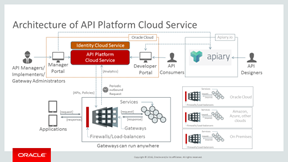
Architecture

Management Portal:
APIs are managed, secured, and published using the Management Portal. The Management Portal is hosted on the Oracle Cloud, managed by Oracle, and users granted API Manager privileges have access.

Gateways:
API Gateways are the runtime components that enforce all policies, but also help in collecting data for analytics. The gateways can be deployed anywhere – on premise, on Oracle Cloud or to any third party cloud providers.

Developer Portal:
After an API is published, Application Developers use the Developer Portal to discover, register, and consume APIs. The Developer Portal can be customized to run either on the Oracle Cloud or directly in the customer environment on premises. Read the complete article here.


PaaS Partner Community

For regular information on Oracle PaaS become a member in the SOA & BPM Partner Community for registration please visit www.oracle.com/goto/emea/soa (OPN account required) If you need support with your account please contact the Oracle Partner Business Center.

Blog Twitter LinkedIn image[7][2][2][2] Facebook clip_image002[8][4][2][2][2] Wiki

Technorati Tags: SOA Community,Oracle SOA,Oracle BPM,OPN,Jürgen Kress