Wellness First: an inside look at Beacon technology by Alessia Sacchi

image 

“Just like lighthouses have helped sailors navigate the world for thousands of years, electronic beacons can be used to provide precise location and contextual cues within apps to help you navigate the world.” (The Google Beacons development team)

What I find thrilling about beacons is that in their simplest sense they are unaware of themselves or any devices around them and we – humans – are not aware of them. So how is possible that these tiny transmitters are being used to help people in their daily lives? According to reports, 5 million beacons attached to the walls around the world are used to offer great help to people with regard to an array of things like travel, shopping, parking, entertainment, transportation, inventory management, assets tracking, indoor navigation  and at last but not least in the healthcare space through more efficient processes and improved patient-care.

Wellness First is a fictitious gym that utilizes beacons to improve the customer experience. In this post we’ll take a close look at the Ionic Framework Mobile App I’ve built that uses Estimote beacons to target a customer located near the room where a Yoga class  is just about to start and offers an unbeatable discount. Read the complete article here.


SOA & BPM Partner Community

For regular information on Oracle SOA Suite become a member in the SOA & BPM Partner Community for registration please visit www.oracle.com/goto/emea/soa (OPN account required) If you need support with your account please contact the Oracle Partner Business Center.

Blog Twitter LinkedIn image[7][2][2][2] Facebook clip_image002[8][4][2][2][2] Wiki

Technorati Tags: SOA Community,Oracle SOA,Oracle BPM,OPN,Jürgen Kress
Integrate and Extend SaaS hands-on training June 25th & 26th 2018 in Dubai

image

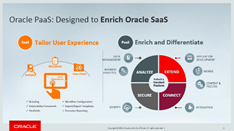
For SaaS partners we offer two days hands-on trainings to extend and integrate SaaS with Oracle PaaS:

Dubai, June 25th & 26th 2018

In case you can’t attend watch thee Partner Overview Webcast on-demand here and get the partner resource kit here.

PaaS Partner Community

For regular information on business process management and integration become a member in the SOA & BPM Partner Community for registration please visit www.oracle.com/goto/emea/soa (OPN account required) If you need support with your account please contact the Oracle Partner Business Center.

Blog Twitter LinkedIn image[7][2][2][2] Facebook clip_image002[8][4][2][2][2] Wiki

Technorati Tags: SOA Community,Oracle SOA,Oracle BPM,OPN,Jürgen Kress
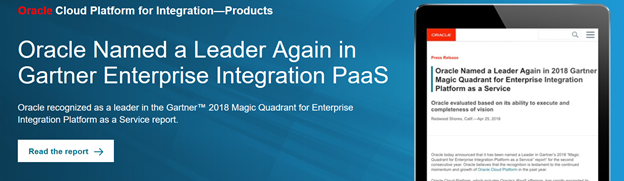
Oracle Named a Leader in 2018 Gartner Magic Quadrant for Enterprise Integration Platform as a Service for the Second Year in a Row by Vika Mlonchina


image

Oracle announced in a press release today that it has been named a Leader in Gartner’s 2018 “Magic Quadrant for Enterprise Integration Platform as a Service” report for the second consecutive year. Oracle believes that the recognition is testament to the continued momentum and growth of Oracle Cloud Platform in the past year.

Gartner views integration platform as a service (iPaaS) as having the “capabilities to enable subscribers (aka "tenants") to implement data, application, API and process integration projects involving any combination of cloud-resident and on-premises endpoints.” The report adds, “This is achieved by developing, deploying, executing, managing and monitoring integration processes/flows that connect multiple endpoints so that they can work together.”

“GE leverages Oracle Integration Cloud to streamline commercial, fulfilment, operations and financial processes of our Digital unit across multiple systems and tools, while providing a seamless experience for our employees and customers,” said Kamil Litman, Vice President of Software Engineering, GE Digital. “Our investment with Oracle has enabled us to significantly reduce time to market for new projects, and we look forward to the autonomous capabilities that Oracle plans to soon introduce.”

Download the full 2018 Gartner “Magic Quadrant for Enterprise Integration Platform as a Service” here.

Oracle recently announced autonomous capabilities across its entire Oracle Cloud Platform portfolio, including application and data integration. Autonomous capabilities include self-defining integrations that help customers rapidly automate business processes across different SaaS and on-premises applications, as well as self-defining data flows with automated data lake and data prep pipeline creation for ingesting data (streaming and batch).

Oracle also recently introduced Oracle Self-Service Integration, enabling business users to improve productivity and streamline daily tasks by connecting cloud applications to automate processes. Thousands of customers use Oracle Cloud Platform, including global enterprises, along with SMBs and ISVs to build, test, and deploy modern applications and leverage the latest emerging technologies such as blockchain, artificial intelligence, machine learning and bots, to deliver enhanced experiences.

A Few Reasons Why Oracle Autonomous Integration Cloud is Exciting

Oracle Autonomous Integration Cloud accelerates the path to digital transformation by eliminating barriers between business applications through a combination of machine learning, embedded best-practice guidance, and prebuilt application integration and process automation.  Here are a few key features:

Pre-Integrated with Applications – A large library of pre-integration with Oracle and 3rd Party SaaS and on-premises applications through application adapters eliminates the slow and error prone process of configuring and manually updating Web service and other styles of application integration.

Pre-Built Integration Flows – Instead of recreating the most commonly used integration flows, such as between sales applications (CRM) and configure, price, quoting (CPQ) applications, Oracle provides pre-built integration flows between applications spanning CX, ERP, HCM and more to take the guesswork out of integration.

Unified Process, Integration, and Analytics – Oracle Autonomous Integration Cloud merges the solution components of application integration, business process automation, and the associated analytics into a single seamlessly unified business integration solution to shrink the time to complete end-to-end business process lifecycles. 

Autonomous – It is self-driving, self-securing, and self-repairing, providing recommendations and best next actions, removing security risks resulting from manual patching, and sensing application integration connectivity issues for corrective action.

Discover OAIC for yourself by taking advantage of this limited time offer to start for free with Oracle Autonomous Integration Cloud.

Check here for Oracle Autonomous Cloud Integration customer stories.

Gartner does not endorse any vendor, product or service depicted in its research publications, and does not advise technology users to select only those vendors with the highest ratings or other designation. Gartner research publications consist of the opinions of Gartner’s research organization and should not be construed as statements of fact. Gartner disclaims all warranties, expressed or implied, with respect to this research, including any warranties of merchantability or fitness for a particular purpose.

PaaS Partner Community

For regular information on business process management and integration become a member in the SOA & BPM Partner Community for registration please visit www.oracle.com/goto/emea/soa (OPN account required) If you need support with your account please contact the Oracle Partner Business Center.

Blog Twitter LinkedIn image[7][2][2][2] Facebook clip_image002[8][4][2][2][2] Wiki

Technorati Tags: SOA Community,Oracle SOA,Oracle BPM,OPN,Jürgen Kress
PaaS (Process & Integration) Partner Community Newsletter May 2018

Dear PaaS Partner Community,

You plan a summer holiday at the beach, enjoy the sun, go surfing or get an ice cream? Attend the PaaS Summer Camp 2018 in Lisbon! The Oracle produce management team will train you hands-on in the latest PaaS cloud services. During the one week training you will become an expert in Oracle PaaS ready to deliver successful customer projects, and find some time to visit the beach. You can choose between 6 different tracks including integration & API Management, chatbots, integrate & extend SaaS, application development, innovation including blockchain & case management and a hackathon to build your own PaaS solution. Register for the PaaS Summer Camps 2018 from August 27th – 31st in Lisbon Portugal.

In case you can’t make it to Lisbon attend one of the Oracle Developer Meetups or an Integrate and Extend SaaS training across Europe. As a follow-up of this training we recommend to become an Oracle certified PaaS expert.

Oracle Named a Leader in 2018 Gartner Magic Quadrant for Enterprise Integration Platform as a Service for the Second Year in a Row. The latest new service of Oracle’s Autonomous Integration Platform is Self-Service Integration (SSI). Get and SSI introduction to see how integrations can be deployed by drag and drop and how this differ from integration in OIC. Thanks to the community for sharing all the Integration articles: Implementing Oracle API Platform Cloud Service & Great APIs need a plan! & API Platform Custom Host Name and Certificate & Oracle API Platform Cloud Service: using the Developer Portal for discovering APIs via the API Catalog and subscribing applications to APIs & Why API-led architecture is important to drive digital transformation & Continuous Integration with Apiary, Dredd, and Wercker & ADVISOR WEBCAST: Cloud Integration Service Administration (OIC, SOACS, MFTCS, APICS) – May 23rd 2018 & Deploying OIC – Definitive Tip #9, Oracle Integration Cloud: New! The Data Mapper Activity & How to install the Oracle Integration Cloud on premises connectivity agent (18.1.3).

The Jarvis Pizzeria team Richard Olrichs & Marcel van de Glind & Marc Kuijpers serve two new articles about  markers and conditions and Aborting a Process. Thanks to the community for sharing all the process articles: Embedding the Oracle OICS Process Workspace Application in an iFrame & Process Cloud Service (PCS) Error Exception Handling.

In our innovation and architecture section IoT is everywhere and why there is no innovation without integration. IDC reports the emergence of blockchain, it’s time to know everything about it!

For a short summery of our key monthly information watch the Fusion Middleware & PaaS Partner Updates on YouTube. The May edition highlights the PaaS Summer Camps and, Integrate & Extend SaaS hands-on training, This month’s community webcast will be the second part of our API Platform cloud service series, please join our monthly PaaS Partner Community Webcast – May 30th 2018.

To read the newsletter please visit www.tinyurl.com/PaaSNewsMay2018 (OPN Account required)

Please like and share the newsletter at Twitter and LinkedIn

Jürgen Kress

Fusion Middleware Partner Adoption
Oracle EMEA
Tel. +49 89 1430 1479
E-Mail: juergen.kress@oracle.com
clip_image003Blog clip_image004LinkedIn clip_image005 Twitter

To become a member of the SOA Partner Community please register at http://www.oracle.com/goto/emea/soa (OPN account required) If you need support with your account please contact the Oracle Partner Business Center.

Newsletter Logo 2017

Blog Twitter LinkedIn image[7][2][2][2] Facebook

Technorati Tags: newsletter,SOA Community newsletter,SOA Community,Oracle,OPN,Jürgen Kress

API Platform Cloud Service part 2 – PaaS Partner Community Webcast – May 30th 2018


Attend our May edition of the PaaS Partner Community Webcast live on May 30th 2018 at 16:image30 CET. In the second part of the API Management webcast series Robert Wunderlich will present a live demo of Oracle API Platform Cloud Service.

Robert Wunderlich LinkedIn profile

Visit the registration page here.image

Call ID: 5566478 and Passcode: 253288

UK: +44 (0) 208 118 1001 & United States: 140 877 440 73

More Local Numbers


Oracle API Platform Cloud Service:

A great API Management solution supports agile API development, and also makes it easy to keep an eye on KPIs covering every aspect of the API lifecycle. True hybrid API deployment – in the Cloud or on-premises – means that your API solution is modern and adaptable, all while employing the most up-to-date security protocols.


Schedule:

Wednesday May 30th 2018 16:30 – 17:30 CET

Visit the registration page here.

Missed our PaaS Partner Community Webcast? – watch the on-demand versions:

· 3rd Generation API Gateways April 17th 2018

· Oracle JET February March 27th 2018

· Oracle Visual Builder Cloud Service February 28th 2018

· Container Native Application Development Platform January 23rd 2018

· Oracle free Cloud Demo Services December 15th 2017

· Oracle Integration Cloud (OIC) November 21st 2017

· Adaptive Case Management in PCS October 31st 2017

· Oracle OpenWorld 2017 September 25th 2017

· Cloud Compliance & Certification August 2017

· Wercker July 21st 2017

· Sales Play webcast June 28th 2017

· Process Cloud Service update – DMN capabilities May 23rd 2017

· Drive DevOps Agility and Operational Efficiency with Oracle Management Cloud April 25th 2017

· Implementing DevOps and Agile Methodologies in Oracle Projects March 21st 2017

· Mobile Cloud Service & Chat Bots February 28th 2017

· b2b January 31st 2017

· Community Resources & free Cloud trails December 20th 2016

· SOA 12 & BPM Suite 12c Roadmap update November 29th 2016

· Microservices October 25th 2016

· Oracle OpenWorld 2016 update September 27th 2016

· API Cloud Platform Service August 30th 2016

· BPM Suite & PCS Update July 26th 2016

· Integration Cloud Service June 28th 2016

· Sales Plays Webcast June 9th 2016

· Real-Time Integration Business Insight May 31st 2016

For the latest information please visit Community Updates Wiki page (SOA Community membership required).


PaaS Partner Community

For regular information on business process management and integration become a member in the SOA & BPM Partner Community for registration please visit www.oracle.com/goto/emea/soa (OPN account required) If you need support with your account please contact the Oracle Partner Business Center.

Blog Twitter LinkedIn image[7][2][2][2] Facebook clip_image002[8][4][2][2][2] Wiki

Technorati Tags: SOA Community,Oracle SOA,Oracle BPM,OPN,Jürgen Kress

My private Corner – PaaS Summer Camp 2018

image

Become an Oracle cloud expert and enjoy the beach in Portugal. During the day you attend the best PaaS classes with trainers from Oracle product management in the afternoon you enjoy the beach or visit Lisbon. That’s why we call the one week training the PaaS Summer Camps.

Choose between one of 6 different hands-on tracks to get ready to deliver a successful cloud project. For more information please visit the registration page here.

SOA & BPM Partner Community

For regular information on Oracle SOA Suite become a member in the SOA & BPM Partner Community for registration please visit www.oracle.com/goto/emea/soa (OPN account required) If you need support with your account please contact the Oracle Partner Business Center.

Blog Twitter LinkedIn image[7][2][2][2] Facebook clip_image002[8][4][2][2][2] Wiki

Technorati Tags: SOA Community,Oracle SOA,Oracle BPM,OPN,Jürgen Kress

Oracle API Cloud Services – Part I: Web APIs: A Pillar of Digital Transformation by Rolando Carrasco

image

Web APIs have turned into a key enablerÑ — indeed, a key pillar — for digital transformation. Final consumers make use of Web APIs all the time, without even realizing it. Most mobile apps use APIs, without which they would not exist.

Developers also make use of them. They are a key input for the creation of new apps, a key element for the innovation that developers are constantly pursuing.

API providers generate a new economy when they publish APIs and offer them to 3rd parties. When those providers can monetize them, a new income for their organizations is created, creating a new business and increasing the investment in publishing new APIs.

In fact, the perception is that an organization that can offer APIs for 3rd parties is de facto an innovative organization.

But how do we publish APIs? How can we do it in an orderly way? What do we need to get started?

These questions might seem easy at first glance, but it is not so. If you can pass a set of challenges, you will be in a position to identify which APIs make sense to be publishedÑin other words, which of them can be monetized.

Throughout the process to meet those challenges, there will always be a technology element present so that you can:

  1. Deploy a Web Portal
    1. that lets developers look up your APIs
    2. that lets developers register their applications and link them to your APIs
    3. that lets you publish the APIs you would like the developer to use
    4. that lets you share appropriate information for your APIs to be well understood and discovered. Read the complete article here.

Play with our APIs by RubiconRed

image

Our main purpose is to build a space where we can share with you, all you need to know to get started exposing and sharing APIs securely with others.

We built a playpen with real APIs for you to play and interact with. The idea is to give you a quick experience on what APIs can do for you. Read the complete article here.


When Screen Scraping became API calling – Gathering Oracle OpenWorld Session Catalog with Node by Lucas Jellema

image

A dataset with all sessions of the upcoming Oracle OpenWorld 2017 conference is nice to have – for experiments and demonstrations with many technologies. The session catalog is exposed at a website here.

With searching, filtering and scrolling, all available sessions can be inspected. If data is available in a browser, it can be retrieved programmatically and persisted locally in for example a JSON document. A typical approach for this is web scraping: having a server side program act like a browser, retrieve the HTML from the web site and query the data from the response. This process is described for example in this article – https://codeburst.io/an-introduction-to-web-scraping-with-node-js-1045b55c63f7 – for Node and the Cheerio library.

However, server side screen scraping of HTML will only be successful when the HTML is static. Dynamic HTML is constructed in the browser by executing JavaScript code that manipulates the browser DOM. If that is the mechanism behind a web site, server side scraping is at the very least considerably more complex (as it requires the server to emulate a modern web browser to a large degree). Selenium has been used in such cases – to provide a server side, programmatically accessible browser engine. Alternatively, screen scraping can also be performed inside the browser itself – as is supported for example by the Getsy library.

As you will find in this article – when server side scraping fails, client side scraping may be a much to complex solution. It is very well possible that the rich client web application is using a REST API that provides the data as a JSON document. An API that our server side program can also easily leverage. That turned out the case for the OOW 2017 website – so instead of complex HTML parsing and server side or even client side scraping, the challenge at hand resolves to nothing more than a little bit of REST calling. Read the complete article here.

Oracle API Platform Cloud Service Overview by Rolando Carrasco

image

Oracle API Platform Cloud Services – API Design This is the first video of a series to showcase the usage of Oracle API Platform Cloud Services.
API Management Part 1 of 2. Oracle API Cloud Services This is the second video of a series to show case the usage of the brand new Oracle API Platform CS.
This is part one of API Management
Oracle API Platform Cloud Services – API Management part 2 This is the 3rd video of the series. In specific here we will see the second part of the API Management functionality focused on Documentation.
Oracle API Platform CS – How to create an app This is the 4th video of this series. In this video you will learn how to create an application.
Oracle API Plaform Cloud Services – API Usage This is the fifth video of this series. In this video I will showcase how you will interact with the APIs that are deployed in APIPCS.