Integrate SaaS hands-on Bootcamps Webtraining Europe Middle East & Africa July 27th, 29th August 3rd 2021

image

Do you want to find out why Gartner named Oracle as a Leader in Magic Quadrant for three years in row? Are you able to innovate quickly in the new digital world? Are you looking for ways to integrate systems and data faster using a modern cloud integration platform? Attend the Oracle Integration Bootcamp, a three days hands-on training for Oracle partners!

Oracle Product Management is pleased to invite Oracle Partners to attend a 3-days hands-on workshop on how to integrate with ERP & HCM applications using Oracle Integration Cloud. This Invite-Only hands-on workshop will be delivered at No-Fee to Partners. It will consist of presentations, demos, and hands-on labs.

Oracle Integration Cloud (OIC) offers Integration, Process Automation and Visual design capabilities that help business analysts and IT specialists to automate end to end business processes across departments. Oracle Integration Cloud offers a simple recipe to be successful in this application integration and process automation journey: Build, Integrate and Engage.

Schedule:

On-demand training

Asia July 13th, 16th & 20th 2021

EMEA July 27th, 29th August 3rd 2021

US & Canada August 10th, 12th & 17th 2021

For additional location please visit our website here.

PaaS Partner Community

For regular information on Oracle PaaS become a member in the PaaS (Integration & Process) Partner Community please register here.

clip_image003 Blog clip_image005 Twitter clip_image004 LinkedIn image[7][2][2][2] Facebook clip_image002[8][4][2][2][2] Wiki

Technorati Tags: SOA Community,Oracle SOA,Oracle BPM,OPN,Jürgen Kress

Additional new content Cloud Platform Partner Community

image

· Speed sailing Fifty-foot racing catamarans are fitted with arrays of sensors and Oracle Cloud technologies to improve performance and build fan excitement, as the SailGP racing championship kicks off Saturday in Bermuda.

· Modernizing monoliths Legacy Java applications need to be modernized for the cloud, but enterprises can’t risk breaking those vital applications. Learn how vFunction can help by refactoring legacy applications into microservices and deploying them on Oracle Cloud Infrastructure.

PaaS Partner Community

For regular information on Oracle PaaS become a member in the PaaS (Integration & Process) Partner Community please register here.

clip_image003 Blog clip_image005 Twitter clip_image004 LinkedIn image[7][2][2][2] Facebook clip_image002[8][4][2][2][2] Wiki

Technorati Tags: SOA Community,Oracle SOA,Oracle BPM,OPN,Jürgen Kress

Extend Process Automation UI Components to JET-Based Applications by Arvind Venugopal, Rameshkumar

image

With the May release, Process UI snippets are now available as Oracle JET (JavaScript Extension Toolkit) composite components for embedding in self-service applications, services, or portals. A JET composite component, similar to a standard web component, allows you to define and use custom DOM (Document Object Model) elements.

Using these components, you can easily incorporate standalone Process UI modules into multiple JET-based applications. Let’s look at how you can extend the Process UI, employing composite components, in the following scenarios.

  • Import a Process Composite Component into Visual Builder
  • Embed a Process Composite Component in a Web Application

Import a Process Composite Component into Visual Builder

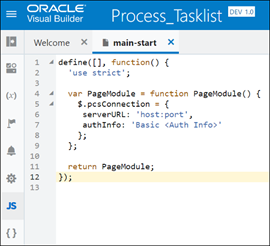
You can make Process UI composite components available in Oracle Visual Builder and use these components, along with other Visual Builder components, to create custom enterprise, web, or mobile applications.

Use the procedure detailed here to make a Process composite component available in Oracle Visual Builder. In this example, we’ll add the Task List component into Visual Builder. Read the complete article here.

PaaS Partner Community

For regular information on Oracle PaaS become a member in the PaaS (Integration & Process) Partner Community please register here.

clip_image003 Blog clip_image005 Twitter clip_image004 LinkedIn image[7][2][2][2] Facebook clip_image002[8][4][2][2][2] Wiki

Technorati Tags: SOA Community,Oracle SOA,Oracle BPM,OPN,Jürgen Kress

Process Automation with Process Cloud Service (PCS) – Part 4 (Testing) by Daniel Teixeira

image

Testing is without doubts the ugly duckling of application development, but it is really a necessary evil Testing in itself is a whole separate discipline where one can have several types of Testing ->Unit, Integrated, Performance, Load, Regression, E2E.

The idea here is to focus only on the testing capabilities that are part of the PCS platform, and how to use them to improve the development stage.

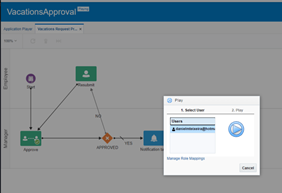
Option 1

The easy way to test the development efforts is straight from the canvas. By pressing the play button the workflow will start and we are given the choice about the user that is playing a role in the execution. Think of this as a sort of Unit Test! You can select who initiates the process and who approves it and act as those users. In this process the start is via a Form read the complete article here.

PaaS Partner Community

For regular information on Oracle PaaS become a member in the PaaS (Integration & Process) Partner Community please register here.

clip_image003 Blog clip_image005 Twitter clip_image004 LinkedIn image[7][2][2][2] Facebook clip_image002[8][4][2][2][2] Wiki

Technorati Tags: SOA Community,Oracle SOA,Oracle BPM,OPN,Jürgen Kress

Invoking Process Applications with Anonymous Users from VB Apps with Oracle Integration by Arvind Venugopal, Shay Shmeltzer, and Nathan Angstadt

imageIn this blog, we will setup a Visual Builder Application with Oracle Integration and use Process behind the scenes. For this particular use case, we will show how to build VB Applications that allow access by Anonymous users to initiate Process Applications. A common use case would be where the Web App is used by many external users where you don’t want to setup secure identities for each user, however you still want to secure the Process Apps.

Let’s explore some options for this use case.

A couple of steps to complete before exploring the various security options:

  • First, setup a Process Application with a Message Start event. A simple example is provided below.
  • Then, In VB have a form with an action that connects to the Process (you will need to setup the VB app to work with the Process App as well). Example using Process Action is shown below. For the options mentioned below, you will need to use the REST action instead. Read the complete article here.

PaaS Partner Community

For regular information on Oracle PaaS become a member in the PaaS (Integration & Process) Partner Community please register here.

clip_image003 Blog clip_image005 Twitter clip_image004 LinkedIn image[7][2][2][2] Facebook clip_image002[8][4][2][2][2] Wiki

Technorati Tags: SOA Community,Oracle SOA,Oracle BPM,OPN,Jürgen Kress
Working Around not Having Complex Gateway by Jan Kettenis

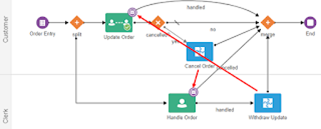
imageIn this article I describe how you can work around not having the Complex Gateway in OIC Structured Process. I will end with what I believe to be the best work around with respect to support for refactoring.

The Complex Gateway in BPMN 2.0 is one of the least used features of BPMN. However, when you find a use case for it also may find that there is no alternative way to model it, or not an easy one. The challenge being that in case of parallel flows (be it via Parallel or Inclusive Gateway) the token must move to the merge gateway for each individual flow before it can move further.

One typical use case that I have ran into a couple of times is the one where at a specific point in the process there is more than one way to do something, and either one of them might happen after which the process can move on to the next activity. In case there are only two ways, most of the times you can model this by adding an interrupting Boundary Message or Timer Catch event to the activities. Read the complete article here.

PaaS Partner Community

For regular information on Oracle PaaS become a member in the PaaS (Integration & Process) Partner Community please register here.

clip_image003 Blog clip_image005 Twitter clip_image004 LinkedIn image[7][2][2][2] Facebook clip_image002[8][4][2][2][2] Wiki

Technorati Tags: SOA Community,Oracle SOA,Oracle BPM,OPN,Jürgen Kress
Cloud Platform Partner YouTube Update July 2021


The July video includes three topics:

• Oracle Fiscal Year Results 2021

• Steps to Success

• b2b Webcast

For regular updates please subscribe to our YouTube channel here. Thanks for your likes and sharing the video on YouTube and LinkedIn.  For the latest integration & process information please join the PaaS community.

clip_image003 Blog clip_image005 Twitter clip_image004 LinkedIn image[7][2][2][2] Facebook image Meetups

Technorati Tags: YouTube,PaaS,Cloud,Middleware Update,WebLogic,WebLogic Community,Oracle,OPN,Jürgen Kress

Using UN/EDIFACT for B2B Transactions by Arvind Venugopal, and Sunil Apte

image

With the May release, we have added support for EDIFACT data format for B2B with Oracle Integration. UN/EDIFACT is a standard and format for electronic business communications. It is controlled and maintained by a committee called, UNECE, that is a body formed by the United Nations.

Now you will be able to design and run EDIFACT transactions with the Cloud Platform. Here are the key steps that allow you to do this:

  • First step is that you will now be able to design EDIFACT formatted schemas from within the B2B Design time experience in ‘B2B Schemas’
  • Once the schema is created you will be able to personalize and customize the named instance of this schema to adhere to the trading partner specifications.
  • Once you have the schemas created you will be able to use them to create B2B documents. Now, you don’t need a custom schema for B2B documents in case you are using standard schemas. In which case, you can go directly to create the B2B document. Read the complete article here.

PaaS Partner Community

For regular information on Oracle PaaS become a member in the PaaS (Integration & Process) Partner Community please register here.

clip_image003 Blog clip_image005 Twitter clip_image004 LinkedIn image[7][2][2][2] Facebook clip_image002[8][4][2][2][2] Wiki

Technorati Tags: SOA Community,Oracle SOA,Oracle BPM,OPN,Jürgen Kress

Modelling Transport Integrations with Trading Partner Management by Arvind Venugopal, and Sunil Apte

image

With the May release of Oracle Integration, we have introduced the ability to setup Transport Integrations within the Trading Partner Management design time experience. With this enhancement, we have also automated the creation of the base B2B integration.

This setup enables a B2B user to onboard Trading Partners on the Cloud platform without requiring to configure the Trading Partner setup via Integrations. In this blog, we will see how to achieve this.

First, we will review a couple of the prerequisites to help enable this.

  • First, the backend Application Integration will have to be created for the transactions you want to process in and out from the respective app you are using. You will be able use the supported Application or technical adapters to create the connection to the app and then create the integration that houses the business logic as well as the mapping. You can find more information on the supported adapters here.
  • Second, before going to the Trading Partner screens you can create the Transport Connection for AS2 or FTP via the connections page as well as the document that you want to process via the Documents screen. Optionally, you can customize your schema as well to be used within the Documents. Read the complete article here.

PaaS Partner Community

For regular information on Oracle PaaS become a member in the PaaS (Integration & Process) Partner Community please register here.

clip_image003 Blog clip_image005 Twitter clip_image004 LinkedIn image[7][2][2][2] Facebook clip_image002[8][4][2][2][2] Wiki

Technorati Tags: SOA Community,Oracle SOA,Oracle BPM,OPN,Jürgen Kress
Using an Event Based Pattern with Oracle Integration by Michael Meiner

image

Something happens in your enterprise application. Let’s say a new item is added to your catalog in your Enterprise Resource Planning (ERP) system. We will call this an event. Perhaps you want to find out about this event so you can take some action. Perhaps you need to add this item to your customer-facing web store.

One way to accomplish this is to continually poll the application. The problem with this solution is that you need to expend resources to keep polling, and then you will likely not find out about the event immediately. This is akin to sending a package and then calling the recipient every few minutes to find out whether they received the package. This of course is inefficient (not to mention the annoyance to the recipient!). A much better option is to have the recipient notify you when the package arrives.

Oracle Integration can help satisfy processing such events by using an event-driven architecture. Your integration does not need to poll the application. Rather, your integration can register for an event, sit back and relax — and wait to be notified. As businesses adopt and embrace Digital Transformation, one critical step in this journey is moving to event-driven architectures to replace older, more cumbersome integration methods.

To illustrate this, we using Oracle ERP and Shopify. Oracle ERP will be our system of record for products in our catalog. New products get added to our Oracle ERP system. Whenever a new product is added to Oracle ERP, the product will be added to Shopify so that our customers can begin ordering the product. The process of adding the product to Shopify will be handled by Oracle Integration, via an event-based pattern. Let’s now build the integration. Read the complete article here.

PaaS Partner Community

For regular information on Oracle PaaS become a member in the PaaS (Integration & Process) Partner Community please register here.

clip_image003 Blog clip_image005 Twitter clip_image004 LinkedIn image[7][2][2][2] Facebook clip_image002[8][4][2][2][2] Wiki

Technorati Tags: SOA Community,Oracle SOA,Oracle BPM,OPN,Jürgen Kress