OIC: Making a REST Integration Returning a 404 instead of 500 by Jan Kettenis

image

In this article I describe how to return a HTTP 404 (resource) Not Found with a REST integration that on its turn calls another REST service that returns a 404.
When an integration invokes the GET action on a REST service that returns a 404, the integration will raise an APIInvocationError. As a result, the integration on its turn will respond with a HTTP 500 error, which is typically not what you want.
Embedding the invoke in a Scope gives you the option to add a Fault Handler:

Chosing the APIInvocationError gives you the option to configure how any APIInvocationError should be handled. As you can see below, I have configured it to use a Switch, where the top flow will make it return a 404: Read the complete article here.

PaaS Partner Community

For regular information on Oracle PaaS become a member in the SOA & BPM Partner Community for registration please visit www.oracle.com/goto/emea/soa (OPN account required) If you need support with your account please contact the Oracle Partner Business Center.

clip_image003 Blog clip_image005 Twitter clip_image004 LinkedIn image[7][2][2][2] Facebook clip_image002[8][4][2][2][2] Wiki

Technorati Tags: SOA Community,Oracle SOA,Oracle BPM,OPN,Jürgen Kress
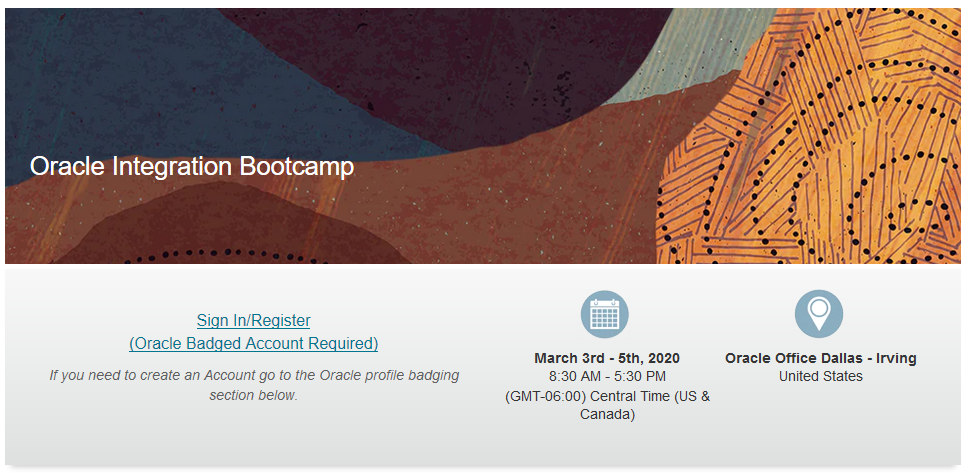
SaaS Integration Partner Bootcamp Irving, Dallas March 3rd-5th, 2020

imageDo you want to find out why Gartner named Oracle as a Leader in Magic Quadrant for three years in row? Are you able to innovate quickly in the new digital world? Are you looking for ways to integrate systems and data faster using a modern cloud integration platform? Attend the Oracle Integration Bootcamp, a three days hands-on training for Oracle partners!

Schedule: March 3rd – 5th, 2020

Location: Oracle Office Dallas – Irving United States

Oracle Product Management is pleased to invite Oracle Partners to attend a 3-days hands-on workshop on how to integrate with ERP & HCM applications using Oracle Integration Cloud. This Invite-Only hands-on workshop will be delivered at No-Fee to Partners. It will consist of presentations, demos, and hands-on labs.

Oracle Integration Cloud (OIC) offers Integration, Process Automation and Visual design capabilities that help business analysts and IT specialists to automate end to end business processes across departments. Oracle Integration Cloud offers a simple recipe to be successful in this application integration and process automation journey: Build, Integrate and Engage.

Workshop format:

  • In-person workshop with presentations, demos, and hands-on labs
  • Attendees will receive training environment login during the workshop

Audience:

  • Oracle SaaS partners who implement ERP, HCM and CX solutions
  • Oracle Tech Partners who are Specialized in SOA Suite
  • Consultants and Architects with technical background

For details please visit the registration page here.

For additional local training’s please visit the website here.

PaaS Partner Community

For regular information on Oracle PaaS become a member in the SOA & BPM Partner Community for registration please visit www.oracle.com/goto/emea/soa (OPN account required) If you need support with your account please contact the Oracle Partner Business Center.

clip_image003 Blog clip_image005 Twitter clip_image004 LinkedIn image[7][2][2][2] Facebook clip_image002[8][4][2][2][2] Wiki

Technorati Tags: SOA Community,Oracle SOA,Oracle BPM,OPN,Jürgen Kress
How to invoke an Integration from another Integration: Oracle Integration Cloud by Ankur Jain

image

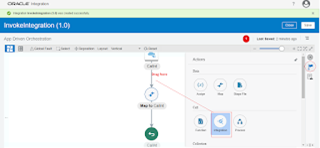
In this blog, we are going to showcase how to call an existing integration from another integration without creating a separate connection. This feature is available in the OIC version 18.3.1 onwards. This feature is available using the feature flag "oic.ics.console.integration.invoke.local.integration". Please go through the blog which helps you to see the feature flag functionality in Oracle Integration Cloud.

Will create a new REST API which will call existing Integration SAMPLE_REST. This  SAMPLE_REST is the rest API which takes one request parameter(name) and gives the response in JSON.
Below is the structure of SAMPLE_REST integration: Read the complete article here.

PaaS Partner Community

For regular information on Oracle PaaS become a member in the PaaS (Integration & Process) Partner Community please register here.

clip_image003 Blog clip_image005 Twitter clip_image004 LinkedIn image[7][2][2][2] Facebook clip_image002[8][4][2][2][2] Wiki

Technorati Tags: SOA Community,Oracle SOA,Oracle BPM,OPN,Jürgen Kress
PaaS Partner YouTube Update February 2020

The February video includes three topics:

• Oracle Cloud trials for partners

• Hands-on Bootcamps for Integration & Digital Assistant

• Integrate HCM community webcast

For regular updates please subscribe to our YouTube channel here. Thanks for your likes and sharing the video on YouTube and LinkedIn. For the latest PaaS Community information please visit our Community update wiki here (Community membership required).

PaaS Partner Community

For regular information on Oracle PaaS become a member in the PaaS (Integration & Process) Partner Community please register here.

clip_image003 Blog clip_image005 Twitter clip_image004 LinkedIn image[7][2][2][2] Facebook clip_image002[8][4][2][2][2] Wiki

Technorati Tags: YouTube,SOA Community,Oracle SOA,Oracle BPM,Jürgen Kress,Middleware Update,Partner Update

Search across business identifiers while monitoring instances by Arya Sanyal

image

In OIC Console, a new enhancement has been added which can help users search across primary and secondary business identifiers across instances. To try this out, OIC instance needs to be on 19.3.1.0.0 (190709.0200.29920) or later.

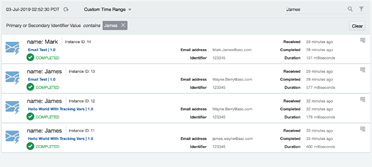
While on Monitoring -> Tracking page of OIC Console, until now, searching for instances containing a specific business identifier value was limited to either primary identifiers or secondary identifiers. But with this enhancement users can search for values across both identifier types.

The UI search has been enhanced to support this as well as the REST API.

So how does it work? Here’s how.

Suppose we have multiple instances of different Integrations and they have common values for primary and secondary business identifiers. This is how it will look like on the Tracking page: Read the complete article here.

PaaS Partner Community

For regular information on Oracle PaaS become a member in the PaaS (Integration & Process) Partner Community please register here.

clip_image003 Blog clip_image005 Twitter clip_image004 LinkedIn image[7][2][2][2] Facebook clip_image002[8][4][2][2][2] Wiki

Technorati Tags: SOA Community,Oracle SOA,Oracle BPM,OPN,Jürgen Kress

OIC: Handling Optional Elements in a REST Integration by Jan Kettenis

image

This article is a follow-up of the a previous article where I discuss how to handle optional elements in case of XML in the Oracle Integration Cloud (OIC). In the following I discuss how to create an integration that invokes VBCS REST service and works in (almost) the same way as the VBCS REST service itself.
A challenge with mapping is always how to handle optional elements. In the previous posting that I refer to above, I describe a way how to deal with this in case of XML messages. As I found out (the hard way) this is cannot be applied 100% to JSON.
I have made it work for an integration that invokes the REST service on a VBCS business object. As there are challenges especially with numeric fields and references (foreign keys), I have used a simple BO called Detail having a string field, a number field and a reference. With VBCS BO’s the latter implies a number field that references the (number) id field of another BO it refers to, which in this case is called Master. Read the complete article here.

PaaS Partner Community

For regular information on Oracle PaaS become a member in the PaaS (Integration & Process) Partner Community please register here.

clip_image003 Blog clip_image005 Twitter clip_image004 LinkedIn image[7][2][2][2] Facebook clip_image002[8][4][2][2][2] Wiki

Technorati Tags: SOA Community,Oracle SOA,Oracle BPM,OPN,Jürgen Kress
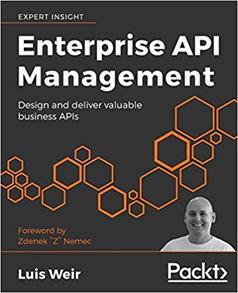
Enterprise API Management: Design and deliver valuable business APIs book by Luis Weir

image

APIs are the cornerstone of modern, agile enterprise systems. They enable access to enterprise services from a wide variety of devices, act as a platform for innovation, and open completely new revenue streams.

Enterprise API Management shows how to define the right architecture, implement the right patterns, and define the right organization model for business-driven APIs.

Drawing on his experience of developing API and microservice strategies for some of the world’s largest companies, Luis Weir explains how APIs deliver value across an enterprise. The book explores the architectural decisions, implementation patterns, and management practices for successful enterprise APIs, as well as providing clear, actionable advice on choosing and executing the right API strategy in your enterprise.

With a relentless focus on creating business value, Luis Weir reveals an effective method for planning, building, and running business products and services with APIs. Get the book here. For additional books see the community wiki here.

PaaS Partner Community

For regular information on Oracle PaaS become a member in the PaaS (Integration & Process) Partner Community please register here.

clip_image003 Blog clip_image005 Twitter clip_image004 LinkedIn image[7][2][2][2] Facebook clip_image002[8][4][2][2][2] Wiki

Technorati Tags: SOA Community,Oracle SOA,Oracle BPM,OPN,Jürgen Kress

Additional new content PaaS Partner Community

image

· Oracle and Microsoft Interconnect Clouds The alliance between Microsoft and Oracle, “moves customers towards the promise of nimble apps that can shift from cloud to cloud easily, and even deploying individual apps that span multiple clouds,” says Oracle’s Vinay Kumar (Shivagange Chandrashekar), vice president of product management. Common multi-cloud use cases.

· VIDEO: AI and Where to Find Opportunity Oracle’s Steve Miranda, executive vice president of applications development, talks to Crossing the Chasm author Geoffrey Moore about machine learning and how it will affect the work of business leaders.

· Tech Dive: Creating an ATP Instance with Oracle Cloud Infrastructure Service Broker for Kubernetes Oracle recently announced the release of Oracle Cloud Infrastructure Service Broker for Kubernetes, an implementation of the Open Service Broker API that streamlines the process of provisioning and binding to services that your cloud native applications depend on. Here, get step-by-step instructions for using Cloud Infrastructure Service Broker for Kubernetes to provision an ATP instance and deploy a container that has access to the ATP credentials and wallet. What’s the first step?

· VR Hits the Road Are you ready to be a virtual passenger?

· Blockchain Records Are Forever in Opaque Diamond Market Consumers want to ensure their jewels weren’t sold to finance insurgencies or wars, while insurers want to stop theft and fraud.

· Food Safety with Oracle Blockchain Platform Drive innovation, accelerate business, and reduce cost and risk with Oracle Blockchain Platform. See how food safety can be guaranteed and product recalls expedited using Oracle Blockchain solutions.

PaaS Partner Community

For regular information on Oracle PaaS become a member in the PaaS (Integration & Process) Partner Community please register here.

clip_image003 Blog clip_image005 Twitter clip_image004 LinkedIn image[7][2][2][2] Facebook clip_image002[8][4][2][2][2] Wiki

Technorati Tags: SOA Community,Oracle SOA,Oracle BPM,OPN,Jürgen Kress

The Future of Supply Chain Technology with Blockchain & IoT by Mario Vollbracht

image

The overall positioning of Blockchain, and the connection between Blockchain and IoT

In the consumer markets industries today, connected consumers are expecting a seamless, personalized and transparent shopping experience. Retailers and brand manufacturers alike have little choice but to respond, unless they want to be left behind. One key technology being discussed at length in this equation is blockchain. I sat down with Prasen Palvankar, the Senior Director of Product Management for IoT Applications Cloud & Blockchain Applications Cloud, to get his perspective on what he is seeing.

Q. Let me start with the obvious question around blockchain – the technology is arguably over-hyped, with many people looking at this technology, much like a silver bullet. What is your perspective?

This is true, at least in the enterprise blockchain area, a lot of people are looking for a problem to solve using blockchain rather than looking at how existing solutions can be enhanced using blockchain or how previously unaddressed issues could be addressed with the help of blockchain. Frequently, blockchain is being viewed as just a secure, distributed data store. The core value prop of enabling trust without the need for a central authority is not being considered. Read the complete article here.

PaaS Partner Community

For regular information on Oracle PaaS become a member in the PaaS (Integration & Process) Partner Community please register here.

clip_image003 Blog clip_image005 Twitter clip_image004 LinkedIn image[7][2][2][2] Facebook clip_image002[8][4][2][2][2] Wiki

Technorati Tags: SOA Community,Oracle SOA,Oracle BPM,OPN,Jürgen Kress

Announcing the Oracle Intelligent Track and Trace Application! By Michael Richter

image

Oracle is a leader in blockchain technology and launched the Oracle Blockchain Platform in July of 2018. With a lot of interest and early adoption by customers, the next step in this evolution was to make it easy for business users to implement and further transform their processes using pre-built blockchain applications.

Four pre-built blockchain applications for supply chain are coming soon. The first of these, Oracle Intelligent Track and Trace, is an application for businesses using supply chain management (available June 13, 2019.)

The application helps to address the challenges of managing complexities in a global network of trading partners. You don’t need to be a developer to use the Oracle Intelligent Track and Trace application because it’s a pre-built application that is ready-to-deploy out of the box. Powered by blockchain technology, the application helps to gain efficiencies for supply chain management by pinpointing where transactions and goods are across the supply chain and trading partners. Read the complete article here.

PaaS Partner Community

For regular information on Oracle PaaS become a member in the PaaS (Integration & Process) Partner Community please register here.

clip_image003 Blog clip_image005 Twitter clip_image004 LinkedIn image[7][2][2][2] Facebook clip_image002[8][4][2][2][2] Wiki

Technorati Tags: SOA Community,Oracle SOA,Oracle BPM,OPN,Jürgen Kress