ICS Pricing – ICS Definitive Tip #9 by Phil Wilkins

image

ICS pricing is based on two aspects – the number of connections and the number of messages processed.  But what constitutes a connection?  What happens if I exceed the number of messages or connections?

Number of Connections

The overall model for ICS pricing is on page 34 of Oracle Platform as a Service and Infrastructure as a Service – Public Cloud Service Descriptions-Metered & Non-Metered. The key definition for a Hosted Connection is on Page 9 of this document.  The critical wording for the connections is:

A Connection is counted per unique application, data source, third party software, Oracle software, Web Service or REST end point to which the Oracle Integration Cloud Service is connected. SOAP or REST Web Services that have the same base URI (combination of host and port) are counted as one Connection.

So you can define for example two ICS connections (one in and one out for example, or one per operation) to the same service aslong as the basic part of the URL e.g. icsallpurpose-xxxxxx.integration.us2.oraclecloud.com  is the same. The ports will typically only become a countable to the same URL if you use different protocols e.g. HTTP, HTTPS, FTP. This simply comes down to the fact different protocols typically use different ports.  But, if I daisy chained integrations within the same ICS instance; then assuming they are all HTTPS calls they would only consume 1 connection. This is regardless of how many different connections created to provide the full path.  This is also important as when transitioning versions of end points you may need the current and previous endpoints available, which within this model would count as the same connection as typically the version identifier is in the subsequent path. Read the complete article here.

Building an Oracle Integration Cloud Service Integration in 2 Minutes by Robert van Molken and ACE Associate Phil Wilkins

image

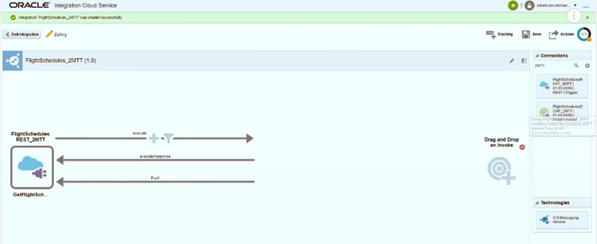
Oracle ACE Robert van Molken and ACE Associate Phil Wilkins, authors of "Implementing Oracle Integration Cloud Service," (2017, Packt Publishing) demonstrate how to create an OICS integration in just 2 minutes. Watch the video here.


Registries: Use Cases for API Management and Microservices by Phil Wilkins

image

Microservices and new 3rd-generation API Management capabilities are very natural technical partners. A (micro)service provides the execution logic for a single capability and 3rd generation API Management provides the means to control the exposure of each service to the outside world, and potentially between the (micro)services as well. Luis Weir’s article, 3rd-Generation API Management, explains the evolution of the API Management capability, and what the 3rd generation offers that makes API Management mesh well with (micro)services. For this article, though, we are going to explore the role of registries in a (micro)services environment and ultimately their relationship to API Management. We aren’t going to dive deeply into any specific solution, although we will reference some of the better known options, and provide links to where you can dig in further.

You’ll note I have referred to microservices as (micro)services. This is very deliberate, and possibly contentious.Microservices are typically associated with certain technologies such as Docker and lightweight app containers such as Tomcat, but from my view point if you’re going to be a purist about microservices, then (as with SOA) you need to think about the design paradigm and the principles—NOT the technologies. It is with this view point we often have to work as, unless you’re fortunate to be working in a services organization that is very enlightened or just plain fortunate, the decisions and constraints you have to work with will mean you need to make some pragmatic decisions. An organization that has made heavy investment in WebLogic licensing isn’t likely to be comfortable in giving it up—but this doesn’t mean you can’t adopt a microservices approach, although certainly you need to mitigate risks that using WebLogic can create when adopting the architecture. Secondly, the concept of registries isn’t unique to microservices; in fact, some of these solutions have origins in solutions such as Big Data/Hadoop offerings, for example.

To underline my point, Gartner has started to talk about mini- or micro-apps as a flavor of microservices. The essence of this is the application of microservice principles but in a more pragmatic manner—not every organization needs hyperscaling and super elasticity like the poster children of microservices (e.g., Netflix and Uber). But we all do need the means to easily manage the addressing of services.

To understand the role of a registry, we need to step back and understand some of the ideas underpinning microservices. So let’s just recap: Read the complete article here.

How Capgemini can enable the new Oracle API Management platform by Mark Albon

image

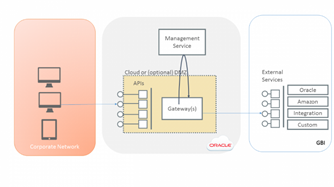
As the tendency continues for organisations to adopt not one but multiple cloud vendors, information has never been more federated. Real time access to such assets via APIs has therefore become a priority for our customers. Oracle API Platform Cloud Service delivers a pure-play 3rd generation API solution capable of creating and managing APIs that run in any vendor’s cloud and/or on-premises –whilst keeping the entire platform operations and API lifecycle central in the Oracle Cloud.

This flexible architecture means that we can create robust solutions for our customers that really puts them in the driving sit when it comes to managing access to information via APIs –regardless of where they are. The incorporation of Apiary into the platform, only makes it better as developers also get the tools they need to ensure that those APIs are well designed, documented and are easy to consume. Read the complete article here.

Save Your Seat: Free Training On-demand – Oracle SOA Suite 12c and Oracle BPM 12C Implementation Specialists Boot Camps April 2018

imageTraining On Demand: Oracle SOA Suite 12c Implementation Specialists AND Oracle Business Process Management 12C

Register for Apr 02 – Apr 27 free SOA Bootcamp

Register for Apr 02 – Apr 27 free BPM Boocamp

Oracle SOA Suite 12c Implementation Specialists

Oracle SOA Suite 12c is the latest version of the industry’s most complete and unified application integration and SOA solution. With simplified cloud, mobile, on premises and Internet of Things (IoT) integration capabilities, all within a single platform, Oracle SOA Suite 12c delivers faster time to integration, increased productivity and lower TCO.
The Oracle SOA Suite 12c Implementation Boot Camp provides relevant insight to current and prospective SOA implementers and for those companies interested on becoming Oracle SOA Suite 12c Specialized. Participants will learn how to develop and implement solutions using SOA Suite 12c that will drive their customer organizations run more effectively and efficiently.
Learn To:

  • Create, deploy, and manage cross-application process orchestration with BPEL Process Manager
  • Describe tasks for users or groups to perform with Human Task Service
  • Define and modify business logic without programming by using Business Rules
  • Create dashboards, alerts, and reports in real time with no coding using Business Activity Monitoring (BAM)
  • Implement SOA Services with Web Services Manager
  • Manage and monitor integration flow with Enterprise Manager
  • Use Adapters to connect to enterprise applications
  • Convert complex point-to-point application integration into simplified, agile, and reusable shared service application infrastructure with Service Bus

Audience

  • SOA Architects
  • System Integrators
  • Technical Consultants Administrator

Register for Apr 02 – Apr 27 Session


Oracle Business Process Management 12C

This boot camp is an ideal starting point for an implementer who is planning to learn Oracle BPM Suite 12c and use it on BPM projects. The course provides a combination of lecture segments that present conceptual and feature background and hands-on labs that provide practice with the tooling.
It introduces process developers to Oracle BPM Suite 12c. It covers the key concepts, features and processes needed to begin using the design-time and run-time capabilities on BPM projects. Throughout the training, you will benefit from hands-on exercises based upon two case studies. At the conclusion of the course, you should feel comfortable to start using BPM Suite 12c for process modeling, simulation, analytics, business rules and human workflow.
Learn To:

  • Use BPMN modeling notation to document business process
  • Simulate a process model to identify bottlenecks
  • Create business rules that condition flow through a model
  • Develop a sophisticated human workflow task routing
  • Define key performance metrics
  • Build a dashboard containing charts that show key performance metrics

Audience

  • Process Developers
  • Application Developers
  • Application Architects
  • SOA Architects
  • System Analysts
  • Technical Consultant

Register for Apr 02 – Apr 27 Session

My first experience with Oracle API Platform Cloud Service – part 1 by Milco Numan

image

In the first part of this two part blog post, I will describe the use case for which we used Oracle API Platform Cloud Service (shortened to APIPCS from now on) as an outbound API Gateway, offering lookup services and centralizing outbound access. This part will also describe a simple Node.js microservice we deployed to Oracle’s Application Container Cloud Service to perform the translation of an internal identification into the API key required by the external API.

The second part of this blog will elaborate on the actual creation of the API definition in APIPCS, the invocation of the microservice using Groovy scripting and the testing of the external API using APIPCS.

Introduction

At a customer, for a proof of concept last year, I have been working with an exiting new Cloud Product from Oracle: API Platform Cloud Service, or APIPCS for short. In this blog, I will not go into architectural details on why you could, should or must use an API Manager of API Gateway. Nor will I be elaborating on all functionality or features of Oracle’s implementation of the product, since they’re perfectly capable of doing that themselves.

Basic Scenario

In the use case encountered at this specific customer, the requirement existed to not use the API Gateway as an inbound Gateway, but rather to use the API Management solution as an outbound gateway. The rationale for this setup is to provide a single outbound gateway through which REST services can be invoked where internal identifications can be translated into different kinds of external identifications, known to the outside world. The former may be thought of as (internal) applications, or perhaps even customer identifications stored in an internal system. The latter category then may relate to API-keys required by the external partner, or even OAuth2 tokens. Read the complete article here.

Everything you Should Know about the API Platform Groovy Policy by Ricardo Ferreira

image

Introduction

Developers using the API Platform Cloud Service often make use of the built-in policies that comes with the platform; to implement any logic that needs to be executed before delivering the actual message to the backend service. One common policy used is the Groovy policy, which allows API developers to write Groovy scripts that can be executed either within the request or the response pipeline. These scripts can be used to inspect and even modify the message content (payload, queries, headers) therefore a very powerful tool to have at their disposal.

Because Groovy is a programming language, there are no boundaries of what can be implemented other than what is supported by its specification. Moreover; Groovy will accept any code that is valid in Java, bringing even more powerfulness to your APIs. However, this power comes with a high price to be paid.

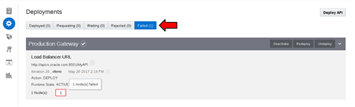
The biggest challenge with the Groovy policy is that you have no way to verify if the code written is correct until it is deployed into the gateways. During deployment; the Groovy script will be transformed into a Java class that uses the code written as part of its implementation. If something in the script is wrong, there will be compilation errors that will cause the deployment of the API to fail, as shown in Figure 1.

This whole situation can be quite frustrating if complex Groovy code is being used or if one API accesses multiple instances of the Groovy policy, each one carrying different scripts. Hours can be spent trying to troubleshoot the root-cause of the deployment issue, which is a situation that the Oracle A-Team has been experiencing quite often with different customers. Thus, this blog will discuss the most important details about the Groovy policy, its common pitfalls and which situations must be avoided to ensure a smooth API deployment.

The Basics: Groovy Policy Under-the-Hood

Given the simplicity of the Groovy policy UI, you may be thinking that its internal implementation is also quite simplistic. After all, how complex should be getting a script that contains Groovy code and executing it in a JVM right? the truth is that it is way more complex than what may appear, and properly understanding what happens under-the-hood may give you a better perspective about what to expect from this policy. Read the complete article here.

Oracle API Platform Cloud Service – The Next-Gen API Management Platform by Sven Bernhardt

image

Nowadays APIs are omnipresent. In a world of intelligent Virtual assistants (a.k.a. Chatbots), like Google’s Alexa, and a “Connect everything”-mentality this is not surprising. In addition, APIs are essential building blocks of modern software applications build on top of new architectural patterns like Microservices. That’s the technical side.

From a corporate perspective, APIs provide the chance to create new digital business models and economies by exposing services and data to business partners and customers. The challenge: How to ensure Usability, Security, Transparency and Discoverability for the exposed APIs?

Design-Driven API Management

With API Platform Cloud Service (APIP CS), Oracle launched the next big thing today making their Platform as a Service (PaaS) offering even more complete.

APIP CS is a lightweight, cloud-native platform that is capable for covering the complete API Lifecycle from Planning to Retirement.

Having an integration with Apiary.io, which was acquired by Oracle in the beginning of this year, the platform comes with a powerful API Design component and thus supports an API First approach, where API designers, API developers, architects and API consumer developers respectively App developers can consistently work collaboratively to create an appropriate API definition. This results in a consistent, intuitive API, driven by design. Read the complete article here.

Oracle SOA Suite: Two-way SSL with TLS1.2 made easy (slightly less complicated) by Maarten Smeets

image

Transport layer security (TLS) is not an easy topic. Many blogs have been written about this already. Surprisingly though, I did not find a single blog which was more or less complete and provided me with everything I needed to know to get this working on SOA Suite 12.2.1. In this blog I try to make the topic more easy to understand and provide a complete end to end example.

Suppose you only want an implementation and do not care much about the explanation, you can skip the ‘Some basics’ section, only execute the commands in bold in the ‘Lets get started!’ section and the steps in the ‘WebLogic and SOA Suite’ section. Do take into consideration any existing SSL related configuration on your own system.

Some basics

SSL/TLS

SSL stands for Secure Sockets Layer. SSL is the predecessor of TLS. SSL should be considered insecure since in October 2014 the POODLE attack was announced. TLS currently has 4 versions. TLS 1.0, 1.1, 1.2 and 1.3. 1.3 is not widely supported/adopted yet. SSL/TLS provide integrity checks, security and authentication.

Identity

A server which hosts traffic on a port which has SSL/TLS enabled, has an identity keystore. This identity keystore contains a private key and a public key/certificate. The public key/certificate can safely be given to other parties. With websites when visiting an HTTPS website (HTTP with SSL enabled), the public key is send to you. The other party / client can use the public key to encrypt messages meant for the server. The only one who can decrypt the messages is the one having the private key of the server. This is usually only the server. Read the complete article here.

BPEL 12.2.1.2 and UMS: no wire target for reference… by Martien van den Akker

image

A moment ago I stumbled on this question on the Oracle community. User Saurabh  tries to build a composite to send email from BPEL. But on testing the deployed composite in EM it fails with a remote fault. This despite of a correct configuration of the email driver and being able to test that   using soa-infra -> Service Engines -> Human Workflow -> Notification Management.
He found that the problem was a bug in JDeveloper/SOA QuickStart, causing the email activity not being wired to a Email UMS notification reference. Fortunately there is a patch for it, as described in DocId 2235669.1 on support. Apply Patch 24898307 to solve this. Read the complete article here.