Understanding the Enterprise Scheduler Service in ICS by Sherwood Zern


Introductionimage

In many enterprise integration scenarios there is a requirement to initiate tasks at scheduled times or at user defined intervals. The Oracle Integration Cloud Service (ICS) provides scheduling functionality via the Oracle Enterprise Scheduler to satisfy these types of requirements.  The Oracle Enterprise Scheduler Service (ESS) is primarily a Java EE application that provides time-based and schedule-based callbacks to other applications to run their jobs. Oracle ESS applications define jobs and specify when those jobs need to be executed and then gives these applications a callback at the scheduled time or when a particular event arrives. Oracle ESS does not execute the jobs itself, it generates a callback to the application and the application actually executes the job request. This implies that Oracle Enterprise Scheduler Service is not aware of the details of the job request; all the job request details are owned and managed by the application.

What follows will be a discussion as to how ICS utilizes the ESS feature.  The document will cover how the ESS threads are allocated and the internal preparation completed for file processing.

Quick ICS Overview

The Integration Cloud Service deployment topology consists of one cluster.  The cluster has two managed servers along with one administration server.  This bit of information is relevant to the discussion of how the Enterprise Scheduler Service works and how it is used by applications like an ICS flow that runs in a clustered HA environment.

A common use case for leveraging ESS is to setup a schedule to poll for files on an FTP server at regular intervals.  At the time files are found and then selected for processing, the ESS does some internal scheduling of these files to ensure the managed servers are not overloaded.  Understanding how this file processing works and how throttling might be applied automatically is valuable information as you take advantage of this ICS feature.

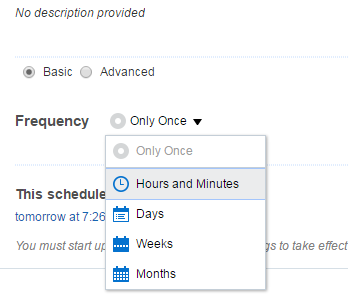
An integration can be scheduled using the ICS scheduling user interface (UI). The UI provides a basic and an advanced option.  The basic option provides UI controls to schedule when to execute the integration. Read the complete article here

SOA & BPM Partner Community

For regular information on Oracle SOA Suite become a member in the SOA & BPM Partner Community for registration please visit www.oracle.com/goto/emea/soa (OPN account required) If you need support with your account please contact the Oracle Partner Business Center.

Blog Twitter LinkedIn image[7][2][2][2] Facebook clip_image002[8][4][2][2][2] Wiki

Technorati Tags: SOA Community,Oracle SOA,Oracle BPM,OPN,Jürgen Kress

ICS Connectivity Agent stdout Log Rotation by Greg Mally

When monitoring and/or troubleshooting the ICS Connectivity Agent server, it is important to not only have the standard logs (e.g., AdminServer-diagnostic.log) but also the standard out/error (stdout/stderr).  One of the big challenges of capturing the stdout is not exhausting the disk storage over time.  Since the ICS Connectivity Agent is a WebLogic server installation, there are out-of-the-box options available for redirecting the stdout/stderr (see WebLogic Server logging options).  However, there are limitations for using the built-in features of WebLogic which include not capturing all the stdout/stderr (e.g., initial startup output, thread dumps using kill -3).  This blog focuses on an option available at the OS level and provides a script to help setup your environment.

One of the requirements of the ICS Connectivity Agent is it must run on Linux (see System Requirements and Restrictions). Because of this requirement, we have a Linux command at our disposal that will help manage the rotation of the agent stdout: logrotate (http://www.linuxcommand.org/man_pages/logrotate8.html). There are plenty of examples of how to use logrotate and if you are a seasoned Linux person, this blog is most likely not needed for you.  However, if you want a helper script to get this going for you in the context of the ICS Connectivity Agent then keep reading.

Starting the Connectivity Agent

Part of the ICS Connectivity Agent installation includes a start script (startAgent.sh) that is created in the directory where the agent is installed. In order to make sure the started agent server is not terminated when exiting the shell/terminal, the agent is started using the Linux nohup command. Read the complete article here.

SOA & BPM Partner Community

For regular information on Oracle SOA Suite become a member in the SOA & BPM Partner Community for registration please visit www.oracle.com/goto/emea/soa (OPN account required) If you need support with your account please contact the Oracle Partner Business Center.

Blog Twitter LinkedIn image[7][2][2][2] Facebook clip_image002[8][4][2][2][2] Wiki

Technorati Tags: SOA Community,Oracle SOA,Oracle BPM,OPN,Jürgen Kress

Differentiating the ICS Agent Types – Definitive Tip #5 by Phil Wilkins

image

In our book we talked about the difference between the agents offered by ICS, namely the Connection  and Execution agents. Whilst we differentiated the two, we did focus on the connection agent as this is the type we expect to see used in most cases. However the execution agent still suffers from a level of confusion, and it has been helped by being called  ‘ICS on-premises’.

As part of a number of recent conversations the questions and confusion of what the execution agent is and how it works has come up. There is the well known saying ‘a picture is as good as a 1000 words’ which prompted us to develop the diagram below as a power point slide – in its power point form much of the detail is used as an animated build up. Read the complete article here.

SOA & BPM Partner Community

For regular information on Oracle SOA Suite become a member in the SOA & BPM Partner Community for registration please visit www.oracle.com/goto/emea/soa (OPN account required) If you need support with your account please contact the Oracle Partner Business Center.

Blog Twitter LinkedIn image[7][2][2][2] Facebook clip_image002[8][4][2][2][2] Wiki

Technorati Tags: SOA Community,Oracle SOA,Oracle BPM,OPN,Jürgen Kress

Oracle Integration Cloud (OIC) partner resource kit

imagePartner Resource kit: Presentation, faq, click-through demo, documentation and decision matrix published at our SOA Community Workspace (SOA Community membership required):

· Oracle Integration Cloud Overview (PPT)

· Frequently Asked Questions

· Oracle Integration Cloud Click-through Demo

· Oracle Integration Cloud Documentation

· Cloud Integration Decision Matrix

· Overview Video YouTube

· Oracle Integration Cloud product page

SOA & BPM Partner Community

For regular information on Oracle SOA Suite become a member in the SOA & BPM Partner Community for registration please visit www.oracle.com/goto/emea/soa (OPN account required) If you need support with your account please contact the Oracle Partner Business Center.

Blog Twitter LinkedIn image[7][2][2][2] Facebook clip_image002[8][4][2][2][2] Wiki

Technorati Tags: SOA Community,Oracle SOA,Oracle BPM,OPN,Jürgen Kress

Selecting which iPaaS Product(s) to use – ICS Definitive Tip #4 by Phil Wilkins

image

In the last few years Oracle’s iPaaS offerings have progressed significantly from one or two solutions such as Mobile Cloud Service to in excess of 35 offerings. This makes it challenging to decide which product(s) to use. The means for selection depends upon a range of factors including:

  • Most suitable licensing model (ICS provides a lower cost of entry than SOA CS as you’re paying by message volumes)
  • Development skills and desire to resilience or invest in people (SOA on-premises to SOA CS is easier than a technology change such as ICS)
  • The amount of control you have in an environment – JCS offers more control than ACCS for example

This is in addition the technical features that the different products offer. In terms of capability, Oracle iPaaS products can overlap, but better than having gaps. Not only is there overlap, you can achieve the same results with one or more products. Obviously, the permutation that provides the least amount of overlap is likely  to provide the best value in terms of investment.  To help see and understand this we have in the past used a visualisation such as the one shown below which helps evaluate these considerations.

It is worth saying that this visualisation has been subjectively constructed, and as products evolve over time it is only true for a limited period of time. Never the less it is helpful in reviewing options, and explaining product recommendations. Read the complete article here.

SOA & BPM Partner Community

For regular information on Oracle SOA Suite become a member in the SOA & BPM Partner Community for registration please visit www.oracle.com/goto/emea/soa (OPN account required) If you need support with your account please contact the Oracle Partner Business Center.

Blog Twitter LinkedIn image[7][2][2][2] Facebook clip_image002[8][4][2][2][2] Wiki

Technorati Tags: SOA Community,Oracle SOA,Oracle BPM,OPN,Jürgen Kress
API Management and Microservices, a Match Made in Heaven

image

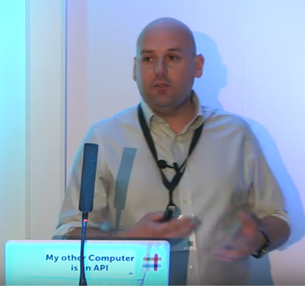
It’s not news anymore that Microservices architecture is changing the way systems are designed and built, however what’s rarely discussed in detail is how the APIs exposed by those Microservices are managed and accessed from other systems or even other Microservices and more importantly how those APIs are discovered and consumed by a community of developers when building solutions. In this presentation Capgemini’s PaaS experts Phil and Luis will explain in detail how Microservices Architecture and API Management relate to each other. To do this reference architectures, capability models and architectural patterns will be described and then it will be shown -with practical examples, how to implement modern solutions in the Oracle Cloud. Watch the video here.

SOA & BPM Partner Community

For regular information on Oracle SOA Suite become a member in the SOA & BPM Partner Community for registration please visit www.oracle.com/goto/emea/soa (OPN account required) If you need support with your account please contact the Oracle Partner Business Center.

Blog Twitter LinkedIn image[7][2][2][2] Facebook clip_image002[8][4][2][2][2] Wiki

Technorati Tags: SOA Community,Oracle SOA,Oracle BPM,OPN,Jürgen Kress

When Creating APIs, Focus your API Gateway on What it Does Best by Robert Wunderlich

image 

When talking with customers and prospects, I often hear about two requirements; converting REST to SOAP or SOAP to REST and Caching of data for performance.

These are great opportunities for an API Gateway, but should be used with extreme caution. Misuse of either of these features can cause performance problems in your gateway or even worse, putting your sensitive data at risk!

Using an Integration Platform with an API Platform provides the opportunity to follow some best-practice approaches to data isolation as well as scaling of certain heavy-weight operations. Furthermore, by separating these concerns, sensitive data is better protected

First, let’s look at the key purposes of an API Platform and an Integration Platform. The API Platform is responsible for the following: Read the complete article here.

WebLogic Partner Community

For regular information become a member in the WebLogic Partner Community please visit: http://www.oracle.com/partners/goto/wls-emea ( OPN account required). If you need support with your account please contact the Oracle Partner Business Center.

Blog Twitter LinkedIn Forum Wiki

Technorati Tags: PaaS,Cloud,Middleware Update,WebLogic, WebLogic Community,Oracle,OPN,Jürgen Kress

Handle locked rows by DB Adapters for distributed Polling technologies in OSB 12c by Chris Laurente

image

In this post, we will learn some ways to handle a database row that is locked by a Database Adapter with Distributed polling capablity in OSB 12c. There we go:

Introduction

Sometimes, when we work with Database adapters with distributed polling we are struggling to update the same polled row in the respective pipeline because, basically, the polled row is locked with the option “FOR UPDATE SKIP LOCKED” and it will be released when the process finishes or if an error occurs. But, what happen if we want to update the same polled row, let see for example the status description of the process or some error messages. So, I would like to show you some ways to handle these cases.

1.- Using JMS resources

If we could handle more resources like for example Topics or queues then we would be able to send the polled row to these resources and process them after the poller was released, so it would be useful if we want to release the polled row as soon as we want.

In this case we will create a topic and we will specify the Messaging request as the request of the DB Poller, the column to read and write is called POLLER_READ from 0(READY) to 1(DONE). Read the complete article here.

SOA & BPM Partner Community

For regular information on Oracle SOA Suite become a member in the SOA & BPM Partner Community for registration please visit www.oracle.com/goto/emea/soa (OPN account required) If you need support with your account please contact the Oracle Partner Business Center.

Blog Twitter LinkedIn image[7][2][2][2] Facebook clip_image002[8][4][2][2][2] Wiki

Technorati Tags: SOA Community,Oracle SOA,Oracle BPM,OPN,Jürgen Kress
Asynchronous Web Services With Oracle SOA Suite by Pavel Samolysov

image

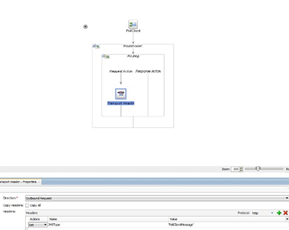
The top web services based approaches for asynchronous interactions among enterprise applications are described in the article. The common used during Oracle SOA Suite leveraging method that based on a callback service and the WS-Addressing specification is shown. A number of examples of asynchronous web service creation and client generation using the JDeveloper IDE are considered.

Introduction

Time to time, when we as architects integrate some enterprise applications, asynchronous communication has be to taken into account. Asynchronous communication means a service consumer isn’t blocked for an response from a service provider, it just gets an acknowledge and continue doing it’s work. There are two popular approaches to implement asynchronous communication among web services:

  • polling refers to actively sampling the status of a being processed request by a service consumer as a synchronous activity.
  • callback refers to a method provided by a service consumer. When the service provider have accomplished the operation processing, it calls the consumer. In this approach, the service consumer simultaneously works like a callback methods service provider as well. Read the complete article here.

SOA & BPM Partner Community

For regular information on Oracle SOA Suite become a member in the SOA & BPM Partner Community for registration please visit www.oracle.com/goto/emea/soa (OPN account required) If you need support with your account please contact the Oracle Partner Business Center.

Blog Twitter LinkedIn image[7][2][2][2] Facebook clip_image002[8][4][2][2][2] Wiki

Technorati Tags: SOA Community,Oracle SOA,Oracle BPM,OPN,Jürgen Kress

Connect Sales and Service with ICS by Waslley Souza

image

Oracle ICS is a solution that facilitate the integration between SaaS x SaaS and SaaS x On-Premise solutions.
It has a lot of connectors to help you to create your integrations throught configuration.
Two examples are Oracle Sales and Oracle Service (formerly Oracle RightNow) connectors.
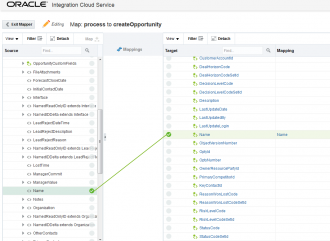
For some Business Objects of Oracle Sales and Oracle Service you can use a feature called Event Subscription, and it means that if you create, update or delete a registry of this objects, the integration inside ICS will start automatically.
Today, this feature is only enabled for Contact and Account in Oracle Sales.

And only enabled for Contact, Organization and Incident in Oracle Service. Read the complete article here.

SOA & BPM Partner Community

For regular information on Oracle SOA Suite become a member in the SOA & BPM Partner Community for registration please visit www.oracle.com/goto/emea/soa (OPN account required) If you need support with your account please contact the Oracle Partner Business Center.

Blog Twitter LinkedIn image[7][2][2][2] Facebook clip_image002[8][4][2][2][2] Wiki

Technorati Tags: SOA Community,Oracle SOA,Oracle BPM,OPN,Jürgen Kress