ECID propagation between SCA composites and JAX-WS web services by Nicolas Fonnegra


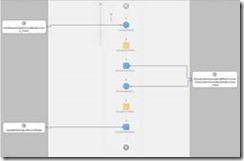
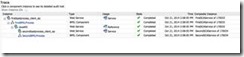
clip_image002The Oracle SOA Suite provides an Audit Trail monitor screen where the message flow between the different SCA composites can be tracked. Depending on the audit level, it can provide a very detailed chronology of the different states of the message, including the first component that receives the messages, its correspondent transformation along the way, and the routing it’s final destination. Nevertheless, a SOA platform is intended to integrate not only internal composites but also external components. The question is how to maintain the audit trail consistency in such scenarios?

The Oracle A-team posted a very helpful blog demonstrating how to propagate the ECID between JCA adapter calls in order to maintain the audit trail consistency. This blog is going to demonstrate how to achieve this result with JAXWS web services.

As the reader might have already figured it out, the key to this problem relies with the ECID. The execution context id (ECID) is the mechanism the SOA Suite uses to keep track of the messages as it passes between the different components. If an SCA calls another one, it will pass through the ECID, helping the audit trail to correlate the different component instances into one flow. Also, if instead of a SCA composite a JAXWS web service, the ECID will be passed in the SOAP header, more specifically in the ReplyTo element: Read the complete article here.

SOA & BPM Partner Community

For regular information on Oracle SOA Suite become a member in the SOA & BPM Partner Community for registration please visit www.oracle.com/goto/emea/soa (OPN account required) If you need support with your account please contact the Oracle Partner Business Center.

Blog Twitter LinkedIn image[7][2][2][2] Facebook clip_image002[8][4][2][2][2] Wiki

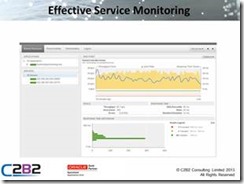
Principles of SOA Suite Performance Tuning by C2B2


clip_image002Part 1 of the Oracle SOA 11g Performance Tuning Webinar Series. Delivered by Steve Millidge, C2B2 Technical Director, on the 21st of January 2013.

C2B2 is running a new series of short and snappy educational webinars about Oracle SOA Suite 11g. Delivered by our experienced middleware consultants, the webinars provide insight and ideas for the performance tuning of Oracle SOA Suite 11g. Over the next few weeks we will take a bottom up walk through the middleware technology stack that makes up Oracle SOA Suite 11g, reviewing processes, tools and techniques for diagnosing performance problems at each layer.
Delivered by a performance tuning specialist the first part of our webinar series will introduce you to the principles of performance tuning large scale SOA infrastructures

Watch the video here.

SOA & BPM Partner Community

For regular information on Oracle SOA Suite become a member in the SOA & BPM Partner Community for registration please visit www.oracle.com/goto/emea/soa (OPN account required) If you need support with your account please contact the Oracle Partner Business Center.

Blog Twitter LinkedIn image[7][2][2][2] Facebook clip_image002[8][4][2][2][2] Wiki

Throttling in SOA Suite via Parking Lot Pattern by Greg Mally


clip_image002The Parking Lot Pattern has been leveraged in many Oracle SOA Suite deployments to handle complex batching, message correlation, and complex processing flows. One scenario that is a frequent topic of discussion is throttling SOA Suite so as not to overwhelm slower downstream systems. Most often this is accomplished via the tuning knobs within SOA Suite and WebLogic Server. However, there are times when the built-in tuning cannot be tweaked enough to stop flooding slower systems. SOA design patterns can be leveraged when product features do not address these edge use cases. This blog will focus on using The Parking Lot Pattern as one implementation for throttling. Also note a working example is provided.

Throttling Parking Lot

The key piece to this pattern is the database table that will be used for the parking lot. The table is very simple and comprised of 3 columns:

Column

Description

ID (NUMBER)

This is the unique ID/key for the row in the table.

STATE (VARCHAR)

This will be used for state management and logical delete with the database adapter. There are three values this column will hold:

1.

N – New (Not Processed)

2.

P – Processing (In-flight interaction with slower system)

3.

C – Complete (Slower system responded to interaction)

The database adapter will poll for ‘N’ew rows and will mark the row as ‘P’rocessing when it hands it over to a BPEL process.

PAYLOAD (CLOB)

The message that would normally be associated with a component is stored here as an XML clob.

The Use Case Flow

Without the parking lot, the normal flow for this use case would be:

1.

Some client applications call SOA Suite via Web Service, JMS, etc.

2.

An asynchronous BPEL instance is created and invokes the slower system for every client request within the tuning parameters of the SOA engine

3.

The slower system cannot handle the volume and gets flooded

How the flow is changed with the parking lot:

1.

Some client applications call SOA Suite via Web Service, JMS, etc.

2.

Each client request is inserted into the parking lot table as an XML clob with STATE = ‘N’.

3.

A composite containing a polling database adapter will select 1 row with STATE = ‘N’ and the count of rows with STATE = ‘P’ are less than a throttle value (e.g., 5).

4.

If the in-flight interactions with the slower system are less than the throttle value, the database adapter gets the next available row and marks it as being processed (STATE = ‘P’).

5.

This row is handed off to an asynchronous BPEL process that will invoke a different BPEL process responsible for interacting with the slower system.

6.

When the slower system responds and this response propagates back to the initiating BPEL process, the row is marked as complete (STATE = ‘C’).

7.

Go to step 3 until all records have been processed.

The throttle control value represents the maximum number of in-flight BPEL processes that are interacting with the slower system. We will see later how this value can be changed at runtime through the SOA Suite Enterprise Manager console.

Read the complete article here.

SOA & BPM Partner Community

For regular information on Oracle SOA Suite become a member in the SOA & BPM Partner Community for registration please visit www.oracle.com/goto/emea/soa (OPN account required) If you need support with your account please contact the Oracle Partner Business Center.

Blog Twitter LinkedIn image[7][2][2][2] Facebook clip_image002[8][4][2][2][2] Wiki

SOA Suite 12c Demo GSE just got more valuable with Internet Accessible Demos and Customer Guest Access

Request access to our middleware demo systems here

clip_image002GSE Provides

• A platform to demo Oracle products in an enterprise setting – the way Oracle is meant to be used

• Easily accessible, fast performing, refreshed canned demos

• Demo environments (deal servers) that can be customized to your customers needs

• Workshops

Increase SC productivity – Less time building demos and more face time with customers.

GSE helps win deals for Oracle

GSE Website is now Internet Facing

What this means? External Site – https://demo.oracle.com

Latest demos which are DemoWeb Complaint can be access on Internet. DemoWeb compliant environments can now be accessed directly from your using your Single Sign-On (SSO) Access demos from customer site without VPN. Partners also access demos from the unified internet facing website https://demo.oracle.com

Close Deals Faster with Customer Demo Access (Guest Access)

GSE Guest Demo Access provides SCs and other Oracle employees the ability to give customers secure browser

Provide Guest Access to Customers and Partners without OPN account

Any Oracle Employee with an ADSWeb account can create a guest access request. Create a reservation and request for guest access. More Details on Demo Store

SOA & BPM Partner Community

For regular information on Oracle SOA Suite become a member in the SOA & BPM Partner Community for registration please visit www.oracle.com/goto/emea/soa (OPN account required) If you need support with your account please contact the Oracle Partner Business Center.

Blog Twitter LinkedIn image[7][2][2][2] Facebook clip_image002[8][4][2][2][2] Wiki

2 Minute Tech Tip: Continous Integration with Oracle Fusion Middleware 12c

Taking advantage of the continuous integration capabilities in Oracle Fusion Middleware 12c "will make your life a lot easier," says Oracle ACE Director Ronald van Luttikhuizen. Watch the video here.

clip_image001

SOA & BPM Partner Community

For regular information on Oracle SOA Suite become a member in the SOA & BPM Partner Community for registration please visit www.oracle.com/goto/emea/soa (OPN account required) If you need support with your account please contact the Oracle Partner Business Center.

Blog Twitter LinkedIn image[7][2][2][2] Facebook clip_image002[8][4][2][2][2] Wiki

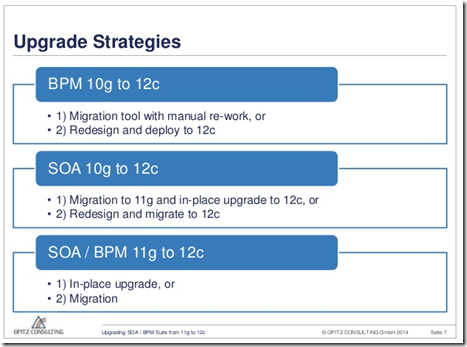
Upgrading Oracle SOA/BPM Suite from 11g to 12c by Danilo Schmiedel


clip_image001

Get the presentation here.

SOA & BPM Partner Community

For regular information on Oracle SOA Suite become a member in the SOA & BPM Partner Community for registration please visit www.oracle.com/goto/emea/soa (OPN account required) If you need support with your account please contact the Oracle Partner Business Center.

Blog Twitter LinkedIn image[7][2][2][2] Facebook clip_image002[8][4][2][2][2] Wiki

Tame the Cloud Integration Beast

clip_image002

View the eBook: Integrate the Cloud.
Software as a service is widely known for its ease of deployment. Less understood is the integration rat’s nest that can result when many SaaS applications are introduced within a company without a cohesive strategy.

Dain Hansen, director of integration product marketing for Oracle, says problems result when organizations bring in various cloud apps without a well-planned strategy that also takes into account on-premise software and systems.

"It’s just so hard to get things to talk together," says Hansen.

SaaS offerings have become very popular because they can be implemented quickly and easily by business units and individual users. Yet, because some of that implementation is outside the purview of IT organizations and others are simply stand-alone, it has led to a proliferation of online technology assets that are isolated from on-premise systems, unable to tap into valuable data stores or other sources of business expertise. Read the complete article here.

SOA & BPM Partner Community

For regular information on Oracle SOA Suite become a member in the SOA & BPM Partner Community for registration please visit www.oracle.com/goto/emea/soa (OPN account required) If you need support with your account please contact the Oracle Partner Business Center.

Blog Twitter LinkedIn image[7][2][2][2] Facebook clip_image002[8][4][2][2][2] Wiki

Cloud Computing Definition & Architecture for Cloud Service Brokers

With the launch of the Oracle Cloud PaaS Platforms we will make the SOA & BPM Partner Community cloud ready. In this article series we will lay the foundation for cloud computing including definition and concepts.

clip_image002Content

Cloud Computing Hype Introduction

Cloud Computing Definition and Criteria

Concepts in Cloud Computing

Industry focus & use case Cloud Computing Providers & Consumers

Differences between Cloud Definitions

NIST Cloud Computing Reference Architecture

Cloud Broker

Types Cloud Broker

Challenges Cloud Broker

Cloud Computing Hype Introduction
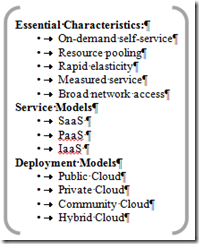
image Why is everyone talking about cloud computing? Drawn-out, expensive IT projects that are planned and implemented with few benefits for the business stakeholders are commonplace. In contrast, cloud computing offers business users the chance to immediately implement services with usage-based billing that are tailored to their requirements, often without the need to consult with the IT department.

However, aspects including security, architecture, availability, and standards are often not evaluated. Cloud consumers find themselves at the mercy of the cloud provider. Scenarios that require changing cloud providers after a cloud provider goes bankrupt, and the associated moving of data and/or applications, have not yet been sufficiently tested. Business continuity should play a key role from the start of a cloud evaluation process.

One of the greatest challenges here is the integration of existing data and systems into the cloud solution. Without integration spanning clouds and on premise systems, processes can only be executed in isolation, leading to cloud-specific silos of isolated solutions. Important information for users is not available across processes and systems. Problems that would have occurred in the company’s internal IT are now shifted to the cloud provider. To prevent "legacy clouds" or solutions that are hard to maintain, it is important to manage the entire architecture proactively and, in particular, the integration into the cloud. Even if cloud providers want us to believe otherwise, not every aspect of IT can be outsourced to cloud solutions!

Cloud Computing Definition and Criteria

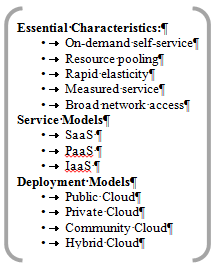
Cloud computing is a model for usage-based network access to a common pool of configurable computing resources (e.g. networks, servers, storage systems, applications, and services) that can be provided and used quickly. IP-based services are requested via self-service and used online independently. A prerequisite for this is a broadband Internet connection with low latency. The IT resources are bundled into pools and provided as required. Billing is based on the services used. *1

Concepts in Cloud Computing

In cloud computing, the following models are differentiated on the basis of horizontal scaling:

· Infrastructure-as-a-Service (IaaS) – provides a hardware platform as a service, such as Amazon EC2 or Oracle Compute Service (now in preview)

· Platform-as-a-Service (PaaS) – provides a software platform as a service, such as Google Apps Engine or Oracle Java Cloud

· Software-as-a-Service (SaaS) – allows applications and functions to be outsourced by virtualizing cloud providers’ hardware and software and providing the functions as services, such as Salesforce CRM [REF-1] or Oracle Sales Cloud

In deployment models, distinctions are made according to availability and installation location. Public clouds are services that are available to the public on the Internet. Private clouds are internal company services. Hybrid clouds and community clouds represent mixtures of these models, such as when Amazon computing power is used in the event of a failure or overload of an internal company cloud application.

Industry focus & use case Cloud Computing Providers & Consumers
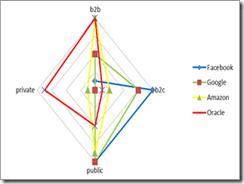
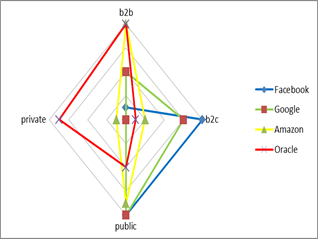
clip_image005Large companies for which IT plays a central role or represents a competitive advantage often build internal company cloud solutions in their own data centers “private clouds”. Small and medium enterprises frequently use public cloud services. A further distinguishing feature is the cloud consumer focus. In the business-to-business segment, private clouds are predominantly used, while in the business-to-consumer segment the majority are public clouds (Figure: 1).

Differences between Cloud Definitions

Thomas Erl, Ricardo Puttini and Zaigham Mahmood define cloud computing in his latest book “Cloud Computing Concepts, Technology & Architecture”. Based on the NIST cloud computing definition they add “ubiquitous access” as a cloud characteristic, to reflect the trend that more and more services are used on mobile devices. As cloud computing becomes more and more adopted also in b2b services, companies run mission critical applications on a global level in the cloud, resiliency of this services becomes important. Therefore Thomas Erl Ricardo Puttini and Zaigham Mahmood add also “resiliency” to the cloud characteristics.*2

Wikipedia defined cloud computing more from a consumer perspective. The article highlights that cloud computing is often used as a jargon term without a commonly accepted non-ambiguous scientific or technical definition.*3. From my perspective the NIST definition is widely accepted between b2b vendors. Many software vendors try to brand their solutions as cloud solution, or cloud enabled solutions without to respect the NIST cloud definition. This reflects the change of the IT industry caused by cloud computing.

NIST Cloud Computing Reference Architecture

Together with the “The NIST Cloud Definition of Cloud Computing” the “NIST Cloud Computing Reference Architecture” lays the theoretical foundation of cloud computing. The NIST Cloud Computing Reference Architecture extends the definition by a reference architecture and a taxonomy. An additional actor and role model is introduced. The cloud provider offers IaaS, PaaS or SaaS services to the cloud consumer. Between them a cloud broker might offer service intermediation, service aggregation and service arbitrage. These services become more important as cloud services need to be integrated with on premise and integrated or exchanged between different cloud providers. A cloud carrier transports the cloud services from the cloud provider to the cloud consumer. A cloud auditor might support the cloud consumer and cloud provider in security, privacy impact and performance audits*4

Cloud Broker

NIST and Gartner define three different types of cloud brokers:

Service Intermediation

Provides value added services on top of a cloud platform. An example is the Force identity service from Salesforce. This identity service can be used to identify users across several cloud services.

Service Aggregation

Ensures the interoperability between different cloud services. An example is Boomi from Dell. The service let cloud consumers integrate for example a Salesforce CRM system with a Netleger billing system and or an on premise solution. As IT System are often historical grown and rally build on a green field approach cloud aggregation becomes key for cloud adoption.

Service Arbitration

A cloud service arbitrage provides flexibility and an “opportunistic choices” by offering multiple similar services to select from.*5 Heroku for example lets the cloud consumer choose between different cloud services. The cloud consumer might increase service level agreements or reduce the dependency from one cloud provider by a service arbitration service.

Key Benefits of Cloud Brokers

Key benefits of cloud brokers might include:

• Cloud interoperability: Integration between several cloud offerings

• Cloud portability: Move application between different cloud vendors

• Different data models between cloud offerings

• Modular services between several cloud offerings e.g. security, document or notification services to increase developer productivity and user usability & security

• Increase business continuity by reducing dependency from one cloud provider

• Increase SLAs by leverage multiple cloud provider

Challenges Cloud Brokers

Large leading cloud providers e.g. Google or Salesforce try to offer comprehensive services & platforms for cloud consumers. Often they are not interested to enable cloud broker services which might enable cloud consumer to choose or broker between different cloud providers. Sometimes their strategy can be characterized as a vendor log-in. Today no industry wide standard for cloud brokers is developed. To enable seamless service aggregation on a process level, between different cloud providers a meta-data model between them needs to be established. This model needs to include joint business objects and services to ensure seamless processes across multiple cloud providers.

Cloud consumers Dependencies based on Service Layer

The risk of such a vendor login might be based on the service model the cloud consumer chooses. The higher the service model, less has to build by the cloud consumer, more is provided by the cloud provider, the higher the risk of vendor login:

Service Model

Risk vendor login

Advice

SaaS

High

Same application on-premise available

PaaS

Medium

Standard programming language available several clouds

IaaS

Low

Operating & Virtualization technologies

With the need of cloud Brokers versus the trend to build whole cloud Economies by one dominant player this might be one of the most challenging and exciting areas of cloud computing in the next years. Today cloud consumers might carefully evaluate this in the cloud selection phase to ensure business continuity.*6

References

  1. NIST Definition Cloud Computing
  2. „Cloud Computing Concepts, Technology & Architecture” Thomas Erl, Zaigham Mahmood, Ricardo Puttini, PRENTICE HALL June 2013
  3. Wikipedia http://en.wikipedia.org/wiki/Cloud_computing
  4. NIST Cloud Computing Reference Architecture
  5. Gartner
  6. NIST Definition Cloud Computing

For more information on Cloud Integration please visit www.soacommunity.com

SOA & BPM Partner Community

For regular information on Oracle SOA Suite become a member in the SOA & BPM Partner Community for registration please visit www.oracle.com/goto/emea/soa (OPN account required) If you need support with your account please contact the Oracle Partner Business Center.

Blog Twitter LinkedIn image[7][2][2][2] Facebook clip_image002[8][4][2][2][2] Wiki

SOA Community,Oracle SOA,Oracle BPM,OPN,Jürgen Kress. Cloud, cloud service broker, cloud integration
API Catalog to Simplify API Management By Mala Ramakrishnan


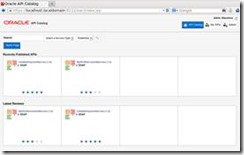
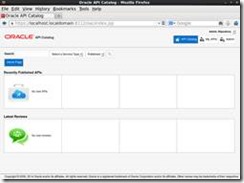
Oracle is extending its API Management solution with a new product, API Catalog. This will give customers the ability to simplify the publication of API services that are developed in Oracle SOA Suite and other sources. Oracle API Catalog will be part of Oracle’s broader API Management solution portfolio. Oracle API Catalog also integrates seamlessly with with Oracle Mobile Suite portfolio of products for mobile enablement. Oracle API Catalog harvests services in Oracle Fusion Middleware to allow one-click publish, submit ratings, or manage re-use across other consuming applications. Oracle’s API Catalog is SOAP as well as REST/JSON compliant to easily support mobile mobile applications.

clip_image001

Here is a validation by one of our beta customers Peter Osborne, IT Technical Lead at LG&E and KU Services Company: "The Oracle API Catalog is a straightforward, easy-to-use governance tool for capturing what services exist, what these services do, and how they can be consumed. Within hours of installation, an organization can begin cataloging their SOAP and REST web services, regardless of the underlying service technology. The harvesting functionality provides a jump start on aggregating service details, while minimizing manual data entry and the risk of duplication and error. Finally, the included JDeveloper plug-in completes the lifecycle by providing a mechanism within JDeveloper to easily view and consume documented services."

To find out more information on Oracle API Catalog, visit us: Website and explore our Datasheet.

Thanks to Andre, Lucas and Luis for the first community feedback. Send us your feedback via twitter @soacommunity #APIcatalog12c & #OER12c

clip_image002André Evensen @anevensen ·  2h 2 hours ago

Harvesting services from WSDLs and publishing to #APIcatalog12c, works like a charm. @soacommunity #OracleSOA

clip_image004

clip_image002[1]André Evensen @anevensen ·  8h 8 hours ago

Newly released #APIcatalog12c installed on SOA Suite 12c. Next: Harvesting services! @soacommunity #OER12c

clip_image006

clip_image007Luis Augusto Weir @Luisw19 ·  10h 10 hours ago

Publish your #API in minutes with #OAC new killer tool to manage APIs @soacommunity @oracleace @OTNArchBeat http://tinyurl.com/oac12c

clip_image008Lucas Jellema @lucasjellema ·  11h 11 hours ago

Oracle Enterprise Repository 12c is available for download at http://www.oracle.com/technetwork/middleware/repository/overview/index.html … – including the brand new API Catalog @soacommunity

SOA & BPM Partner Community

For regular information on Oracle SOA Suite become a member in the SOA & BPM Partner Community for registration please visit www.oracle.com/goto/emea/soa (OPN account required) If you need support with your account please contact the Oracle Partner Business Center.

Blog Twitter LinkedIn image[7][2][2][2] Facebook clip_image002[8][4][2][2][2] Wiki

Link Consulting SOA Suite 12c and BPM Suite 12c Launch in Portugal


clip_image002On the 7th  October, Link Consulting, in partnership with Oracle, at the Hotel SANA Lisboa – Lisbon -  presented the new 12c versions for BPM Suite and SOA Suite.

This event “Introducing Oracle BPM Suite 12 and SOA Suite 12c” had the presence of more than 60 guests, that had the opportunity to get a deep insight about the new 12c versions from BPM Suite and SOA Suite, and about what these innovative solutions can provide to the organizations.

One of the high points of this event was the Keynote by Yogesh Sontakke, Principal Product Manager for Integration across Europe, Middle East and Africa, where the new market trends were presented, and how Oracle is addressing them; two parallel tracks, with demos and insights on the products’ new functionalities.

Link presented these products’ new components and features, as well as their most meaningful use-cases. It were also introduced – hands-on – Oracle’s Cloud Integration e Cloud Application Foundation service offerings.

In this event we got a deep insight about these innovative solutions that provide organizations the needed flexibility to support their business process transformation and integration roadmaps, resulting in a significant cost reduction.

Some of the topics covered in the event:

         SOA Developer Productivity

         Industrial SOA

         Mobile Enablement

         Migration: from 11g to 12c

         Process Analytics and Business Activity Monitoring

         Business Process Architecture

         Adaptive Case Management

         Process Accelerators

With the presentations and demos, it became clear how, with Oracle products – market leader technologies -, our clients will be more and more able to be one step ahead of their competition with bigger agility and operational efficiency.

Link, having been active in its Beta program during almost a year, has reached a higher understanding and deep knowledge about this versions, and we believe that they can be game-changers to your organization.

Link Consulting is one of the few companies to hold several Oracle Fusion Middleware Specializations, with the Oracle Platinum Partner certification. These specializations are obtained by the high number of certified workers and number of successfully executed projects. These are also recognized by Link’s customers as having been delivered with quality, and deep technological knowledge evidences.

Want to get more information about Link Consulting please visit the website here.

Interested to host a SOA 12c and BPM 12c launch event for your customers? Participate in our Fusion Middleware ACT on marketing campaign, for details please see the presentation here.

SOA & BPM Partner Community

For regular information on Oracle SOA Suite become a member in the SOA & BPM Partner Community for registration please visit www.oracle.com/goto/emea/soa (OPN account required) If you need support with your account please contact the Oracle Partner Business Center.

Blog Twitter LinkedIn image[7][2][2][2] Facebook clip_image002[8][4][2][2][2] Wiki