Integration & Process Partner Community Newsletter May 2021

It is time for the May quarterly update to Oracle Integration. With Spring in the air, we are excited to share all our exciting new features and improvements. Thanks to Simone, Antony, Michael and Niall for the blog post series:

Thanks to the community for sharing all the integration articles: Five key Oracle Integration lessons from handling billions of messages monthly by Amit Saxena & Practical Guide to use HCM Data Loader with Oracle Integration & Using an Event Based Pattern with Oracle Integration & Modelling Transport Integrations with Trading Partner Management & Using UN/EDIFACT for B2B Transactions & OSB 12c SOAP webservice for temperature conversion i.e. Celsius to Fahrenheit and vice versa & DevOps and Release Automation for Oracle Integration Cloud – Webcast May 13th 2021.

Visual Builder Cloud Service is the user interface tool for many SaaS services. This SaaS solutions can be connected with Oracle integration and extended with custom process. Consultants can use the same VBCs and OIC services like Oracle SaaS team. Jan posted an article on complex gateways article in the process & innovation section. Thanks to the community for sharing all the process articles: Invoking Process Applications with Anonymous Users from VB Apps with Oracle Integration & Process Automation with Process Cloud Service (PCS) – Part 4 (Testing) & Extend Process Automation UI Components to JET-Based Applications.

For a short summery of our monthly key information watch the PaaS Partner Updates on YouTube. The May edition highlights an on-demand training to become a chatbot expert and Artie a digital assistant. In this month’s community webcast Martin Jarvis and Martijn de Grunt will present hot to accelerate a chatbot project with Oracle Digital Assistant Templates . Please join the Partner Community Webcast May 18th 2021. On-demand webcast recordings are available at the Oracle Video Hub.

Want to publish your best practice article & news in the next community newsletter? Please feel free to send it via Twitter @soaCommunity #PaaSCommunity.

To read the newsletter please visit www.bit.ly/PaaSNewsMay2021

Please like and share the newsletter at Twitter and LinkedIn.

Integration newsletter logo

PaaS Partner Community

For regular information on Oracle PaaS become a member in the PaaS (Integration & Process) Partner Community please register here.

clip_image003 Blog clip_image005 Twitter clip_image004 LinkedIn image[7][2][2][2] Facebook clip_image002[8][4][2][2][2] Wiki

Technorati Tags: newsletter,SOA Community newsletter,SOA Community,Oracle,OPN,Jürgen Kress

Using Aggregate Functions Sum(), Count() while Processing Larger Files by Phaneendra Bommisetty

image

Introduction:

OIC has the capability of processing huge CSV files (up to 1GB) using Stage "Read File In Segments" activity.  In some use-cases, customers require to calculate the sum of a column or count of rows.

Consider the following payload. Say, we want to calculate the sum of all the values in the column "Amount1". Customers tend to declare a variable upstream to Stage action and keep on updating this variable with the computation done in each chunk of the Stage.

Solution:

This blog describes one of the optimal approaches to use the aggregate functions Sum, Count while processing larger files. Read the complete article here.

PaaS Partner Community

For regular information on Oracle PaaS become a member in the PaaS (Integration & Process) Partner Community please register here.

clip_image003 Blog clip_image005 Twitter clip_image004 LinkedIn image[7][2][2][2] Facebook clip_image002[8][4][2][2][2] Wiki

Technorati Tags: SOA Community,Oracle SOA,Oracle BPM,OPN,Jürgen Kress

How to define a Repeating Global Variable by Jorge Herreria

image

Summary

This blog addresses the following use case:  "In my OIC Orchestration, when I define a Global variable based on a repeating element (aka unbounded), the global variable is not repeating; I cannot add/append to it"

The nutshell solution:

Choose the parent element when defining the global variable

Details

Why the variable is not repeating?

Because of XML Rules: When a global variable is defined, internally it is defining a reference to a XML Document. Any XML Document must have a single instance root element; in other words it cannot be a collection of root elements, even if they have the same element name.

How Do I Solve my requirement?

When defining the Variable, choose the parent element of the unbounded element (repeating). That way the  XML Document root element will be the parent element, and one of its children will be the unbounded element

To reference the variable use the location path (xpath) to the unbounded element.

Example

Defining vErrors with the intent to use errorDetails repeating element. Read the complete article here.

PaaS Partner Community

For regular information on Oracle PaaS become a member in the PaaS (Integration & Process) Partner Community please register here.

clip_image003 Blog clip_image005 Twitter clip_image004 LinkedIn image[7][2][2][2] Facebook clip_image002[8][4][2][2][2] Wiki

Technorati Tags: SOA Community,Oracle SOA,Oracle BPM,OPN,Jürgen Kress

Identity Propagation call from Integration Cloud to Oracle SaaS Applications – free on-demand webinar

image

One of the big challenges that Oracle Integration Cloud developers face is any outbound REST call from Integration Cloud (IC) to Fusion Applications (FA) APIs require a user’s identity. Although this may seem trivial on the surface, the mechanism to have the identity of a user flow from a client application to IC to FA in a secure fashion is not trivial. However, there is a proven pattern that can be leveraged with Oracle Cloud technologies to solve this problem and the following presentation will illustrate this pattern.

Speaker: Greg Mally & Deepak Arora

Watch the webcast on-demand

Take the opportunity to watch our community webcasts on-demand:

· Identity Propagation call from Integration Cloud to Oracle SaaS Applications

· Connect Opera with Oracle SaaS

· Extreme Scalability and Enhanced Resilience for OIC

· SOA Modernization

· Cloud Native and Serverless SaaS Extensions

· How Process Workflow can extend the role of Integration

· Innovate Service Cloud with Chatbots

· Integration Update & New Features

· Chatbot Design best practices for Conversational UX

· Connect, Innovate, Extend SaaS KickOff Webcast 2020

· Cloud Platform KickOff Webcast 2020

· Netsuite Integration

· Integration Insight

· Innovate HCM with Chatbots

· ERP Integration with Application Adapters

· HCM Integration with Application Adapters

· Extend SaaS with Visual Builder Cloud Service

· Integration Adapters

· Integrate SaaS

· Digital Assistant Update

· SOA Cloud Service

· PaaS Overview Webcast

· Process Cloud Service Update

· Integrate ERP Cloud

· Integrate HCM Cloud

· Functions and Cloud Native

· Blockchain

· API Platform Cloud Service part 2

· 3rd Generation API Gateways part1

· Oracle JET

· Oracle Visual Builder Cloud Service

· Container Native Application Development Platform

PaaS Partner Community

For regular information on Oracle PaaS become a member in the PaaS (Integration & Process) Partner Community please register here.

clip_image003 Blog clip_image005 Twitter clip_image004 LinkedIn image[7][2][2][2] Facebook clip_image002[8][4][2][2][2] Wiki

Technorati Tags: SOA Community,Oracle SOA,Oracle BPM,OPN,Jürgen Kress

Convert from Schedule to REST based integration by Vijay Kendai

image

This blog is for a new feature coming out in Oracle Integration (OIC) February 2021 release.

Currently in Orchestration, after a trigger has been added, the user does not have the ability to replace it with another trigger. The user essentially has to re-create the integration to achieve this. With this feature, users will be provided with the ability to replace a trigger with minimal impact and without having the need to re-construct various actions in the canvas. After conversion, users will be provided with appropriate warnings and errors to take any corrective action needed, to bring the integration to a configured state.

What is covered ?

In the first phase, only scheduled orchestrations will be addressed.

  • Schedule trigger will be allowed for replacement only with a REST trigger.

What is not covered ?

  • Replacing schedule in Scheduled orchestrations with REST trigger having multiple verbs
  • Replacing trigger in App driven orchestrations

Details

The following section describes in detail how a schedule can be converted to a REST trigger.

On clicking the schedule node, user will be provided with a menu option under more actions to convert to a REST based trigger as shown below. Read the complete article here.

PaaS Partner Community

For regular information on Oracle PaaS become a member in the PaaS (Integration & Process) Partner Community please register here.

clip_image003 Blog clip_image005 Twitter clip_image004 LinkedIn image[7][2][2][2] Facebook clip_image002[8][4][2][2][2] Wiki

Technorati Tags: SOA Community,Oracle SOA,Oracle BPM,OPN,Jürgen Kress

Reactivate All Integrations Together that Use the Same Connection by Shubham Agrawal

image

This blog is for a new feature coming out in Oracle Integration Cloud (OIC) February 2021 release. This blog covers the issue of applying the changed connection properties to the active integrations.

A connection can be used by multiple integration. If connection is updated then Active integrations don’t reflect until they are re-activated. After updating the connection, user currently has to manually go to each integration and re-activate to reflect the updated connection. As an Oracle Integration Cloud user after connection update, user should be able to reactivate all the active integration which are using the same connection.

What does it cover

Users can reactivate the associated integrations for the connection they are trying to update.

User only need to reactivate the integrations if they change connection properties, it does not apply if only primary info is changed, as that would not impact the running integrations.

Now, we can simply reactivate all the associated integrations with a single click, and it will restore the active integrations to its original state (like retain if tracing need to be enabled). Read the complete article here.

PaaS Partner Community

For regular information on Oracle PaaS become a member in the PaaS (Integration & Process) Partner Community please register here.

clip_image003 Blog clip_image005 Twitter clip_image004 LinkedIn image[7][2][2][2] Facebook clip_image002[8][4][2][2][2] Wiki

Technorati Tags: SOA Community,Oracle SOA,Oracle BPM,OPN,Jürgen Kress

API Gateway Deployment by Niall Commiskey

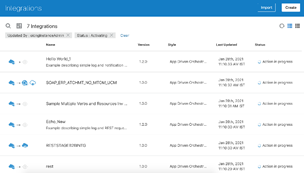
imageThe February 21 of OIC release brings OCI API Gateway Connectivity to OIC. So, as you can see, I have my Gateway. Now I create an API Gateway connection in OIC – Read the complete article here

PaaS Partner Community

For regular information on Oracle PaaS become a member in the PaaS (Integration & Process) Partner Community please register here.

clip_image003 Blog clip_image005 Twitter clip_image004 LinkedIn image[7][2][2][2] Facebook clip_image002[8][4][2][2][2] Wiki

Technorati Tags: SOA Community,Oracle SOA,Oracle BPM,OPN,Jürgen Kress

DevOps and Release Automation for Oracle Integration Cloud – Webcast May 13th 2021

image

As you may know, the FlexDeploy DevOps platform can improve your enterprise software development, operations, and release processes. You can achieve high quality software faster with less cost and risk, increase visibility into your pipeline, and eliminate manual activities and scripting.

In this technical webinar, take a deep-dive into FlexDeploy’s out-of-the-box support for Oracle Integration Cloud (OIC) with a FlexDeploy expert.

You will learn:

  • Continuous delivery release pipelines, dashboards, and reports
  • Automated deployment of integrations and configuration
  • Manage connection property replacement
  • Incorporate continuous integration (CI) and automated testing
Details:

When: May 13th at 11am-12pm EDT / 8am-9am PDT

Where: Virtually, via WebEx

Who: Those interested in exploring DevOps, CI/CD, and Release Orchestration for Oracle Integration Cloud

Register for the webinar today!

PaaS Partner Community

For regular information on Oracle PaaS become a member in the PaaS (Integration & Process) Partner Community please register here.

clip_image003 Blog clip_image005 Twitter clip_image004 LinkedIn image[7][2][2][2] Facebook clip_image002[8][4][2][2][2] Wiki

Technorati Tags: SOA Community,Oracle SOA,Oracle BPM,OPN,Jürgen Kress

OIC & OCI API Gateway Integration: Quick and Easy by Varinder Kaur

image

This blog is for a new feature coming out in Oracle Integration Cloud (OIC) February 2021 release.

If you are interested in OCI API Gateway Integration, then read this blog as it covers the steps needed to seamlessly integrate with API Gateway.

The API Gateway service enables you to publish APIs with private endpoints that are accessible from within your network, and which you can expose with public IP addresses if you want them to accept internet traffic. Now you can create an Oracle OCI API Gateway Deployment from a OIC Rest based Integration. The API deployment will be created with routing rules pointing to the activated integration.

AssumptionOIC user has already created API Gateway or access to API Gateway.
Creating a Deployment from OIC :

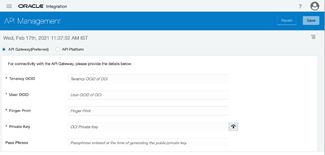
· Configure in API Management settings with OCI Signature V1 Policy : Configure the properties – tenancy OCID, user OCID, fingerprint, private key and passphrase(if present). These properties can be found under your profile menu, tenancy and user settings. Click on Save button after configuring the values, it will validate the credentials and save API gateway settings.

· Activate an Integration: Taking the example of a sample integration here- "Echo" integration ( You can build your own integration). Activate the integration by clicking on Activate icon. The below activate dialog will appear.In the activate dialog, there is an additional action of "Activate and Deploy" which will perform two actions- first activate the integration and then deploy it. Read the complete article here.

PaaS Partner Community

For regular information on Oracle PaaS become a member in the PaaS (Integration & Process) Partner Community please register here.

clip_image003 Blog clip_image005 Twitter clip_image004 LinkedIn image[7][2][2][2] Facebook clip_image002[8][4][2][2][2] Wiki

Technorati Tags: SOA Community,Oracle SOA,Oracle BPM,OPN,Jürgen Kress

Embedding Oracle Integration Insight dashboards : Quickly and Easily by Sandhya Lakshmi Gopalan

image

Integration Insight in Oracle Integration empowers business users by providing a real-time view into their business processes. In addition to viewing Insight dashboards within the Oracle Integration console, Insight offers the capability to embed business dashboards in other applications.

For example:

  • If your business involves order management and you already have your business users using Oracle Cloud ERP to manage your orders, you can embed Insight dashboards for the order process in Cloud ERP. This provides business users with a single consolidated view within Cloud ERP, without needing to sign into Oracle Integration to view the Insight dashboards.
  • If you have a financial business process, with a front-end application that is used by business users, Insight dashboards can be embedded in the front-end application to show real-time business process metrics that can assist in making business decisions.

Integration Insight provides two ways to embed dashboards in other applications:

  • A URL builder for embedding dashboards in an iFrame.
  • Oracle JET Composite Component Architecture (CCA) components for embedding dashboards as HTML elements. Read the complete article here.

PaaS Partner Community

For regular information on Oracle PaaS become a member in the PaaS (Integration & Process) Partner Community please register here.

clip_image003 Blog clip_image005 Twitter clip_image004 LinkedIn image[7][2][2][2] Facebook clip_image002[8][4][2][2][2] Wiki

Technorati Tags: SOA Community,Oracle SOA,Oracle BPM,OPN,Jürgen Kress