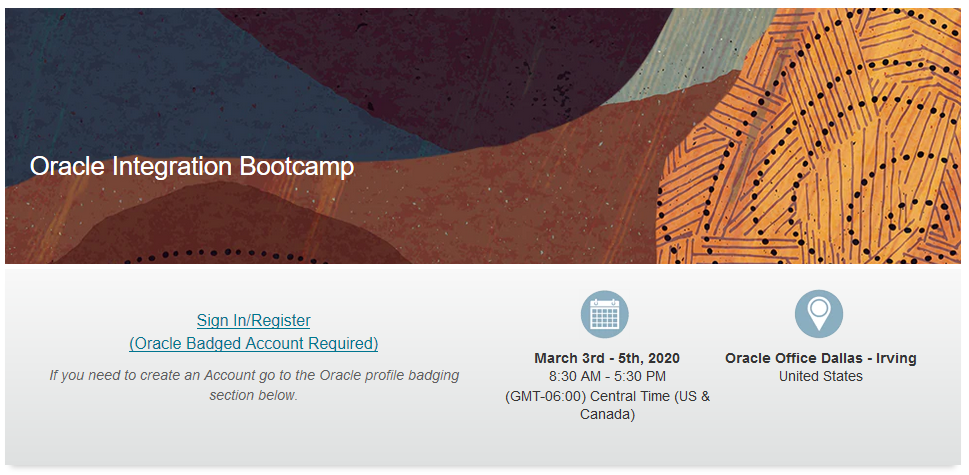
SaaS Integration Partner Bootcamp Irving, Dallas March 3rd-5th, 2020

imageDo you want to find out why Gartner named Oracle as a Leader in Magic Quadrant for three years in row? Are you able to innovate quickly in the new digital world? Are you looking for ways to integrate systems and data faster using a modern cloud integration platform? Attend the Oracle Integration Bootcamp, a three days hands-on training for Oracle partners!

Schedule: March 3rd – 5th, 2020

Location: Oracle Office Dallas – Irving United States

Oracle Product Management is pleased to invite Oracle Partners to attend a 3-days hands-on workshop on how to integrate with ERP & HCM applications using Oracle Integration Cloud. This Invite-Only hands-on workshop will be delivered at No-Fee to Partners. It will consist of presentations, demos, and hands-on labs.

Oracle Integration Cloud (OIC) offers Integration, Process Automation and Visual design capabilities that help business analysts and IT specialists to automate end to end business processes across departments. Oracle Integration Cloud offers a simple recipe to be successful in this application integration and process automation journey: Build, Integrate and Engage.

Workshop format:

  • In-person workshop with presentations, demos, and hands-on labs
  • Attendees will receive training environment login during the workshop

Audience:

  • Oracle SaaS partners who implement ERP, HCM and CX solutions
  • Oracle Tech Partners who are Specialized in SOA Suite
  • Consultants and Architects with technical background

For details please visit the registration page here.

For additional local training’s please visit the website here.

PaaS Partner Community

For regular information on Oracle PaaS become a member in the SOA & BPM Partner Community for registration please visit www.oracle.com/goto/emea/soa (OPN account required) If you need support with your account please contact the Oracle Partner Business Center.

clip_image003 Blog clip_image005 Twitter clip_image004 LinkedIn image[7][2][2][2] Facebook clip_image002[8][4][2][2][2] Wiki

Technorati Tags: SOA Community,Oracle SOA,Oracle BPM,OPN,Jürgen Kress
How to invoke an Integration from another Integration: Oracle Integration Cloud by Ankur Jain

image

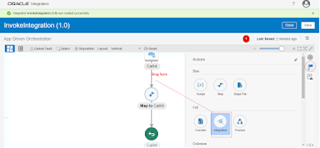
In this blog, we are going to showcase how to call an existing integration from another integration without creating a separate connection. This feature is available in the OIC version 18.3.1 onwards. This feature is available using the feature flag "oic.ics.console.integration.invoke.local.integration". Please go through the blog which helps you to see the feature flag functionality in Oracle Integration Cloud.

Will create a new REST API which will call existing Integration SAMPLE_REST. This  SAMPLE_REST is the rest API which takes one request parameter(name) and gives the response in JSON.
Below is the structure of SAMPLE_REST integration: Read the complete article here.

PaaS Partner Community

For regular information on Oracle PaaS become a member in the PaaS (Integration & Process) Partner Community please register here.

clip_image003 Blog clip_image005 Twitter clip_image004 LinkedIn image[7][2][2][2] Facebook clip_image002[8][4][2][2][2] Wiki

Technorati Tags: SOA Community,Oracle SOA,Oracle BPM,OPN,Jürgen Kress
Search across business identifiers while monitoring instances by Arya Sanyal

image

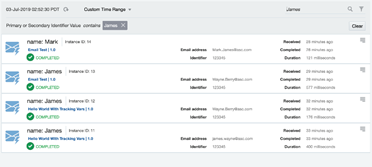
In OIC Console, a new enhancement has been added which can help users search across primary and secondary business identifiers across instances. To try this out, OIC instance needs to be on 19.3.1.0.0 (190709.0200.29920) or later.

While on Monitoring -> Tracking page of OIC Console, until now, searching for instances containing a specific business identifier value was limited to either primary identifiers or secondary identifiers. But with this enhancement users can search for values across both identifier types.

The UI search has been enhanced to support this as well as the REST API.

So how does it work? Here’s how.

Suppose we have multiple instances of different Integrations and they have common values for primary and secondary business identifiers. This is how it will look like on the Tracking page: Read the complete article here.

PaaS Partner Community

For regular information on Oracle PaaS become a member in the PaaS (Integration & Process) Partner Community please register here.

clip_image003 Blog clip_image005 Twitter clip_image004 LinkedIn image[7][2][2][2] Facebook clip_image002[8][4][2][2][2] Wiki

Technorati Tags: SOA Community,Oracle SOA,Oracle BPM,OPN,Jürgen Kress

OIC: Handling Optional Elements in a REST Integration by Jan Kettenis

image

This article is a follow-up of the a previous article where I discuss how to handle optional elements in case of XML in the Oracle Integration Cloud (OIC). In the following I discuss how to create an integration that invokes VBCS REST service and works in (almost) the same way as the VBCS REST service itself.
A challenge with mapping is always how to handle optional elements. In the previous posting that I refer to above, I describe a way how to deal with this in case of XML messages. As I found out (the hard way) this is cannot be applied 100% to JSON.
I have made it work for an integration that invokes the REST service on a VBCS business object. As there are challenges especially with numeric fields and references (foreign keys), I have used a simple BO called Detail having a string field, a number field and a reference. With VBCS BO’s the latter implies a number field that references the (number) id field of another BO it refers to, which in this case is called Master. Read the complete article here.

PaaS Partner Community

For regular information on Oracle PaaS become a member in the PaaS (Integration & Process) Partner Community please register here.

clip_image003 Blog clip_image005 Twitter clip_image004 LinkedIn image[7][2][2][2] Facebook clip_image002[8][4][2][2][2] Wiki

Technorati Tags: SOA Community,Oracle SOA,Oracle BPM,OPN,Jürgen Kress
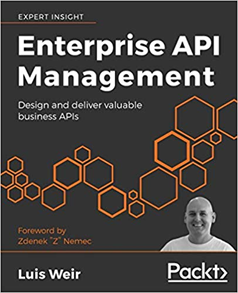
Enterprise API Management: Design and deliver valuable business APIs book by Luis Weir

image

APIs are the cornerstone of modern, agile enterprise systems. They enable access to enterprise services from a wide variety of devices, act as a platform for innovation, and open completely new revenue streams.

Enterprise API Management shows how to define the right architecture, implement the right patterns, and define the right organization model for business-driven APIs.

Drawing on his experience of developing API and microservice strategies for some of the world’s largest companies, Luis Weir explains how APIs deliver value across an enterprise. The book explores the architectural decisions, implementation patterns, and management practices for successful enterprise APIs, as well as providing clear, actionable advice on choosing and executing the right API strategy in your enterprise.

With a relentless focus on creating business value, Luis Weir reveals an effective method for planning, building, and running business products and services with APIs. Get the book here. For additional books see the community wiki here.

PaaS Partner Community

For regular information on Oracle PaaS become a member in the PaaS (Integration & Process) Partner Community please register here.

clip_image003 Blog clip_image005 Twitter clip_image004 LinkedIn image[7][2][2][2] Facebook clip_image002[8][4][2][2][2] Wiki

Technorati Tags: SOA Community,Oracle SOA,Oracle BPM,OPN,Jürgen Kress

How to Update Oracle SOA 11g Timeouts by Sebastian Marucci

image

Imagine your SOA/BPM application is consuming a service (internal or third party) that takes more than 5 minutes to reply, which is more than the default JTA timeout. What would happen in this situation? The result is a faulted instance.

Last month at a Oracle BPM project, we faced a similar situation. After doing some research, we realized that not only do you have to update the EJBs or JTA timeouts, but there are also several other timeouts to tweak. In fact, six different timeouts need to be updated. Five of them related to the Oracle SOA Suite, plus the DB timeout. Here’s an overview of the 6 timeouts that we had to update and how to do so!

Web Service binding timeout

First, you need to identify all composites involved with the long-running service. This will include the composites where the service is called, and the composites calling these composites. Then, in each composite go to the source view and add the following properties to the web service binding (tag <binding.ws/>): Read the complete article here.

PaaS Partner Community

For regular information on Oracle PaaS become a member in the PaaS (Integration & Process) Partner Community please register here.

clip_image003 Blog clip_image005 Twitter clip_image004 LinkedIn image[7][2][2][2] Facebook clip_image002[8][4][2][2][2] Wiki

Technorati Tags: SOA Community,Oracle SOA,Oracle BPM,OPN,Jürgen Kress

Managing API Gateway Costs with Oracle API Platform by Phil Wilkins

image

The Oracle API Platform adopted an intelligent pricing model by basing costs on API call volumes and Logical gateway node groupings per hour. In our book about the API Platform (more here). We suggested that a good logical grouping would be to reflect the development, test, preproduction and production model. This makes it nice and easy to use gateway based routing to different environments without needing to change the API policy configuration as you promote your solution through environments.

We have also leveraged naming and Role/Group Based Access Controls to make to make it easy to operate the API Platform as a shared service, rather than each team having its own complete instance. In doing so the number of logical gateways needed is limited (I.e. not logical gateway divisions on per team models needed). Group management is very easy through the leveraging of Oracle’s Identity Cloud Service – which is free for managing users on the Oracle solutions, and also happens to a respected product in its own right. Read the complete article here.

PaaS Partner Community

For regular information on Oracle PaaS become a member in the PaaS (Integration & Process) Partner Community please register here.

clip_image003 Blog clip_image005 Twitter clip_image004 LinkedIn image[7][2][2][2] Facebook clip_image002[8][4][2][2][2] Wiki

Technorati Tags: SOA Community,Oracle SOA,Oracle BPM,OPN,Jürgen Kress
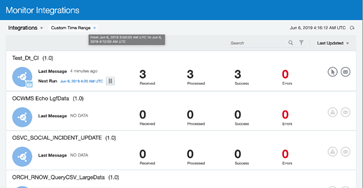
Custom time range filter for monitoring pages in OIC by Arya Sanyal

image

Custom time range filter is a new time based filter being added in the monitoring pages, which allows an user to filter runtime data for a user-defined time period. This filter will be available under feature flag oic.ics.console.monitoring.tracking.filter.custom-date-range.

With this, any user can select a time range as small as a minute and track only those instances which were processed/modified within the specified time range. Similar to other existing time window filters, this filter is preserved by default when user navigates from one monitoring page to another.

Note : The time range selected should be within the retention period, as data beyond Retention period are not retained. Even if selected time range is beyond retention period, only available data will be displayed.

Step-by-step guide

Following steps show how to use the custom time range filter after enabling the feature flag.

1. Select the time window as shown below. "From" and "To" date fields for the new time filter are displayed. Read the complete article here.

PaaS Partner Community

For regular information on Oracle PaaS become a member in the PaaS (Integration & Process) Partner Community please register here.

clip_image003 Blog clip_image005 Twitter clip_image004 LinkedIn image[7][2][2][2] Facebook clip_image002[8][4][2][2][2] Wiki

Technorati Tags: SOA Community,Oracle SOA,Oracle BPM,OPN,Jürgen Kress

Migrating ICS to OIC by Niall Commiskey

image

First question – Why migrate?

How about the following 3 compelling reasons –
1. OIC is your Swiss Army knife, when it comes to integration. It contains not only integration, but also Process and Visual Builder. So now you can also extend your apps and create net new apps on top of your SaaS apis.

2. New Features in OIC – new adapters (e.g. UI Path, Automation Anywhere etc.). New JET based mapper – the list is exhaustive.

3. It will probably be cheaper. So now to a simple example of moving your integrations from ICS to OIC.
Essentially what we do it export the repository of your integration artefacts from ICS to OIC. Btw. the relevant Oracle Migration documentation is here and I strongly suggest you look at it. Read the complete article here.

PaaS Partner Community

For regular information on Oracle PaaS become a member in the PaaS (Integration & Process) Partner Community please register here.

clip_image003 Blog clip_image005 Twitter clip_image004 LinkedIn image[7][2][2][2] Facebook clip_image002[8][4][2][2][2] Wiki

Technorati Tags: SOA Community,Oracle SOA,Oracle BPM,OPN,Jürgen Kress

Invoice Automation in the Cloud into Oracle ERP Cloud, EBS, JDE or PeopleSoft – live demonstration January 21st 2020 & February 19th 2020

Invoice AutomationInvoice Automation in the Cloud into Oracle ERP Cloud, EBS, JDE or PeopleSoft. Arcivate are a dynamic cloud solutions provider offering SaaS Invoice Automation, tightly integrated with Oracle ERP platforms.

Overview

Invoice processing can be labour intensive, costing organisations time and money through less than efficient processes.
Mi Invoices the Arcivate invoice processing solution, automates the paper-intensive AP invoice process by coupling scanning, capture and imaging technology with workflow to reduce errors, increase throughput and boost efficiency. This allows organisations to shift their focus to the management of information from the processing of data.
Mi Invoices is a SaaS solution providing Oracle Invoice Automation and is a true cloud environment that is multi-tenanted to give a rapid deployment for customers and so maximise benefit of the solution instantly.
Mi Invoices forms a critical part of improving your procure to pay, P2P, processes, by automating the capture and processing of supplier invoices.

Key Benefits

Seamless Integration into ERP Cloud, EBS, JDE & PeopleSoft

Full OCR Header, Footer & line item extraction

Exception handling and dynamic workflow

Notifications and email approval

Multi-language, currency, entities supported

User friendly one screen interface

Live DemonstrationLive Demonstration

Live demonstration of the Arcivate Invoice automation solution offering AP a fully featured cloud platform which can be deployed in days:

  • January 21st 2020
  • February 19th 2020
  • March 17th 2020

For details please visit the registration page here

PaaS Partner Community

For regular information on Oracle PaaS become a member in the PaaS (Integration & Process) Partner Community please register here.

clip_image003 Blog clip_image005 Twitter clip_image004 LinkedIn image[7][2][2][2] Facebook clip_image002[8][4][2][2][2] Wiki

Technorati Tags: SOA Community,Oracle SOA,Oracle BPM,OPN,Jürgen Kress