Managing Applications in Oracle API Cloud Service (CS) by Ankur Jain

image

Applications represent the applications API consumers use to send requests to registered APIs in Oracle API CS. Consumers register applications to APIs they use.

Below are steps to create an application using Oracle API CS console

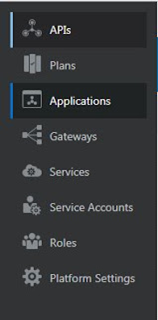
  • Login to API CS console and navigate to Applications tab
  • Click on Create button
  • Enter below information from the Application Dialog and click Create button
    • Application Name: Enter application name
    • Description(Optional): Enter brief description of the application
    • Application Types(Optional): Select zero or more application type from available list
    • Read the complete article here.

PaaS Partner Community

For regular information on Oracle PaaS become a member in the SOA & BPM Partner Community for registration please visit www.oracle.com/goto/emea/soa (OPN account required) If you need support with your account please contact the Oracle Partner Business Center.

clip_image003 Blog clip_image005 Twitter clip_image004 LinkedIn image[7][2][2][2] Facebook clip_image002[8][4][2][2][2] Wiki

Technorati Tags: SOA Community,Oracle SOA,Oracle BPM,OPN,Jürgen Kress
IP Filter Validation policy to restrict access in Oracle API CS by Ankur Jain

image

IP white-listing allows to create lists of trusted IP addresses or IP ranges from which a users can access APIs.

IP white-list is a security feature often used for limiting and controlling access only to trusted users or applications.

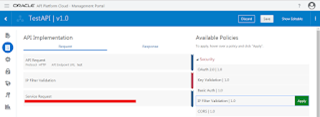
Oracle API CS (Cloud Service) provides IP Filter Validation policy to control which IP Addresses can successfully send requests to the API.

The IP address originated by the client is received from the HTTPRequest. This policy checks if the address matches allowed or disallowed IP addressed configured as part of the policy. Upon finding a match, it takes appropriate action as configured. Nonstandard HTTP headers such as X-ProxyUser-Ip, X-Forwarded-For , or HTTP_X_CLUSTER_CLIENT_IP are not supported.

IP Filter Validation policy can be added in the request flow only. It can not be placed first in the flow. Other security polices must be placed before it.

Let’s see how to configure the IP Filter Validation policy using API CS console. To complete this task there should be API configured in API CS. If not, please go through the blog Creating an API in Oracle API Platform Cloud Service Read the complete article here.


PaaS Partner Community

For regular information on Oracle PaaS become a member in the SOA & BPM Partner Community for registration please visit www.oracle.com/goto/emea/soa (OPN account required) If you need support with your account please contact the Oracle Partner Business Center.

clip_image003 Blog clip_image005 Twitter clip_image004 LinkedIn image[7][2][2][2] Facebook clip_image002[8][4][2][2][2] Wiki

Technorati Tags: SOA Community,Oracle SOA,Oracle BPM,OPN,Jürgen Kress
Innovate, extend and integrate SaaS hands-on trainings for SaaS partners in Espoo, Palma, Riyadh and Reading

imageAre you working on Oracle SaaS implementations and want to integrate and extend them using PaaS?

Attend our 2 days hands-on training to understand how use Oracle PaaS service like Oracle Integration Cloud, Oracle Mobile Cloud Enterprise & Oracle Visual Builder Cloud Service in combination with Oracle SaaS solutions like Oracle ERP Cloud & Oracle Engagement Cloud. This session goes through extending SaaS services with PaaS.

The training is most suitable for developer and consultants who are trying to use SaaS and PaaS together. Though the example use case uses some basic banking services, methodology used in the use case is applicable to any domain having similar requirements.

We offer an all new innovate, extend and integrate SaaS hands-on training for partners. For details please visit the registration pages:

For additional information please see the integrate SaaS partner resource kit here.


PaaS Partner Community

For regular information on Oracle PaaS become a member in the SOA & BPM Partner Community for registration please visit www.oracle.com/goto/emea/soa (OPN account required) If you need support with your account please contact the Oracle Partner Business Center.

clip_image003 Blog clip_image005 Twitter clip_image004 LinkedIn image[7][2][2][2] Facebook clip_image002[8][4][2][2][2] Wiki

Technorati Tags: SOA Community,Oracle SOA,Oracle BPM,OPN,Jürgen Kress

Why microservices and monoliths are not simple by Phil Wilkins

image

Microservices are inherently more complex because they are distributed and shared less, and therefore, require a better foundation.

It’s a bit controversial to say that microservices are not simple given how much is said about using them to simplify and accelerate software delivery. So can this statement even be made? It is, in Chris Richardson’s excellent new book, “Microservice Patterns” (here) and indirectly in Eric Evan’s “Domain-Driven Design” (here). Martin Fowler also agrees that they come at a premium in one of his blogs (here).  So, I’m not the first to say it, and I won’t be the last.

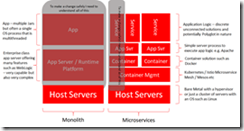
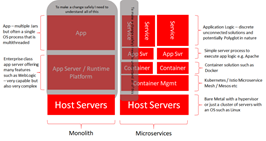
But the assertion that microservices done right are simpler and allow rapid delivery and evolution of solutions is a bit of a contradiction. Since a picture is worth a thousand words, take a look at this:

To make a change with the monolith and understand the impact of the change, you need to have a greater appreciation of how the entire solution works (area highlighted in gray). If changes are implemented without understanding or adhering to the design strategies and patterns, or if changes are rushed to address some urgent need (business deadline, bug, and so on), the design erodes and the effort to understand the change impact for future changes is accelerated. In effect, the monolith becomes difficult and unwieldy.

Microservices are inherently more complex because they are distributed and shared less, and therefore, require a better foundation. So, not only do you need to understand the programming language, and a simple app container, such as Tomcat; you also need Docker and something like Kubernetes or Istio. It is important that the isolation between the different services be more robust; no longer can you just add another import or another method overload on class. It takes more effort and it is easier to govern the points of exposure. As a result, the risk of design degradation is reduced – but not removed.

Moreover, understanding any one part of a solution requires less understanding of the whole. The net result is that there is less temptation to use shortcuts to deliver urgent solutions for just one area. Regardless of whether the solution is a monolith or microservices, sooner or later the solution will reach a point where dedicated skills in those non-functional areas are needed. But in the monolith world, the platform specialist doesn’t have to struggle with the big picture while tuning resources – i.e., some parts of a monolith may be memory-hungry while others need I/O performance. In the microservices world, the Kubernetes specialist only needs to master one set of dependencies at a time in order to optimize deployment and deliver value. Furthermore, there is the possibility that different microservices will have related demands – so they can share infrastructure most suited to those demands and host the microservices with different demands on infrastructure meeting its needs.

Which brings us back to our original statement: since there are moving parts, there is complexity, but it is easier to master any one part because it is smaller. As the solution grows and becomes more effective, it becomes possible to have specialists for each component and layer. While Martin Fowler’s diagram (below) doesn’t show this, I suspect it holds true. Read the complete article here.


PaaS Partner Community

For regular information on Oracle PaaS become a member in the SOA & BPM Partner Community for registration please visit www.oracle.com/goto/emea/soa (OPN account required) If you need support with your account please contact the Oracle Partner Business Center.

clip_image003 Blog clip_image005 Twitter clip_image004 LinkedIn image[7][2][2][2] Facebook clip_image002[8][4][2][2][2] Wiki

Technorati Tags: SOA Community,Oracle SOA,Oracle BPM,OPN,Jürgen Kress
Integrate HCM Cloud with Oracle Integration Cloud – PaaS Partner Community Webcast February 27th 2019

Attend our February edition of the PaaS Partner Community imageWebcast live on February 27th 2019.

Integrate HCM Cloud (global hr, talent management, workforce rewards, workforce management, work life)

Oracle Integration eliminates barriers between business applications through a combination of machine learning, embedded best-practice guidance, prebuilt integration, and process automation. Oracle Integration is unique in the market by leveraging Oracle application expertise to build an extensive library of adapters to Oracle and 3rd party SaaS and on-premises applications to enable you to deliver new business services faster. For more information please visit www.tinyurl.com/integrateSaaS

Presenter: Niall Commiskeyimage

Director Product Management

Visit the registration page here.

Call ID: 5566478 and Passcode: 264331

UK: +44 (0) 208 118 1001 & United States: 140 877 440 73

More Local Numbers

Schedule:

Wednesday February 27th 2019 16:00-17:00 CET

Watch live here

Missed our PaaS Partner Community Webcast? – watch the on-demand versions:

· Functions and Cloud Native

· Cloud trials & community update

· Oracle Integration Cloud Update

· Oracle OpenWorld 2018 Preview

· Innovate, Extend and Integrate SaaS Overview and Pricing

· Robotic Process Automation

· Autonomous Mobile Cloud

· PaaS Overview Webcast

· Blockchain

· API Platform Cloud Service part 2

· 3rd Generation API Gateways part1

· Oracle JET

· Oracle Visual Builder Cloud Service

· Container Native Application Development Platform

For the latest information please visit Community Updates Wiki page (Community membership required).


PaaS Partner Community

For regular information on Oracle PaaS become a member in the SOA & BPM Partner Community for registration please visit www.oracle.com/goto/emea/soa (OPN account required) If you need support with your account please contact the Oracle Partner Business Center.

clip_image003 Blog clip_image005 Twitter clip_image004 LinkedIn image[7][2][2][2] Facebook clip_image002[8][4][2][2][2] Wiki

Technorati Tags: SOA Community,Oracle SOA,Oracle BPM,OPN,Jürgen Kress
SOA Suite 12c in Docker containers. Only a couple of commands, no installers, no third party scripts by Maarten Smeet

image

For developers, installing a full blown local SOA Suite environment has never been a favorite (except for a select few). It is time consuming and requires you to download and run various installers after each other. If you want to start clean (and you haven’t taken precautions), it could be you have to start all over again.

There is a new and easy way to get a SOA Suite environment up and running without downloading any installers in only a couple of commands without depending on scripts provided by any party other than Oracle. The resulting environment is an Oracle Enterprise Edition database, an Admin Server and a Managed Server. All of them running in separate Docker containers with ports exposed to the host. The 3 containers can run together within an 8Gb RAM VM.

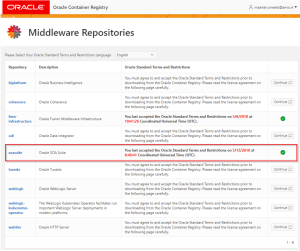
The documentation Oracle provides in its Container Registry for the SOA Suite images, should be used as base, but since you will encounter some errors if you follow it, you can use this blog post to help you solve them quickly.

A short history

QuickStart and different installers

During the 11g times, a developer, if he wanted to run a local environment, he needed to install a database (usually XE), WebLogic Server, SOA Infrastructure, run the Repository Creation Utility (RCU) and one or more of SOA, BPM, OSB. In 12c, the SOA Suite QuickStart was introduced. The QuickStart uses an Apache Derby database instead of the Oracle database and lacks features like ESS, split Admin Server / Managed Server, NodeManager and several other features, making this environment not really comparable to customer environments. If you wanted to install a standalone version, you still needed to go through all the manual steps or automate them yourself (with response files for the installers and WLST files for domain creation). As an alternative, during these times, Oracle has been so kind as to provide VirtualBox images (like this one or this one) with everything pre-installed. For more complex set-ups Edwin Biemond / Lucas Jellema have provided Vagrant files and blog posts to quickly create a 12c environment. Read the complete article here.


PaaS Partner Community

For regular information on Oracle PaaS become a member in the SOA & BPM Partner Community for registration please visit www.oracle.com/goto/emea/soa (OPN account required) If you need support with your account please contact the Oracle Partner Business Center.

clip_image003 Blog clip_image005 Twitter clip_image004 LinkedIn image[7][2][2][2] Facebook clip_image002[8][4][2][2][2] Wiki

Technorati Tags: SOA Community,Oracle SOA,Oracle BPM,OPN,Jürgen Kress

Extending analytics for Integration cloud using Elastic stack by Mani Krishnan Introduction

imageOracle Integration Cloud (OIC) offers industry-leading SaaS integration capabilities.  It provides extensive monitoring, tracking and reporting features out-of-the-box. Occasionally, enterprises do have reporting and analysis needs those are better met by additional reporting and analytics products. This article discusses couple of such use cases and describes how to implement one of them using Elastic stack. Information in this article is applicable to release 18.1.3 of integration cloud.

Main article

Let’s consider these scenarios:

  • Customer’s integrations are deployed to multiple instances of OIC. Customer wants a consolidated view of all integrations on single dashboard.
  • Customer needs to customize several aspects of reporting such as type of charts and data retention.
  • Customer wants end-to-end view of transactions across multiple applications, including those deployed to OIC.

Use cases represented by these scenarios can be met by externalizing integration metrics from OIC into another platform specializing on analytics.  Let’s look at some recommended ways to extract metrics from OIC and importing them into ELK (Elastic-LogStash-Kibana). Elastic stack is a widely-used opensource platform for analytics and dashboards. Jump to one of the sections by click the link.

Why Elastic stack?

Elastic is among products that allow infinite scaling and support map-reduce for efficient distributed queries. Note that other products such as Oracle big-data analytics cloud service or Oracle log analytics can also meet aforementioned requirements.  Elastic is used in this blog for its simplicity for demonstration purposes.

For sake of simplicity, the post does not address deployment of ELK stack. Refer to Elastic web site for instructions. A simple installation could run on a laptop. More complex, distributed deployments will require careful planning of compute, storage resources and indexes.

Patterns

Now that the basics on collecting relevant metrics are covered here are patterns that will help meet the requirements.

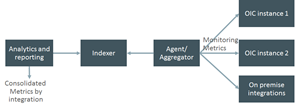
Consolidated Reporting is achieved by collecting monitoring metrics from multiple OIC instances and feeding them into one analytics application instance.

With ELK stack, LogStash is the agent/aggregator, Elastic is the indexer and Kibana is the analytics and reporting client. This pattern could help building reports for billing and historic analytics or correlate traffic patterns from multiple integration platforms.

End-to-end transaction monitoring can be achieved by collecting start, end times, tracking id and completion status for parts of an end-to-end transaction  from each participating application, feeding them into an analytics application and running map-reduce queries that correlate parts of a transaction using tracking id. Read the complete article here.


PaaS Partner Community

For regular information on Oracle PaaS become a member in the SOA & BPM Partner Community for registration please visit www.oracle.com/goto/emea/soa (OPN account required) If you need support with your account please contact the Oracle Partner Business Center.

clip_image003 Blog clip_image005 Twitter clip_image004 LinkedIn image[7][2][2][2] Facebook clip_image002[8][4][2][2][2] Wiki

Technorati Tags: SOA Community,Oracle SOA,Oracle BPM,OPN,Jürgen Kress
Integrating and Extending SaaS Applications by John Klinke

image

Knex Technology, a consulting firm based in Irvine, California, helps companies architect, integrate, implement and tune cloud applications to drive business success.

For example, Knex is currently helping a large pharmaceutical company tie together multiple business systems including their financial, procurement and project management applications to improve operational agility.  Using a combination of Oracle Java Cloud, Oracle Database Cloud and Oracle SOA Suite, Knex is integrating financial data across multiple systems including ingesting bank account information into their financial application for streamlining cash management.

Listen to Basheer Khan, CEO of Knex Technology, talk about how they save customers time and money by using Oracle PaaS solutions to integrate, extend and enhance SaaS. Read the complete article here.

PaaS Partner Community

For regular information on Oracle PaaS become a member in the SOA & BPM Partner Community for registration please visit www.oracle.com/goto/emea/soa (OPN account required) If you need support with your account please contact the Oracle Partner Business Center.

clip_image003 Blog clip_image005 Twitter clip_image004 LinkedIn image[7][2][2][2] Facebook clip_image002[8][4][2][2][2] Wiki

Technorati Tags: SOA Community,Oracle SOA,Oracle BPM,OPN,Jürgen Kress
Oracle Integration Cloud: The Data Mapper Activity by Jan Kettenis

image

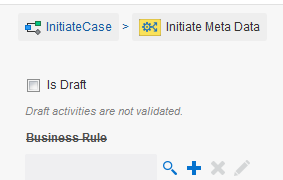
In a previous blog I discussed a work-around for not having a Script activity in Oracle Integration Cloud’s Process Builder. In this blog I will discuss another work-around which is actually not a work-around, but the real thing: the Data Mapper!
As you can read in a previous blog about the matter, not having the equivalent of the Script activity of the on-premise BPM Suite, was an omission that we often had to find a work-around for. The one I used was the Business Rule activity. However, some weeks ago the Business Rule activity got deprecated (you could clearly see that).

With the latest release of OIC (which may not yet be public available when you read this) the Business Rule activity has vanished. At the same time the Data Mapper activity has been added. Read the complete article here.

PaaS Partner Community

For regular information on Oracle PaaS become a member in the SOA & BPM Partner Community for registration please visit www.oracle.com/goto/emea/soa (OPN account required) If you need support with your account please contact the Oracle Partner Business Center.

clip_image003 Blog clip_image005 Twitter clip_image004 LinkedIn image[7][2][2][2] Facebook clip_image002[8][4][2][2][2] Wiki

Technorati Tags: SOA Community,Oracle SOA,Oracle BPM,OPN,Jürgen Kress
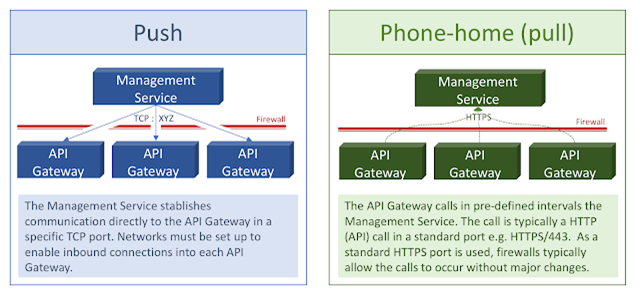
A comparison of push vs phone-home communication approaches between API Gateways and Management Services by Luis Weir

image

API Gateways deliver critical runtime capabilities in enterprise-wide API management infrastructures. However, such runtime capabilities must also be complemented with other design-time and governance capabilities in support of activities such as APIs lifecycle management, API design, policy definition and implementation, deployment, retirement, monitoring, and so on.
The aforementioned design-time/governance capabilities, are often offered by different API management vendors as a separate Management Service infrastructure that augments/complements the runtime infrastructure (API Gateways). Needless to say in order for runtime and design-time/governance infrastructure to work together cohesively as a collective whole, there must be some sort of effective and reliable communication between these two main components.
Whereas some products like for example the Oracle API Platform Cloud Service, deliver a phone-home approach for API Gateways to communicate with the management infrastructure, other vendors implement a push approach whereby the Management Service is responsible for establishing and handling the connection to the API Gateways.
Both approaches are fundamentally different and understanding how such differences can impact/influence a solution becomes even more critical as the need for API Gateways increase e.g. as a result of  adopting cloud or Microservices Architectures.
Furthermore, as cloud adoption continues to rocket, vendors also offer Management Service capabilities as a PaaS cloud service. This is important and not trivial as it means that communication between the PaaS-based management infrastructure and the API Gateways must be in placed prior implementing the solution.
This article compares these two main communication strategies and highlights key differences including pros and cons (from the point of view of the author).Read the complete article here.


PaaS Partner Community

For regular information on Oracle PaaS become a member in the SOA & BPM Partner Community for registration please visit www.oracle.com/goto/emea/soa (OPN account required) If you need support with your account please contact the Oracle Partner Business Center.

clip_image003 Blog clip_image005 Twitter clip_image004 LinkedIn image[7][2][2][2] Facebook clip_image002[8][4][2][2][2] Wiki

Technorati Tags: SOA Community,Oracle SOA,Oracle BPM,OPN,Jürgen Kress