Welcome to the PaaS Partner Community Forum 2018

PaaSForum2018When you read this you arrived safely in Budapest and we would like to thank you and your management for investing the time to attend the PaaS Partner Community Forum 2018. On March 15th Hungary celebrates their Memorial Day. Like the Hungarian revolution from 1848, our economy is changed by digitalization. Disrupting technologies like cloud computing, blockchain and machine learning are changing our business and society. To reflect this changes we offer an innovation track.

There will be more than 200 delegates from more than 45 countries, which will give you the opportunity to learn from other cloud minded partners and network with partners from Europe and different regions as we also have representation from Africa, Asia, North America, South America and the Middle-East. Many Oracle employees will attend and we would like to invite you to challenge them how we can support you to grow your business and maintain profitability on your investment with Oracle.

Scale innovation blockchain and machine learning

Cloud Computing is leading on all service levels. SaaS solutions became a standard model for enterprise customers. Infrastructure as a Service is used to deploy all kind of workload flexible in the cloud. This year’s conference introduces innovations to the Oracle Platform as a Services (PaaS) platform. Blockchain cloud service is launched and machine learning is used within the platform which becomes autonomous. Self-driving, self-securing and self-repairing capabilities demonstrates advances in autonomous Oracle Cloud.

During this event you will see presentations from Product Management, Pre-Sales Consultants and Partners, that will share their real life experiences with you how to implement Oracle PaaS solutions and to see the business drivers behind these projects.

The Partner Community Forum is one of the best opportunities to get details and hands-on trainings about Oracle Integration Cloud Service (OIC), API Platform Cloud Service (API CS), Process Cloud Service (PCS), Mobile & Chatbot Cloud Service (MCS), Internet of Things Cloud Service (IoT CS), Java Cloud Service (JCS) & Application Container Cloud Service (ACCs), Visual Builder Cloud Service (ABCs) and Content Cloud Service.

Oracle PaaS Services create many new opportunities for partners to build, customize and integrate applications in a public cloud environment. Our joint customers will benefit from this new cloud offering by faster time to market, higher availability and flexibility, lower project cost an risks. With the introduction of universal cloud credits (UCCs) partners can deploy customer projects agile. With hybrid cloud computing Oracle offers a unique value proposition for customer and partners. You can choose where to host your cloud solutions in the data center of your choice. Cloud marketplace gives you as a partner new opportunities to build, deploy and promote and market offerings on the Oracle PaaS Cloud. The Oracle Cloud Excellence Implementer (CIE) and Oracle Cloud Managed Service Provider (MSP) Program reflect the focus on cloud computing.

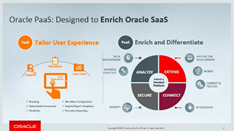
The Enrich SaaS with PaaS initiative is designed for Oracle SaaS applications partners. The underlying PaaS platform enables customers to enrich and differentiate SaaS solutions. Connect SaaS solutions with other SaaS solutions and on-premises, analyze data, secure and extend applications. As part of the conference multiple session and a two days hands-on training are offered specifically for SaaS partners to Enrich SaaS solutions with PaaS.

Each conference attendee was granted access to free PaaS demo service before and during the conferences. As an Oracle partner you can request free PaaS demo services via demo.oracle.com or our partner communities any time – make use of it!

Last year in Split we introduced the community day to present success stories and best practice. Based on the excellent feedback Lucas Jellema and myself selected 7 presentation for the first conference day.

We are excited to welcome again Ed Zou at the conference who will highlight in his keynote how to Drive Digital Transformation on Oracle Cloud Platform including live demos of machine learning and blockchain. Digital is changing the economy, our joint customers face this challenge, PaaS is the platform you can build new digital solutions either in the Cloud. Thanks to our product management team you will get updates and roadmap details including demos for our PaaS solutions.

We would like to congratulate the annual winners of the PaaS Partner Community Awards. You will have the opportunity to learn direct from them why they have won the awards. On Tuesday evening during our social event you will have plenty of chance for deep discussion within the community and speakers.

On the third day you can choose between different four breakout tracks: Enterprise Process & Integration or Mobile & Chatbot & Content or Application Development or the Innovation track. We will keep our tradition to wrap up the conference with the legendary ACE demo – special thanks to Lucas Jellema and team!

Thursday and Friday four different hands-on trainings take place. A two days Integrate and Extend SaaS workshop. Or 12 different half day labs, you can build your own agenda by choosing each session

During the conference we host run multiple information points. Please take the opportunity to talk to the product management teams and business development teams. Three partners will exhibit their solutions. APIMatic API tools for API developers , Felxagon a devops tool and UiPath for robotics process automation (RPA). The Oracle User Experience team invites you participate in usability tests.

We also want to give a special thank you to our Specialized partners that have been able to differentiate themselves in their local markets by showing their experience and commitment in Oracle PaaS & Fusion Middleware solutions. To continue your road to success please ensure that you align with our local cloud sales teams and use our marketing services including the marketing campaigns kits.

From previous conferences we received the feedback that networking is key, it is always a challenge to keep the balance between more exiting live demos and networking breaks. Take the opportunity to connect via twitter and Facebook. Also most of the conference speakers arrive on Monday and are available for 1:1 meetings!

We would like to encourage you to network within the community using our web2.0 features. For twitter please use the event hashtag #PaaSForum:

http://www.twitter.com/soacommunity @soacommunity

http://www.twitter.com/wlscommunity @wlscommunity

Like our Facebook pages and post comments and pictures at: http://www.facebook.com/WebLogicCommunity & http://www.facebook.com/soacommunity

Three years ago we hosted a PaaS Partner Community Forum at the Boscolo hotel in Budapest. We are excited to be back in this wonderful hotel & conference venue and city. Take the opportunity to visit the historic center, the buda castle part of the world heritage and visit a thermal bath. Plan to celebrate again your community success in one of the ruin bars!

The conference, Oracle OpenWorld and the Summer Camps are part of the annual community highlights. It’s exciting to see the community to get together full of energy and to develop new ideas. We opened the conference registration 100 days in advance, with more than 350 registrations and more than 200 attendees the conference is sold out! Special thanks to my management for the trust and freedom to host this conference and assigning additional budget to allow us to host additional attendees – thank you!

Thank you for attending the conference and your Oracle PaaS & Middleware Partner business.

Jürgen Kress

Additional new content SOA & BPM Partner Community

image

Avoiding Service Call Failures in Oracle Service Bus and SOA Suite This article by Oracle ACE Rolando Carrasco and Lorenzo Gonzalez targets Oracle Service Bus (OSB) developers and architects who want to learn new strategies for avoiding service call failures within their integration pipelines. Read it.

Sample Chapter: Integrations Between SaaS Applications This sample chapter from Implementing Oracle Integration Cloud Service (2017, Packt Publishing), by Oracle ACE Robert Van Molken and Oracle ACE Associate Phil Wilkins, explores how to integrate SaaS solutions, and shows how you can test your integration without affecting a live system. Read it.

Podcast: Cloud Integration: 9 Into 1 = Innovation Arun Pareek and Matt Wright of Rubicon Red came away among the winners in the Oracle Integrated Cloud Hackathon held in Australia late last year. In this podcast they describe their entry, a project that integrated nine Oracle Cloud PaaS services to produce an innovative mobile healthcare solution. Listen.

Video: Who Needs Microservices Anyway? Who needs microservices? You do. Or at least you will at some point, when the circumstances are right. So best be well prepared for when the time comes, right? Software architect and indie consultant Reza Rahman offers some sound advice on separating the microservice hype from reality in this new 2 Minute Tech Tip. Watch.

Developer Cloud Service May Update The May update for Oracle Developer Cloud Service adds over 30 new features, including a new top-level feature to track Releases, tools to provision Oracle Cloud services in Builds, new webhooks for external build systems, enhancements to Agile tools, and language aware Code Search. Learn more.

Now Available: SOA Cloud Service 16.3.3 The 16.3.3 release of SOA Cloud Service (SOA CS) contains the new Integration Analytics service type, which includes Real-Time Integration Business Insight and a preview of BAM. Learn more.

Coming Soon: Oracle API Platform Cloud Service Oracle API Platform Cloud Service provides a foundation for Digital Transformation through the first API Management offering that comprises the full API Lifecycle. Learn more.

Oracle Code Oracle Code is an event for developers building modern Web, mobile, enterprise, and cloud-native applications. The focus is on the latest software developer technologies, practices, and trends, including: Containers, Microservices/APIs, and DevOps; Databases; Open Source Technologies; Development Tools and Low Code Platforms; Machine Learning, Chatbots and AI. Click the link below for the complete schedule. Learn more.

PLAYING AT WORK

image

Sometimes work can also be play – and guess what, that’s good for the worker and for the work. Read this new article about how work and play intersect in the research conducted by the Oracle Applications User Experience (OAUX) group’s emerging technologies team, the AppsLab. For more from the AppsLab and what they’re researching, visit their blog. Two recent series of posts were on the developer experience and fun with Facebook.

CONFERENCE SEASON
The OAUX team’s on-site lab had a busy April, traveling the country and welcoming more than 100 Oracle customers and partners at various conferences to a series of one-on-one usability feedback sessions, focus groups on FinTech, collaborative design jams on mobile cloud analytics, and more. Read more about where we’ve been on the OAUX blog in our latest post. We’ve also built photo albums from our recent trips in the last month. Visit the OAUX team’s Facebook page to see us in action and follow us on Twitter.

Oracle BAM 12c Security by Dan Atwood

image

Oracle Business Activity Monitoring (BAM) 12c comes with Oracle SOA Suite and BPM, and it is a very powerful tool that should be used on most projects.  Organizations are using it successfully today to graphically visualize trends in their data to make operational decisions and to send alerts before issues occur.

One of the difficulties organizations initially have after installing Oracle BAM 12c is determining how to define the security levels and permissions for its different types of users.  Oracle BAM has both coarse grained security defined at the application role level down to very fine grained security defined at individual BAM artifact and data object row levels.
BAM Coarse Grained Security – BAM Application Roles
For many organizations today, different parts of the organization will each access and share the same BAM domain. For some, the coarse grained predefined BAM security groups and roles assignments will suffice. When left to the default coarse grained security, these three types of BAM users will exist:

  1. BAM Administrators in an organization are able to access and edit any data object, EMS, or projects that other teams have created
  2. BAM Designers in an organization can access and edit any BAM project and their queries, views, dashboards and alerts that other teams have created
  3. BAM End Users in an organization can view any dashboard as long as they know the URL for the dashboard. Read the complete article here.

BAM Alerts by Marcel van de Glind

image

This post (next in the BAM series) is about BAM Alerts. Alerts were not part of the POC, but in the blog series I also wanted to pay attention to it, resulting in this post. I have made a very small example to get some feeling in there and will not get into all the details of alerts.

As usual, first a piece of theory from the Oracle documentation:

An alert performs one or more actions when launched by an event and filtered by one or more conditions. An event can be an amount of time, a specific time, a date and time, a repeating event between two dates, a change in a data object, output from a continuous query, or a manual event. A condition restricts the alert to an event occurring between two times or dates or to a specific day of the week. An action can send a notification, perform a data object operation, invoke a web service, call an external method, or launch other alerts. Read the complete article here

Part 1 – Oracle BPM 12c Process Invoke Database by Dan Atwood

image

Part 1 – Create a WebLogic JNDI Database Connection

This explains how the WebLogic JNDI connection to a database schema is created.  In the next two posts, you will see how the Database Adapter can use this connection once it has been created.  This simply describes the steps that are necessary to configure the JNDI connection initially. 

Components exposed in a SOA application can be exposed as a service, and a call to the database is no exception.  In order to invoke the database from a BPM process, it first has to be exposed as a service.

First, a datasource needs to be created.  You need the database schema’s datasource configured to create the JNDI connection information needed to access it. If all you want to do is to access the data from ADF, this is all you would need. 

Where the database adapter comes into play, however, is when your project’s composite needs to access it as a service (e.g., when a composite’s Mediator needs to connect to the database adapter). In the fourth part of this series, the Database Adapter SOA component will be dragged into the External References column of your composite diagram. For this to succeed at runtime, the datasource’s JNDI connection to the datasource has to first be added to the database adapter’s DBAdapter deployment.  This will be done in part 3 of this series.

This example uses the HR schema that comes that is preinstalled with the Oracle XE 11g or 12c SE database, but these same steps could be used to expose other database schemas. 

1. Open the WebLogic Console (e.g., http://localhost:7001/console), and log in.

2. In this step, the source of the data is configured as a datasource to the SOA infrastructure.  This datasource provides the connection to the actual underlying data provider.  Configure the JDBC Datasource in the WebLogic by selecting Services -> Data Sources. Read the complete article here.

PaaS Partner YouTube Update March 2018


The March edition of the PaaS & Middleware Partner Update contains four topics:

• Free on-demand trainings

• Oracle Developer Meetups

• Oracle OpenWorld Call for Papers

• PaaS Community Webcast Oracle JET

For regular updates please subscribe to our YouTube channel here. Thanks for your likes and sharing the video on YouTube and LinkedIn. For the latest SOA & BPM Partner Community information please visit our Community update wiki here (Community membership required).

PaaS Partner Community

For regular information on Oracle SOA Suite become a member in the SOA & BPM Partner Community for registration please visit www.oracle.com/goto/emea/soa (OPN account required) If you need support with your account please contact the Oracle Partner Business Center.

Blog Twitter LinkedIn image[7][2][2][2] Facebook clip_image002[8][4][2][2][2] Wiki

Technorati Tags: YouTube,SOA Community,Oracle SOA,Oracle BPM,Jürgen Kress,Middleware Update,Partner Update

Dealing with Dates and Times in Oracle Process Cloud Service by Sebastien Wiertz

image

Introduction

Oracle Process Cloud Service (PCS) is great! You can build process-based applications in two shakes of a lamb’s tail, much quicker than most Low Code platforms in the market. Of course, you can’t, or at least shouldn’t, develop any “normal” master-detail CRUD application with Oracle Process Cloud Service. If you need this kind of applications perhaps Oracle Application Builder Cloud Service will suit you better, but for process-centric applications, it’s a hard to beat tool.

As you may know, Oracle also has an on-premise product, called Oracle BPM, which features a similar codebase, but it features a more advanced and complex UI and it takes a bit more time to produce a similar application.

Oracle PCS really shines for its simplicity and ease of use, because the UI was streamlined and is much more focused. However, all this optimization and streamlining led to decisions to simplify the UI and some features present in Oracle BPM are not present in Oracle PCS. Most of them we won’t really need except for 1% of all our application needs, but a few are a more common necessity. The capacity to use functions to manage and operate dates and times fit this last set.

Oracle BPM allows you to manipulate dates using several options, with Data Associations and Script tasks perhaps being the most common. In Oracle PCS, the Data Associations don’t allow you manipulate dates nor retrieve the current Date / Time, and script tasks plain and simply are not available.

It’s possible to create services that do whatever we need to do with dates and then call them in Oracle PCS, but sometimes we want a more direct approach.

The Use Case

Let’s consider the following case:

We have a simple approval process with 3 steps. Every time there’s a response to a task, we want to record which response was and at which date and time it was made. We also want to show this information to the user, in the task web form, and we want that the whole process takes a calculated amount of time as the most, with it automatically finishing up after that amount.

Something a bit like this: Read the complete article here.

Web Forms in Oracle Process Cloud Service by Antonis Antoniou

image

The September 2016 release introduced an entirely new web forms functionality called “Web Forms”, an alternative to its existing Frevvo web forms with the latter being renamed to “Basic Forms”. The new “Web Forms” functionality is more business user-friendly, promoting important development principles like multiple views, re-use, branding, list of values and fetching data using REST connections.

The new “Web Forms” group its functionality into three areas; the left area which includes the “Properties” section and the “Data” section, the right area that includes the palettes (basic, advanced, forms and business types) and the main area which is the drawing canvas.

Using drag and drop gestures you can design your form using any components from all four palettes. The “Basic Palette” includes basic components like the input text, button, checklist, radio button, date, etc. while the “Advanced Palette” includes components like image, video, section, tab, table, etc.

You can also use the “Forms Palette” to re-use previously created forms or you can use the “Business Type Palette” to create a user interface using a “data-first” approach (Oracle Process Cloud Service will automatically create a form using the data definitions of the business type). Read the complete article here.

Implementing Case Management Patterns using Oracle Process Cloud Service (PCS) by Jose Rodrigues

image

Hi everyone and welcome to the second part of our article on implementing Case Management (CM) patterns with Oracle Process Cloud Service (PCS).

On the first part, we learned a bit about the concepts around Case Management and we (barely) started a process on PCS. We’ll use this process now as a container to implement the ad-hoc nature patterns.

The First Rule of Fight Club

“We do NOT try to implement Case Management on PCS!” – That’s the first rule. What we will do is implement a small subset of behaviors, which will offer some of the advantages of Case Management.

The second rule is that we have two buddies that can help us in this quest: Database Cloud Service (DBCS) and Integration Cloud Service (ICS). Some of the behaviors will need a bit of persistence, which implies placing a lot of case metadata in some control tables, hence the DBCS, with the ICS being used to handle all integrations. ICS may not be necessary but makes integration easy as peach. Use them extensively!

As we’re trying to “hammer a screw”, things will not be pretty. This is a workaround. Please take it as a way to implement these behaviors.

Regarding the first rule, the set of behaviors which we’re going to implement is the following:

  • Ad-hoc Task and Process Invocation
  • Milestone and Stage Trigger/Set
  • Event Listeners

Let’s Start

So, last time we created a message based process

Again, the process must be created with messages events, as these will allow it to be called by other cases in an asynchronous way.

The first thing we do is get a case ID. This ID should come from another system (for instance, a database) and will be used to guarantee correlation between all elements of the case. We’ll get into to that further ahead.

Then, what we typically do is set up a business rule (decision table) or a database table, in which we predefine some configurations, such as Overall Process SLA, Milestone SLA’s, etc… This will allow you to change the way a process/case behaves, without actually having to change the process model. Read the complete article here.