Five Best Practices for Platform as a Service Success

image

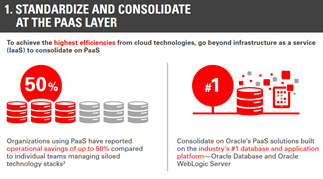
Research firm IDC estimates that the market for platform as a service (PaaS) solutions will have a compound annual growth rate (CAGR) of 30 percent and reach $14 billion by 2017. PaaS provides application runtime, database, integration, messaging, and other services in the cloud, accelerating application development and reducing infrastructure acquisition and maintenance costs. Here are five best practices for maximizing the business value of your PaaS solutions. Get the report here.

SOA & BPM Partner Community

For regular information on Oracle SOA Suite become a member in the SOA & BPM Partner Community for registration please visit www.oracle.com/goto/emea/soa (OPN account required) If you need support with your account please contact the Oracle Partner Business Center.

Blog Twitter LinkedIn image[7][2][2][2] Facebook clip_image002[8][4][2][2][2] Wiki

Technorati Tags: SOA Community,Oracle SOA,Oracle BPM,OPN,Jürgen Kress

Fee on-demand SOA Suite 12 and BPM Suite 12c Bootcamps

image

In March and April we offer free on-demand Bootcamps for SOA Suite 12c and BPM Suite 12c. For details and registration please visit the training calendar:

Date Training Location By Focus
06-31.03.2017 SOA Suite 12c Bootcamp on-demand OPN Tech
06-31.03.2017 BPM Suite 12c Bootcamp on-demand OPN Tech
03-28.04.2017 SOA Suite 12c Bootcamp on-demand OPN Tech
03-28.04.2016 BPM Suite 12c Bootcamp on-demand OPN Tech

SOA Suite 12c Bootcamp on-demand

What will we cover

Oracle SOA Suite 12c is the latest version of the industry’s most complete and unified application integration and SOA solution. With simplified cloud, mobile, on premises and Internet of Things (IoT) integration capabilities, all within a single platform, Oracle SOA Suite 12c delivers faster time to integration, increased productivity and lower TCO.

The Oracle SOA Suite 12c Implementation Boot Camp provides relevant insight to current and prospective SOA implementers and for those companies interested on becoming Oracle SOA Suite 12c Specialized. Participants will learn how to develop and implement solutions using SOA Suite 12c that will drive their customer organizations run more effectively and efficiently.

Learn to

  • Create, deploy, and manage cross-application process orchestration with BPEL Process Manager
  • Describe tasks for users or groups to perform with Human Task Service
  • Define and modify business logic without programming by using Business Rules
  • Create dashboards, alerts, and reports in real time with no coding using Business Activity Monitoring (BAM)
  • Implement SOA Services with Web Services Manager
  • Manage and monitor integration flow with Enterprise Manager
  • Use Adapters to connect to enterprise applications

· Convert complex point-to-point application integration into simplified, agile, and reusable shared service application infrastructure with Service Bus

For details and registration please visit the training calendar.

Can access the training calendar? Become a community member www.oracle.,com/goto/emea/soa

BPM Suite 12c Bootcamp on-demand

imageWhat will we cover

This boot camp is an ideal starting point for an implementer who is planning to learn Oracle BPM Suite 12c and use it on BPM projects. The course provides a combination of lecture segments that present conceptual and feature background and hands-on labs that provide practice with the tooling.

It introduces process developers to Oracle BPM Suite 12c. It covers the key concepts, features and processes needed to begin using the design-time and run-time capabilities on BPM projects. Throughout the training, you will benefit from hands-on exercises based upon two case studies. At the conclusion of the course, you should feel comfortable to start using BPM Suite 12c for process modeling, simulation, analytics, business rules and human workflow.

Learn to

  • Use BPMN modeling notation to document business process
  • Simulate a process model to identify bottlenecks
  • Create business rules that condition flow through a model
  • Develop a sophisticated human workflow task routing
  • Define key performance metrics
  • Build a dashboard containing charts that show key performance metrics

For details and registration please visit the training calendar.

Can access the training calendar? Become a community member www.oracle.,com/goto/emea/soa


SOA & BPM Partner Community

For regular information on Oracle SOA Suite become a member in the SOA & BPM Partner Community for registration please visit www.oracle.com/goto/emea/soa (OPN account required) If you need support with your account please contact the Oracle Partner Business Center.

Blog Twitter LinkedIn image[7][2][2][2] Facebook clip_image002[8][4][2][2][2] Wiki

Technorati Tags: SOA Community,Oracle SOA,Oracle BPM,OPN,Jürgen Kress

Welcome to the PaaS Partner Community Forum XXIV

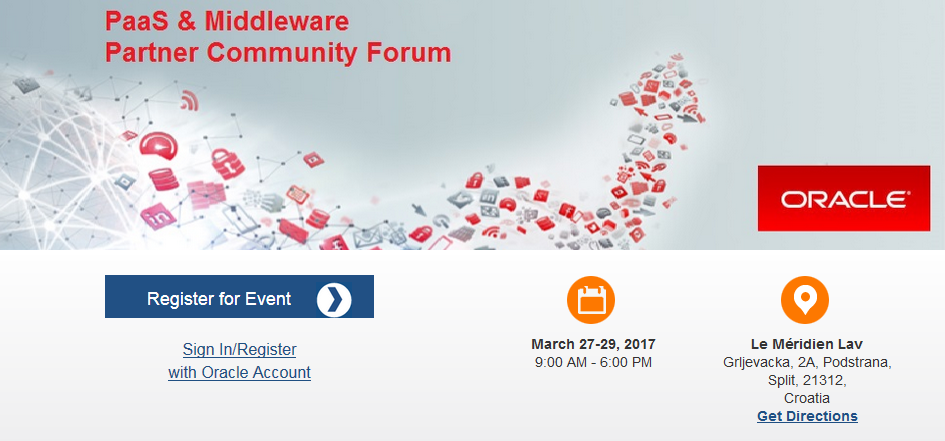
When you read this you arrived safely in Split and we would like to thank you and your management for investing the time to attend the PaaS Partner Community Forum XXIV. There will be more than 200 delegates from more than 40 countries, which will give you the opportunity to learn from other cloud minded partners and network with partners from different regions as we also have representation from Africa, Asia, North America, South America and the Middle-East. Many Oracle employees will attend and we would like to invite you to challenge them how we can support you to grow your business and maintain profitability on your investment with Oracle.

This year’s conference marks a turning point in our journey. Cloud Computing is leading on all service levels. SaaS solutions became a standard model for enterprise customers. Infrastructure as a Service is used to deploy all kind of workload flexible in the cloud. Platform as a Service (PaaS) is crossing the chasm. At our community workspaces you can get a slide deck with more than 70 PaaS live production references. PaaS often is used to integrate SaaS solutions with other SaaS solutions or on-premises. Cloud platforms like Application Cloud Container (ACC) enable developers to build cloud native applications utilizing a microservices model. Often this applications are optimized for mobile devices. Application Programming Interfaces (APIs) play a key role in the digital transformation. New cloud services like machine learning and chatbots are arising.

During this event you will see presentations from Product Management, Pre-Sales Consultants and Partners, that will share their real life experiences with you how to implement Oracle PaaS & Middleware solutions and to see the business drivers behind these projects.

Focus of the 24th Fusion Middleware Partner Community Forum will be Platform as a Service (PaaS) Cloud Computing. During the last months many of the new PaaS service became mature. The Partner Community Forum is one of the best opportunities to get details and hands-on trainings about Integration Cloud Service (ICS), SOA Cloud Service (SOA CS), API Platform Cloud Service (API CS), Process Cloud Service (PCS), Mobile Cloud Service (MCS), Internet of Things Cloud Service (IoT CS), Java Cloud & Developer Cloud Service, Application Builder Cloud Service (ABCs) and Application Container Cloud Service (ACCs) and Content and Experience Cloud Service. Oracle PaaS Services give partners many new opportunities to build, customize and integrate applications in a public cloud environment. Our joint customers will benefit from this new cloud offering by fast time to market, higher availability and flexibility, lower project cost an risks. With hybrid cloud computing Oracle offers a unique value proposition for customer and partners. You can choose where to host your cloud solutions in the data center of your choice. Cloud marketplace gives you as a partner new opportunities to build, deploy and promote and market offerings on the Oracle PaaS Cloud. The Oracle Cloud Partner Program reflect the focus on cloud computing.

The Enrich SaaS with PaaS initiative is designed for Oracle SaaS applications partners. The underlying PaaS platform enables customers to enrich and differentiate SaaS solutions. Connect SaaS solutions with other SaaS solutions and on-premises, analyze data and extend applications. As part of the conference multiple session and a two days hands-on training are offered to Enrich SaaS solutions with PaaS.

Each conference attendee was granted access to free PaaS demo service before and during the conferences. As an Oracle gold partner or above you can request free PaaS demo services via demo.oracle.com or our partner communities any time – make use of it!

On the first conference day you can learn from ACEs implementing successful PaaS solutions at our joint customers and PaaS best practices.

We are excited to welcome again Ed Zou at the conference who will highlight in his keynote how to innovate on Oracle Cloud Platform – build, integrate, analyze and secure solutions. Digital is changing the economy, our joint customers face this challenge, PaaS is the platform you can build new Digital solutions either in the Cloud on on-premises. Thanks to our product management team you will get updates and roadmap details including demos for our PaaS & Middleware solutions.

We would like to congratulate the annual winners of the Fusion Middleware Partner Community Awards. You will have the opportunity to learn direct from them why they have won the awards. On Tuesday evening during our social event you will have plenty of chance for deep discussion within the community and speakers.

On the third day you can choose between four breakout tracks: Enterprise Integration track, BPM & User experience track, Application Development track and Mobile & Internet of Things track. We will keep our tradition to wrap up the conference with the legendary ACE demo – special thanks to Lucas Jellema and team!

Thursday and Friday six different hands-on boot camps take place. During the conference we host run multiple information points. Please take the opportunity to talk to the product management teams and business development teams. From previous conferences we received the feedback that networking is key, it is always a challenge to keep the balance between more exiting live demos and networking breaks. As Split is hard to reach – you will be rewarded with a hotel & conference center overlooking the beach – many attendees will arrive on Monday. Therefore we introduce the community day with best practice and customer references. Take the opportunity to connect via twitter and Facebook. Also most of the conference speakers arrive on Monday and are available for 1:1 meetings!

We would like to encourage you to network within the community using our web2.0 features. clip_image002For twitter please use the event hashtag #PaaSForum:

http://www.twitter.com/soacommunity @soacommunity

http://www.twitter.com/wlscommunity @wlscommunity

Like our Facebook pages and post comments and pictures at: http://www.facebook.com/WebLogicCommunity & http://www.facebook.com/soacommunity

We also want to give a special thank you to our Specialized partners for SOA, BPM, WebLogic and ADF that have been able to differentiate themselves in their local markets by showing their experience and commitment in Oracle Fusion Middleware & PaaS. To continue your road to success please ensure that you align with our local PaaS & Fusion Middleware sales teams and use our marketing services including the marketing campaigns kits.

The conference, Oracle OpenWorld and the Summer Camps are part of the annual community highlights. It’s exciting to see the community to get together full of energy and to develop new ideas. We opened the conference registration 100 days in advance, after 50 days the conference was sold out! Special thanks to my management for assigning additional budget to allow us to host additional attendees – thank you!

Thank you for attending the conference and your Oracle PaaS & Middleware Partner business.

Jürgen Kress


Conference Guide app & online

clip_image004Conference details will be posted in the Oracle Events 17 App for Android and iOS. To get access to the Fusion Middleware Partner Community Forum Apps please:

· Make sure you downloaded the app "Oracle Events 17"

· Click on EventID

· Input “PPCF” in the box

· Password “1234

· Click download

clip_image006

Or download the conference program as a pdf file at our Community Workspaces:

Welcome to Spit!

Learn, Share and Connect

Your conference chair

Jürgen Kress

SOA & BPM Partner Community

For regular information on Oracle SOA Suite become a member in the SOA & BPM Partner Community for registration please visit www.oracle.com/goto/emea/soa (OPN account required) If you need support with your account please contact the Oracle Partner Business Center.

Blog Twitter LinkedIn image[7][2][2][2] Facebook clip_image002[8][4][2][2][2] Wiki

Technorati Tags: SOA Community,Oracle SOA,Oracle BPM,OPN,Jürgen Kress
More chaos as an OWSM policy by Jeroen Ninck Blok

imageErrors & failures

So it is very easy to implement a happy flow. However handling errors, rolling back transactions and recovering from errors and failures can be quite challenging. It is not possible to find all the possibilities during development or design. Some errors or failures will only occur when very rare circumstances come into play together. Then all the parts of the application either will handle the error and will ensure that no data is lost and the application survives or not. In the last case people lose data, applications crash and managers get upset.

A very good read on this topic is the book Release It!.

A policy

Most of the time I write services in either Oracle Service Bus or Oracle SOA Suite. I can mock expected error behaviour, however sometimes having errors when you don’t expect them can give you new insite into the stability and resilience of the application.

To create (unexpected) errors a Managed Server can be stopped, data sources can be removed or entire virtual machine’s can be deleted. However these Managed Servers are quite heavy and when I ask somebody if I can break something during a test I am usually asked to get a cup of coffee 😉

So I wanted a different method (unfortunately not implemeted at a customer) so I created an Oracle Web Service Manager (OWSM) policy. I was inspired by the Chaos Monkey application made by Netflix. The Chaos Monkey application creates havoc. The OWSM policy should also create problems, but in a very modest way. It generates an error on a random basis.

The OWSM framework is not really meant for this kind of policies, but it is a start! The sources can be found on my GitHub repository.

Building & installing the policy

The policy is build using JDeveloper. I build it using JDeveloper 12.2.1.1, but I think it can be back ported to 12.1.3. There are two deployment profiles: Read the complete article here.

SOA & BPM Partner Community

For regular information on Oracle SOA Suite become a member in the SOA & BPM Partner Community for registration please visit www.oracle.com/goto/emea/soa (OPN account required) If you need support with your account please contact the Oracle Partner Business Center.

Blog Twitter LinkedIn image[7][2][2][2] Facebook clip_image002[8][4][2][2][2] Wiki

Technorati Tags: SOA Community,Oracle SOA,Oracle BPM,OPN,Jürgen Kress

Configuring Amazon RDS as the Oracle SOA Suite Database by Fabio Douek

imageWe are proud to announce that RDS support is fully integrated and certified against MyST 3.8.2, which was released on 15/Jun/2016. To know more about MyST visit: http://myst.rubiconred.com

1. Overview

We started to provision Oracle Fusion Middleware platforms against AWS in anger about three years ago. From the beginning we took advantage of the ability to create the AWS infrastructure within minutes. We could also use MyST to provision complex Oracle Fusion Middleware EDG (Enterprise Deployment Guide) Compliant platforms in less than an hour.

One challenge that we faced, was that we couldn’t use Oracle RDS as the database for our Oracle Fusion Middleware installations. This was primarily because the RDS master user didn’t have the database privileges required to run the Oracle Repository Creation Utility (RCU). As a result, we implemented our own automation for provisioning the Oracle Database running on EC2 instances.

Whilst this works for running Dev and Test workloads in AWS, when it comes to implementing Production workloads, Oracle RDS provides a number of additional benefits. This includes simplified administration tasks, including backups, software patching, monitoring, and hardware scaling.

In addition, the Multi-AZ deployment option simplifies the implementation of a highly available architecture, as it contains built-in support for automated fail-over from your primary database to a synchronously replicated secondary database in an alternative Availability Zone in case of a failure.

This all started to change late last year, with a number of our customers looking at running Oracle SOA workloads in Production on AWS. Being an AWS Technology Partner, we provided this feedback to AWS, who in return invited us to collaborate with the RDS team.

We spent the last 4 months of this year working with the AWS Oracle RDS Team (a big thank you to Michael and Jinyoung) to test the RCU capability within MyST. This went extremely well, and the RDS team worked closely with us to support the go-live of our first customer on Oracle SOA 12.2.1 on AWS using RDS – what we believe to be a world first!

Our very first customer go-live on RDS was a few weeks ago in June-2016. More recently, Amazon has now announced that RCU is officially supported by Oracle RDS. This is great news for us and our customers. We can can now provision an Oracle Fusion Middleware EDG HA compliant environment within minutes and take advantage of RDS to simplify on-going operations.

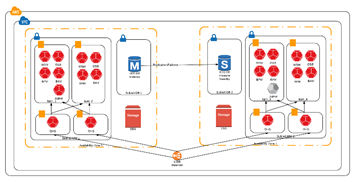
The following diagram depicts a typical highly available Oracle Fusion Middleware deployment in AWS. Note that the number of compute nodes, as well as the components may vary depending on the requirements.

2. Oracle RDS Compatibility

Before getting started with Oracle RDS, its important to check its compatibility with RCU and the corresponding Oracle Fusion Middleware components. The following AWS Oracle RDS edition/version options support RCU. Read the complete post here.

SOA & BPM Partner Community

For regular information on Oracle SOA Suite become a member in the SOA & BPM Partner Community for registration please visit www.oracle.com/goto/emea/soa (OPN account required) If you need support with your account please contact the Oracle Partner Business Center.

Blog Twitter LinkedIn image[7][2][2][2] Facebook clip_image002[8][4][2][2][2] Wiki

Technorati Tags: SOA Community,Oracle SOA,Oracle BPM,OPN,Jürgen Kress
SOA Suite Code Quality: SonarQube Quality Gates, XML Plugin and custom XPath rules by Maarten Smeets

imageThere are several ways to do code quality checks in SOA Suite. In this blog post I will describe a minimal effort setup which uses Jenkins 2.9, SonarQube 5.6 and the SonarQube XML Plugin 1.4.1. SonarQube is a popular tool to check and visualize code quality. An XML Plugin is available for SonarQube which allows you to define custom XPath rules. At the end of this post I will shortly describe several other options which you can consider to help you improve code quality by doing automated checks.

Using SonarQube and the XML Plugin to do code quality checks on SOA Suite components has several benefits compared to other options described at the end of this post.

  • It is very flexible and relatively technology independent. It allows you to scan any XML file such as BPEL, BPMN, OSB, Mediator, Spring, composite.xml files
  • It requires only configuration of SonarQube, the SonarQube XML Plugin and the CI solution (Jenkins in this example)
  • It has few dependencies. It does not require an Oracle Home or custom JAR files on your SonarQube server.
  • The XML Plugin has support (by SonarSource) so high probability it will still work in future versions of SonarQube.
  • Writing rules is simple; XPath expressions. it does not require you to write Java code to create checks.

What we can’t do with this setup is check relations between files since the XPath expressions are executed on single documents (defined with an Ant-style file-mask). Usually though when compiling or deploying SOA Suite composites, it will fail if there are references to files which are not present.

Jenkins / SonarQube setup

Setting up the environment

In this setup I’ve used Git, Jenkins, Maven, SonarQube. I’ve used an Ubuntu Server 16.04 install. The installation of the tools is pretty straightforward. Git and Maven are easiest: sudo apt-get install git maven. Jenkins is also pretty easy since there is a Debian package available. See here. For SonarQube I’ve installed a MySQL server (sudo apt-get install mysql-server). Next I’ve used the following manual. After the installation I’ve set the default admin password to admin (see here). I have also got Sonatype Nexus 3 installed on the server. This required a bit more effort. Nexus 2.x and Nexus 3.x use different API locations. Maven needed to be able to find Nexus (settings.xml file used for Nexus 2 cannot be used OOTB for Nexus 3). The init.d script had some different installation steps. See here.

Of course most people will know how to use Git. I prefer a setup in which the server has a single Git user who owns the repository and grant other users access with SSH keys to that repository. You can see how this is done here.

SonarQube

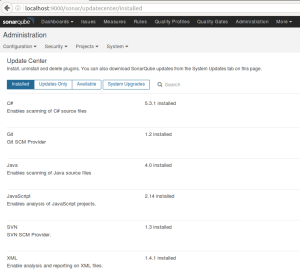
I’ve used the XML Plugin in SonarQube to define XPath rules. This first needs to be installed. Administration, System, Update Center and install the plugin:

You have to define a project in SonarQube. Administration, Projects, Management, Create Project. Read the complete article here.

SOA & BPM Partner Community

For regular information on Oracle SOA Suite become a member in the SOA & BPM Partner Community for registration please visit www.oracle.com/goto/emea/soa (OPN account required) If you need support with your account please contact the Oracle Partner Business Center.

Blog Twitter LinkedIn image[7][2][2][2] Facebook clip_image002[8][4][2][2][2] Wiki

Technorati Tags: SOA Community,Oracle SOA,Oracle BPM,OPN,Jürgen Kress

Get ready for Split – Cloud Computing & PaaS resources

PaaSCommunityForum

The PaaS Partner Community Forum will be all about Platform as a Service Cloud Computing.

Infographic: 5 Best Practices for Platform as a Service Success

iPaper: Public Platform as a Service for Dummies

IDC Research: Empower Digital Transformation with Platform as a Service

Webcast: Harvard Business Review Research: Cloud Computing Comes of Age

Try it: Register for the Demo.oracle.com system http://tinyurl.com/opndemo and access it here.

Good trip to Split

Jürgen Kress

SOA & BPM Partner Community

For regular information on Oracle SOA Suite become a member in the SOA & BPM Partner Community for registration please visit www.oracle.com/goto/emea/soa (OPN account required) If you need support with your account please contact the Oracle Partner Business Center.

Blog Twitter LinkedIn image[7][2][2][2] Facebook clip_image002[8][4][2][2][2] Wiki

Technorati Tags: SOA Community,Oracle SOA,Oracle BPM,OPN,Jürgen Kress

SOA Suite Unit test with Groovy (11g, 12c) – part 1 by Carlos Giraldo

imageIt’s going to be a little long but if you stay until the last line, you are going to know what i did to create dynamic xml requests and responses usign the unit test framework of the Soa Suite with groovy. (yes, groovy!)
I’m going to give some background of the problem and later my own personal solution. Lets begin 😀
[Update 30/06/2016] Wrote a second blog about subject with more functionality for the tests; JUnit test execution, pre load of dat and post processing of information. http://carlgira.blogspot.com.es/2016/06/oracle-soa-suite-unit-test-with-groovy.html

PROBLEM

I was trying to create Unit Test for some Bpel with several Web Service calls, human task, JCAs to database, and i get really frustated trying to create dynamic requests or responses using the tool within the Jdeveloper.
I wanted to re-create some fields, update dates etc.
The only thing i found was something that the TestSuites supports but the graphic wizards dont show. You can use small Xpath functions to replace values of the payloads in your TestSuite.
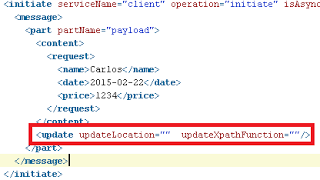
The next image shows the initiation message of a TestCase. You can see that after the payload, there is an element called "update". This element only receives two attributes, the "updateLocation" that refers a XpathLocation of a field to update, and the "updateXpathFunction" with the xpath function with the new value. Read the complete article here.

SOA & BPM Partner Community

For regular information on Oracle SOA Suite become a member in the SOA & BPM Partner Community for registration please visit www.oracle.com/goto/emea/soa (OPN account required) If you need support with your account please contact the Oracle Partner Business Center.

Blog Twitter LinkedIn image[7][2][2][2] Facebook clip_image002[8][4][2][2][2] Wiki

Technorati Tags: SOA Community,Oracle SOA,Oracle BPM,OPN,Jürgen Kress

SOA & BPM Community Newsletter March 2017

Dear SOA & BPM Partner Community,

We are excited to announce the keynote presentations during our PaaS Partner Community Forum 2017. Ed Zou will start the conference with an overview of the PaaS platform including live demos. API Cloud Service & Integration and Process Cloud Service is part of Vikas Anand demo. For all Developers Mike Lehmann will highlight the Cloud-Native / Microservice programming model for application development and How Oracle fits here with its cloud offering. Remember when we included WebCenter solutions as part of the conference? This year we will welcome back David le Strat to give us insights into Content and Experience. Frank Nimphius will introduce Chat Bot solution. In the last session the annual community award winners will be announced. We will close the day with our social networking dinner a great opportunity to share your experience and to chat with the product management team.

Demo.Oracle.com will also play a key role at our conference. Each attendee will use it to build cloud solutions. Every day Demo.Oracle is used by the Oracle pre-sales team for thousands of customer presentations around the world. As part of the system pre-configured and scripted PaaS demo services are available free of charge for Oracle Gold Partners or higher. To learn more about Demo.Oracle.com please visit OPN and request your PaaS free trial via the partner community here (membership required).

In case you will not be able to attend our conference in Split make sure you watch the latest Cloud announcements by Thomas Kurian. To understand how to position successful PaaS services with your customer base please see the PaaS live Customer Stories and get the info graphic Five Best Practices for Platform as a Service Success.

In preparation of the API Cloud Service launch read the blog article on ICS to API Platform and visit our community workspace (membership require). Thanks to the community for sharing all the Integration articles: Designer Content Filters – ICS Definitive Tip #1 & Teaching how to use the Integration Cloud Service Connectivity Agent & Using Integration Versioning – ICS Definitive Tip #2 & SOA Suite 11g and SOA Suite 12c Bundle Patches January 2017 & SOA 12.2.1.2.0: Schedule your Integration Workload Statistics (IWS) Report by Command Line & Automated Fusion Middleware 12c Migration – Part 1 – Introduction & Service Bus: Pipeline alerts in Splunk using SNMP traps

In this newsletter edition two Internet of Things articles are published Uncovering Decaying Supply Chain Links with IOT Asset Monitoring and Delivering the Enterprise to the Edge.

Thanks to the community for sharing all the BPM articles: Migrating your Oracle BPM assets into Oracle Process Cloud Service (PCS) & PCS 17.1.3 leveraging ICS & BAM Database & Renew BAM demodata & BAM Data Objects

In our last section Architecture & Enrich SaaS with PaaS the latest presentations are available to Enrich SaaS with PaaS updates presentations for CX, ERP and HCM. A must watch is the User Experience Lab Tour Oracle HQ.

The US Team highlights Oracle Cloud World – SaaS momentum continues & JD Edwards EnterpriseOne with Oracle Process, Document, and Social Cloud Services & Oracle Applications User Experience (OAUX) team.

For a short summery of our key monthly information watch the Fusion Middleware & PaaS Partner Updates on YouTube. The March edition of the PaaS Partner Update contains details about Demo.Oracle free PaaS Trial Services, PaaS Partner Community Forum 2017

and the upcoming community webcast about Implementing DevOps and Agile Methodologies in Oracle Projects on March 21st 2017. See you in Split!

Want to publish your best practice article & news in the next community newsletter? Please feel free to send it via Twitter @soaCommunity #soaCommunity!

My personal goal is to reach 10.000 partner community members, therefore I need your support! Please make sure that you invite your teams to join the SOA & BPM Partner Community and the WebLogic & Developer Partner Community.

To read the newsletter please visit http://tinyurl.com/PaaSNewsMarch2017 (OPN Account required)

Please like and share the newsletter at Twitter and LinkedIn.

Jürgen Kress

Fusion Middleware Partner Adoption
Oracle EMEA
Tel. +49 89 1430 1479
E-Mail: juergen.kress@oracle.com
clip_image003Blog clip_image004LinkedIn clip_image005 Twitter

To become a member of the SOA Partner Community please register at http://www.oracle.com/goto/emea/soa (OPN account required) If you need support with your account please contact the Oracle Partner Business Center.

Newsletter Logo 2017

Blog Twitter LinkedIn image[7][2][2][2] Facebook

Technorati Tags: newsletter,SOA Community newsletter,SOA Community,Oracle,OPN,Jürgen Kress

Publishing Oracle SOA Maven plugin by Maarten Tijhof

image

When setting up a continuous integration solution for Oracle SOA Suite code, it is best to work with mavenized projects, and thus rely on Oracle-provided maven plugins to do the tough job of compiling and deploying artifacts.

This way of working has been introduced by Oracle in the 12c range of products. There are no Maven plugins available for 11g Oracle products.
This post describes how to set up the plugin in a Binary Repository for Maven to be able to fetch it when the time has come to compile a SOA Composite.

Prerequisites:

  • Installed software
    • Maven
    • Oracle SOA Suite (e.g. 12.1.3)
  • Binary repository
    • User + password
    • Right to publish to repository

Binary Repository

The Oracle SOA Maven Plugin needs to be published to a Maven repository, this can be a local repository or a remote repository. Here, we’ll discuss a remote repository, as publishing to your local repository is similar and even easier!

Make sure your binary repository is set up, and you have a user and password with sufficient rights to add binaries to the repository.

Maven Settings

Edit your Maven Settings file, it is located at ~/.m2/settings.xml.

Make sure that you set up a profile, and that the profile/id matches activeProfiles/activeProfile. Also make sure that repository/id matches server/id for the credentials to be used when communicating to the server.
Combined, the settings.xml file would look something like this: Read the complete article here.

SOA & BPM Partner Community

For regular information on Oracle SOA Suite become a member in the SOA & BPM Partner Community for registration please visit www.oracle.com/goto/emea/soa (OPN account required) If you need support with your account please contact the Oracle Partner Business Center.

Blog Twitter LinkedIn image[7][2][2][2] Facebook clip_image002[8][4][2][2][2] Wiki

Technorati Tags: SOA Community,Oracle SOA,Oracle BPM,OPN,Jürgen Kress