Some thoughts on Oracle SOA Cloud Service

clip_image002


Its been a few weeks now since Oracle released its new and highly fanfared SOA Cloud Service.

So what does this mean to Oracle SOA practitioners?. We personally think that this is an important moment in time, because the tide has finally led us to the existence of a fully fledged SOA platform offered in the form of an iPaaS, to go with a whole set of cloud services which already include: Integration, Process Automation, Document/Content Management, Mobile, Identity, etc.

There’s little doubt that digital disruption is and will continue fostering increasingly complex and sizable hybrid architectures. Web APIs have become the toast of the town and mobile-first strategies are at a premium for organizations looking to keep competitive and generate new revenue streams.

Besides the obvious use cases such as sandbox/dev environments and occasional production workload shifting, this is where SOA CS should jump in as a powerful, attainable and ready made enabler for companies looking to invest on digital transformation.

We just wrote a fairly detailed article about all this for Oracle OTN, including an excellent contribution from Dutch stalwart Robert van Mölken. Here’s the direct link:

SOA Cloud Service in a Nutshell

So please enjoy the article and don’t hesitate to ask any questions or post your comments about it. Watch the video here.

SOA & BPM Partner Community

For regular information on Oracle SOA Suite become a member in the SOA & BPM Partner Community for registration please visit www.oracle.com/goto/emea/soa (OPN account required) If you need support with your account please contact the Oracle Partner Business Center.

Blog Twitter LinkedIn image[7][2][2][2] Facebook clip_image002[8][4][2][2][2] Wiki

SOA Cloud Service in a Nutshell by Arturo Viveros, Robert van Molken, and Rolando Carrasco

clip_image002

Introduction

Service Oriented Architecture (SOA) has been present in the Oracle Fusion Middleware Stack for many years now. With varied and powerful options such as Business Process Execution Language (BPEL) Process Manager, Service Bus, Mediator, Business Rules, Business Activity Monitoring (BAM) and others all running on WebLogic Server (WLS) since version 11g, SOA Suite has established itself as the solution of choice for achieving all kinds of on-premises integrations, as well as a comprehensive toolset for enabling the adoption and implementation of Service Orientation design principles.

Furthermore, and looking beyond the tools, SOA itself has evolved into a modern and dynamic architectural style, aligned with business and industry trends and widely regarded as an enabler for technological innovation and digital disruption.

Long gone are the days when SOA adoption was perceived as an almost esoteric ultimate goal, as are the proclamations that left it for dead. After its first generation, SOA reinvented itself and took hold in the IT mainstream. In this regard, SOA Suite has maintained its relevance, despite Oracle’s transformation into a Cloud-first company; so much so that, within a single year, we witnessed first the emergence of a 12c version, an Integration Cloud Service (ICS) built on top of it, and now the delivery of a full-fledged SOA Suite Cloud Service.

In this article we discuss this new offering in detail, together with its implications, possible use cases and scenarios. Along the way, we’ll also attempt to clarify some potentially confusing elements and draw some first-hand conclusions on the present and future of the product.

SOA Cloud Service Overview

First, Oracle has categorized this new offering as an Integration Platform as a Service (iPaaS) alternative, and rightly so. Let’s look at Gartner’s definition for iPaaS:

“…a suite of cloud services enabling development, execution and governance of integration flows connecting any combination of on premises and cloud-based processes, services, applications and data within individual or across multiple organizations”

This is a very broad definition for a cloud-based solution, where Oracle has positioned a lightweight and simplified option in ICS; nevertheless, the need for integration within the cloud increases by the day, which definitely leaves room for much more.

So, this is where SOA Cloud Service comes in, as a ready-made platform for running not only the bona fide functionalities of SOA-Infra and Service Bus, but also API Manager; a recent and very valuable addition to the Fusion Middleware stack (we’ll come back to this later).

Let’s take a look at the components available in this first release: Read the complete article here.

SOA & BPM Partner Community

For regular information on Oracle SOA Suite become a member in the SOA & BPM Partner Community for registration please visit www.oracle.com/goto/emea/soa (OPN account required) If you need support with your account please contact the Oracle Partner Business Center.

Blog Twitter LinkedIn image[7][2][2][2] Facebook clip_image002[8][4][2][2][2] Wiki

SOA Cloud Service, SOA, Cloud, PaaS, Robert Molken, SOA Community,Oracle SOA,Oracle BPM,OPN,Jürgen Kress

PaaS & Middleware Partner YouTube Update October 2016

The October edition of the PaaS & Middleware Partner Update contains three key topics:

· Oracle OpenWorld 2016 summery

· PaaS Summer Camps training material & cloud accounts

· SOA & BPM Partner Community Webcasts October 25th 2016

For regular updates please subscribe to our YouTube channel here. For the latest SOA & BPM Partner Community information please visit our Community update wiki here (Community membership required)

SOA & BPM Partner Community

For regular information on Oracle SOA Suite become a member in the SOA & BPM Partner Community for registration please visit www.oracle.com/goto/emea/soa (OPN account required) If you need support with your account please contact the Oracle Partner Business Center.

Blog Twitter LinkedIn image[7][2][2][2] Facebook clip_image002[8][4][2][2][2] Wiki

Why the Cloud is Like an Orchestra and PaaS the Conductor by Dain Hansen

clip_image002


Musical instruments sound great on their own, but they’re even better when played together: the same applies to cloud services

For many years, cloud adoption was presented as a series of choices. These included such decisions as whether to adopt public or private cloud; or to ignore both and to stick with on-premise enterprise IT systems. Businesses also had to get to grips with a wide variety of services – starting with Software as a Service (SaaS) and then moving swiftly on to Infrastructure as a Service (IaaS) and Platform as a Service (PaaS). This raised further questions: which of these services would benefit them the most? Which should they invest in immediately and for which could they afford to wait?

With the coming of age of cloud computing, it is now clear that while key decisions still need to be made, making the right choices for the business has never been easier. This is because it is now clear that the future for enterprise IT doesn’t lie in the implementation of one or two cloud services (no matter how strategic) so much as in a holistic adoption of the cloud in all its forms. This is because the value of cloud services and infrastructure increases exponentially when delivered as an orchestrated whole.

In the same way the sound of a lone saxophonist is in no way comparable to the power of a full orchestra; likewise, businesses that have a holistic cloud strategy are in a different league to those that run isolated elements of the cloud. While the latter might enjoy productivity and costs benefits in the short term, the former stand to deliver far greater benefits from the complete transformation of their businesses. Read the complete article here.

SOA & BPM Partner Community

For regular information on Oracle SOA Suite become a member in the SOA & BPM Partner Community for registration please visit www.oracle.com/goto/emea/soa (OPN account required) If you need support with your account please contact the Oracle Partner Business Center.

Blog Twitter LinkedIn image[7][2][2][2] Facebook clip_image002[8][4][2][2][2] Wiki

Cloud, PaaS, SOA Community,Oracle SOA,Oracle BPM,OPN,Jürgen Kress

PaaS free trial accounts ICS and PCS, IoT and PaaS for SaaS

image

As part of our communities we do offer free PaaS accounts (only for partners in Europe, Middle East and Africa. In case you are not part of EMEA please contact your local partner manager):

· Integration Cloud Service & Process Cloud Service & SOA Cloud & IoT & PaaS for SaaS Service PaaS Demo Accounts  (Community membership required)

· Java Cloud Service & Application Cloud Container Service & Mobile Cloud Service PaaS Demo Accounts (Community membership required)

Watch the GSE Overview Video! Get an overview of what GSE is and how you can use GSE to help you sell. You can also get long running dedicated PaaS instances, therefore please send us details about your use cases. For instant access please request a sandbox demo

SOA & BPM Partner Community

For regular information on Oracle SOA Suite become a member in the SOA & BPM Partner Community for registration please visit www.oracle.com/goto/emea/soa (OPN account required) If you need support with your account please contact the Oracle Partner Business Center.

Blog Twitter LinkedIn image[7][2][2][2] Facebook clip_image002[8][4][2][2][2] Wiki

Technorati Tags: PaaS,Cloud,ICS,PCS,PaaS4SaaS,SOA Community,Oracle SOA,Oracle BPM,OPN,Jürgen Kress

Additional new content SOA & BPM Partner Community

image

· Call for Papers: Session proposals are being accepted for future OTN Virtual Technology Summit events. Submit your proposal for Middleware track sessions in the OTN Virtual Technology Summit Middleware Ideas Space, part of the OTN Community Platform.

· VTS Replay Library: Registration for the next OTN Virtual Technology Summit will open soon. But in the meantime you can watch replays of all the sessions from the July 2015 and September 2015 events in the VTS Replay Library. In addition, you can post questions and comments for the session presenters. You’ll find all of the middleware track sessions here.

· Video: Monitoring Oracle SOA Suite Matt Brasier, head of consulting at C2B2 and the co-author of the Oracle SOA Suite 11g Performance Tuning Cookbook (Packt Publishing) discusses monitoring in Oracle SOA Suite in this 2 Minute Tech Tip recorded at the UKOUG Tech 15 Conference. Watch the video.

SOA & BPM Partner Community

For regular information on Oracle SOA Suite become a member in the SOA & BPM Partner Community for registration please visit www.oracle.com/goto/emea/soa (OPN account required) If you need support with your account please contact the Oracle Partner Business Center.

Blog Twitter LinkedIn image[7][2][2][2] Facebook clip_image002[8][4][2][2][2] Wiki

Technorati Tags: SOA Community,Oracle SOA,Oracle BPM,OPN,Jürgen Kress

PaaS 4 SaaS webcast on-demand

clip_image002[4]

Maximize the Value of Your CX Investments with Oracle Cloud Platform

With Oracle CX Cloud, companies not only get the most comprehensive CX offering, but also an innovative and powerful cloud platform to extend, analyze and integrate these applications with the rest of the enterprise resources, as well as to optimize them for every user.  This session outlines the Cloud Platform (PaaS & IaaS) solutions that Oracle provides to streamline cloud development and empowers you to deliver enterprise-grade solutions rapidly and cost effectively. Join this event if you are interested in the most advanced way to extend, analyze and integrate the Oracle CX solutions. In subsequent webinars, we will drive you through further Integration Solutions’ details. Watch the webcast on-demand here.

SOA & BPM Partner Community

For regular information on Oracle SOA Suite become a member in the SOA & BPM Partner Community for registration please visit www.oracle.com/goto/emea/soa (OPN account required) If you need support with your account please contact the Oracle Partner Business Center.

Blog Twitter LinkedIn image[7][2][2][2] Facebook clip_image002[8][4][2][2][2] Wiki

How to Recover BPM Process Instances from a MDS 00054 Error in Oracle BPM 12.1.3 (Part 1) by Siming Mu

clip_image001


Introduction

There is an issue in Oracle SOA Suite Fabric layer in version 11.1.x. and 12.1.3. The issue is documented in Bug# 20517579: “Composites Lost Completely after redeployment and server restart”. This bug is fixed in version 12.2.1. A few customers have run into this bug. Once this bug is encountered, BPM server usually shows “MDS 00054: The file to be loaded oramds:/deployed-composites/CompositeName_rev1.0/composite.xml does not exist” error during server startup. The composite is no longer visible in EM and all User Tasks from this composite are not visible in BPM Workspace either. The composite appears to be lost.

One work-around for this issue is deploying the same composite as a higher version. Or customers can manually un-deploy their problematic version of the composite using WLST script and then deploy the same composite again. In either case, customers will lose all running instances of this composite. If this outcome is not desirable, we need to find a way to recover all running instances.

This multi-part blog will present one way to manually recover those instances. To make this process more understandable to readers, a very simple BPM composite is used to take you through the processes of deployment/undeployment, reproduction of the bug# 20517579 and MDS 00054 errors, and finally steps to recover instances. Along the way, we will look at changes in MDS and SOAINFRA tables due to normal life cycles of the sample composite and bug# 20517579.

Even though this bug is fixed in 12.2.1, I think the information documented in this blog will provide a valuable resource for understanding MDS and SOAINFRA schema.

What happens in MDS when a composite is deployed?

First, let’s take a look what happens in MDS when a BPM composite is deployed. To do that, we need a tool like MDS Explorer. Before any BPM composite is deployed, your MDS should look empty similar to the following image.

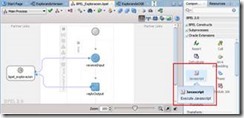
Now we will deploy a very simple BPM composite to check for changes in MDS. We can use a BPM composite similar to the following for our testing purposes.

Notice that I created two human tasks but only have one interactive activity in my BPM process. We will only use human task 1 for now and the other one will be used to generate the MDS 00054 error later.

After deploy this composite, the MDS  should look like this: Read the complete article here.

SOA & BPM Partner Community

For regular information on Oracle SOA Suite become a member in the SOA & BPM Partner Community for registration please visit www.oracle.com/goto/emea/soa (OPN account required) If you need support with your account please contact the Oracle Partner Business Center.

Blog Twitter LinkedIn image[7][2][2][2] Facebook clip_image002[8][4][2][2][2] Wiki

The BPM 12c Process Monitor Dashboard in 5 Minutes by Jaideep

clip_image002

The Oracle BPM 12c Workspace offers two dashboards right out of the box. The Process Monitor and the Standard Dashboard. In this video we’ll go over how to use the process monitor.

Process monitor dashboards enable you to monitor and optimize business process execution. It can be a very helpful tool to be able to see process statistics like how many instances are currently running, how many have completed, how many have faulted etc over a time interval. It displays alerts that can help to identify process issues that are affecting performance. It also displays two performance graphs, the Workload per Activity and Performance per Activity.

Watch this video to get a quick overview of what the process monitor looks like and how to use it. Watch the video here.

SOA & BPM Partner Community

For regular information on Oracle SOA Suite become a member in the SOA & BPM Partner Community for registration please visit www.oracle.com/goto/emea/soa (OPN account required) If you need support with your account please contact the Oracle Partner Business Center.

Blog Twitter LinkedIn image[7][2][2][2] Facebook clip_image002[8][4][2][2][2] Wiki

PCS: Form rules in human tasks by Rubén Rodríguez Santiago

clip_image001In Oracle BPM it is possible to use Oracle ADF to implement Human Tasks, but in Oracle Process Cloud Service you can only create a form using web forms. Creating a form is an easy task and it offers us to define rules that it gives us a lot of flexibility to achieve complex requirements.
Having this simple form. We can navigate to rules clicking on the marked button.

For each of the elements we have a number of properties or events that we can manage,
For example we can manage form load event, or get if a field value is valid…

To build the rules we have to use JavaScript and we can get code snippets if we click on the button next to each of the properties.

Let’s build a couple of rules so you can see how easy it is.
Having this combo with this value.

We can build a rules that populates that combo and also add some kind of value change listener so if its value is "Spain" we can set the country code in Telephone field.
If we have any syntax errors, will be displayed in the bottom of the editor. Read the complete article here.

SOA & BPM Partner Community

For regular information on Oracle SOA Suite become a member in the SOA & BPM Partner Community for registration please visit www.oracle.com/goto/emea/soa (OPN account required) If you need support with your account please contact the Oracle Partner Business Center.

Blog Twitter LinkedIn image[7][2][2][2] Facebook clip_image002[8][4][2][2][2] Wiki