Cloud Platform Partner YouTube Update July 2021


The July video includes three topics:

• Oracle Fiscal Year Results 2021

• Steps to Success

• b2b Webcast

For regular updates please subscribe to our YouTube channel here. Thanks for your likes and sharing the video on YouTube and LinkedIn.  For the latest integration & process information please join the PaaS community.

clip_image003 Blog clip_image005 Twitter clip_image004 LinkedIn image[7][2][2][2] Facebook image Meetups

Technorati Tags: YouTube,PaaS,Cloud,Middleware Update,WebLogic,WebLogic Community,Oracle,OPN,Jürgen Kress

OSB 12c SOAP webservice for temperature conversion i.e. Celsius to Fahrenheit and vice versa by Pranav Davar

image

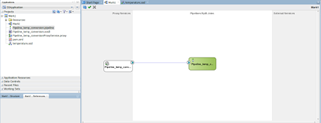
This tutorial is intended for the audience who are completely new to OSB and want to try a simple hello world kind of application. Instead of sending and receiving Hello World!. We will be using simple temperature conversion i.e. from Celsius to Fahrenheit and vice versa. We will be using simple Xquery to do all conversion and logic.

High Level:

In this case, our OSB component will contain 2 parts proxy service and pipeline. Proxy service will expose SOAP endpoint to the client application and pipeline will perform various operations on input payload. Since this is just a Hello World application, we will not be using business services. XQuery will be used to implement mathematical logic and conditional logic. Service will take temperature as input and will perform either Fahrenheit to Celsius (FtoC) or Celsius to Fahrenheit (CtoF) temperature conversion. If the conversion type is invalid, then the service will return a failure status.

Mathematical Calculations:

Let temperature in Fahrenheit be X℉ and temperature in Celsius be Y℃. Read the complete article here

PaaS Partner Community

For regular information on Oracle PaaS become a member in the PaaS (Integration & Process) Partner Community please register here.

clip_image003 Blog clip_image005 Twitter clip_image004 LinkedIn image[7][2][2][2] Facebook clip_image002[8][4][2][2][2] Wiki

Technorati Tags: SOA Community,Oracle SOA,Oracle BPM,OPN,Jürgen Kress

Using UN/EDIFACT for B2B Transactions by Arvind Venugopal, and Sunil Apte

image

With the May release, we have added support for EDIFACT data format for B2B with Oracle Integration. UN/EDIFACT is a standard and format for electronic business communications. It is controlled and maintained by a committee called, UNECE, that is a body formed by the United Nations.

Now you will be able to design and run EDIFACT transactions with the Cloud Platform. Here are the key steps that allow you to do this:

  • First step is that you will now be able to design EDIFACT formatted schemas from within the B2B Design time experience in ‘B2B Schemas’
  • Once the schema is created you will be able to personalize and customize the named instance of this schema to adhere to the trading partner specifications.
  • Once you have the schemas created you will be able to use them to create B2B documents. Now, you don’t need a custom schema for B2B documents in case you are using standard schemas. In which case, you can go directly to create the B2B document. Read the complete article here.

PaaS Partner Community

For regular information on Oracle PaaS become a member in the PaaS (Integration & Process) Partner Community please register here.

clip_image003 Blog clip_image005 Twitter clip_image004 LinkedIn image[7][2][2][2] Facebook clip_image002[8][4][2][2][2] Wiki

Technorati Tags: SOA Community,Oracle SOA,Oracle BPM,OPN,Jürgen Kress

Modelling Transport Integrations with Trading Partner Management by Arvind Venugopal, and Sunil Apte

image

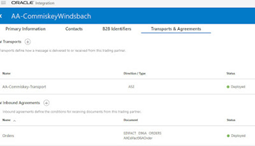
With the May release of Oracle Integration, we have introduced the ability to setup Transport Integrations within the Trading Partner Management design time experience. With this enhancement, we have also automated the creation of the base B2B integration.

This setup enables a B2B user to onboard Trading Partners on the Cloud platform without requiring to configure the Trading Partner setup via Integrations. In this blog, we will see how to achieve this.

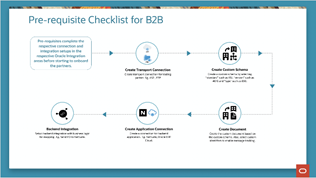
First, we will review a couple of the prerequisites to help enable this.

  • First, the backend Application Integration will have to be created for the transactions you want to process in and out from the respective app you are using. You will be able use the supported Application or technical adapters to create the connection to the app and then create the integration that houses the business logic as well as the mapping. You can find more information on the supported adapters here.
  • Second, before going to the Trading Partner screens you can create the Transport Connection for AS2 or FTP via the connections page as well as the document that you want to process via the Documents screen. Optionally, you can customize your schema as well to be used within the Documents. Read the complete article here.

PaaS Partner Community

For regular information on Oracle PaaS become a member in the PaaS (Integration & Process) Partner Community please register here.

clip_image003 Blog clip_image005 Twitter clip_image004 LinkedIn image[7][2][2][2] Facebook clip_image002[8][4][2][2][2] Wiki

Technorati Tags: SOA Community,Oracle SOA,Oracle BPM,OPN,Jürgen Kress

Using an Event Based Pattern with Oracle Integration by Michael Meiner

image

Something happens in your enterprise application. Let’s say a new item is added to your catalog in your Enterprise Resource Planning (ERP) system. We will call this an event. Perhaps you want to find out about this event so you can take some action. Perhaps you need to add this item to your customer-facing web store.

One way to accomplish this is to continually poll the application. The problem with this solution is that you need to expend resources to keep polling, and then you will likely not find out about the event immediately. This is akin to sending a package and then calling the recipient every few minutes to find out whether they received the package. This of course is inefficient (not to mention the annoyance to the recipient!). A much better option is to have the recipient notify you when the package arrives.

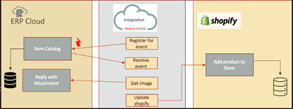
Oracle Integration can help satisfy processing such events by using an event-driven architecture. Your integration does not need to poll the application. Rather, your integration can register for an event, sit back and relax — and wait to be notified. As businesses adopt and embrace Digital Transformation, one critical step in this journey is moving to event-driven architectures to replace older, more cumbersome integration methods.

To illustrate this, we using Oracle ERP and Shopify. Oracle ERP will be our system of record for products in our catalog. New products get added to our Oracle ERP system. Whenever a new product is added to Oracle ERP, the product will be added to Shopify so that our customers can begin ordering the product. The process of adding the product to Shopify will be handled by Oracle Integration, via an event-based pattern. Let’s now build the integration. Read the complete article here.

PaaS Partner Community

For regular information on Oracle PaaS become a member in the PaaS (Integration & Process) Partner Community please register here.

clip_image003 Blog clip_image005 Twitter clip_image004 LinkedIn image[7][2][2][2] Facebook clip_image002[8][4][2][2][2] Wiki

Technorati Tags: SOA Community,Oracle SOA,Oracle BPM,OPN,Jürgen Kress

Practical Guide to use HCM Data Loader with Oracle Integration by Harris Qureshi

image

There are many good resources & blogs available that demonstrate how to use Oracle Integration (OIC) to import data into HCM using HDL Import Job. So if you wish to learn how to use the OIC Adapter and create an integration, please refer to the following examples plus there are others available too.

A Simple Guide to Oracle HCM Data Loader (HDL) Job Support in Oracle HCM Cloud Adapter

Import Business Objects with the HCM Data Loader (HDL)

This blog will try to address some key practical steps and pre-requisites needed to make this all work. Some of these are mentioned in these blogs but I feel it demands its own write-up to help guide the new integration developers and this will try to address some overall steps.

How to Generate Business Object Mapping File in HCM

One of the key requirements to load data using OIC for HDL is that you need the integration mapping file (nxsd file) of the relevant business object along with a sample .dat file.

Now if you go to the HCM environment and View Business Objects, the default setting only provides you the sample template file (.dat file) but it does not give you the relevant integration mapping file i.e. nxsd file. Read the complete article here.

PaaS Partner Community

For regular information on Oracle PaaS become a member in the PaaS (Integration & Process) Partner Community please register here.

clip_image003 Blog clip_image005 Twitter clip_image004 LinkedIn image[7][2][2][2] Facebook clip_image002[8][4][2][2][2] Wiki

Technorati Tags: SOA Community,Oracle SOA,Oracle BPM,OPN,Jürgen Kress

Five key Oracle Integration lessons from handling billions of messages monthly by Amit Saxena

imageAutomating end-to-end enterprise business processes involves connecting multiple software-as-a-service (SaaS), on-premises, and custom applications.

One of the most innovative things you can do with your enterprise applications is to integrate them into end-to-end business processes, such as recruit-to-retire, requisition-to-receipt, and lead-to-invoice. When automating processes across multiple event-based services and data sources, you want the ability to adjust and evolve those interactions on the fly.

Many, varied integration patterns pose a complex challenge to traditional integration strategies. To keep pace, our customers need to enable self-service, capitalize on existing APIs, and implement a hybrid integration platform. Watch Oracle Integration Architecture Principles to see for yourself how we can help your connected business strategy support modern integration and automation best practices.

Modernize end-to-end business processes with low-code, polyglot development for Oracle Digital Assistant and BlockChain across SaaS and on-premises applications. Read the complete article here.

PaaS Partner Community

For regular information on Oracle PaaS become a member in the PaaS (Integration & Process) Partner Community please register here.

clip_image003 Blog clip_image005 Twitter clip_image004 LinkedIn image[7][2][2][2] Facebook clip_image002[8][4][2][2][2] Wiki

Technorati Tags: SOA Community,Oracle SOA,Oracle BPM,OPN,Jürgen Kress

Improved Navigation for the OCI Console by Simone Geib

image

We’re excited to announce that the Oracle Cloud Infrastructure (OCI) Console navigation menu is undergoing a major upgrade this month.

As OCI continues to grow, adding new services and expanding our current services, our customers need a more efficient way to navigate the Console. In this change, we’re better organizing the rapidly growing set of OCI services into logical top-level categories and reducing the scrolling and manual searching that customers have to do today.

For more information about key features and how to get started, please go here: Announcing Improved Navigation for the OCI Console.

In the new menu, Oracle Integration (OIC) can be found under "Developer Services -> Application Integration -> Integration". Read the complete article here.

PaaS Partner Community

For regular information on Oracle PaaS become a member in the PaaS (Integration & Process) Partner Community please register here.

clip_image003 Blog clip_image005 Twitter clip_image004 LinkedIn image[7][2][2][2] Facebook clip_image002[8][4][2][2][2] Wiki

Technorati Tags: SOA Community,Oracle SOA,Oracle BPM,OPN,Jürgen Kress

OIC May 21 Release – B2B support for UN EDIFACT Part 2 by Niall Commiskey

image

This post covers the creation of the "missing" backend integration from the previous post.

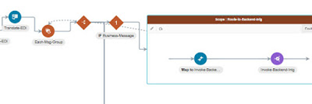
I discussed the auto-generation of the send/receive integrations in the previous post. What I now need to do is create a backend integration for processing my EDFACT Order. That integration will create a Sales Order in Netsuite. It will then be called from the scope below.

Create the Backend Integration

To recap, the "receive" integration has done the formal AS2 and EDIFACT checks – nothing else. The backend integration will do the actual fetch/translate of the document so that OIC can process it further. The basic backend integration flow is as follows – read the complete article here.

PaaS Partner Community

For regular information on Oracle PaaS become a member in the PaaS (Integration & Process) Partner Community please register here.

clip_image003 Blog clip_image005 Twitter clip_image004 LinkedIn image[7][2][2][2] Facebook clip_image002[8][4][2][2][2] Wiki

Technorati Tags: SOA Community,Oracle SOA,Oracle BPM,OPN,Jürgen Kress

OIC May 21 Release – B2B support for UN EDIFACT Part 1 by Niall Commiskey

image

The May 21 release of OIC brings lots of new features to B2B. This post will focus on the new UN EDIFACT support, but will also detail our new auto-generation of – send/receive pre-processor integrations – feature.

The usual caveat from me at the outset – I am not an EDI/EDIFACT expert – many folks tasked with creating such integrations are also not, so this is for you! Version 1 of B2B in OIC supported X12, now we are also providing UN EDIFACT support. So what is the difference between the 2, apart from the fact that the latter is mainly used in Europe? Apparently X12 has made inroads into the healthcare market (HIPAA), whereas UN EDIFACT has not. Both standards are used in areas such as supply chain, government etc.

This post begins with an introduction to the format of an order in UN EDIFACT, it is rather pedestrian, if fact probably boring for most of you, who are at home in EDI. I go through the order document line for line, this I am mainly doing for my own benefit, so that I actually understand the values being sent.

The post continues with a short introduction to the transport protocol I will use, AS2. Finally, we get to the section that covers the implementation of a simple UN EDIFACT orders based B2B transaction in OIC. Read the complete article here.

PaaS Partner Community

For regular information on Oracle PaaS become a member in the PaaS (Integration & Process) Partner Community please register here.

clip_image003 Blog clip_image005 Twitter clip_image004 LinkedIn image[7][2][2][2] Facebook clip_image002[8][4][2][2][2] Wiki

Technorati Tags: SOA Community,Oracle SOA,Oracle BPM,OPN,Jürgen Kress