Oracle Named a Leader for Four Consecutive Years in Gartner Magic Quadrant for Enterprise Integration Platform as a Service

image

For the fourth straight year, Oracle was named a Leader in Gartner’s 2020 “Magic Quadrant for Enterprise Integration Platform as a Service (iPaaS)” report.

Thanks to all partners who supported us by your successful customer projects!

The fast growing iPaaS market demonstrates that enterprises are continuing to invest substantially in their cloud and digital transformation strategies. Oracle believes that its leadership in this market is a testament to the success that large and midsize organizations have achieved with the cost effective, agile connectivity enabled by Oracle Integration.

Oracle Integration runs on Oracle’s highly secure, high performance Oracle Cloud Infrastructure and is a complete and comprehensive application integration service that connects SaaS and on-premises business applications. The service offers prebuilt adapters, prebuilt business accelerators and recipes, as well as machine learning powered auto mapping. In addition, enterprises have access to low code tools for citizen integrations that rapidly deliver business value and simplify the technical complexity of dealing with low-level APIs. Oracle Integration also includes cloud native file transfer, support for B2B e-commerce integrations and business-friendly dashboards to monitor business-level metrics using web-based dashboards.

Oracle’s success stems from being able to eliminate the barriers between business applications through a combination of machine learning, pre-built application integration, visual process automation and intuitive, real-time analytics. Oracle’s embedded AI capabilities, such as self-defining integrations and prediction of SLA violations enable enterprises to execute any number of integration development processes.

“The success our customers have seen on their business transformation journey, speaks volumes to the level of innovation and speed achieved by integration processes,” said Suhas Uliyar, vice president, Digital Assistant and Integration, Oracle. “To us, being recognized as a Leader for the fourth year in a row demonstrates that our customers rely on our partnership to help them continue to gain efficiencies and build business resiliency.”

Thousands of organizations of all sizes, across industries and regions, have adopted Oracle Integration to accelerate their digital transformation by connecting and extending any SaaS, on-premises, or custom application. For customers with on-premises Oracle applications, databases, and middleware, only Oracle offers the ability to move their workloads to the cloud as-is. Customers who have selected Oracle SaaS and are taking advantage of quarterly innovation updates in machine learning, AI, digital assistants, and analytics, can rest assured that their extensions and connections will continue to work. With pre-built adapters for any application, database, or enterprise messaging approach, Oracle Integration offers the speed, ease of use, and full range of connectivity capabilities needed to automate end-to-end enterprise processes.

Download a complimentary copy of Gartner’s September 2020 “Magic Quadrant for Enterprise Integration Platform as a Service” here.

Resources

PaaS Partner Community

For regular information on Oracle PaaS become a member in the PaaS (Integration & Process) Partner Community please register here.

clip_image003 Blog clip_image005 Twitter clip_image004 LinkedIn image[7][2][2][2] Facebook clip_image002[8][4][2][2][2] Wiki

Technorati Tags: SOA Community,Oracle SOA,Oracle BPM,OPN,Jürgen Kress

    Additional new content PaaS Partner Community

    image

    · Can AI find and treat cancer? The Lawrence J. Ellison Institute for Transformative Medicine of USC is using AI to potentially recognize cancer and even recommend a course of treatment

    · Keeping the lights on As millions of people stay home and many face economic hardship, utilities are taking measures, including lowering bills and suspending disconnects while working to keep their employees safe

    · Oracle Cloud Platform Application Integration 2020 Specialist | 1Z0-1042-20

    · Oracle Cloud Platform Digital Assistant 2020 Specialist | 1Z0-1071-20

    · Oracle Integration (OIC) Generation 2 is now available in all cloud tenancies

    PaaS Partner Community

    For regular information on Oracle PaaS become a member in the PaaS (Integration & Process) Partner Community please register here.

    clip_image003 Blog clip_image005 Twitter clip_image004 LinkedIn image[7][2][2][2] Facebook clip_image002[8][4][2][2][2] Wiki

    Technorati Tags: SOA Community,Oracle SOA,Oracle BPM,OPN,Jürgen Kress

    Use Oracle Integration to Add Attachments to a Process Instance

    Use Oracle Integration to Add Attachments to a Process Instance by Bogdan Eremiaimage

    The other day it came to my attention that it’s not really straightforward to add attachments to an Oracle Process Instance using the REST API.

    One reason for this is that it requires multipart/mixed media type for the request body message format, and producing this kind format is not so common for JavaScript clients. The JS clients are more used to working with multipart/form-data, the de-facto standard for form-based file upload in HTML.

    One way of overcoming this is to use Oracle Integration Cloud (OIC) between the JS client and Process REST API. OIC has a REST Technology Adapter that supports sending/receiving attachments in both multipart/mixed and multipart/form-data media types. The goal is to shape in OIC a REST interface that accepts multipart/form-data, to do a translation into multipart/mixed (alongside with other transformations/actions if required) and to call the Process REST API. Below are the main steps for achieving this.

    1. Create a REST Connection in OIC for Process REST API.

    Go to OIC Homepage > Designer > Connections to create a new connection by selecting the REST Adapter. Read the complete article here.

    PaaS Partner Community

    For regular information on Oracle PaaS become a member in the PaaS (Integration & Process) Partner Community please register here.

    clip_image003 Blog clip_image005 Twitter clip_image004 LinkedIn image[7][2][2][2] Facebook clip_image002[8][4][2][2][2] Wiki

    Technorati Tags: SOA Community,Oracle SOA,Oracle BPM,OPN,Jürgen Kress
    OIC: Identity Propagation In Structured Process by Jan Kettenis

    image

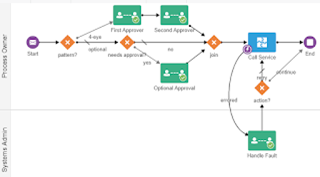
    When a process calls a service you sometimes have a requirement that some user identity needs to be propagated to the service call. This article describes how you can propagate the identity (but alas not the principle) of a user on behalf of whom a service call is executed. When calling a service in a structured process you sometimes must pass on the identity of the user that called the service. This could be the case when that service call is done to a SaaS application and it is required to track on behalf of whom that service is called. The identity (user name) only is not enough when authentication must happen using the principle (security token) of the user, but there are applications that can handle this using some combination of a system user (or client id plus secret) with an on behalf of user. And there are situations where having an on behalf of user only is enough, like when storing data in a database table with audit columns (you don’t want all the end users also to be database users so passing on the user’s principle to the DB would not make sense).
    It is not always trivial who that on behalf of user should be. Take for example the following process model: Read the complete article here.

    PaaS Partner Community

    For regular information on Oracle PaaS become a member in the PaaS (Integration & Process) Partner Community please register here.

    clip_image003 Blog clip_image005 Twitter clip_image004 LinkedIn image[7][2][2][2] Facebook clip_image002[8][4][2][2][2] Wiki

    Technorati Tags: SOA Community,Oracle SOA,Oracle BPM,OPN,Jürgen Kress

    PaaS Partner YouTube Update October 2020


    The October video includes three topics:

    • Free cloud trials for partners

    • Partner Community newsletters

    • Innovate Service Cloud with chatbots webcast

    For regular updates please subscribe to our YouTube channel here. Thanks for your likes and sharing the video on YouTube and LinkedIn. For the latest PaaS Community information please visit our Community update wiki here (Community membership required).

    PaaS Partner Community

    For regular information on Oracle PaaS become a member in the PaaS (Integration & Process) Partner Community please register here.

    clip_image003 Blog clip_image005 Twitter clip_image004 LinkedIn image[7][2][2][2] Facebook clip_image002[8][4][2][2][2] Wiki

    Technorati Tags: YouTube,SOA Community,Oracle SOA,Oracle BPM,Jürgen Kress,Middleware Update,Partner Update

    Use of correlation sets in SOA Suite by Martien van den Akker

    image

    Years ago, I had plans to write a book about BPEL or at least a series of articles to be bundled as a BPEL Course. I stranded with only one Hello World article. This year, I came up with the idea of doing something around Correlation Sets. Preparing a series of articles and a talk. And therefor, let’s start with an article on Correlation Sets in BPEL. Maybe later on I could pick up those earlier plans again.

    You may have read "BPEL", and tend to skip this article. But wait, if you use BPM Suite: the Oracle BPM Process Engine is the exact same thing as the BPEL Process engine! And if you use the Processes module of Oracle Integration Cloud: it can use Correlation Sets too. Surprise: again it uses the exact same Process Engine as Oracle SOA Suite BPEL and Oracle BPM Suite.

    Why Correlation Sets?

    Now, why Correlation Sets and what are those? You may be familiar with OSB or maybe Mulesoft, or other integration tools. OSB is a stateless engine. What comes in is executed at once until it is done. So, services in OSB are inherently synchronous and short-lived. You may argue that you can do Asynch Services in OSB. But those are in fact "synchronous" one-way services. Fire & Forget, as you will. They are executed right away (hence the quoted synchronous) , until it is done. But the calling application does not expect a result (and thus asynchronous in the sense that the caller won’t wait).

    You could, and I have done it actually, create asynchronous request response services in OSB. Asynchronous Request Response services are actually two complementary one way fire & forget services. For such a WSDL both services are defined in different port types: one for the actual service consumer, and one callback service for the service provider. Using WS-Addressing header elements the calling service will provide a ReplyTo callback-endpoint and a MessageId to be provided by the responding service as an RelatesTo MessageId. Read the complete article here.

    PaaS Partner Community

    For regular information on Oracle PaaS become a member in the PaaS (Integration & Process) Partner Community please register here.

    clip_image003 Blog clip_image005 Twitter clip_image004 LinkedIn image[7][2][2][2] Facebook clip_image002[8][4][2][2][2] Wiki

    Technorati Tags: SOA Community,Oracle SOA,Oracle BPM,OPN,Jürgen Kress
    Data Stitch: Repeating element path does not have a predicate for selecting 1 instance – Warning by Jorge Herreria

    Summaryimage

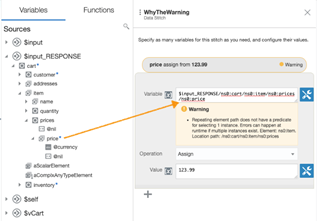
    The "Repeating element path does not have a predicate for selecting 1 instance." warning message will come up on some stitch statements; specially on the "Variable" field.   It means the Location Path XPath expression will select more than one instance and then the operation (Append or Assign) will fail at runtime.

    In this blog I’ll try to explain how to read the warning and how to fix the expression.

    There is a lot of XPath and XSD Schema lingo in this post; however I’ll try to explain it with less lingo that I can. Wish me luck.

    Expect twisted humor here and there; more of then than none.

    A quote that I like: "If you want to be free, stay anonymous…"

    The meaning of the warning

    Lets start peeling the onion (warning) into heads and tales and then put it back together… I’m going to use an example and simulate a conversation with you.

    The example orchestration the $input_RESPOSE is a Shopping Cart.  The Stitch statement with the warning is trying to assign 123.99 to the item’s price. See the pic below. Read the complete article here.

    PaaS Partner Community

    For regular information on Oracle PaaS become a member in the PaaS (Integration & Process) Partner Community please register here.

    clip_image003 Blog clip_image005 Twitter clip_image004 LinkedIn image[7][2][2][2] Facebook clip_image002[8][4][2][2][2] Wiki

    Technorati Tags: SOA Community,Oracle SOA,Oracle BPM,OPN,Jürgen Kress
    Data Stitch: Append and Assign for repeating elements by Jorge Herreria

    imageSummary

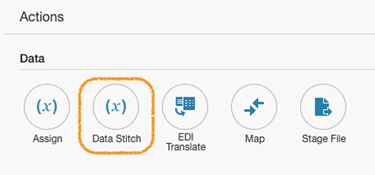
    Data Stitch has ASSIGN, APPEND and REMOVE operations. Some use-cases are easy to grasp; some others require a little thinking… On this blog I‘ll explain behaviors I deem they are not straightforward to derive the outcome for using Data Stitch in a OIC Orchestration:

    · Assigning into unbounded elements (aka – Repeating Elements)

    · Appending instances into an unbounded element and how to complete the data.

    I assume you are familiar with XPath Expressions and XSD Schemas, because there is a lot a lingo in this post…

    You will not see many screen shots. My goal is to give you the concepts so you become a good data “tailor?”

    Expect some twisted humor here and there; more often that none.

    I love this quote:  Perfection is boring; therefor laugh at your mistakes.

    Syntax

    For Data Stitch Sentences

    (TO XPath expression).OPERATION(FROM XPath expression)

    Example:

    ($v1/ns0:customer/ns0:name).ASSIGN(“Jorge Herreria”)

    On explanations you will see step/step/step/… in location paths. I’m going to omit the namespace prefixes, and just put the local-name on each step; looking to make it easy to read… However on actual XPathExpressions you’ll see prefixes. Read the complete article here.

    PaaS Partner Community

    For regular information on Oracle PaaS become a member in the PaaS (Integration & Process) Partner Community please register here.

    clip_image003 Blog clip_image005 Twitter clip_image004 LinkedIn image[7][2][2][2] Facebook clip_image002[8][4][2][2][2] Wiki

    Technorati Tags: SOA Community,Oracle SOA,Oracle BPM,OPN,Jürgen Kress

    Recursive calls in Oracle Integration Flows (Scenario: Paginated API calls for large Data Sets) by Jang-Vijay Singh

    image

    A number of use-cases can be implemented cleanly using a recursive approach. This post is not to debate the pros and cons of recursion versus looping but provides a simple approach to achieve this.

    For scenarios such as the ones listed below, and possibly more, this approach is quite efficient, concise, maintainable, and most importantly, it is highly scalable. It also leaves a smaller runtime footprint with a smaller execution time per instance than a looping flow instance. This also makes error handling easier as I will describe later.

    • Polling (continuously monitoring an FTP location, a database, or an API output)
    • Paginated API’s (when the target system exposes an API with a paginated* interface such as the eBay findProducts operation)
    • Retryable flows
    Paginated Calls

    Many software systems store large sets of data. For instance, a vendor might have hundreds of thousands of products and product-prices listed on EBay or an eCommerce store. They might have millions of transactions in their PayPal account.

    There might occasionally be legitimate scenarios to fetch all of this data. The software system can provide various interfaces to export such data in bulk. Such a bulk data export interface could be raw data files, access to a database, but also a standard API like a Rest Service.

    For reasons of performance and good practice, such Rest API’s (typically a GET operation) would limit the amount of data returned in any one call by using a pagination strategy. An eCommerce store could list hundreds of thousands of products for instance, and it wouldn’t be appropriate to return such a large data set in a single call. A pagination strategy would involve setting parameters like pageNumber and pageSize. Read the complete article here.

    PaaS Partner Community

    For regular information on Oracle PaaS become a member in the PaaS (Integration & Process) Partner Community please register here.

    clip_image003 Blog clip_image005 Twitter clip_image004 LinkedIn image[7][2][2][2] Facebook clip_image002[8][4][2][2][2] Wiki

    Technorati Tags: SOA Community,Oracle SOA,Oracle BPM,OPN,Jürgen Kress

    Innovate Service Cloud with Chatbots Partner Community Webcast October 20th 2020

    imageChatbots have quickly become a critical platform for interacting with users, customers, and prospects. Organizations can now engage customers and employees in a proactive, personalized way, at scale across web, mobile, and messaging platforms. Connect and customize service engagements. Personalize your service engagements across any channel. Oracle CX Service delivers connected experiences to both consumers and businesses with knowledge-driven interactions and automation.

    Speaker: Martin Jarvis Director Product Management, Oracle HQ

    Schedule: October 20th 2020 16:30-17:30 CET (Berlin time)

    For details please visit the registration page here.

    Take the opportunity to watch our community webcasts on-demand:

    · Integration Update & New Features

    · Chatbot Design best practices for Conversational UX

    · Connect, Innovate, Extend SaaS KickOff Webcast 2020

    · Cloud Platform KickOff Webcast 2020

    · Netsuite Integration

    · Integration Insight

    · Innovate HCM with Chatbots

    · ERP Integration with Application Adapters

    · HCM Integration with Application Adapters

    · Extend SaaS with Visual Builder Cloud Service

    · Integration Adapters

    · Integrate SaaS

    · Digital Assistant Update

    · SOA Cloud Service

    · PaaS Overview Webcast

    · Process Cloud Service Update

    · Integrate ERP Cloud

    · Integrate HCM Cloud

    · Functions and Cloud Native

    · Blockchain

    · API Platform Cloud Service part 2

    · 3rd Generation API Gateways part1

    · Oracle JET

    · Oracle Visual Builder Cloud Service

    · Container Native Application Development Platform

    For the latest information please visit Community Updates Wiki page (Community membership required).

    PaaS Partner Community

    For regular information on Oracle PaaS become a member in the PaaS (Integration & Process) Partner Community please register here.

    clip_image003 Blog clip_image005 Twitter clip_image004 LinkedIn image[7][2][2][2] Facebook clip_image002[8][4][2][2][2] Wiki

    Technorati Tags: SOA Community,Oracle SOA,Oracle BPM,OPN,Jürgen Kress