BPM, SOA, big data, fast data, cloud, mdm–what is important for you?

In today’s fast moving world of tighter budgets and higher expectations businesseimages and IT need to ensure resources and timescales are fully aligned delivering a user experience of the highest level.  As a leading Oracle BPM and SOA Specialized partner Griffiths Waite is undertaking a cross sector market survey to provide visibility as to these needs and their priority within the business.
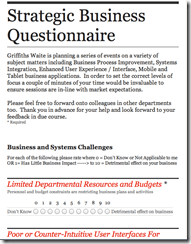
This five minute survey covers all the key aspects facing business and IT leaders from issues on integration, planning for mobile development, the use of Cloud as well and Business Process efficiency, BIG and Master Data Management.
The questionnaire can be filled in anonymously however, anyone leaving their contact details will receive a copy of the results.
I thank you for your time and please feel free to share the link with colleagues and customers alike as the more responses the more representative the overall picture. take the survey here

SOA & BPM Partner Community

For regular information on Oracle SOA Suite become a member in the SOA & BPM Partner Community for registration please visit  www.oracle.com/goto/emea/soa (OPN account required) If you need support with your account please contact the Oracle Partner Business Center.

Blog Twitter LinkedIn Mix Forum

Additional new content SOA Community

SOA & BPM Partner Community

For regular information on Oracle SOA Suite become a member in the SOA & BPM Partner Community for registration please visit  www.oracle.com/goto/emea/soa (OPN account required) If you need support with your account please contact the Oracle Partner Business Center.

Blog Twitter LinkedIn Mix Forum

Connect to multiple SOA / BPM Virtual Machines from different computers in your network by Danilo Schmiedel

Today I’d like to explain how to share instances of Oracle’s Pre-built Virtual Machine for SOA Suite and BPM Suite across different computers in your network.

Three requirements I had to address:

  1. Call of external services like GeoNames (http://www.geonames.org/postal-codes/) from within the BPM Suite VM
  2. Connection to multiple BPM Suite VMs from Host (e.g. JDeveloper and Browser)
  3. Connection to multiple BPM Suite VMs from different developer computers in the network
  4. Share data between VMs and developer computers via FTP

The default options already support connections between host and client. However the target here was to address multiple independent VMs from different computers in the same network. The following settings worked in my environment:

1) Start the Oracle VM VirtualBox Manager and open network settings of the VM. Read the full article here.

SOA & BPM Partner Community

For regular information on Oracle SOA Suite become a member in the SOA & BPM Partner Community for registration please visit  www.oracle.com/goto/emea/soa (OPN account required) If you need support with your account please contact the Oracle Partner Business Center.

Blog Twitter LinkedIn Mix Forum

eProseed Delivers Processes Skillfully with Oracle BPM Suite

Geoffroy de Lamalle, CEO and Founder of eProseed, discusses how Oracle BPM Suite enables businesses to integrate business processes and achieve higher efficiency.

You want to publish your BPM success? Feel free to make use of the partner reference program:

  • Enables partners to be recognized by both Oracle and our customers
  • Provides an opportunity for partners to showcase successes with their customers on Oracle solutions
  • Helps raise awareness of our partners’ capabilities, elevating them above their competition

Time to submit a BPM & SOA reference request today.

SOA & BPM Partner Community

For regular information on Oracle SOA Suite become a member in the SOA & BPM Partner Community for registration please visit  www.oracle.com/goto/emea/soa (OPN account required) If you need support with your account please contact the Oracle Partner Business Center.

Blog Twitter LinkedIn Mix Forum

RDA Health Checks for SOA By Shawn Bailey

What is a health check in RDA?
A health check evaluates something in your environment to determine whether a change needs to be considered in order to avoid a problem or optimize fuctionality. Examples of what this ‘something’ might be are:

  • Configuration Parameters
  • JVM Options
  • Runtime Statistics

What have we done for SOA?
In the latest release of RDA, 4.30, we have added a Rule Set for SOA called ‘Oracle SOA 11g (11.1.1) Post Installation (Generic)’. This Rule Set contains 14 SOA related health checks.
These checks were all derived from common issues / solutions we see in support of the SOA product. Many of the recommendations come from the product documentation while others are covered in the SOA Knowledge Base. Our goal is that you will be able to easily identify the areas of concern and understand the guidance available from the output of the Rule Set.
Running the health checks for SOA
The rules that the checks use are installed with RDA and bundled by product or functional area into what are called ‘Rule Sets’. To view the available Rule Sets simply run the command from the RDA home location:
rda.cmd (or .sh) -dT hcve
This will bring up a list of the available HCVE (Health Check / Verification Engine) Rule Sets. Each Rule Set contains a group of related rules that are used for evalutation and display of results. A rule can be considered synonymous with a single health check and they are assigned an ID, Name and Description that can be seen when they are executed. The Rule Set for SOA is option number 11 and you just enter this selection at the prompt. The Rule Set will then execute to completion. After running an HCVE Rule Set the tool will write the output to the RDA_HOME/output folder. The simplest way to view the output is to drag the .htm file to a browser but of course it can also be uploaded to a Service Request for evaluation by Oracle Support. Read the full article here.

SOA & BPM Partner Community

For regular information on Oracle SOA Suite become a member in the SOA & BPM Partner Community for registration please visit  www.oracle.com/goto/emea/soa (OPN account required) If you need support with your account please contact the Oracle Partner Business Center.

Blog Twitter LinkedIn Mix Forum

Cloud Conversations

Recorded live at OTN Architect Day in Los Angeles in October 2012, these programs in the OTN ArchBeat podcast represent the Q&A between the audience and the experts panel assembled for the event, which included speakers from the day’s technical sessions.

  • Listen to Part 1: Dude, What’s My Role?
    Members of the Architect Day panel respond to an audience question about what happens to traditional IT roles in a cloud environment.
  • Listen to Part 2: Migrating Mission-Critical Applications to the Cloud
    The panel offers advice and examples in response to an audience question about dealing with mission-critical applications.
  • Listen to Part 3: All Clouds Are Not Equal
    The panel responds to a challenging question about cloud strategy with a discussion of enterprise-grade cloud services.
  • Listen to Part 4: Cloud Security and Auditing
    The last segment in the series is short discussion in response to an audience question about auditing and security in the cloud.

A Pragmatic Approach to Cloud Adoption
For enterprises that seek to transform their IT capabilities and avoid disruption in the process, a structured, pragmatic approach to Cloud computing is required. You’ll find one in this practitioner guide, part of the IT Strategies from Oracle library. Read it.

Cloud Foundation
This reference architecture document from the IT Strategies from Oracle library provides architectural principles, standards, concepts, and a conceptual view for Cloud architecture. Read it.

Cloud Infrastructure
Also from the IT Strategies from Oracle library, this reference architecture document focuses on cloud computing from a provider view, covering the capabilities for public and private Clouds, and providing key architecture views to jumpstart a Cloud architecture initiative. Read it.

SOA & BPM Partner Community

For regular information on Oracle SOA Suite become a member in the SOA & BPM Partner Community for registration please visit  www.oracle.com/goto/emea/soa (OPN account required) If you need support with your account please contact the Oracle Partner Business Center.

Blog Twitter LinkedIn Mix Forum

“Cloud Integration in Minutes” – True or False? By Bruce Tierney

The short answer is “yes”. Connecting on-premise and cloud applications “in minutes” is true…provided you only consider the connectivity subset of integration and have a small number of cloud integration touch points.

At the recent Gartner AADI conference, 230 attendees filled up the Oracle session to get a more comprehensive answer to this question. During the session, titled “Simplifying Integration – The Cloud & Mobile Pre-requisite”, Oracle’s Tim Hall described cloud connectivity and then, equally importantly, the other essential and sometimes overlooked aspects of integration required to ensure a long term application and service integration strategy. To understand the challenges and opportunities faced by cloud integration, the session started off with a slide that describes how connectivity can quickly transition from simplicity to complexity as the number of applications and service vendor instances grows:Reasons for Cloud Integration Complexity
Increased complexity puts increased demand on the integration platform
As companies expand from on-premise applications into a hybrid on-premise/cloud infrastructure with support for mobile, cloud, and social, there is a new sense of urgency to implement a unified and comprehensive service integration platform. Without getting this unified platform in place, companies face increased complexity and cost managing a growing patchwork of niche integration toolsets as well as the disparate standards mandated by each SaaS vendor as shown in the image below: Read the full article here.

SOA & BPM Partner Community

For regular information on Oracle SOA Suite become a member in the SOA & BPM Partner Community for registration please visit  www.oracle.com/goto/emea/soa (OPN account required) If you need support with your account please contact the Oracle Partner Business Center.

Blog Twitter LinkedIn Mix Forum

A-Team – SOA Series of new blog posts

clip_image002The Oracle A-Team shares best practice from large SOA Suite customer projects, make sure you follow their blog:

SOA & BPM Partner Community

For regular information on Oracle SOA Suite become a member in the SOA & BPM Partner Community for registration please visit  www.oracle.com/goto/emea/soa (OPN account required) If you need support with your account please contact the Oracle Partner Business Center.

Blog Twitter LinkedIn Mix Forum

B2B samples and training material available

Oracle B2B IntegrationAt our SOA Community Workspace (SOA Community membership required) you can find b2b training material and samples:

SOA & BPM Partner Community

For regular information on Oracle SOA Suite become a member in the SOA & BPM Partner Community for registration please visit  www.oracle.com/goto/emea/soa (OPN account required) If you need support with your account please contact the Oracle Partner Business Center.

Blog Twitter LinkedIn Mix Forum

Generate Tradingpartners for Oracle B2B 11g with Ant by Martien van den Akker

At my previous customer, a Dutch energy infrastructure managing company, I worked on an implementation of AS2 (http://en.wikipedia.org/wiki/AS2) message exchanging with Oracle B2B (part of SOASuite 11g) The company needed to exchange information about energy delivery with other companies that supply and transport energy (in this case natural gas).

Problem
Since there are many companies in the Netherlands that supply and transport gas, we needed to enter about 80 tradingpartners (TP’s), that were very similar in message-exchange capabilities. Instead of entering those 80 TP’s in Oracle B2B by hand, which is a lot of error-prone work, I decided to see if it was possible to automate the process, by generating an export file that would serve as input property file for B2B. Hence, as a start I looked at the B2B selfservice scripts. With those (ANT) scripts you can generate an export file based on a set of definition input xml files. Afterwards this export file can be imported into B2B. This last step can be done manually, but you could even import (deploy) the generated export file and even deploy the agreements automatically.

Generating the export file from an addressing properties input Excel sheet
Oracle B2B IntegrationIn our case we had two roles: shippers and suppliers. There are a few differences between the two tradingpartner roles, but all the shippers have the same capabilities as well as all the suppliers.
Hence, shippers and suppliers send and receive about the same set of messages.
Also, all the TP’s are identified in the same way, using a code. Furthermore, all the addressing properties were delivered in an Excel sheet. So I could generate a property file naming all the TP’s with all their properties and their roles. Based on the TP’s role I determined if the TP should be enabled or not: only suppliers and shippers had to be imported, the rest of the TP’s I disabled in the property file.
Lets take a look in how this was done.

Initializing
For the scripting I have some base targets and a base property file.

The property file: Read the full article here.

SOA & BPM Partner Community

For regular information on Oracle SOA Suite become a member in the SOA & BPM Partner Community for registration please visit  www.oracle.com/goto/emea/soa (OPN account required) If you need support with your account please contact the Oracle Partner Business Center.

Blog Twitter LinkedIn Mix Forum