Filtering/grouping in BAM by ‘specific’ metrics (explored solutions) by Marcel van de Glind
October 15, 2017 Leave a comment
Recently I did a POC with BAM 12c at the customer. In a series of post’s I will describe my findings/experiences.
In a previous post I described the initial situation (Impact of ACM Implementation on BAM). That post ended up with the following problem description.
Problem description
We have a ACM case consisting of about thirty Case Activities. The Case and the individual Case Activities are housed in a private composite (1 + ~30 composites).
Challenge: How can we group/filter in BAM by ‘specific’ metrics that are present in each composite. For example ‘Department’.
In this post I will describe solutions we have recognised/examined to make Management Information (MI) available for this ACM implementation.
Starting situation
There are per composite two data objects in BAM:
- Activity data for the specific BPM process
- Process data for the specific BPM process
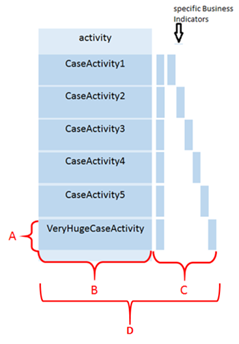
Each of these data objects is associated to a personal database view. Actually, under the hood all these views get their data from the same database tables. More details about this will follow in a separate post (<link to database post as soon as the post is their>). See figure below. Same goes for the ‘Process’ variant.
The views contain a subset of the rows and columns in the table.
- the rows of a BPM process
- Number of default columns that are the same for each process (generic part of e.g. BEAM_VIEW_116, BEAM_VIEW_11)
- Number of specific columns for the relevant BPM process (indicators) (specific part of e.g. BEAM_VIEW_116)
- Table where data is stored (e.g. BEAM_FLEX_11) Read the complete article here.
For regular information on Oracle SOA Suite become a member in the SOA & BPM Partner Community for registration please visit www.oracle.com/goto/emea/soa (OPN account required) If you need support with your account please contact the Oracle Partner Business Center.
 Blog
Blog  Twitter
  LinkedIn
 ![image[7][2][2][2]](https://paascommunity.com/wp-content/uploads/2013/04/image7222.png?w=20&h=20 "image[7][2][2][2]") Facebook
Facebook ![clip_image002[8][4][2][2][2]](https://paascommunity.com/wp-content/uploads/2013/04/clip_image00284222.jpg?w=26&h=23 "clip_image002[8][4][2][2][2]") Wiki
Wiki
Technorati Tags: SOA Community,Oracle SOA,Oracle BPM,OPN,Jürgen Kress
 There are a lot of informal end-to-end processes in organizations. These end-to-end processes are usually supported by scattered applications, email, spreadsheets and a lot of goodwill of the personnel involved. When compliance, regulations and/or customer demands are imposed on an organization, these end-to-end processes do not have the ability to comply with new demands due to lack of support from the current application landscape. In the financial, public and utilities market organizations are re-landscaping their existing application portfolio due to these higher compliance, regulations and customer demands. This often is not a huge transformation program, with a roadmap spanning over years.


 PaaS Community Blog