Jarvis Pizzeria: The various Decisions of a Decision Model by Richard Olrichs & Marcel van de Glind & Marc Kuijpers

image

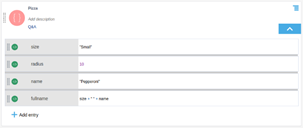
In one of our next posts we will implement the Decision Model in the Order Process. Before we do that we first explain the various type of decisions that are available for a Decision Model.
The Decision Model editor in PCS (Process Cloud Service) or the later OIC (Oracle Integration Cloud) supports the DMN (Decision Modeling Notation) standard version 1.1, and uses FEEL (Friendly Enough Expression Language) to make decision modeling easier and more intuitive.
In DMN all decision logic is represented as ‘boxed expressions’. A ‘boxed expression’ is a graphical notation for decision logic. Within OIC we recognize the following boxed expressions: Read the complete article here.

PaaS Partner Community

For regular information on Oracle PaaS become a member in the SOA & BPM Partner Community for registration please visit www.oracle.com/goto/emea/soa (OPN account required) If you need support with your account please contact the Oracle Partner Business Center.

Blog Twitter LinkedIn image[7][2][2][2] Facebook clip_image002[8][4][2][2][2] Wiki

Technorati Tags: SOA Community,Oracle SOA,Oracle BPM,OPN,Jürgen Kress
Jarvis Pizzeria: Activating activities and attaining milestones by Richard Olrichs & Marcel van de Glind & Marc Kuijpers

image

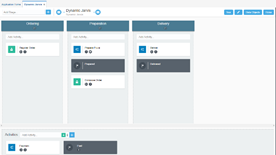
In our previous blogs we have given a brief overview of the look-and-feel of the dynamic process possibilities within PCS. In this blog we take a dive into the activation of activities, how milestones can be attained and how rules are configured to make sure that the correct actions are triggered when conditions are met.
Let’s take a look at our dynamic Jarvis overview first. In the picture below we came up with three stages: ordering, preparation and delivery.

Obviously we start the preparation phase after the ordering stage has completed. This configuration is shown below: Read the complete article here.


PaaS Partner Community

For regular information on Oracle PaaS become a member in the SOA & BPM Partner Community for registration please visit www.oracle.com/goto/emea/soa (OPN account required) If you need support with your account please contact the Oracle Partner Business Center.

Blog Twitter LinkedIn image[7][2][2][2] Facebook clip_image002[8][4][2][2][2] Wiki

Technorati Tags: SOA Community,Oracle SOA,Oracle BPM,OPN,Jürgen Kress
Jarvis Pizzeria: The logic underneath the Dynamic Process by Richard Olrichs & Marcel van de Glind & Marc Kuijpers

image

In our previous blog we have made the first set up of our dynamic process. We created several stages and had the first processes, human tasks and milestones in there. Now that we have the first draft of the dynamic process, it is time to actually call some processes and human tasks from our dynamic process.
In this blog we will explain how that is done. We already had imported the Preparation Process Application. But the delivery and payment are not part of this application. They are part of the overall Jarvis Pizzeria application. So before this blog, we also imported the Jarvis 1.0 application and the DeliveryDM to the new integration cloud.
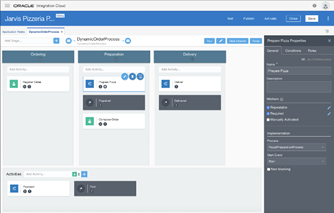
When we click the edit pencil of the ‘Prepare Pizza’ step, on the right hand side, we get to see the properties of this step. Under the Process section, we select the ‘PizzaPreparationProcess’ and the ‘start’ as start event.

We repeat these steps for all the processes we want to call, for example to do the delivery we call the existing start event from the DeliveryProcess. Read the complete article here.

PaaS Partner Community

For regular information on Oracle PaaS become a member in the SOA & BPM Partner Community for registration please visit www.oracle.com/goto/emea/soa (OPN account required) If you need support with your account please contact the Oracle Partner Business Center.

Blog Twitter LinkedIn image[7][2][2][2] Facebook clip_image002[8][4][2][2][2] Wiki

Technorati Tags: SOA Community,Oracle SOA,Oracle BPM,OPN,Jürgen Kress
Jarvis Pizzeria: Setting up the Dynamic Process by Richard Olrichs & Marcel van de Glind & Marc Kuijpers

image

In this blog we will implement a first version of the preparation of an order using a dynamic process. We continue where blog one stopped. The imported order process is extended with an example dynamic process.

We open the DynamicOrderProcess, which should still contains the example. We will build this so that it contains the Pizza ordering process. However, when opening the Process, we can see that the example is no longer there. Apparently, the example is not saved, maybe because we did not make any changes to it? Let’s create the example again, and then change it immediately.
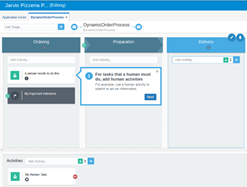
The first step we take to make it our own is to define the stages. Rename the ‘First Stage’ in ‘Ordering’. The ‘Second Stage’ in ‘Preparation’ and add another third stage ‘Delivery’.
For changing the name of a stage, select the pencil in the title bar to get to to properties.
In there change the name. Use the add icon just above the pencil to add the third stage.

Now let’s save our changes and see what happens to this modified ‘example’. We close the Dynamic process, and then open it again.
However, our changes have disappeared as well. The whole example is gone once again. How is that possible? Is something thoroughly wrong with the application or is an example application just an example, and can it not be saved? Anyway, it is good to realize the example application is there as an example and not like a QuickStart application.
So let’s restart again. Now we will not create an example, but just add the different stages.
After doing this, yet again, let’s put it to the test. We save our application, close it and reopen it. Yeah! Alright! Now the changes persists, so it does have something to do with the example mode. Read the complete article here.


PaaS Partner Community

For regular information on Oracle PaaS become a member in the SOA & BPM Partner Community for registration please visit www.oracle.com/goto/emea/soa (OPN account required) If you need support with your account please contact the Oracle Partner Business Center.

Blog Twitter LinkedIn image[7][2][2][2] Facebook clip_image002[8][4][2][2][2] Wiki

Technorati Tags: SOA Community,Oracle SOA,Oracle BPM,OPN,Jürgen Kress
Is BPM Dead, Long Live Microservices? By Luis Weir

image

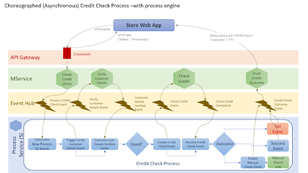
With the massive uptake of Microservices Architecture -industry wide- and with it, the adoption of patterns such as Event Sourcing, CQRS and Saga as the means for Microservices to asynchronously communicate with each and effectively "choreograph" business processes, it might seem as if the days of process orchestration using BPM engines (e.g. Oracle Process Cloud now also part of Oracle Integration Cloud, Pega, Appian, etc) or BPEL (or BPEL-like) engines are over.

Although the use of choreography and associated patterns (such as the aforementioned) makes tons of sense in many use cases, I’ve come across a number of them where choreography can be impractical.

Some examples:

  • Data needs to be collected and aggregated from multiple services -e.g. check the Microservice.io Composition pattern. Note that this pattern doesn’t necessarily implies that an orchestration is required. Could be that data is collected and aggregated (not transformed) into a single response. But if data collected from multiple sources needs to also be transformed into a common response payload, then it feels pretty close to one of the typical use cases for orchestration.
  • The process is human-centric and can’t be fully automated. Basically at some point a human has to take an action in other for the process to complete (e.g. approval of a credit card application, or a credit check) -BPM/Orchestration tools tend to be quite good at this.
  • There is a need to have very clear visibility of the end to end business processes. In traditional BPM tools, this is fairly straight forward, with Choreography / Events, although possible to monitor individual events, a form of correlation would be required to build an end to end view on the status of a business process. Read the complete article here.

PaaS Partner Community

For regular information on Oracle PaaS become a member in the SOA & BPM Partner Community for registration please visit www.oracle.com/goto/emea/soa (OPN account required) If you need support with your account please contact the Oracle Partner Business Center.

Blog Twitter LinkedIn image[7][2][2][2] Facebook clip_image002[8][4][2][2][2] Wiki

Technorati Tags: SOA Community,Oracle SOA,Oracle BPM,OPN,Jürgen Kress
Pre-built Virtual Machine for SOA Suite 12.2.1.3.0

image

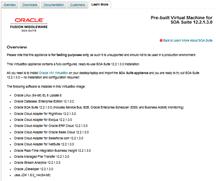
Please note that this appliance is for testing purposes only, as such it is unsupported and should not to be used in a production environment.

This VirtualBox appliance contains a fully-configured, ready-to-use SOA Suite 12.2.1.3.0 installation.

All you need is to install Oracle VM VirtualBox on your desktop/laptop and import the SOA Suite appliance and you are ready to try out SOA Suite 12.2.1.3.0 — no installation and configuration required! Get the virtual box here.

PaaS Partner Community

For regular information on Oracle PaaS become a member in the SOA & BPM Partner Community for registration please visit www.oracle.com/goto/emea/soa (OPN account required) If you need support with your account please contact the Oracle Partner Business Center.

Blog Twitter LinkedIn image[7][2][2][2] Facebook clip_image002[8][4][2][2][2] Wiki

Technorati Tags: SOA Community,Oracle SOA,Oracle BPM,OPN,Jürgen Kress
Rubicon Red Uses Oracle Cloud to Grow Green Business

image

Automating their end-to-end sales process with Oracle Integration Cloud and Mobile Cloud Enterprise saved Rubicon Red’s innovative professional services business 90% in cloud costs for trial provisioning and cut time spent from weeks to seconds. Watch the video here.


PaaS Partner Community

For regular information on Oracle PaaS become a member in the SOA & BPM Partner Community for registration please visit www.oracle.com/goto/emea/soa (OPN account required) If you need support with your account please contact the Oracle Partner Business Center.

Blog Twitter LinkedIn image[7][2][2][2] Facebook clip_image002[8][4][2][2][2] Wiki

Technorati Tags: SOA Community,Oracle SOA,Oracle BPM,OPN,Jürgen Kress
Provision Oracle Integration Cloud Using Stack Templates

image

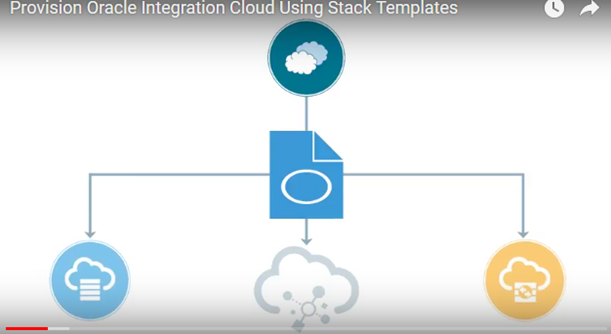
Complete a template that automatically provisions the required set of services together to get you up and running (Oracle Integration Cloud, Oracle Database Cloud Service, and Oracle Storage Cloud Service for data storage and backups).

For more information, see Creating an Instance with the Oracle Cloud Stack Template


PaaS Partner Community

For regular information on Oracle PaaS become a member in the SOA & BPM Partner Community for registration please visit www.oracle.com/goto/emea/soa (OPN account required) If you need support with your account please contact the Oracle Partner Business Center.

Blog Twitter LinkedIn image[7][2][2][2] Facebook clip_image002[8][4][2][2][2] Wiki

Technorati Tags: SOA Community,Oracle SOA,Oracle BPM,OPN,Jürgen Kress
Integration Cloud – Lets POC and get our feet wet by Kevin King

image

At a recent client, I had a "citizen integrator" ask me to show them some of the orchestrations that I’ve created in ICS, and how I went about creating them.  I began showing off some of the integrations, and some of the POCs that I created.  I didn’t get very far until he stopped me and asked, how I was able to invoke the integrations to test them.  This is when I realized he had previously attempted to create some integrations, but didn’t understand what he created, or how to trigger them and see them in action.

How do I test my integration on Oracle Integration Cloud Service (ICS)?

So, let’s take a common scenario, where you are asked to verify that an integration works from ICS or as a developer you want to explore a new integration you are going to interact with. We are going to look at the most common type of integrations, ‘Orchestration’.  Oracle has this all documented here, so feel free to jump there for more thorough documentation!

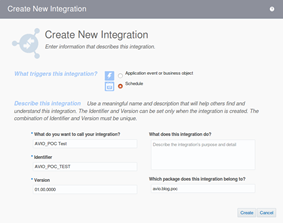
On creating a new Orchestration integration, the first decision is ‘What triggers this integration?’.  There are two options,  ‘Schedule’ and ‘Application event or business object’… So what are these, and what should I choose.

Trigger 1: Schedule

Let’s start with Scheduled, as this is the quickest option to ‘try out’ an integration or mapping.

Creating a ‘Scheduled’ orchestration is meant for exactly as it sounds, a schedule.  You can define it to run every minute, every hour, every Monday, whatever the requirement is…  The bonus feature about this option is the ‘Submit Now’ selection.  This makes it very easy to test!

Now, let’s create a new Orchestration, and select ‘Scheduled’ (make sure you follow best practices and add it to a package!). Read the complete article here.


PaaS Partner Community

For regular information on Oracle PaaS become a member in the SOA & BPM Partner Community for registration please visit www.oracle.com/goto/emea/soa (OPN account required) If you need support with your account please contact the Oracle Partner Business Center.

Blog Twitter LinkedIn image[7][2][2][2] Facebook clip_image002[8][4][2][2][2] Wiki

Technorati Tags: SOA Community,Oracle SOA,Oracle BPM,OPN,Jürgen Kress
Teaching How to Recover Errored Instances with Oracle Integration Cloud by Carlos Rodriguez Iturria

image 

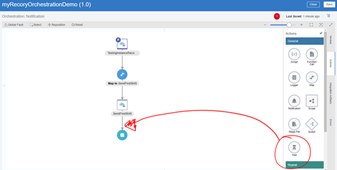
Building Enterprise integrations in the Cloud with iPaaS brings many benefits, including among others: simplicity, agility and scalability. However, these benefits should not be taxed by having a weak core, not able to properly manage common enterprise requirements, such as error management. I’ve been a bit disappointed with how most iPaaS vendors handle runtime exceptions of integration flows. A typical example of this, is not being able to support dehydration for asynchronous flows (i.e. dehydration is crucial to supporting long-running instances by saving their memory state into a database, until a correlation invocation, a.k.a call-back, wakes it up to continue with the flow). This causes that when an error occurs, recovery has to start from the beginning of the integration flow that failed.

In these situations, we would have to either design an integration to be fully idempotent and stateless across all its partner links (service invocations), which is not always possible. Another way to do it is by manually handling the recovery of errored scenarios, this is to avoid state inconsistency across the previous service invocations in the orchestration, prior to the error… But then if we have to manually handle compensation, what about iPaaS being easier? Read the complete article here.

PaaS Partner Community

For regular information on Oracle PaaS become a member in the SOA & BPM Partner Community for registration please visit www.oracle.com/goto/emea/soa (OPN account required) If you need support with your account please contact the Oracle Partner Business Center.

Blog Twitter LinkedIn image[7][2][2][2] Facebook clip_image002[8][4][2][2][2] Wiki

Technorati Tags: SOA Community,Oracle SOA,Oracle BPM,OPN,Jürgen Kress