Custom SOA Administrator by Antonis Antoniou

clip_image002

The default SOA administrator in a SOA/BPM installation is "weblogic". The SOA administrator, amongst other tasks, is the BPM Workspace administrator, the out-of-the-box web-based interface where users can access and manage their tasks. This is just fine for development and testing purposes.
However, at some point during your process lifecycle you will be faced with the task of creating and assigning a custom SOA administrator other than "weblogic" to serve your processes’ administrative tasks, for example, mapping application roles to users and/or enterprise groups.
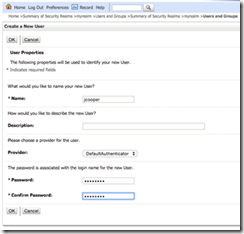
The first thing that you need to do is of course create your new SOA admin user using the Weblogic Administrator Console.

Next you need to point out to the SOA Infrastructure that James Cooper, as in the example above, will be the new SOA Administrator.
There are a couple of ways to do so.
The first and most easiest way is by assigning the "Administrators" group to your new user as in the image below.

The easiest way though is not always the right way. Doing so you are automatically granting access administrative access to applications like the Weblogic Console where you new SOA admin user can fiddle with your Weblogic settings.
A much better approach would be to map your new user to the SOAAmin application role using the Enterprise Manager. To do so, right click the soa-infra node and from the context menu select "Security > Application Roles"
On the "Application Roles" page enter SOAAdmin in the search box field and click on the search button. You should see the SOAAdmin application role displayed in the search results page and selected. Read the complete article here.

SOA & BPM Partner Community

For regular information on Oracle SOA Suite become a member in the SOA & BPM Partner Community for registration please visit www.oracle.com/goto/emea/soa (OPN account required) If you need support with your account please contact the Oracle Partner Business Center.

Blog Twitter LinkedIn image[7][2][2][2] Facebook clip_image002[8][4][2][2][2] Wiki

BPEL – Performance optimization of payload transformations within loops by Alexander Daeubler


clip_image002In a recent project (developed using SOA Suite 11g) one of the requirements was to filter out certain lines of an order as these lines should not be forwarded to the business partners. In a first version we looped over all lines of the order and used a transformation activity within the loop to add each line to the response element. In case the line should not be added to the response we just ignored it.

The loop looked like this:

The actual process contained more logic but for reasons of simplification I removed all activities that are not related to the topic of this blog post.

The XSL transformation logic was as follows:

  <xsl:param name=”CurrentlyProcessedLine” />
  <xsl:template match=”/”>
    <ns1:Order>
      <ns1:OrderHeader>
        <xsl:copy-of select=”/ns1:Order/ns1:OrderHeader/*” />
      </ns1:OrderHeader>
      <xsl:copy-of select=”/ns1:Order/ns1:OrderLine” />
      <ns1:OrderLine>
        <xsl:copy-of select=”$CurrentlyProcessedLine/ns1:OrderLine/*” />
      </ns1:OrderLine>
    </ns1:Order>
  </xsl:template>

Basically, for each iteration of the loop the old order was cloned and the current line was attached to that order (except for ignored orders, of course). Read the complete article here.

SOA & BPM Partner Community

For regular information on Oracle SOA Suite become a member in the SOA & BPM Partner Community for registration please visit www.oracle.com/goto/emea/soa (OPN account required) If you need support with your account please contact the Oracle Partner Business Center.

Blog Twitter LinkedIn image[7][2][2][2] Facebook clip_image002[8][4][2][2][2] Wiki

A Word About Microservice Architectures and SOA by Luis Augusto Weir


clip_image002In this article I will talk about my first conclusions and my point of view regarding Microservice Architectures. As there is still quite a lot of confusion and debate out there on this topic, I will try to describe with my own words what Microservice Architecture is, how does it differ from typical Service Oriented Architectures (SOA) and what design principles and practices governs it.
What is a Microservice Architecture?
In the article http://martinfowler.com/articles/microservices.html written by Fowler and Lewis, Microservice Architecture is described as following::

Microservice architectural style is an approach to developing a single application as a suite of small services, each running in its own process and communicating with lightweight mechanisms, often an HTTP resource API. These services are built around business capabilities and independently deployable by fully automated deployment machinery. There is a bare minimum of centralized management of these services, which may be written in different programming languages and use different data storage technologies

The article overall it’s a fantastic piece of work (really suggest you read it). The way Microservice Architectures it’s defined opens up a few pandora boxes (in a good way I think) which I will talk about subsequently.
First of all, if you are familiar with SOA and it’s guiding principles this will seem very familiar (read for example: http://en.wikipedia.org/wiki/Service-oriented_architecture or http://www.soa-manifesto.org/). Yet, if you noticed the highlighted texts, it’s not quite the same as what we are used to in traditional SOA. The truth is, wether we accept it or not, SOA architectures evolved around the adoption of certain design patterns (such as Enterprise Service Bus (ESB), canonical schemas, centralised contracts, -see http://www.soapatterns.org/ for more) and the use of SOA specific infrastructures to build and deploy services and APIs became the approach of choice (note that the service vs API topic it’s not discussed in this post. For my view on this read http://www.soa4u.co.uk/2013/09/restful-is-also-soa.html).
From my perspective, I would define Microservice Architecture’s as both 1) a design pattern and 2) a discipline for delivering services and APIs. To elaborate further based on my conclusions I can highlight the following guiding principles:

  • Delivering business focused and lightweight services/APIs that are truly design, built, deployed and executed independently of each other (meaning that in terms of infrastructure dependencies, they share very little)
  • Strong focus on people collaboration and communication as the main mechanism in the adoption of best practices and standards rather than common set of strict guidelines and standards that constraint the way services are define, built, deployed and maintained
  • DevOps (config management, deployment automation, CI, Continuous Delivery) as a fundamental building block rather than a value add
  • Scalability should be easy as services are very lightweight and stateless (The same service can run in many servers and DevOps makes the deployment process automatic and easy)
  • Doesn’t encourages the use of monoliths to deploy services (a monolith is for example an application server or an ESB). Services should run almost as demons

One can argue that SOA architectures can also satisfy the listed requirements as SOA it’s really an architecture paradigm that can be realised in different ways. I personally think this myself and I would regard Microservice Architecture as a SOA design pattern, however as per my previous point, comparing it with traditional SOA architecture’s there is a difference.

Microservices vs SOA Read the complete article here.

SOA & BPM Partner Community

For regular information on Oracle SOA Suite become a member in the SOA & BPM Partner Community for registration please visit www.oracle.com/goto/emea/soa (OPN account required) If you need support with your account please contact the Oracle Partner Business Center.

Blog Twitter LinkedIn image[7][2][2][2] Facebook clip_image002[8][4][2][2][2] Wiki

Upgrading to SOA 12c and details of the next UKOUG Middleware SIG by Simon Haslam

clip_image002SOA 12c is the most important release of Oracle’s flagship integration product set that we’ve seen for 5 years (when 11g was launched). Oracle has also now produced the first SOA 12c bundle patch-set (12.1.3.0.1) so in my opinion any new SOA installations should definitely be using 12c, and existing 11g users should be seriously considering upgrading to take advantage of the many new features.

For administrators what is particularly nice about this release is that a lot of work has clearly been put into the upgrade process, building on some of the changes introduced in WebLogic 12.1.2. The upgrade is actually surprisingly straightforward – in outline you have to:

  • Carefully review pre-requisites and do any purging of old instances
  • Install Fusion Middleware Infrastructure and SOA Suite 12c into a new Oracle home
  • Shut down SOA 11g, backup repository and domain home
  • Run RCU to install the new 12c schemas into the existing repository alongside the 11g ones
  • Run the Upgrade Assistant to upgrade the 11g schemas, including running instance data, to 12c format
  • Run the new Reconfiguration Wizard against the 11g domain home to rewire for the 12c home
  • Run the Upgrade Assistant a second time to upgrade some infrastructure components
  • If you have modified setDomainEnv,sh etc you will need to re-apply the changes
  • Backup repository and domain home, then start up SOA

Of course you may only have short-lived processes so be able to drain down the old SOA 11g system and switch over to a brand new SOA 12c system running in parallel, in which case the above upgrade is probably unnecessary.

The above does not consider migration from SOA Suite 10g to 11g/12c which is much more complicated and, if you’ve not already done it by now, a project in itself. Plus I’ve not mentioned Service Bus or BAM yet but we’ll describe in more detail in a week’s time…

UKOUG Middleware SIG – 25 March 2015

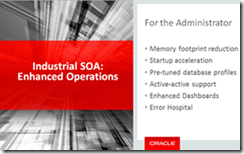
If you’re a UKOUG member and interested in SOA have a look at next week’s UKOUG Middleware SIG, themed around SOA 12c.  We’ve split the day into two – during the morning we will have several sessions by Oracle’s Yogesh Sontakke and Sid Joshi. These will review the new SOA 12c features, focus on the changes to Service Bus which will be very relevant to administrators, look at improvements to EDN and describe the new MFT product. As you might expect my interest mostly lies in the non-functional features of the platform, which happily has also been a focus for 12c under the moniker "Industrial SOA". Therefore I will be presenting some Oracle slides about changes in this area and will include some of my own 12c observations from project and O-box development work. Read the complete article here.

SOA & BPM Partner Community

For regular information on Oracle SOA Suite become a member in the SOA & BPM Partner Community for registration please visit www.oracle.com/goto/emea/soa (OPN account required) If you need support with your account please contact the Oracle Partner Business Center.

Blog Twitter LinkedIn image[7][2][2][2] Facebook clip_image002[8][4][2][2][2] Wiki

Stream Explorer series by Niall Commiskey

clip_image002Thanks to Niall for his Stream Explorer blog series:

Stream Explorer OEP Basics

Stream Explorer Preferences

Stream Explorer CSV Target

Stream Explorer JMS as Source and Target

Stream Explorer Patterns

SOA & BPM Partner Community

For regular information on Oracle SOA Suite become a member in the SOA & BPM Partner Community for registration please visit www.oracle.com/goto/emea/soa (OPN account required) If you need support with your account please contact the Oracle Partner Business Center.

Blog Twitter LinkedIn image[7][2][2][2] Facebook clip_image002[8][4][2][2][2] Wiki

SOA BPM Useful Links by Raviteja


clip_image002The below are some of the useful links I  refer for Oracle SOA BPM. I will  keep on adding the links regularly and please feel free to share important links via comments and I will add it to the list.
Lets help each other in sharing knowledge and solving issues and deliver an excellent product  for the Humanity 🙂

  1. ADF eCourses : Part1 and  Part2.
  2. SOA basics (Explore the right side of the website for more topics ) : link
  3. Getting Started with BPM: Free Oracle University Video Tutorials : link
  4. Oracle BPM organization unit : here.
  5. Case Management  basics: here .
  6. Case Management A-team basics: Part1, Part2 and Part3.
  7. Case Management A-tem in-depth : Part1, Part2 ,Part3 and Part4
  8. Case Management A-team cases : here.
  9. Case Management A-team Hello World : here .
  10. Official Oracle SOA Suite 11g Samples : here .

Get the complete link list here. Hey you missed the SOA & BPM Partner Community as Nr.1

SOA & BPM Partner Community

For regular information on Oracle SOA Suite become a member in the SOA & BPM Partner Community for registration please visit www.oracle.com/goto/emea/soa (OPN account required) If you need support with your account please contact the Oracle Partner Business Center.

Blog Twitter LinkedIn image[7][2][2][2] Facebook clip_image002[8][4][2][2][2] Wiki

Stream Explorer – Monitor the health of Devices in real time – video


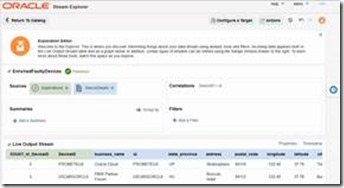
clip_image002This video demonstrates the use of Oracle Stream Explorer for monitoring and analyzing the health of devices (that report their status continuously). Events are consumed, filtered, pattern matched, enriched and finally forwarded to the EDN (Event Delivery Network) of SOA Suite where they trigger a SOA Composite application. Watch the video here.

SOA & BPM Partner Community

For regular information on Oracle SOA Suite become a member in the SOA & BPM Partner Community for registration please visit www.oracle.com/goto/emea/soa (OPN account required) If you need support with your account please contact the Oracle Partner Business Center.

Blog Twitter LinkedIn image[7][2][2][2] Facebook clip_image002[8][4][2][2][2] Wiki

Demonstration of Stream Explorer for live device monitoring – collect, filter, aggregate, pattern match, enrich and publish by Lucas Jellema


clip_image002This article describes a use case for Oracle Stream Explorer – Oracle’s business user friendly interface on top of OEP – Oracle Event Processor. We assume a large number of devices – such as printers, copiers, sensors, detectors, coffee machines – spread across the globe – and the cloud.

All devices continuously report their status, by sending a message every other second that contains their device identifier, a code that can indicate the healthy status or an error and some additional details. The sheer number of devices combined with the continuous stream of reports they sent in set the challenges perimeters within which we have to implement fast and effective monitoring. Our specific challenge is: “whenever a device reports an error code three times within 10 seconds, we consider that device broken, and action should be taken” (that also means that we do not spring into action on the first or even second fault report from a device). Additionally: we only require a single action for a broken device – once the action is initiated, we do not have to start an action again for that same device – unless of course it is broken again at a much later point in time.

The concrete implementation described in this article looks as follows:

For the sake of a simple demonstration, we read device message reports from a csv file, instead of a live stream such as a JMS destination or an HTTP channel. Note that the Stream Explorer implementation would be exactly the same for these other stream types. Stream Explorer processes the device signals. For signals that satisfy the requirements of a broken device, the information is enriched from a database with device details – such as the physical location of the device – and finally an EDN event is composed and published. This event is consumed by a SOA Composite application in the SOA Suite 12c environment. This composite can virtually do anything, including assigning a task, starting a BPM process or sending an email.

The implementation described in this article is also demonstrated in a video on YouTube: Read the complete article here.

SOA & BPM Partner Community

For regular information on Oracle SOA Suite become a member in the SOA & BPM Partner Community for registration please visit www.oracle.com/goto/emea/soa (OPN account required) If you need support with your account please contact the Oracle Partner Business Center.

Blog Twitter LinkedIn image[7][2][2][2] Facebook clip_image002[8][4][2][2][2] Wiki

Stream Explorer article series by Lucas Jellema


SOA & BPM Partner Community

For regular information on Oracle SOA Suite become a member in the SOA & BPM Partner Community for registration please visit www.oracle.com/goto/emea/soa (OPN account required) If you need support with your account please contact the Oracle Partner Business Center.

Blog Twitter LinkedIn image[7][2][2][2] Facebook clip_image002[8][4][2][2][2] Wiki

Middleware Update 06 August 2015


clip_image002The August edition of the Middleware Partner Update contains three key topics:

  • SOA 12c Specialization
  • Solutions Catalog & Cloud Marketplace
  • SOA & BPM Partner Community Webcast

For regular updates please subscribe to our YouTube channel here. For the latest SOA & BPM Partner Community information please visit our Community update wiki here (Community membership required)

SOA & BPM Partner Community

For regular information on Oracle SOA Suite become a member in the SOA & BPM Partner Community for registration please visit www.oracle.com/goto/emea/soa (OPN account required) If you need support with your account please contact the Oracle Partner Business Center.

Blog Twitter LinkedIn image[7][2][2][2] Facebook clip_image002[8][4][2][2][2] Wiki