Accessing Object Storage from Oracle Integration by Ankur Jain

image

The Oracle Cloud Infrastructure (OCI) offers a rich set of services and Object Storage is one of the important services that can be used to store a wide variety of objects of any content type such as videos, images, documents, and so on. Depending on the bucket you created in Object Storage, you can access it from OCI or the public internet.

In the previous few other posts, you may have seen the usage of an FTP adapter to read/write files which is a traditional approach to store files. So as the digitization of data is on-demand, Object Storage is in high demand to store the data and access it from anywhere.

You can automate your different document repositories to store data in the Object Storage using the Oracle Integration Cloud to make it a centralized repository.

You would be requiring few things before you access the Object Storage from the Oracle Integration and store your objects. Following are the few things you would be requiring: Read the complete article here.

PaaS Partner Community

For regular information on Oracle PaaS become a member in the PaaS (Integration & Process) Partner Community please register here.

clip_image003 Blog clip_image005 Twitter clip_image004 LinkedIn image[7][2][2][2] Facebook clip_image002[8][4][2][2][2] Wiki

Technorati Tags: SOA Community,Oracle SOA,Oracle BPM,OPN,Jürgen Kress

OIC and Oracle Hospitality (OHIP) – Getting the most out of Opera APIs by Niall Commiskey

image

This is my second post on integrating with Oracle Hospitality Cloud using OIC. The introductory post is here. So let’s continue our journey…I preface this post with the usual caveat – I am not an expert on Oracle Hospitality, however, I have been playing around with the apis provided by OHIP.

So here is the basic scenario – I want to implement the following basic use cases –

1. room reservation

2. checkin

The introductory post covered room reservation, but here is a recap. Think of OHIP (Oracle Hospitality Integration Platform) as THE catalog of APIs for Opera integration and THE Gateway for processing API requests. Starting point is getting the required OAuth Token -  Read the complete article here.

PaaS Partner Community

For regular information on Oracle PaaS become a member in the PaaS (Integration & Process) Partner Community please register here.

clip_image003 Blog clip_image005 Twitter clip_image004 LinkedIn image[7][2][2][2] Facebook clip_image002[8][4][2][2][2] Wiki

Technorati Tags: SOA Community,Oracle SOA,Oracle BPM,OPN,Jürgen Kress
Integrating Oracle Hospitality Cloud and 3rd party CRM (SFDC) via OIC and OHIP by Niall Commiskey

image

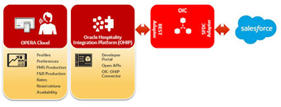
This is a typical Opera Integration use case – extract guest details from reservations/profiles and put them into a CRM for sales and marketing purposes. Simple scenario here – create contacts in SFDC for new Opera reservations. Here I query the Profile and Reservations objects in Opera via OHIP and then leverage the OIC SFDC adapter to create the relevant Contacts in SFDC. This will be a scheduled job that runs on a regular basis, ensuring my guest profiles etc are in sync with the relevant contact data in SFDC. Starting point, as usual, is Postman and the starter collection delivered by OHIP. Read the complete article here and watch the webcast Connect Opera with Oracle SaaS.

PaaS Partner Community

For regular information on Oracle PaaS become a member in the PaaS (Integration & Process) Partner Community please register here.

clip_image003 Blog clip_image005 Twitter clip_image004 LinkedIn image[7][2][2][2] Facebook clip_image002[8][4][2][2][2] Wiki

Technorati Tags: SOA Community,Oracle SOA,Oracle BPM,OPN,Jürgen Kress
Guidelines when moving Integration Workloads from SOA to Oracle Integration by Shreenidhi Raghuram

image

Introduction

The aim of this blog is to guide customers when they set out to migrate their integration solutions from SOA to Oracle Integration (OIC). 
The focus in this blog is to help customers during the creation, configuration of Oracle Integration service instances, and also provide best practices for choosing the right OIC features and integration patterns when developing SOA equivalent integrations on Oracle Integration Cloud.

The existing SOA workloads could be running in customer data-centers, on-premise or on Oracle cloud. The blog aims to provide high level guidelines when moving integration workloads from SOA to Oracle Integration Cloud.

To start with the SOA Suite installations could be any of the below –

  • SOA on-premise – Where SOA is installed and managed on-premise or within customer datacenter
  • SOACS on OCI – these are SOACS installation running on customer OCI tenancy in one of the OCI regions worldwide
  • SOACS Marketplace – This is the newer installations which run on OCI and are installed using the SOA images available in Oracle market place
  • SOACS on OCI Classic – These are legacy SOACS installations running on OCI Classic datacenters. Read the complete article here.

PaaS Partner Community

For regular information on Oracle PaaS become a member in the PaaS (Integration & Process) Partner Community please register here.

clip_image003 Blog clip_image005 Twitter clip_image004 LinkedIn image[7][2][2][2] Facebook clip_image002[8][4][2][2][2] Wiki

Technorati Tags: SOA Community,Oracle SOA,Oracle BPM,OPN,Jürgen Kress

Subscribing to Fusion Custom Business Events in OIC by Kishore Katta

image

Integration with all Oracle Fusion based Cloud services – like Oracle Financials Cloud , Oracle SCM Cloud, Oracle Engagement Cloud each service publishes Business Events wherein Oracle Integration can subscribe. Events is a great way to broadcast information to downstream systems for Real Time Synchronization

ERP cloud publishes 2 types of events. In this blog we will see how Custom Business Events can be published in ERP cloud and subscribe in OIC

Whenever we create a new custom object in Oracle ERP Cloud using Oracle Application Composer,  custom business events can be published explicitly. Once published, these business events can be subscribed from Oracle Integration (OIC). Business Events  are visible for selection when configuring the Oracle ERP Cloud Adapter in OIC as a trigger connection in the Adapter Endpoint Configuration Wizard.

For each Custom parent Object, OIC supports 3 Standard Events (Create, update, and delete ). Any operations on child custom objects generate update events for the parent custom objects. When  a record is created, OIC is notified with record detail information through event handler framework on subscription to any related events. Read the complete article here.

PaaS Partner Community

For regular information on Oracle PaaS become a member in the PaaS (Integration & Process) Partner Community please register here.

clip_image003 Blog clip_image005 Twitter clip_image004 LinkedIn image[7][2][2][2] Facebook clip_image002[8][4][2][2][2] Wiki

Technorati Tags: SOA Community,Oracle SOA,Oracle BPM,OPN,Jürgen Kress
Beating OIC’s FTP File Limits by Phil Wilkins

image

OIC has for some time now provided an FTP adaptor and more recently included a full FTP server capability. But both have limits on the file size and capacity. The file constraints (1GB for a file and 500GB for the FTP server) shouldn’t be an issue for day to day activities. But OIC is often used to support SaaS Financials and other cloud solutions which do have monthly process cycles which can generate significant data volumes, for example, payroll data. The question is how to handle such data with such constraints?

Data Integration?

There is a school of thought that points to the possibility when handling such large data volumes we should consider using Data Integration rather than a more event-centric integration tool. Personally, I think there is a lot of validity in the argument, and anyone dealing with such bulky data activities should review and question if it is a better answer.

That said, there are cases where it does stand-up. For example:

  • If an organization is transitioning to a more event-driven or at least micro-batch model, you have to start the transition somewhere, but trying to line up changes everywhere can be problematic, so we have to start somewhere. Building an integration process so you have an event model developed, but in the interim, you need to take that bulk mechanism and convert it to a small stream of events.
  • You may be working with a bulk data extract and only need a small subset of the data provided, it won’t help if the data is also represented using a verbose notation such as XML.

Other Approaches

How to overcome the constraint? Oracle databases aren’t so constrained, and SQLLoader can provide an easy means to ingest the data into a staging table. The benefit of this is:

  • if you’re only needing a subset of the data you can pull just those columns from the table.
  • the bulk of the use of XML to be self-describing can be shed through using the DB schema as being more prescriptive. Read the complete article here.

PaaS Partner Community

For regular information on Oracle PaaS become a member in the PaaS (Integration & Process) Partner Community please register here.

clip_image003 Blog clip_image005 Twitter clip_image004 LinkedIn image[7][2][2][2] Facebook clip_image002[8][4][2][2][2] Wiki

Technorati Tags: SOA Community,Oracle SOA,Oracle BPM,OPN,Jürgen Kress

    Using Aggregate Functions Sum(), Count() while Processing Larger Files by Phaneendra Bommisetty

    image

    Introduction:

    OIC has the capability of processing huge CSV files (up to 1GB) using Stage "Read File In Segments" activity.  In some use-cases, customers require to calculate the sum of a column or count of rows.

    Consider the following payload. Say, we want to calculate the sum of all the values in the column "Amount1". Customers tend to declare a variable upstream to Stage action and keep on updating this variable with the computation done in each chunk of the Stage.

    Solution:

    This blog describes one of the optimal approaches to use the aggregate functions Sum, Count while processing larger files. Read the complete article here.

    PaaS Partner Community

    For regular information on Oracle PaaS become a member in the PaaS (Integration & Process) Partner Community please register here.

    clip_image003 Blog clip_image005 Twitter clip_image004 LinkedIn image[7][2][2][2] Facebook clip_image002[8][4][2][2][2] Wiki

    Technorati Tags: SOA Community,Oracle SOA,Oracle BPM,OPN,Jürgen Kress

    How to define a Repeating Global Variable by Jorge Herreria

    image

    Summary

    This blog addresses the following use case:  "In my OIC Orchestration, when I define a Global variable based on a repeating element (aka unbounded), the global variable is not repeating; I cannot add/append to it"

    The nutshell solution:

    Choose the parent element when defining the global variable

    Details

    Why the variable is not repeating?

    Because of XML Rules: When a global variable is defined, internally it is defining a reference to a XML Document. Any XML Document must have a single instance root element; in other words it cannot be a collection of root elements, even if they have the same element name.

    How Do I Solve my requirement?

    When defining the Variable, choose the parent element of the unbounded element (repeating). That way the  XML Document root element will be the parent element, and one of its children will be the unbounded element

    To reference the variable use the location path (xpath) to the unbounded element.

    Example

    Defining vErrors with the intent to use errorDetails repeating element. Read the complete article here.

    PaaS Partner Community

    For regular information on Oracle PaaS become a member in the PaaS (Integration & Process) Partner Community please register here.

    clip_image003 Blog clip_image005 Twitter clip_image004 LinkedIn image[7][2][2][2] Facebook clip_image002[8][4][2][2][2] Wiki

    Technorati Tags: SOA Community,Oracle SOA,Oracle BPM,OPN,Jürgen Kress

    My private Corner – 20 years

    Kress 2015 aMay 1st 2001 I joined Oracle. In my first role I supported partners in Germany, from large system integrators, hardware partners, resellers to outsourcing companies. Driven by the middleware success we created the EMEA SOA and WebLogic Partner Communities. Oracle evolved from a database company to a full stack provider. Numerous acquisitions like Sun, BEA Peoplesoft accelerated the expansion in the hardware, middleware and applications business. With the raise of Cloud Computing the industry changes. In my global product management role we support you to adopt the Oracle Cloud Platform. Oracle Integration is a key accelerator to connect SaaS and Oracle Digital Assistant to innovate SaaS. What’s your Oracle journey, how did you participate in our communities? Let us know, send us a tweet at #PaaSCommunity!

    PaaS Partner Community

    For regular information on Oracle PaaS become a member in the PaaS (Integration & Process) Partner Community please register here.

    clip_image003 Blog clip_image005 Twitter clip_image004 LinkedIn image[7][2][2][2] Facebook clip_image002[8][4][2][2][2] Wiki

    Technorati Tags: SOA Community,Oracle SOA,Oracle BPM,OPN,Jürgen Kress

    Top tweets PaaS Partner Community May 2021

    Mayimage top tweets by PaaSCommunity

    Send your tweets @soacommunity #PaaSCommunity and follow us at http://twitter.com/soacommunity. Make sure you share your content with the community!

    PaaS Partner Community

    For regular information on Oracle PaaS become a member in the PaaS (Integration & Process) Partner Community please register here.

    clip_image003 Blog clip_image005 Twitter clip_image004 LinkedIn image[7][2][2][2] Facebook clip_image002[8][4][2][2][2] Wiki

    Technorati Tags: SOA Community,Oracle SOA,Oracle BPM,OPN,Jürgen Kress, Twitter