Microprocess Consequences by Jan Kettenis

image

In a previous blog article I introduced the Microprocess Architecture. The article below discusses the consequences of maintaining, managing and running applications that are build according to this architecture.

We are applying the Microprocess Architecture to some 4 Dynamic Process applications that are being built with the Oracle Integration Cloud (OIC) for some one and a half year already, but none of them went production so far. We can clearly see the benefits of applying the Microprocess Architecture, but also realize the consequences. I have addressed most of these with some pointers for dealing with them in a follow-up article on the subject.

As the go-live date slowly but inevitably is nearing, people obviously start wondering what the consequences regarding maintaining, managing and running such applications mean in the context of OIC. The below discusses this, referring to a “business process” as the main application that is made up by a collection of microprocesses.

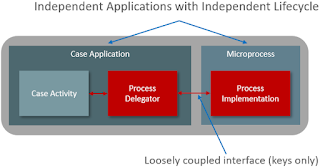
The following picture shows the core concepts of the Microprocess Architecture in the context of a case application: The case application with its activities is separated from the components that do the "actual work": the microprocesses. The case application does only the choreography and therefore is restricted to rule logic. The microprocesses are relatively small and simple stand-alone process application doing service calls and handling human tasks. Read the complete article here.

PaaS Partner Community

For regular information on Oracle PaaS become a member in the PaaS (Integration & Process) Partner Community please register here.

clip_image003 Blog clip_image005 Twitter clip_image004 LinkedIn image[7][2][2][2] Facebook clip_image002[8][4][2][2][2] Wiki

Technorati Tags: SOA Community,Oracle SOA,Oracle BPM,OPN,Jürgen Kress
My private Corner – are you an expert?

image

More than 725 consultants become a certified Oracle Implementation expert in the last 6 months. Thanks for spending the time to study and taking the exam. Want to become an expert? Take the exam here. Trained and certified experts deliver successful customer projects. You are one of this certified expert? Let us know, send us a tweet at #PaaSCommunity!

PaaS Partner Community

For regular information on Oracle PaaS become a member in the PaaS (Integration & Process) Partner Community please register here.

clip_image003 Blog clip_image005 Twitter clip_image004 LinkedIn image[7][2][2][2] Facebook clip_image002[8][4][2][2][2] Wiki

Technorati Tags: SOA Community,Oracle SOA,Oracle BPM,OPN,Jürgen Kress

Archiving and Purging Process Automation Data in Oracle Integration by Arvind Venugopal and Nilakshi Soni

image

What data is generated by Process in Oracle Integration

Large volumes of data are generated during the life of each process instance. This data collected can be broadly divided into two. Instance data and Analytics data.

  • Instance Data:    This is instance specific data generated at each step during execution. It includes the payload, comments, execution and audit information. 
  • Analytics Data:   Additional system metrics and user defined business metrics are also collated and stored at predefined events during the lifecycle of an instance. This data exists independently of the instance data
Archive Process data in Oracle Integration

Archiving is taking data which is no longer actively used and storing it in an external secondary storage where it can be retained for extended time. This archived data can be accessed, if needed, for compliance, audit, and analytics. Archiving the right data can not only save businesses money, but also intelligence derived using this will add value to the business. The following questions are often asked when users are setting up archive: what all data should be archived, how to setup archiving and finally how to retrieve data from the archived file. The purpose of these blogs is to discuss couple of options which will answer these very questions.
When planning an archiving strategy best suited for your needs one must give thought to some basic questions like

  • how often you would need to retrieve data from the archive
  • what data needs to be available for legal and regulatory compliance
  • what data set could be analyzed to add value to the business over time etc.
  • what insights are relevant for your business. Read the complete article here.

PaaS Partner Community

For regular information on Oracle PaaS become a member in the PaaS (Integration & Process) Partner Community please register here.

clip_image003 Blog clip_image005 Twitter clip_image004 LinkedIn image[7][2][2][2] Facebook clip_image002[8][4][2][2][2] Wiki

Technorati Tags: SOA Community,Oracle SOA,Oracle BPM,OPN,Jürgen Kress
The Micro Process Feature Making Life Easier by Jan Kettenis

image

In this article I discuss the Micro Process feature in the Oracle Integration Cloud (OIC). With some price I can take credit for being the name giver of this feature, which makes applying the Microprocess Architecture in OIC a bit simpler. But even when you are not applying that architecture, it still is a feature worth being aware of.

A few releases ago the Micro Process feature has been introduced in the Oracle Integration Cloud (OIC). Simply put, it provides a convenience for calling a Structured Process from a different process application.

"What a great feature that sounds, why did you not write about it before?", I can hear you thinking. Well, there were a few issues with it which mostly have been fixed since OIC release (20.2.3.0.0 (200705.0200.36413)). That’s why.

"What is this "Microprocess Architecture?", I hear some others thinking. In short, the Microprocess Architecture is about constructing a process application by having (typically but not necessarily) 1 main process that orchestrates / choreographs activities of which each of them is implemented as separate, decoupled process applications. It is not the same but inspired by many of the solid principles behind the Microservices Architecture, hence the name.

When applied to the Oracle Integration Cloud, every activity in the main process is implemented by an (asynchronous) Structured Process called a "Delegator" that does nothing but start some other Structured Process using a Send activity and then wait for the outcome in a Receive activity. There are a few deviations, but basically that’s it and what the "Use Micro Process" feature supports.

Before this, you as a developer first had to configure the external process as External SOAP Integration and provide the URL to the WSDL (or upload it), and secondly you had to create the Delegator yourself. Now you just point and click and off you go. When using it in a Dynamic Process, a Delegator is automatically created and hidden in the background.

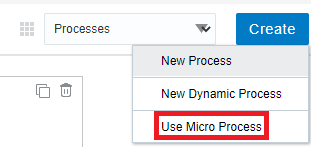
Microprocesses are configured from the Processes tab.

You select the Structured Process to use from a picklist. Be aware that only Structured Processes are shown from activated Process Applications. For bigger Microprocess applications there can be many of them, so it is good that you can filter them with a Search box. Also mind that it shows Structured Processes from all the default revisions of the Process Applications containing them. Read the complete article here.

PaaS Partner Community

For regular information on Oracle PaaS become a member in the PaaS (Integration & Process) Partner Community please register here.

clip_image003 Blog clip_image005 Twitter clip_image004 LinkedIn image[7][2][2][2] Facebook clip_image002[8][4][2][2][2] Wiki

Technorati Tags: SOA Community,Oracle SOA,Oracle BPM,OPN,Jürgen Kress

Import and Export MDS artifacts in SOA 12c by Pranav Davar

image

Oracle SOA-MDS (Metadata Store) repository can be used to access artifacts that can be shared among various SOA composites. For example, we have one common schema for a business fault that is consumed by various applications. Instead of having a localized copy of that schema file in each SOA composite, we can have it in a centralized repository (SOA-MDS). Another benefit of using SOA-MDS is that we can change the file at runtime and need not redeploy the complete code.

While developing SOA composites, we use SOA design-time repository, later these changes can be synced to the SOA servers. In this article, we will discuss 2 ways to sync the artifacts available in the SOA design-time repository and the SOA servers.

  1. Establishing the connection to SOA-MDS in Jdeveloper.
  2. Using SOA em console or Fusion Middleware control console.

Moving a file between SOA composite to SOA design-time MDS repository

Let’s assume, we created a businessFault.xsd which will be used by various SOA composites or projects. Before moving this file to the SOA server MDS location, we need to first push it to the SOA design-time repository. Read the complete article here.

PaaS Partner Community

For regular information on Oracle PaaS become a member in the PaaS (Integration & Process) Partner Community please register here.

clip_image003 Blog clip_image005 Twitter clip_image004 LinkedIn image[7][2][2][2] Facebook clip_image002[8][4][2][2][2] Wiki

Technorati Tags: SOA Community,Oracle SOA,Oracle BPM,OPN,Jürgen Kress
Create Delimited String from XML Nodes and Vice Versa in SOA 12c by Pranav Davar

image

A delimited string is a string representation of data separated by a delimiter(e.g. ","). A simple representation of the delimited string will look like.

Delimited String Examples

Sample-1– Delimiter as ","
    Value1,Value2,Value3 
Sample-2– Delimiter as "|"
    Value1|Value2|Value3

If we want to represent the above set of delimited values in the form of an XML document under some root and parent tag. The representation will look like this.

XML Example

<root xmlns="http://test.com/sample/xml"&gt;

  <Values>

    <value>Value1</value>

    <value>Value2</value>

    <value>Value3</value>

  </Values>

</root>

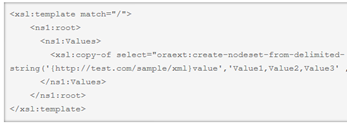
Sometimes we may need to convert values coming in delimited string to an xml document or vice versa. Since delimited string is similar to csv format. We can create a nxsd schema and then perform translate i.e. native to xml or xml to native within our SOA application. But in the scenarios wherein we just want to convert one delimited string to xml or recurring xml nodes to one delimited string, there we can make use of oracle xpath extension functions: Read the complete article here.

PaaS Partner Community

For regular information on Oracle PaaS become a member in the PaaS (Integration & Process) Partner Community please register here.

clip_image003 Blog clip_image005 Twitter clip_image004 LinkedIn image[7][2][2][2] Facebook clip_image002[8][4][2][2][2] Wiki

Technorati Tags: SOA Community,Oracle SOA,Oracle BPM,OPN,Jürgen Kress
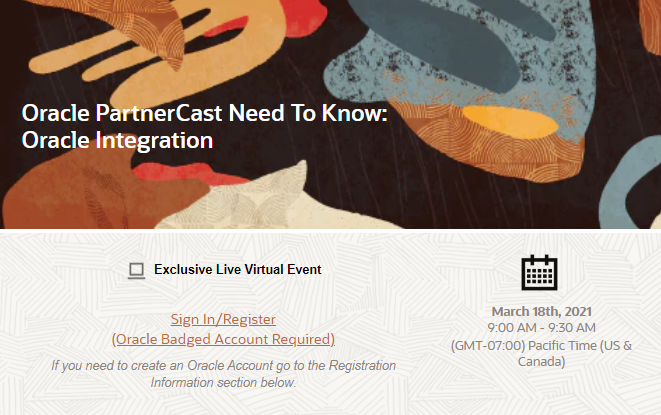
Experience Oracle’s innovative Integration portfolio from end to end – March 18th, 2021 9:00 AM – 9:30 AM Pacific Time

Experience Oracle’s innovative Integration portfolio from end to endimage
Highlights

Learn about various key components of the Oracle Integration solution. Establish seamless connectivity with your Applications; On-prem, SaaS or in any cloud with our large portfolio of Adapters. Learn how you can leverage Business Accelerators to speed up your integrations by 10X. Empower your Business Owners with Integration Insights. Collaborate with your Trading Partners with B2B. Design, develop, deploy, manage and monetize your API’s. Extend your applications with Visual Builder.

Agenda
  • Oracle Integration Overview
  • Core Components
  • Demonstration
  • Customer Case Studies
  • Summary

Schedule:  March 18th, 2021 9:00 AM – 9:30 AM Pacific Time

For details please visit the registration page here.

PaaS Partner Community

For regular information on Oracle PaaS become a member in the PaaS (Integration & Process) Partner Community please register here.

clip_image003 Blog clip_image005 Twitter clip_image004 LinkedIn image[7][2][2][2] Facebook clip_image002[8][4][2][2][2] Wiki

Technorati Tags: SOA Community,Oracle SOA,Oracle BPM,OPN,Jürgen Kress
Identity Propagation – VBCS > IC > Fusion Apps by Greg Mally

image

This blog was a collaborative effort between Greg Mally and Mike Muller of the A-Team.  There is an effort under way to provide example assets for this blog and when those assets are available, this blog will be updated with details on how to get to them.

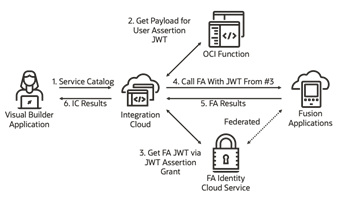
One of the big challenges that Oracle Integration Cloud developers face is any outbound REST calls from Integration Cloud (IC) to Fusion Applications (FA) APIs require a user’s identity.  On the surface this seems pretty trivial because the IC REST connections allow for configuring the connection with basic authentication or OAuth 2 JSON Web Token (JWT). However, this configuration is tied to a single user and many use cases/flows require the identity of the person making the FA REST call due to access restrictions, security, auditing, etc. This blog will present a pattern that has been implemented to accomplish identity propagation from a client application, through IC, and to FA. Read the complete article here.

PaaS Partner Community

For regular information on Oracle PaaS become a member in the PaaS (Integration & Process) Partner Community please register here.

clip_image003 Blog clip_image005 Twitter clip_image004 LinkedIn image[7][2][2][2] Facebook clip_image002[8][4][2][2][2] Wiki

Technorati Tags: SOA Community,Oracle SOA,Oracle BPM,OPN,Jürgen Kress
On-demand Webinar: Maximize the Potential of Oracle Integration Cloud with FlexDeploy

image

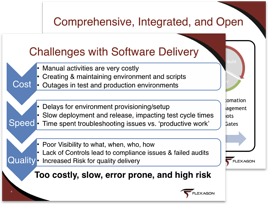
Oracle Integration Cloud (OIC) can help quickly and seamlessly integrate data, applications, and services and be a key enabler to your digital transformation process.
However, OIC does not include features for automated CI/CD, and deployment of OIC artifacts is a manual process, which means extra time, additional manpower, and management nightmares.
In this webinar, you will learn how FlexDeploy can eliminate these manual steps and reduce costs and risk by:

  • Automating the build and deployment of OIC artifacts including Integrations, Connections, Lookups, and Libraries
  • Adopting Continuous Integration (CI) and Release Pipelines
  • Integrating tools like Git, SVN, Jira, SoapUI, Postman, and ServiceNow. Read the complete article here.

PaaS Partner Community

For regular information on Oracle PaaS become a member in the PaaS (Integration & Process) Partner Community please register here.

clip_image003 Blog clip_image005 Twitter clip_image004 LinkedIn image[7][2][2][2] Facebook clip_image002[8][4][2][2][2] Wiki

Technorati Tags: SOA Community,Oracle SOA,Oracle BPM,OPN,Jürgen Kress

New Release of Oracle SOA Suite Docker Image by Ravi Pinto

image

We are extremely happy to announce the release of a new version of the Oracle SOA Suite Docker Image. In keeping with our policy of Quarterly Feature release, this release will be tagged as 20.4.2. This is an update to our earlier GA announcement, which was tagged 20.3.3

The salient features of this release are as follows

  1. The release incorporates October 2020 PSU and known bug fixes.
  2. We have added HEALTHCHECK support for the Oracle SOA Suite docker image

You can download the Oracle SOA Suite 12.2.1.4 Docker image using patch id 32215749 on My Oracle Support. As always, up-to-date documentation is available here – https://oracle.github.io/fmw-kubernetes/soa-domains/

Wishing you very happy Holidays and keep watching this space for even more exciting news and updates coming your way! Read the complete article here.

PaaS Partner Community

For regular information on Oracle PaaS become a member in the PaaS (Integration & Process) Partner Community please register here.

clip_image003 Blog clip_image005 Twitter clip_image004 LinkedIn image[7][2][2][2] Facebook clip_image002[8][4][2][2][2] Wiki

Technorati Tags: SOA Community,Oracle SOA,Oracle BPM,OPN,Jürgen Kress