OIC Nov 20 Release – Netsuite adapter New Features by Niall Commiskey

image
Searching on Item

Item and Transaction are super records which can have many constituent types.

For example –

Inventory Items – physical products that can be bought or sold.

Assembly Items – physical components that need to be assembled into a finished product.

There are also non-inventory items e.g. for digital assets etc. Read the complete article here.

PaaS Partner Community

For regular information on Oracle PaaS become a member in the PaaS (Integration & Process) Partner Community please register here.

clip_image003 Blog clip_image005 Twitter clip_image004 LinkedIn image[7][2][2][2] Facebook clip_image002[8][4][2][2][2] Wiki

Technorati Tags: SOA Community,Oracle SOA,Oracle BPM,OPN,Jürgen Kress

Diagnostic logging ‘events’ and benefits of decoupled log-processors by Jang-Vijay Singh

image

The implementation of  good logging frameworks is typically asynchronous for good reason: background processing involved in logging activities must not cause an overhead in the main flow. Even the simplest action like writing the output to a log file is implemented behind the scenes in separate threads.


From a log analysis and diagnostics point of view, this is not a problem as each log entry includes a timestamp that shows the instant when the log entry was requested (rather than the time it was actually written to a log file)

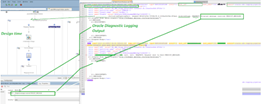
The same principle applies when we use more complex technologies like the Oracle Service Bus and Oracle Integration Cloud (OIC). Each offers dedicated log activities that write to *-diagnostic.log files or the OIC activity stream.

Customer Requests

More than once, I came across some customer requests where they proposed writing dedicated services to perform something more complex than just writing to log files or activity streams. Customer would perhaps expect structured log entries in a specific format to be published to some queue or persisted to some big-data store. It is proposed that such a dedicated services/API’s that would then be called by each integration flow or process at different points like entry, exit, and error catch blocks.

However this has two clear drawbacks:

1) It involves a design-time and development time overhead where this new custom ‘logging API’ would be called by each integration flow (we then need to worry about its availability and error handling in addition to the actual real services we need to worry about). Read the complete article here.

PaaS Partner Community

For regular information on Oracle PaaS become a member in the PaaS (Integration & Process) Partner Community please register here.

clip_image003 Blog clip_image005 Twitter clip_image004 LinkedIn image[7][2][2][2] Facebook clip_image002[8][4][2][2][2] Wiki

Technorati Tags: SOA Community,Oracle SOA,Oracle BPM,OPN,Jürgen Kress
Oracle Hospitality Innovation Week March 22nd – 25th 2021

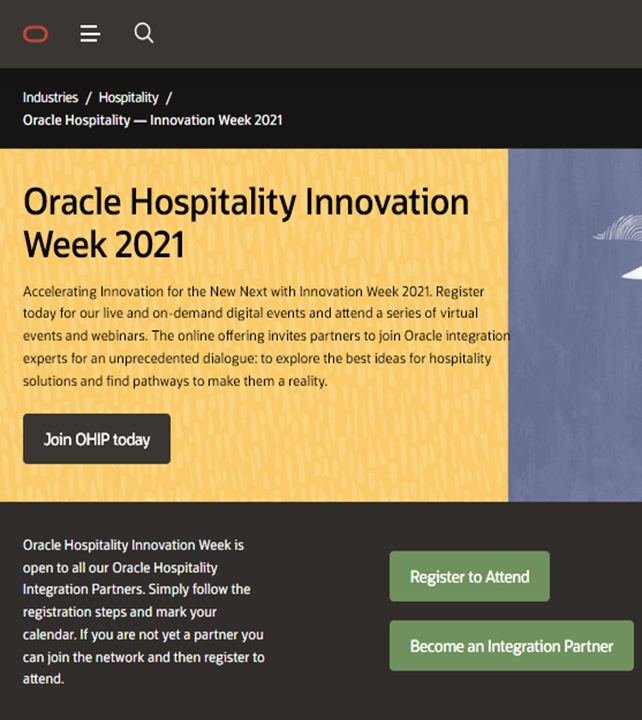
imageAccelerating Innovation for the New Next with Innovation Week 2021. Register today for our live and on-demand digital events and attend a series of virtual events and webinars. The online offering invites partners to join Oracle integration experts for an unprecedented dialogue: to explore the best ideas for hospitality solutions and find pathways to make them a reality.

Oracle Integration Cloud and OHIP: A Match Made in Heaven

The Hospitality IT landscape is complex and fragmented. View this session to accelerate your digital transformation with pre-integrated connectivity to Oracle as well as third-party SaaS and on-premises apps, run-ready process automation templates, and an intuitive visual app builder.

Topics include:

  • Oracle Integration for Hospitality
  • Oracle Integration demo
  • Learn how to get started

Speakers: Niall Commiskey, Luis Weir & Jürgen Kress

Schedule: March 23rd 2021

For details please visit the registration page here.

PaaS Partner Community

For regular information on Oracle PaaS become a member in the PaaS (Integration & Process) Partner Community please register here.

clip_image003 Blog clip_image005 Twitter clip_image004 LinkedIn image[7][2][2][2] Facebook clip_image002[8][4][2][2][2] Wiki

Technorati Tags: SOA Community,Oracle SOA,Oracle BPM,OPN,Jürgen Kress
OIC – A Generic Invoke for Scheduled Jobs by Niall Commiskey

image

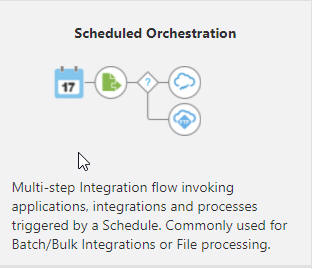
The customer requirement is as follows – I need to run reports in ERP – format of the call is reportName and dateLastRun.

This information – reportName and dateLast Run – is stored in a DB table on Oracle ATP. Do I need to have 1 OIC scheduled job for each report? No – here is a simple example of implementing such. Here is the generic job executor – all it does is write to FTP.

Granted, doesn’t look like much, but this is where you would leverage the ERP adapter to kick off the execution of the report. Ok, now to the client – this will read from the DB, get the report name and date last run values.

It will then use the OIC REST api to submit the AA-Generic-Scheduler discussed above, passing the appropriate parameter values. Read the complete article here.

PaaS Partner Community

For regular information on Oracle PaaS become a member in the PaaS (Integration & Process) Partner Community please register here.

clip_image003 Blog clip_image005 Twitter clip_image004 LinkedIn image[7][2][2][2] Facebook clip_image002[8][4][2][2][2] Wiki

Technorati Tags: SOA Community,Oracle SOA,Oracle BPM,OPN,Jürgen Kress
How to Invoke an OCI Function from the Oracle Integration Cloud by Daniel Martins Teixeira

image

The Oracle Cloud Infrastructure (OCI) offers a great set of services that can be very useful in combination with Oracle Integration Cloud (OIC) for a wide variety of use cases. Things like the Object Storage, Oracle Streaming Service, Functions etc, can easily be accessed from OIC. The OCI ecosystem has a rich set of API’s that can be used for that purpose – https://docs.cloud.oracle.com/en-us/iaas/api/#/

In this post I am going to show how to deploy a Function, and how to Invoke it from OIC.

What are Functions

“Oracle Functions is based on Fn Project. Fn Project is an open source, container native, serverless platform that can be run anywhere, It’s easy to use, supports every programming language, and is extensible and performant.”

How to Start

There is extended documentation and plenty of blogs & tutorials that provide a comprehensive deep dive into OCI , Docker Images and Functions etc.

Being this an Integration Blog, we will focus on the OIC side of things, while providing some tutorials on how to setup an OCI Function.

If you already have a deployed Function, you can skip the next section. Read the complete article here.

PaaS Partner Community

For regular information on Oracle PaaS become a member in the PaaS (Integration & Process) Partner Community please register here.

clip_image003 Blog clip_image005 Twitter clip_image004 LinkedIn image[7][2][2][2] Facebook clip_image002[8][4][2][2][2] Wiki

Technorati Tags: SOA Community,Oracle SOA,Oracle BPM,OPN,Jürgen Kress

OIC Nov 20 Release – Data Retention by Niall Commiskey

image

New Feature – allowing you to centrally manage your OIC space. It is available in the Settings sub-menu. Here you can define retention time for Integration instances under normal/low space available conditions.

Purge when Low Space Reached will also delete Process Runtime data.

This fact may determine whether you check that box or not.

If Process data from completed instances needs to be retained then this can be done in Process. Read the complete article here.

PaaS Partner Community

For regular information on Oracle PaaS become a member in the PaaS (Integration & Process) Partner Community please register here.

clip_image003 Blog clip_image005 Twitter clip_image004 LinkedIn image[7][2][2][2] Facebook clip_image002[8][4][2][2][2] Wiki

Technorati Tags: SOA Community,Oracle SOA,Oracle BPM,OPN,Jürgen Kress

My private Corner – community workspace

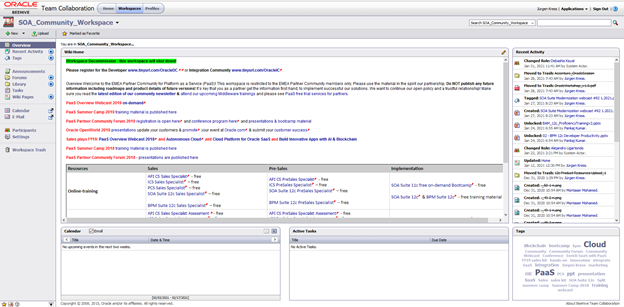
With 10426 users and 97,57 GB of data the SOA Community workspace (membership required) is our central source of information. Yes I crashed the workspace once! Oracle migrated the Beehive collaboration suite to a cloud based solution. With this change the community workspace will become obsolete. Please download any data like SOA Suite or BPM Suite or OIC hands-on training material asap! We are working on plans to launch a new website build in Oracle Content and Experience Cloud. What should be included? Let us know via twitter at #PaaSCommunity!

image

PaaS Partner Community

For regular information on Oracle PaaS become a member in the PaaS (Integration & Process) Partner Community please register here.

clip_image003 Blog clip_image005 Twitter clip_image004 LinkedIn image[7][2][2][2] Facebook clip_image002[8][4][2][2][2] Wiki

Technorati Tags: SOA Community,Oracle SOA,Oracle BPM,OPN,Jürgen Kress
Recover unsaved changes for an Integration edit session by Vijay Kendai

image

This blog is for a new feature coming out in Oracle Integration Cloud (OIC) November release.

Due to many unforeseen circumstances, integration developers can lose their work while editing integrations. Lost work may be as a result of browser crashing, losing network connectivity, server going down etc.  Depending on the state of the edited integration, the loss of the work can range from minimal changes to complicated mappings and transformations between applications.  This blog describes how the integration developer can recover the lost changes.

What is recovered?

· Changes made by the integration developer after fully completing an action. For Example,

o If the developer is adding an Invoke action, it is considered complete only after the developer completes the configuration and clicks the Done button on the Summary page and returns to the canvas.

o If the developer is adding a Logger action, it is considered complete only after the developer clicks the Close button on the Configure Logger page and returns to the canvas. Read the complete article here.

PaaS Partner Community

For regular information on Oracle PaaS become a member in the PaaS (Integration & Process) Partner Community please register here.

clip_image003 Blog clip_image005 Twitter clip_image004 LinkedIn image[7][2][2][2] Facebook clip_image002[8][4][2][2][2] Wiki

Technorati Tags: SOA Community,Oracle SOA,Oracle BPM,OPN,Jürgen Kress

OIC Log Management with VB Studio, OCI Bucket and OCI Logging Analytics by Jin Park

image

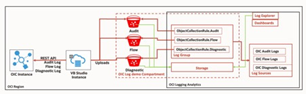
I would like to show how OIC log management can be achieved with OCI Object Storage (I’ll call it bucket) and OCI Logging Analytics, Visual Builder Studio (used to be Developer Cloud, I’ll call it VB Studio).

Interestingly I’m not going to use OIC to download log files, either to ingest log data from OCI Object Storage.  VB Studio will be my tool to do sourcing log files and feeding it to bucket – I’ll be taking advantage of unix shell and oct-cli from VB Studio. Then OCI Logging Analytics will ingest log data from bucket based on cloud event.

Here is the simple architecture what I’m going to do. In this architecture, OIC instance and VB Studio instance can be located different OCI region from the where bucket and OCI Logging Analytics belong to as it’s using REST API and OCI-CLI. OIC. Read the complete article here.

PaaS Partner Community

For regular information on Oracle PaaS become a member in the PaaS (Integration & Process) Partner Community please register here.

clip_image003 Blog clip_image005 Twitter clip_image004 LinkedIn image[7][2][2][2] Facebook clip_image002[8][4][2][2][2] Wiki

Technorati Tags: SOA Community,Oracle SOA,Oracle BPM,OPN,Jürgen Kress
Oracle Integration: ICS to OIC Migration with transition to ATP by Michael Meiner

image

Overview

Oracle Integration (OIC)  has a rich set of capabilities to enable our customers to connect to Oracle databases including on-premise databases and Cloud (DbaaS, ATP). We continue to enhance Oracle Integration to provide additional database connectivity functionality. In the November 2020 release, Oracle Integration offers new functionality for transitioning to an ATP database.

This can be especially important when migrating from Integration Cloud Service (ICS) to Oracle Integration (OIC). As OIC runs on Oracle Cloud Infrastructure (OCI), you might want to also take advantage of ATP which is available in OCI. ICS integration flows which integrate with Oracle Database as a Service (DBaaS) typically use the Database adapter. When migrating such integrations to OIC, the Database adapter will appear in the migrated integrations. This makes uptake of ATP cumbersome, as each integration flow would need to be hand-modified to replace the Database adapter with the ATP adapter.

Integration of ATP using the Database Adapter

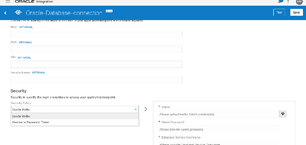
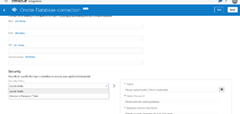
In the Oracle Integration November release, it is now possible to integrate such existing integrations with ATP. In prior releases, the only connection option available with the Database adapter was username password token. This security option is not supported by ATP-Serverless. In the November release, there is an additional connectivity option for Oracle Wallet. You can use this option to connect with ATP-Serverless. This allows you to seamlessly replace the DBaaS connections from ICS with ATP-Serverless connections for use with OIC. There is no need to modify the integrations, just update the connection information including the connectivity agent and you’re ready to use ATP!

This is all made possible by the Oracle Wallet option in the Database adapter. See below for this new security option  in the Oracle Database connection. Read the complete article here.

PaaS Partner Community

For regular information on Oracle PaaS become a member in the PaaS (Integration & Process) Partner Community please register here.

clip_image003 Blog clip_image005 Twitter clip_image004 LinkedIn image[7][2][2][2] Facebook clip_image002[8][4][2][2][2] Wiki

Technorati Tags: SOA Community,Oracle SOA,Oracle BPM,OPN,Jürgen Kress