Oracle Field Service adapter –> Subscribing to OFS Events by Niall Commiskey

image

Simple example here –
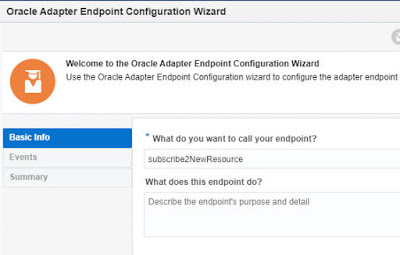
I want to trigger an OIC integration, when a new Resource is created in OFS.
A resource is one who does the actual work – so all hail our venerable resources!

OIC Trigger Configuration

I drop the OFS connection as a Trigger and configure as follows. Read the complete article here.

PaaS Partner Community

For regular information on Oracle PaaS become a member in the PaaS (Integration & Process) Partner Community please register here.

clip_image003 Blog clip_image005 Twitter clip_image004 LinkedIn image[7][2][2][2] Facebook clip_image002[8][4][2][2][2] Wiki

Technorati Tags: SOA Community,Oracle SOA,Oracle BPM,OPN,Jürgen Kress
See How Easily You Can Access Integration’s metadata by Venkatesh Mohanram

image

Many times we may want to use the name of the integration, its version inside the OIC integration flow and we may not want to hardcode the values. And also we may want to access dynamic value like runtime instanceId, invoked by etc., inside the integration flow. All these are possible now with the introduction of a new feature called ‘Integration Metadata Access’ and it allows access to most of the commonly useful metadata. In this blog, we will see what are the metadata that we can access and how we can use it in the integration flow.

The minimum Oracle Integration version required for the feature is 20.34310

List of exposed metadata

  1. Integration
    1. Name
    2. Identifier
    3. Version
  2. Runtime data
    1. Instance ID
    2. Invoked by name
  3. Environment data
    1. Service instance name
    2. Base URL

All these metadata are read-only fields and can be used in any orchestration like Assign activity, Log activity, Notification activity etc., Read the complete article here.

PaaS Partner Community

For regular information on Oracle PaaS become a member in the PaaS (Integration & Process) Partner Community please register here.

clip_image003 Blog clip_image005 Twitter clip_image004 LinkedIn image[7][2][2][2] Facebook clip_image002[8][4][2][2][2] Wiki

Technorati Tags: SOA Community,Oracle SOA,Oracle BPM,OPN,Jürgen Kress

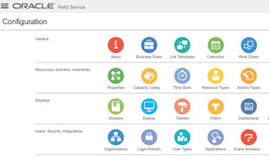
Oracle Field Service Adapter by Niall Commiskey

imageLike all OIC adapters, the OFS adapter has comprehensive documentation.
The users guide is available here

Pre-requisites

There are some pre-requisites, which are discussed in the aforementioned doc. Read the complete article here.

PaaS Partner Community

For regular information on Oracle PaaS become a member in the PaaS (Integration & Process) Partner Community please register here.

clip_image003 Blog clip_image005 Twitter clip_image004 LinkedIn image[7][2][2][2] Facebook clip_image002[8][4][2][2][2] Wiki

Technorati Tags: SOA Community,Oracle SOA,Oracle BPM,OPN,Jürgen Kress
OIC –> Netsuite adapter – processing Customers by Niall Commiskey

image

Simple example – let’s start by creating a customer. I’m not a Netsuite expert – so I begin by creating a Customer in Netsuite

Ok, now I’ve seen the mandatory fields –
So now off to OIC. I create a simple REST based integration that leverages the Netsuite adapter to create a customer in Netsuite. Read the complete article here.

PaaS Partner Community

For regular information on Oracle PaaS become a member in the PaaS (Integration & Process) Partner Community please register here.

clip_image003 Blog clip_image005 Twitter clip_image004 LinkedIn image[7][2][2][2] Facebook clip_image002[8][4][2][2][2] Wiki

Technorati Tags: SOA Community,Oracle SOA,Oracle BPM,OPN,Jürgen Kress

Use Global Variables and Data Stitch to log request payloads by Thomas Hora

imageIn this blog, we will look at 2 new Integration features Global Variables, and Data Stitch.  Data Stitch allows us to make assignments to complex type variables.  We will show how the features can be leveraged to log invoke request payloads in case of fault.

Prerequisite

Enable following features:

  • oic.ics.console.integration.stitch-action
  • oic.ics.console.integration.complex-variables

To enable feature flags – Refer to Blog Enabling Feature Flags in Oracle Integration

The minimum Oracle Integration version required for the feature is 200113.1400.33493

Use case: 

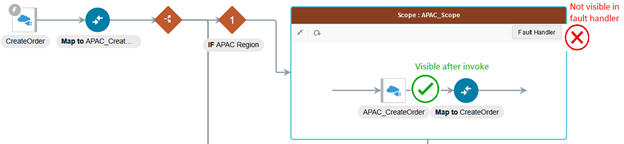
When invoke fails, we want to log the request payload.  Currently, request payloads are visible after the invoke, but not visible inside the fault handlers.

Solution:

We will create a Global Variable based on the request payload.  Global Variables are visible anywhere in the integration, including fault handlers. Read the complete article here.

PaaS Partner Community

For regular information on Oracle PaaS become a member in the PaaS (Integration & Process) Partner Community please register here.

clip_image003 Blog clip_image005 Twitter clip_image004 LinkedIn image[7][2][2][2] Facebook clip_image002[8][4][2][2][2] Wiki

Technorati Tags: SOA Community,Oracle SOA,Oracle BPM,OPN,Jürgen Kress
My private Corner – Goodbye to an old friend

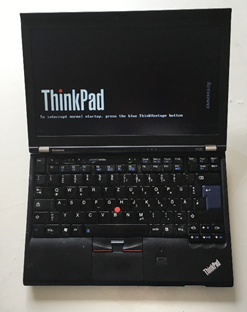
imageFor year’s I used an X220 ThinkPad. It was a great companion on hundreds of business trips. On it’s excellent keyboard I wrote most of the community newsletters. The model was launched in 2011, during the years I piped it with 16 GB RAM and two SSD drives. Which where a great help to run demos and trainings based on virtual box. The raise of cloud computing gave it’s CPU a second spring. With mandatory move to Windows 10 it’s time to say goodbye to a good friend – thanks for the great service!

PaaS Partner Community

For regular information on Oracle PaaS become a member in the PaaS (Integration & Process) Partner Community please register here.

clip_image003 Blog clip_image005 Twitter clip_image004 LinkedIn image[7][2][2][2] Facebook clip_image002[8][4][2][2][2] Wiki

Technorati Tags: SOA Community,Oracle SOA,Oracle BPM,OPN,Jürgen Kress
Additional new content PaaS Partner Community

image

Digital Transformation: We’ve Faced the Same Challenges at Oracle The hardest part of a digital transformation is often not the computers or software, but “the entire rethinking of how to operate in a modern global environment,” says Oracle CEO Safra Catz, who spoke at the recent Oracle OpenWorld Europe in London. But these transformations can lead to better customer understanding, financial decisions, and operations. At Oracle, by using the company’s own cloud-based applications and infrastructure, “things that would take weeks, like supply chain planning, now take an hour,” Catz says.

Data Science Is a Team Sport. Up Your Game Oracle built its new Oracle Cloud Data Science Platform to make it easier for data science teams to collaboratively build, train, and deploy machine-learning models. The goal: “To increase the success of data science projects,” says Oracle’s Greg Pavlik, by adding capabilities such as shared projects, model catalogs, team security policies, and reproducibility and auditability features. What else does it deliver?

Top 10 Strategic CIO Priorities for 2020 First on the list: Accelerate the pace of innovation. CIOs need to see the broad shift to the cloud, including autonomous technologies, as freeing their IT organizations to spend more time and money on developing customer-wowing, market-share-expanding, products and services—and less time and money on system maintenance, tuning, security, and upgrades. What’s next?

Oracle Builds on Cloud Momentum with Five New Regions Worldwide To run critical systems in the cloud, Oracle customers need fully independent cloud regions for disaster recovery purposes. That’s why Oracle has committed to having 36 cloud regions available by the end of 2020. Just this month, the company announced local regions in Saudi Arabia, Australia, Japan, Canada, and the Netherlands, all open for business and available in the Oracle Cloud Console.

Video: Introducing Oracle Cloud Free Tier

PaaS Partner Community

For regular information on Oracle PaaS become a member in the PaaS (Integration & Process) Partner Community please register here.

clip_image003 Blog clip_image005 Twitter clip_image004 LinkedIn image[7][2][2][2] Facebook clip_image002[8][4][2][2][2] Wiki

Technorati Tags: SOA Community,Oracle SOA,Oracle BPM,OPN,Jürgen Kress

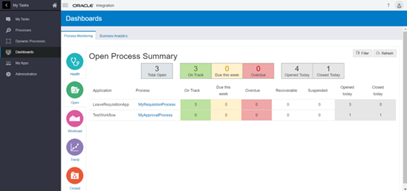
Managing Oracle Process Cloud Service (PCS) Application by Ankur Jain

image

Managing Oracle Process Cloud Service application includes assigning roles to users or groups to initiate the process, approve/reject the assigned task etc.

Roles assigned to end users define their permissions, such as task assignment and whether they can start an application.

By default, roles get created for each swimlane defined in an application’s processes.

Some important link which might help you to extend your knowledge

Web Application in Oracle Visual Builder

Parent Child relationship in Oracle Visual Builder

Dependent/Cascading List Of Values (LOV) in VBCS

Default Roles of PCS application

Process Owner: Users assigned this role can view process activity history, take actions (such as approve or reject), alter process flow, and view form data for applications they own. Process owners typically manage activated business processes and use metric analysis tools such as dashboards to monitor business processes and alter task flow as needed.

Process Reviewer: Users assigned this role can view tracking and process activity history and view or add comments, attachments, or documents for the specified application. Process reviewers cannot take actions on tasks or alter task flow.

Analytics Reviewer: Users assigned this role can create and view business analytics dashboards associated with the specified application. Read the complete article here.

PaaS Partner Community

For regular information on Oracle PaaS become a member in the PaaS (Integration & Process) Partner Community please register here.

clip_image003 Blog clip_image005 Twitter clip_image004 LinkedIn image[7][2][2][2] Facebook clip_image002[8][4][2][2][2] Wiki

Technorati Tags: SOA Community,Oracle SOA,Oracle BPM,OPN,Jürgen Kress
OCI: When and How to Create an Integration to Call a Service from a Process? By Jan Kettenis

image

With the Oracle Integration Cloud, when you have to call a service from a Process you can choose to call an external service directly or you can put an Integration in between. This article gives some directives why you may want to do the latter, and how to prevent a pitfall that is easy to step in to.

To call a service you have to import the WSDL with it’s XSD’s. With that Business Types are auto-generated for all complexTypes in that XSD. Recently I was refactoring a case where this resulted in some 220 (!) Business Types being generated from 1 single external service, of which only a few were actually used. Granted, it concerned a service with a very complex interface, but for some reason all the external SOAP services we have to consume are moderate to very complex and easily generate 50+ Business Types. Not only that, they also use relatively long namespaces. Can you imagine what will happen when you have to call 5 of these services from the same Process application! You barely can see the forest from the trees, and you may find it pretty difficult to identify the correct Business Type to use for your request. The following example shows the selection list showing the types to chose from when creating a data object for one of the most simple cases we have. Read the complete article here.

PaaS Partner Community

For regular information on Oracle PaaS become a member in the PaaS (Integration & Process) Partner Community please register here.

clip_image003 Blog clip_image005 Twitter clip_image004 LinkedIn image[7][2][2][2] Facebook clip_image002[8][4][2][2][2] Wiki

Technorati Tags: SOA Community,Oracle SOA,Oracle BPM,OPN,Jürgen Kress

PaaS Partner YouTube Update July 2020

The July video includes three topics:

• Sales kits to integrate Apps & modernize Apps
• Virtual developer Meetups
• Kickoff Webcasts for PaaS & SaaS partners community

For regular updates please subscribe to our YouTube channel here. Thanks for your likes and sharing the video on YouTube and LinkedIn. For the latest PaaS Community information please visit our Community update wiki here (Community membership required).

PaaS Partner Community

For regular information on Oracle PaaS become a member in the PaaS (Integration & Process) Partner Community please register here.

clip_image003 Blog clip_image005 Twitter clip_image004 LinkedIn image[7][2][2][2] Facebook clip_image002[8][4][2][2][2] Wiki

Technorati Tags: YouTube,SOA Community,Oracle SOA,Oracle BPM,Jürgen Kress,Middleware Update,Partner Update