Oracle Critical Patch Update for October 2018 is Released

imageThe Critical Patch Update for October 2018 is released today. Oracle strongly recommends applying the patches as soon as possible. The Critical Patch Update Advisory is the starting point for finding relevant information. It includes the list of products affected, pointers to obtain the patches, a summary of the security vulnerabilities for each product suite, and links to other important documents. Supported products that are not listed in the "Affected Products and Components" section of the advisory do not require new patches to be applied. It is also essential to review the Critical Patch Update supporting documentation referenced in this Advisory before applying patches, as this is where you can find important pertinent information.

More information about Critical Patch Update Advisories are available at the following location:

Oracle Fusion Middleware Risk Matrix– Oracle Technology Network
Oracle Critical Patch Update Advisory – October 2018– Oracle Technology Network:
Critical Patch Updates, Security Alerts and Bulletins – Oracle Technology Network:
► Oracle Knowledge Management Document – October 2018 Critical Patch Update: Executive Summary and Analysis (Doc ID 2456979.1)
► Important information can also be found at: https://blogs.oracle.com/security/

PaaS Partner Community

For regular information on Oracle PaaS become a member in the SOA & BPM Partner Community for registration please visit www.oracle.com/goto/emea/soa (OPN account required) If you need support with your account please contact the Oracle Partner Business Center.

Blog Twitter LinkedIn image[7][2][2][2] Facebook clip_image002[8][4][2][2][2] Wiki

Technorati Tags: SOA Community,Oracle SOA,Oracle BPM,OPN,Jürgen Kress
Which SOA Product Support Ends in 2018? by Antonella Giovannetti

image

Once your products are in the market and customers are using them, what is the one thing that matters most to you? Every night you go sleep, keeping your fingers crossed, hoping nothing goes wrong. Yes, we are talking about dreaded software downtime!

There are many reasons to upgrade your Oracle products to the latest patch version. One very important reason to upgrade, is to minimize downtime. One recently published Gartner’s report shows that true average cost per hour of software downtime can be more than $600k! It is prudent to invest time and resources in upgrading your Oracle products at every opportunity.  You don’t want to risk downtime, simply because you failed to install a simple patch. It goes without saying that the effort you put into upgrading, always outweighs the cost you pay because of downtime. Product downtime can impact more than your revenue.  Your brand, the most critical part for your business, might also take a substantial hit! When you avoid an upgrade, you may also face higher security risk vulnerabilities. The performance of your products can also be affected.

Unfortunately, it is nearly impossible to achieve 100% uptime / 0% downtime.  You can only maximize the effort it takes to avoid it.  This means keeping track of the latest available patches for your Oracle products.

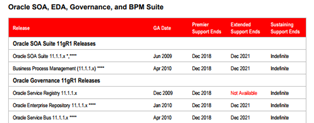
Eventually, Oracle will stop producing patches to the older versions of their products so, if you are still behind when it comes to upgrading to the latest patches, Oracle strongly recommends to upgrade as soon as possible. In this context, note the following table showing the Oracle SOA, EDA, Governance and BPM Support End dates for the year of 2018. Read the complete article here.

PaaS Partner Community

For regular information on Oracle PaaS become a member in the SOA & BPM Partner Community for registration please visit www.oracle.com/goto/emea/soa (OPN account required) If you need support with your account please contact the Oracle Partner Business Center.

Blog Twitter LinkedIn image[7][2][2][2] Facebook clip_image002[8][4][2][2][2] Wiki

Technorati Tags: SOA Community,Oracle SOA,Oracle BPM,OPN,Jürgen Kress

Recipe in Oracle Self-Service Integration

Learn how to edit a recipe in Oracle Self-Service Integration Cloud Service.

image

Watch the video here.

PaaS Partner Community

For regular information on Oracle PaaS become a member in the SOA & BPM Partner Community for registration please visit www.oracle.com/goto/emea/soa (OPN account required) If you need support with your account please contact the Oracle Partner Business Center.

Blog Twitter LinkedIn image[7][2][2][2] Facebook clip_image002[8][4][2][2][2] Wiki

Technorati Tags: SOA Community,Oracle SOA,Oracle BPM,OPN,Jürgen Kress

REST API for Oracle SOA Cloud Service

image

Provisions a new service instance in a domain.

IP networks: A service instance can be attached to an IP network that is already created in Oracle Compute Cloud Service. If you specify an IP network, when you add an instance to an IP network, the instance is assigned an IP address in the IP subnet that you specify. See Creating an IP Network in Using Oracle Compute Cloud Service (IaaS).

IP reservations: A consequence of using an IP network is that the auto-assigned IP address could change each time the service instance is started. To assign fixed public IP addresses to a service instance that is attached to an IP network, you can first create reserved IP addresses, then provision the service instance to use those persistent IP addresses. Read the complete article here.


PaaS Partner Community

For regular information on Oracle PaaS become a member in the SOA & BPM Partner Community for registration please visit www.oracle.com/goto/emea/soa (OPN account required) If you need support with your account please contact the Oracle Partner Business Center.

Blog Twitter LinkedIn image[7][2][2][2] Facebook clip_image002[8][4][2][2][2] Wiki

Technorati Tags: SOA Community,Oracle SOA,Oracle BPM,OPN,Jürgen Kress

Top tweets PaaS Partner Community – October 2018

image

October 2018  top tweets by PaaSCommunity

Send your tweets @soacommunity #PaaSCommunity and follow us at http://twitter.com/soacommunity. Make sure you share your content with the community!

SOA & BPM Partner Community

For regular information on Oracle SOA Suite become a member in the SOA & BPM Partner Community for registration please visit www.oracle.com/goto/emea/soa (OPN account required) If you need support with your account please contact the Oracle Partner Business Center.

Blog Twitter LinkedIn image[7][2][2][2] Facebook clip_image002[8][4][2][2][2] Wiki

Technorati Tags: twitter,SOA Community,Oracle SOA,Oracle BPM,OPN,Jürgen Kress,SOA Community twitter

Teaching How to Recover Errored Instances with Oracle Integration Cloud by Carlos Rodriguez Iturria

image


Building Enterprise integrations in the Cloud with iPaaS brings many benefits, including among others: simplicity, agility and scalability. However, these benefits should not be taxed by having a weak core, not able to properly manage common enterprise requirements, such as error management. I’ve been a bit disappointed with how most iPaaS vendors handle runtime exceptions of integration flows. A typical example of this, is not being able to support dehydration for asynchronous flows (i.e. dehydration is crucial to supporting long-running instances by saving their memory state into a database, until a correlation invocation, a.k.a call-back, wakes it up to continue with the flow). This causes that when an error occurs, recovery has to start from the beginning of the integration flow that failed.

In these situations, we would have to either design an integration to be fully idempotent and stateless across all its partner links (service invocations), which is not always possible. Another way to do it is by manually handling the recovery of errored scenarios, this is to avoid state inconsistency across the previous service invocations in the orchestration, prior to the error… But then if we have to manually handle compensation, what about iPaaS being easier?

Luckily, Oracle Integration Cloud maintains simplicity at the front end and a mature and strong integration core at the backend. It acknowledges when an orchestration is asynchronous, so that dehydration points (a.k.a. break points) are enforced along the way across service invocations or long-term actions (e.g. waits), enabling with this long-term running instances avoiding to timeout, but to stay in memory (and DB back store) until all activities and external call-backs in the orchestration flow complete. Read the complete article here.

PaaS Partner Community

For regular information on Oracle PaaS become a member in the SOA & BPM Partner Community for registration please visit www.oracle.com/goto/emea/soa (OPN account required) If you need support with your account please contact the Oracle Partner Business Center.

Blog Twitter LinkedIn image[7][2][2][2] Facebook clip_image002[8][4][2][2][2] Wiki

Technorati Tags: SOA Community,Oracle SOA,Oracle BPM,OPN,Jürgen Kress

Oracle API Platform Cloud Service: Design-First approach and using Oracle Apiary by Marc Lameriks

image

At the Oracle Partner PaaS Summer Camps VII 2017 in Lisbon last year, at the end of august, I attended the API Cloud Platform Service & Integration Cloud Service bootcamp.

In a series of article’s I will give a high level overview of what you can do with Oracle API Platform Cloud Service. The version used of Oracle API Platform CS was Release 17.3.3 — August 2017.

See https://docs.oracle.com/en/cloud/paas/api-platform-cloud/whats-new/index.html to learn about the new and changed features of Oracle API Platform CS in the latest release.

In preparation of creating an API Blueprint document, I took a closer look at Oracle REST Data Services and used the RESTful Services feature in Oracle SQL Developer, to generate example JSON payload’s based on some tables in the “HR’ schema. For more information about this, see my article “Oracle REST Data Services (ORDS)”.
[https://technology.amis.nl/2018/01/22/oracle-rest-data-services-ords/]

In this first article in the series about Oracle API Platform CS, the focus will be on the Design-First approach and using Oracle Apiary.

Short overview of Oracle API Platform Cloud Service

Oracle API Platform Cloud Service enables companies to thrive in the digital economy by comprehensively managing the full API lifecycle from design and standardization to documenting, publishing, testing and managing APIs. These tools provide API developers, managers, and users an end-to-end platform for designing, prototyping. Through the platform, users gain the agility needed to support changing business demands and opportunities, while having clear visibility into who is using APIs for better control, security and monetization of digital assets.
[https://cloud.oracle.com/en_US/api-platform/datasheets]

Architecture

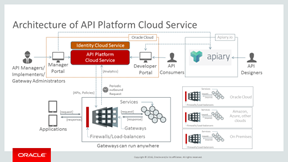
Management Portal:
APIs are managed, secured, and published using the Management Portal. The Management Portal is hosted on the Oracle Cloud, managed by Oracle, and users granted API Manager privileges have access.

Gateways:
API Gateways are the runtime components that enforce all policies, but also help in collecting data for analytics. The gateways can be deployed anywhere – on premise, on Oracle Cloud or to any third party cloud providers.

Developer Portal:
After an API is published, Application Developers use the Developer Portal to discover, register, and consume APIs. The Developer Portal can be customized to run either on the Oracle Cloud or directly in the customer environment on premises. Read the complete article here.


PaaS Partner Community

For regular information on Oracle PaaS become a member in the SOA & BPM Partner Community for registration please visit www.oracle.com/goto/emea/soa (OPN account required) If you need support with your account please contact the Oracle Partner Business Center.

Blog Twitter LinkedIn image[7][2][2][2] Facebook clip_image002[8][4][2][2][2] Wiki

Technorati Tags: SOA Community,Oracle SOA,Oracle BPM,OPN,Jürgen Kress
Web APIs: A Pillar of Digital Transformation Oracle API Cloud Services – Part 2 by Rolando Carrasco

image

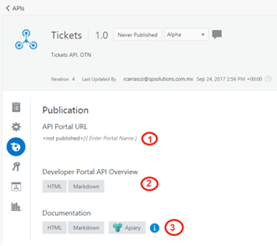
How to Publish APIs to the API Portal

Either for internal or external purposes, it’s necessary to have an API Portal where 3rd parties or internal developers can register applications to subscribe to APIs. Our API management strategy will be successful only if developers actually use our APIs. And if that happens, we need to:

  • Identity those developers
  • Manage them
  • Communicate to them any changes in our APIs
  • Understand how they’re using the APIs
  • Receive feedback from them

An API Portal is key to enabling this communication. Oracle API Platform Cloud Service offers an out-of-the-box portal that you can use to fulfill the requirements listed above. In the next section of this article we will publish our Tickets API to the API Portal.

The following steps are performed within the API Manager Portal:

(https://<hostname&gt;:<port>/apiplatform)

Login as an API manager user: Read the complete article here.

PaaS Partner Community

For regular information on Oracle PaaS become a member in the SOA & BPM Partner Community for registration please visit www.oracle.com/goto/emea/soa (OPN account required) If you need support with your account please contact the Oracle Partner Business Center.

Blog Twitter LinkedIn image[7][2][2][2] Facebook clip_image002[8][4][2][2][2] Wiki

Technorati Tags: SOA Community,Oracle SOA,Oracle BPM,OPN,Jürgen Kress
Validating API Platform Policies & Gateway Deployments by Phil Wilkins

image

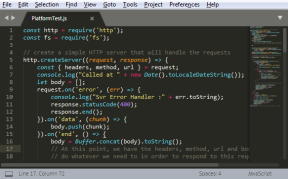
When configuring API Policies in the the Oracle API Platform it helps if there is a simple back end that can take the received payload and record the sent values (header & body) as well as reflect the call details back as the response, or possibly respond with a test payload (so that response policies, particularly policies that require payload navigation  can be exercised correctly).  By having this facility it becomes a lot easier to determine whether the policies are executing correctly in terms of routing, transforming, filtering etc. without needing to worry about whether the API implementation is correct. You could say that this is a kind of mock for testing the API Platform.

The added benefit of having a mock back end is that it is easy to ‘smoke test’ a gateway deployment very easily.  Particularly if the mock is happy to receive any form of call.

Whilst implementing such a capability can be done in pretty much any language and platform you like.  We have in the past for example built a Springboot Java application that can have the dependencies configured to then deploy into WebLogic for example.  We have come to refer these test apps/mocks as PlatformTests as that’s exactly what they help do. A Node.js implementation of a PlatformTest such as as the following implementation is particularly appealing as the Node.js footprint is small and simple to deploy and undeploy. A basic Node.js implementation can also consume any URL and operation you choose to use. The nature of JavaScript makes it very quick to adapt the mock if need be. Although in the ideal world, we write the solution once and then use simple configuration to tune behavior. Read the complete article here.


PaaS Partner Community

For regular information on Oracle PaaS become a member in the SOA & BPM Partner Community for registration please visit www.oracle.com/goto/emea/soa (OPN account required) If you need support with your account please contact the Oracle Partner Business Center.

Blog Twitter LinkedIn image[7][2][2][2] Facebook clip_image002[8][4][2][2][2] Wiki

Technorati Tags: SOA Community,Oracle SOA,Oracle BPM,OPN,Jürgen Kress
Teaching How to Design and Secure an API with Oracle API Platform by Carlos Rodriguez Iturria

image 

This blog is the second part of an end-to-end exercise that starts explaining the steps to clone a GitHub repository that contains an agnostic Medical Records application, built by us in NodeJS and which exposes REST API endpoints via a Swagger API-descriptor running locally on Swagger UI (all included as part of the repository). The previous part of this 2-blogs series also explains the steps required to run the MedRec NodeJS application on Docker containers either locally or in the Oracle Public Cloud. For more information about this first part, go here.

Moving to this second part, we are going to cover the following steps:

1. Create an Apiary account used to Design APIs (API First approach) and create a new API Project using the existing MedRec Swagger API-definition.

2. We are going to spend a little bit of time playing with Apiary to feel comfortable in areas such as:

1. Validating API definitions

2. Testing API endpoints

3. Switching across out-of-the-box Mock Servers and real Production MedRec service end-points. Read the complete article here.

PaaS Partner Community

For regular information on Oracle PaaS become a member in the SOA & BPM Partner Community for registration please visit www.oracle.com/goto/emea/soa (OPN account required) If you need support with your account please contact the Oracle Partner Business Center.

Blog Twitter LinkedIn image[7][2][2][2] Facebook clip_image002[8][4][2][2][2] Wiki

Technorati Tags: SOA Community,Oracle SOA,Oracle BPM,OPN,Jürgen Kress