Oracle Process Cloud Service – Decision Model Notation part 1 by Lykle Thijssen

image

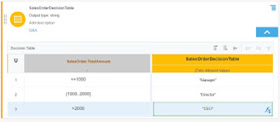
Recently, Oracle Process Cloud Service (PCS) has made another major step forward through the addition of a whole new way of dealing with business rules. This brand new Decision Model Notation (DMN) feature is developed seperate from the actual processes and deployed as a microservice, so your decision models can be reused and everything is nicely loosely coupled. I like it.
What I also like about DMN is that it’s much more (business) user friendly than the rule engine from Oracle SOA Suite, which was used until now. While it was performing well and somewhat agreeable for technical users, business users were often lost and leaving the business rule modelling to developers. With this new DMN feature, this is no longer necessary. Business users will be able to do much more, if not everything, themselves and actually enjoy the experience!
I’ve decided to write a series of blogs about the different types of decision models that can be created and how to use them. But first we need to turn it on.

Getting Started

When you’re in the home screen, click on your login name in the top-right corner and choose ‘Administration’. On the Admin page, go to ‘UI Customization’ and tick ‘Enable DMN in Composer’, then Save. Read the complete article here.

Uncovering Booking Fraud with Oracle Process Cloud Service (PCS) and Decision Model Notation (DMN) by Arun Pareek

image

In a previous blog post, I wrote about the new Decision Modeling capability introduced in Oracle Process Cloud Service. The earlier post provided an introduction to DMN and a usage scenario along with a working prototype.

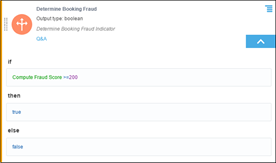
The decision modeling and notation standard released by OMG is a very powerful framework providing an implementation and modeling specification for solving many complex operational and strategic decision in an organization. In this second blog post of the series, I will put the DMN engine in Oracle PCS through a litmus test by implementing a complex decision modeling use case.

To make matters more interesting, I have now selected a decision modelling scenario published as an open challenge in the Decision Management Community in February. The solution shared in this post has been accepted and validated by the community moderator.

The modeling approach shared in this blog is based on the principle of “Inherent Simplicity” which says that every situation, no matter how complex it initially looks, is exceedingly simple. I chose this use case as it shows how principles of decision modeling can allow us to break a layered problem into simpler and easy to implement fragments. Read the complete article here.

Streamline your Oracle PCS Process Models with Decision Model Notation by Arun Pareek

image 

Introduction to DMN and Feature Preview

With the latest release of the Process Cloud Service (17.1.3), Oracle has released a preview version of its much awaited Decision Model and Notation (DMN) engine. The DMN standard provides a powerful meta-model, notation and semantics for modeling of operational decision and business rules. It is a critical addition in the process, case and decision modeling framework providing an open standard for modeling the data and logic associated within a process.

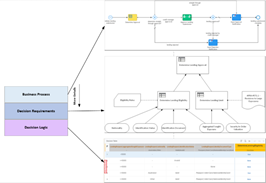
The notation standard aims at defining requirements and decision logic for manual and automated decision-making by representing a complete, executable model which can either be used independently or in conjunction with a business process. Similar to BPMN, it aims to support designing of decision models, providing guided operational decision and potentially automation of operational decisions. A combination of process and decision modeling simplifies business processes by eliminating and replacing sections of a process model with a decision model. The decision logic of the process model is captured as a separate, yet linked, model. By focusing on decisions and processes independently the requirements process is more focused. A decision-driven process acts on the outcome of the evaluation of decision logic in several possible ways, including: Read the complete article here.

bpmNEXT: Boost Business Process Agility with DMN, by Eduardo Chiocconi


image

Watch the video here.

Wellness First: an inside look at Beacon technology by Alessia Sacchi

image

“Just like lighthouses have helped sailors navigate the world for thousands of years, electronic beacons can be used to provide precise location and contextual cues within apps to help you navigate the world.” (The Google Beacons development team)

What I find thrilling about beacons is that in their simplest sense they are unaware of themselves or any devices around them and we – humans – are not aware of them. So how is possible that these tiny transmitters are being used to help people in their daily lives? According to reports, 5 million beacons attached to the walls around the world are used to offer great help to people with regard to an array of things like travel, shopping, parking, entertainment, transportation, inventory management, assets tracking, indoor navigation  and at last but not least in the healthcare space through more efficient processes and improved patient-care.

Wellness First is a fictitious gym that utilizes beacons to improve the customer experience. In this post we’ll take a close look at the Ionic Framework Mobile App I’ve built that uses Estimote beacons to target a customer located near the room where a Yoga class  is just about to start and offers an unbeatable discount. Read the complete article here.

6 Reasons Why Companies Need IoT by: Kirk Carlsen


imageDuring my time as a professional cyclist, I learned that the more information and technology I could leverage, the faster I rode. As technology improved, the data and insights I collected from daily training optimized my performance. I monitored things like heart rate, power, and nutrition and incorporated all of it into my routine. The more I analyzed and integrated this data into my training regimen, the better I began to understand how sensitive each individual aspect of my lifestyle was and how information delivered key indications of my fitness. In a sport where races are won and lost sometimes by inches, any increase in my fitness, even if it was only one percent, could mean the difference between winning and losing. If I could have connected my entire body to sensors that delivered real-time insights to increase performance, I would have.

In athletics, I was just touching the surface of how to incorporate information technology into understanding human potential. Luckily for business, similar enterprise transformations are possible today by using key technologies such as the Internet of Things (IoT). With the visibility and analytics delivered by connected devices, companies can make the right decisions at the right time, safeguarding profitability and customer service. And not unlike cycling, small percentages in improvement for a business could mean the difference between establishing competitive advantage or dropping behind the pack. So, here are six key reasons why I think organizations across every industry need to adopt IoT into their digital transformation strategy.

1. Increase Visibility Across Siloed Business Functions to Improve Business Maturity. Read the complete article here.

Visual Builder Cloud Service – PaaS Partner Community Webcast – February 28th 2018

image

Attend our February edition of the PaaS Partner Community Webcast live on February 28th 2018 at 16:30 CET. In the webcast John Ceccarelli and Angelo Santagata will update you on the Visual Builder Cloud Service and how to extend SaaS.

John Ceccarelli LinkedInimage

Angelo Santagata LinkedIn & Twitter

Visit the registration page here.

Call ID: 5566478 Call Passcode: 249228

UK: +44 (0) 208 118 1001 & United States: 140 877 440 73 image

More Local Numbers

Mobile and JavaScript Rapid App Development with Visual Builder Cloud Service

The Oracle Cloud Tooling team is excited to preview the new version of Visual Builder Cloud Service. This version:

* Unites the MAX and ABCS products into a single design time and runtime for building JET-based mobile and web applications

* Expands our audience from business users to include Rapid Application developers and traditional code-first developers

* Provides enhanced flexibility to build any type of UI you can image

* Gives you full two-way code editing between the visual designer and code view

* Provides declarative support for connecting to any REST service

* Integrates seamlessly with Oracle SaaS, Process Cloud, Integration Cloud, and any on-premise app supported by an Integration Cloud connector

Schedule:

Tuesday February 28th 2018 16:30 – 17:30 CET

Visit the registration page here.

Missed our PaaS Partner Community Webcast? – watch the on-demand versions:

· Container Native Application Development Platform January 23rd 2018

· Oracle free Cloud Demo Services December 15th 2017

· Oracle Integration Cloud (OIC) November 21st 2017

· Adaptive Case Management in PCS October 31st 2017

· Oracle OpenWorld 2017 September 25th 2017

· Cloud Compliance & Certification August 2017

· Wercker July 21st 2017

· Sales Play webcast June 28th 2017

· Process Cloud Service update – DMN capabilities May 23rd 2017

· Drive DevOps Agility and Operational Efficiency with Oracle Management Cloud April 25th 2017

· Implementing DevOps and Agile Methodologies in Oracle Projects March 21st 2017

· Mobile Cloud Service & Chat Bots February 28th 2017

· b2b January 31st 2017

· Community Resources & free Cloud trails December 20th 2016

· SOA 12 & BPM Suite 12c Roadmap update November 29th 2016

· Microservices October 25th 2016

· Oracle OpenWorld 2016 update September 27th 2016

· API Cloud Platform Service August 30th 2016

· BPM Suite & PCS Update July 26th 2016

· Integration Cloud Service June 28th 2016

· Sales Plays Webcast June 9th 2016

· Real-Time Integration Business Insight May 31st 2016

For the latest information please visit Community Updates Wiki page (SOA Community membership required).

SOA & BPM Partner Community

For regular information on Oracle SOA Suite become a member in the SOA & BPM Partner Community for registration please visit www.oracle.com/goto/emea/soa (OPN account required) If you need support with your account please contact the Oracle Partner Business Center.

Blog Twitter LinkedIn image[7][2][2][2] Facebook clip_image002[8][4][2][2][2] Wiki

Technorati Tags: SOA Community,Oracle SOA,Oracle BPM,OPN,Jürgen Kress,webcast

Oracle SOA Suite: Two-way SSL with TLS1.2 made easy (slightly less complicated) by Maarten Smeets

image

Transport layer security (TLS) is not an easy topic. Many blogs have been written about this already. Surprisingly though, I did not find a single blog which was more or less complete and provided me with everything I needed to know to get this working on SOA Suite 12.2.1. In this blog I try to make the topic more easy to understand and provide a complete end to end example.

Suppose you only want an implementation and do not care much about the explanation, you can skip the ‘Some basics’ section, only execute the commands in bold in the ‘Lets get started!’ section and the steps in the ‘WebLogic and SOA Suite’ section. Do take into consideration any existing SSL related configuration on your own system.

Some basics

SSL/TLS

SSL stands for Secure Sockets Layer. SSL is the predecessor of TLS. SSL should be considered insecure since in October 2014 the POODLE attack was announced. TLS currently has 4 versions. TLS 1.0, 1.1, 1.2 and 1.3. 1.3 is not widely supported/adopted yet. SSL/TLS provide integrity checks, security and authentication.

Identity

A server which hosts traffic on a port which has SSL/TLS enabled, has an identity keystore. This identity keystore contains a private key and a public key/certificate. The public key/certificate can safely be given to other parties. With websites when visiting an HTTPS website (HTTP with SSL enabled), the public key is send to you. The other party / client can use the public key to encrypt messages meant for the server. The only one who can decrypt the messages is the one having the private key of the server. This is usually only the server. Read the complete article here.

BPEL 12.2.1.2 and UMS: no wire target for reference… by Martien van den Akker

image

A moment ago I stumbled on this question on the Oracle community. User Saurabh  tries to build a composite to send email from BPEL. But on testing the deployed composite in EM it fails with a remote fault. This despite of a correct configuration of the email driver and being able to test that   using soa-infra -> Service Engines -> Human Workflow -> Notification Management.
He found that the problem was a bug in JDeveloper/SOA QuickStart, causing the email activity not being wired to a Email UMS notification reference. Fortunately there is a patch for it, as described in DocId 2235669.1 on support. Apply Patch 24898307 to solve this. Read the complete article here.

Complete Tutorial: Step By Step Configuration of Oracle SOA Cloud by Sandeep Pachauri

image

Recently I got an opportunity to learn Oracle Cloud for SOA 12C, With using Oracle Cloud you don’t required any IT team who will take care of your server and need to manage them. With new Oracle SOA cloud you just need to maintenance your SOA service.

Let us start how to configure Oracle SOA Cloud.

What is Oracle SOA Cloud????

Ref @Oracle Documentation….

Oracle SOA Cloud Service provides an iPaaS computing platform solution for running integration platform applications in the cloud. The following service types are available for provisioning:

  • Oracle Service Bus is a configuration-based, policy-driven enterprise service bus that provides capabilities for service discovery and mediation, rapid service provisioning and deployment, and governance.
  • Oracle Service Bus is a configuration-based, policy-driven enterprise service bus that provides capabilities for service discovery and mediation, rapid service provisioning and deployment, and governance.
  • Oracle Managed File Transfer Cloud Service securely exchanges files between internal departments and external partners.
  • Oracle API Manager facilitates the creation of APIs that expose the functionality of back-end systems or other services. These APIs are published for use by application developers and are managed and monitored at runtime.

You have complete and unrestricted administrative access to your application environment in the cloud.

Oracle Cloud following components over Cloud:

•Oracle Database Cloud Service—Oracle SOA Cloud Service requires that you first subscribe to Oracle Database Cloud Service. You run a provisioning wizard to select an Oracle database instance and node cluster environment. The database is securely hosted in the cloud. Read the complete article here.