Superior Third Generation API Management: Two partners, one comprehensive solution

image

You want to get the most out of your digital transformation initiatives. But if you lack visibility and access to key information assets and functionality across your operations, these initiatives can be severely limited. To deliver the omni-channel customer and employee-centric solutions you desire, all your information and functionality must be accessible in a consistent way throughout all your channels. The only way to attain this is with comprehensive and matured APIs, which are managed throughout their full cycles (API management).

Visibility, access, growth—APIs are key in unlocking

new digital business opportunities

If you’re looking to deliver fresher and richer user experiences, APIs can facilitate rapid user interface evolution without having to change the entire system. If you’re looking to modernize legacy systems, APIs can act as a bridge to modernize them one piece at a time, reducing risks and costs. If you want to monetize key information assets via partner channels or the general public, APIs can also make this happen. Get the document here.

SOA & BPM Partner Community

For regular information on Oracle SOA Suite become a member in the SOA & BPM Partner Community for registration please visit www.oracle.com/goto/emea/soa (OPN account required) If you need support with your account please contact the Oracle Partner Business Center.

Blog Twitter LinkedIn image[7][2][2][2] Facebook clip_image002[8][4][2][2][2] Wiki

Technorati Tags: SOA Community,Oracle SOA,Oracle BPM,OPN,Jürgen Kress
API Platform Cloud Service is available – Partner resource kit

image

For Oracle Partners we offer an API Platform Cloud Service resource kit (community membership required):

· Sales kit

· Online training and certification: API Platform Cloud Service Partner Sales Rep GLP and API Platform Cloud Service Partner Sales Consultant GLP

· API trial service

· API CS Whitepaper & API Platform Cloud Service Data Sheet & Apiary Data Sheet

· API Platform Cloud Service Documentation

· Upcoming API hands-on trainings

· API CS website & OTN page

SOA & BPM Partner Community

For regular information on Oracle SOA Suite become a member in the SOA & BPM Partner Community for registration please visit www.oracle.com/goto/emea/soa (OPN account required) If you need support with your account please contact the Oracle Partner Business Center.

Blog Twitter LinkedIn image[7][2][2][2] Facebook clip_image002[8][4][2][2][2] Wiki

Technorati Tags: SOA Community,Oracle SOA,Oracle BPM,OPN,Jürgen Kress
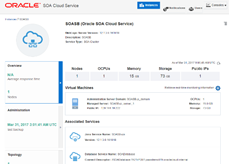
Additional new content SOA & BPM Partner Community

image

· Automating Oracle SOA Deployment with Maven and Oracle Developer Cloud Service Learn how Oracle Developer Cloud Service’s Maven plugin enhancement can provide access to the Oracle Maven repository, simplifying build and deployment of SOA composites on Oracle SOA Cloud Service. Read the article.

· Podcast: 10 Services, 5 Developers, 1 Hour – A Cloud Integration Story Five developers integrated ten Oracle Cloud PaaS services in one hour in front of a live conference audience, and lived to tell the tale. Members of that team share the details in this podcast. Listen to the podcast.

· Oracle Code Oracle Code is an event for developers building modern Web, mobile, enterprise, and cloud-native applications. The focus is on the latest software developer technologies, practices, and trends, including: Containers, Microservices/APIs, and DevOps; Databases; Open Source Technologies; Development Tools and Low Code Platforms; Machine Learning, Chatbots and AI. Fifteen cities around the world remain on the tour, including Atlanta, Sao Paolo, Mexico City, London, Berlin, and more. Click here for more information.

· Great Indian Developer Summit Featuring eight tracks and more than 100 speakers, the Great Indian Developer Summit for 2017 has something for every developer and architect. April 25-28, 2017, Bangalore, India. Click here for more information.

SOA & BPM Partner Community

For regular information on Oracle SOA Suite become a member in the SOA & BPM Partner Community for registration please visit www.oracle.com/goto/emea/soa (OPN account required) If you need support with your account please contact the Oracle Partner Business Center.

Blog Twitter LinkedIn image[7][2][2][2] Facebook clip_image002[8][4][2][2][2] Wiki

Technorati Tags: SOA Community,Oracle SOA,Oracle BPM,OPN,Jürgen Kress
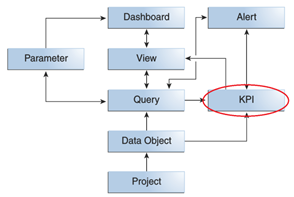
BAM KPIs by Marcel van de Glind

image

Next I my BAM Series, a post about BAM KPIs.

First the theory from the oracle documentation

Understanding KPIs

There are two major types of performance indicators: outcome metrics and driver metrics. Outcome metrics, sometimes called lagging indicators, measure business activity that a strategy is designed to achieve, such as return rate per month or average call processing time for the last moving hour. Driver metrics, sometimes called leading indicators, measure business activity that influences the outcome metrics.

KPIs are outcome metrics that compare performance measures to specific business goals that roll up into larger organizational strategies requiring monitoring, improvement, and evaluation. KPI values vary with time, have targets to determine performance status, include dimensions to allow for more specific analysis, and can be compared over time for trending purposes and to identify performance patterns. Read the complete article here

SOA & BPM Partner Community

For regular information on Oracle SOA Suite become a member in the SOA & BPM Partner Community for registration please visit www.oracle.com/goto/emea/soa (OPN account required) If you need support with your account please contact the Oracle Partner Business Center.

Blog Twitter LinkedIn image[7][2][2][2] Facebook clip_image002[8][4][2][2][2] Wiki

Technorati Tags: SOA Community,Oracle SOA,Oracle BPM,OPN,Jürgen Kress
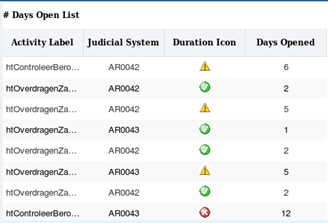
BAM Views by Marcel van de Glind

image

After the Queries and KPIs I will continue with the next topic. Business Views or shortly just Views.

As usual I first start with a piece of theory from the oracle documentation.

A business view is a visual representation of data fetched by a business query or one or more KPIs. In most views, numeric data fields, called measures, are grouped by non-numeric data fields, called dimensions. For example, lawsuit costs, a measure, can be grouped by department, a dimension. An aggregation is a computation based on multiple values in a data field, such as a sum or average.

Oracle BAM uses various view types:

  • Graph Views
  • Chart Views
  • Table Views
  • Gauge Views
  • Geo Map View
  • Treemap View
  • KPI Watchlist View

Area Chart, Bar Chart, Horizontal Bar Chart, Line Chart, Pie Chart, Combo Chart, Scatter Chart, and Bubble Chart views are collectively called chart views. There are corresponding graph view variations of each of these views.

Some graph views are switchable. They can be changed to a compatible type. Provided that queries are compatible, some views are switchable with each other. These are Area, Bar, Horizontal Bar, Line, Pie, and Combo views. Gauge views are switchable within the category.
You can format views in many ways, changing colors, fonts, labels, thresholds, and other properties. Read the complete article here.

SOA & BPM Partner Community

For regular information on Oracle SOA Suite become a member in the SOA & BPM Partner Community for registration please visit www.oracle.com/goto/emea/soa (OPN account required) If you need support with your account please contact the Oracle Partner Business Center.

Blog Twitter LinkedIn image[7][2][2][2] Facebook clip_image002[8][4][2][2][2] Wiki

Technorati Tags: SOA Community,Oracle SOA,Oracle BPM,OPN,Jürgen Kress

BPM BAC Subversion Server refusing connections by Martien van den Akker

image

These days I work on setting up several development lifecycle environments for BPM, SOA and OSB. What means that we setup servers for Development and test, culminating eventually in supporting the setup of the acceptance and production servers.
Since we want to have development resemble production as much as possible, we installed a dual-node clustered BPM environment, including BAM. However, since it is development, we have the two Managed Servers per cluster on the same phsyical (actually virtual) host.
In 12c BPM introduced a new component the Process Asset Manager, as described here. But installing BPM on a dual node cluster on a single node, will give problems with the underlying BAC/Subversion Component.
Errors you could encounter in the logs are for example: Read the complete article here.

SOA & BPM Partner Community

For regular information on Oracle SOA Suite become a member in the SOA & BPM Partner Community for registration please visit www.oracle.com/goto/emea/soa (OPN account required) If you need support with your account please contact the Oracle Partner Business Center.

Blog Twitter LinkedIn image[7][2][2][2] Facebook clip_image002[8][4][2][2][2] Wiki

Technorati Tags: SOA Community,Oracle SOA,Oracle BPM,OPN,Jürgen Kress
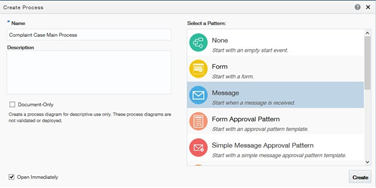
Case Management Patterns using Oracle Process Cloud Service by Jose Rodrigues

image

Hi and welcome to a new article on Oracle Process Cloud Service (PCS).

This time, we’re going to address some use patterns that may seem difficult to implement using PCS, and tackle the need for unstructured parts of the process, which is to say, parts of the process that can’t be previously modelled because, well… we don’t know how they’ll turn out.

Take for instance a complaint to your customer service department. You’ll never know, in advance, what kind of complain it will be, or if you need one, two, five or fifty interactions with the customer, or if you need to get approval from department A or B to try and compensate the customer, or even if any legal action will be needed with a supplier of yours, after they failed to compensate the complainer in due time.

So, you see, there are some elements that may render part of your process impossible to predict, at least in terms of activity sequence. You know that these may take place at some point in time in the process, but you can’t plan ahead and model the exact activity sequence (“A” will happen after “B”).

To handle this type of less structured processes (I don’t like the term “Unstructured”, because they have a structure), there’s a discipline called “Case Management” (CM). CM handles the choreography of this type of processes, called Cases, guaranteeing that the activities that are part of the process are executed at the right time and when conditions permit it.

For the remainder of the article, please consider the terms “Case” and “Process” as interchangeable, the term “Less structured Process” as equivalent to Case, and the term “Structured Process” as equivalent to a predefined flow-controlled Process (BPMN process or equivalent).

The main idea behind CM is that instead of the process model determining the next action to be taken, it’s the worker who, actually decides what should be the next best action to perform in each situation, using his experience.

This is not to say that the worker can just do any activity at any time. Typically, there are specific business rules that enable or disable a given activity based on the current data and events associated with a specific process. However, these rules can be as tight or as flexible as we may need.

Case Management Patterns

The idea of the article is to give you the tools you need to implement Case Management patterns using Oracle PCS. This is not to implement Case Management in PCS, but just some case management behavioral patterns. Parts of what is “Case Management” will not be addressed in any way, but things like Ad-hoc process/task calls will, and this is sufficient for most needs. Read the complete article here.


SOA & BPM Partner Community

For regular information on Oracle SOA Suite become a member in the SOA & BPM Partner Community for registration please visit www.oracle.com/goto/emea/soa (OPN account required) If you need support with your account please contact the Oracle Partner Business Center.

Blog Twitter LinkedIn image[7][2][2][2] Facebook clip_image002[8][4][2][2][2] Wiki

Technorati Tags: SOA Community,Oracle SOA,Oracle BPM,OPN,Jürgen Kress

Patient Health Monitoring with Oracle IoTCS and PCS by Arun Pareek

image
Accelerate Speed to Value with Oracle Cloud Platform (PaaS)

In an increasingly digitized world, technology enabled transition is increasingly becoming a strategic ally for organisations and how they deliver services and products more effectively. Organisations need to orient their business along capabilities and commercially viable ‘proof points’ that can scale quickly. A key to this approach is to avoid large multi-year road maps and refrain from multi-million dollar investment projects to be locked into an uncertain future. The concept of providing a differentiated customer experience is the only way to create a sustainable advantage. A recent Oracle Partner event (Sydney PaaS Hackathon) was a perfect stage for partners in APAC to demonstrate the power and capabilities of the Oracle Cloud Platform to accelerate a customer’s digital transformation journey. Now that the dust has settled on the amazing Sydney Hackathon where we participated and won the second prize for our prototype using Oracle PaaS products, it is time to share what we actually built and how. In this opening blog, I will provide a glimpse of the end to end solution that we put together using nine different Oracle Cloud Services in the 28 hour marathon. Along the way, I would also share the best practices and lessons learnt of integrating the different Cloud Service and an approach to building solutions around user centric design principles. The core prototype and use case was around building a real time remote patient well being monitoring system. In particular, the solution centered around patients suffering with blood pressure related disease which is a major cause of health related deaths in Australia. Read the complete article here.

SOA & BPM Partner Community

For regular information on Oracle SOA Suite become a member in the SOA & BPM Partner Community for registration please visit www.oracle.com/goto/emea/soa (OPN account required) If you need support with your account please contact the Oracle Partner Business Center.

Blog Twitter LinkedIn image[7][2][2][2] Facebook clip_image002[8][4][2][2][2] Wiki

Technorati Tags: SOA Community,Oracle SOA,Oracle BPM,OPN,Jürgen Kress
Oracle Service Bus: transport thread blocking evidences by Fabio Mazanatti

image

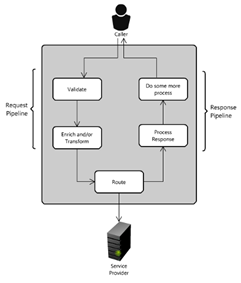
The common case scenario for a service exposed via Oracle Service Bus is to receive a message, validate/enrich/transform it, call a service provider and then do some additional work with the response from the provider before returning it to the caller. The initial steps are grouped inside a request pipeline; the message then goes through a route to the provider, and the final processing is done by a response pipeline before sending it back to the caller:

Usual structure of an OSB service

The threading model used by Oracle Service Bus states that the request pipeline must execute on a thread (the Inbound Request Message Thread) and the response pipeline must use another thread to process the response (properly named the Outbound Response Message Thread). The route is done by a transport provider, which can or cannot use the request thread to wait for the provider’s response.

When the transport holds the request thread until it gets a response, it is called a blocking transport. Conversely, if the transport puts the call and releases the thread, it’s called a non-blocking transport. Some of the transports are listed below, with info about their support to non-blocking calls: Read the complete article here.

SOA & BPM Partner Community

For regular information on Oracle SOA Suite become a member in the SOA & BPM Partner Community for registration please visit www.oracle.com/goto/emea/soa (OPN account required) If you need support with your account please contact the Oracle Partner Business Center.

Blog Twitter LinkedIn image[7][2][2][2] Facebook clip_image002[8][4][2][2][2] Wiki

Technorati Tags: SOA Community,Oracle SOA,Oracle BPM,OPN,Jürgen Kress
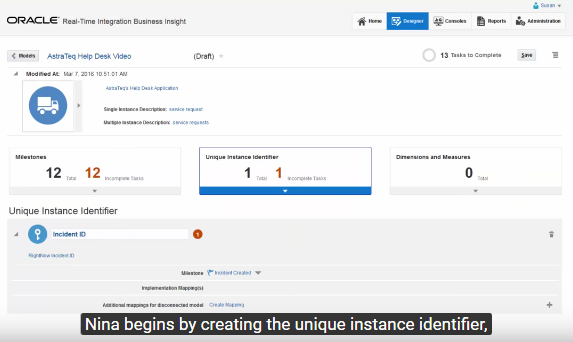
Oracle Real-Time Integration Business Insight

image

Oracle Real-Time Integration Business Insight: Designing Insight Models This video describes the designing of business models in Oracle Real-Time Integration Business Insight.

Oracle Real-Time Integration Business Insight: Working with Reports This short video will be part of the Introducing Oracle Real-Time Integration Business Insight (aka Insight) video series. This video demonstrates what business insights you can gain from the pre-configured reports.

SOA & BPM Partner Community

For regular information on Oracle SOA Suite become a member in the SOA & BPM Partner Community for registration please visit www.oracle.com/goto/emea/soa (OPN account required) If you need support with your account please contact the Oracle Partner Business Center.

Blog Twitter LinkedIn image[7][2][2][2] Facebook clip_image002[8][4][2][2][2] Wiki

Technorati Tags: SOA Community,Oracle SOA,Oracle BPM,OPN,Jürgen Kress