SOA Suite on Docker by Jorge Quilcate


clip_image002

Visit Docker here

SOA & BPM Partner Community

For regular information on Oracle SOA Suite become a member in the SOA & BPM Partner Community for registration please visit www.oracle.com/goto/emea/soa (OPN account required) If you need support with your account please contact the Oracle Partner Business Center.

Blog Twitter LinkedIn image[7][2][2][2] Facebook clip_image002[8][4][2][2][2] Wiki

Technorati Tags: SOA Community,Oracle SOA,Oracle BPM,OPN,Jürgen Kress

Service Bus enabling API Management by Tshepo Madigage


clip_image002Two of the most important questions businesses are asking themselves when launching new application infrastructure projects are:

  1. What steps do we need to take to elevate our initial “services infrastructure” into a “shared services infrastructure” supporting spikes in loads, improving high service availability, introducing agility, and simplifying manageability?
  2. As our infrastructure begins to expand beyond our firewalls to incorporate more third-party cloud services into mission critical projects, are we prepared to manage the increase in service response latency time and risk?

Oracle Service Bus – an integral part of Oracle SOA Suite – is proven, lightweight integration Enterprise Service Bus (ESB), Oracle Service Bus simplifies integration and improves time-to-market for new business services by replacing complex point-to-point integration with a single service virtualisation connection. Instead of disparate integration tool kits throughout your enterprise, Oracle Service Bus delivers a common standards-based integration solution spanning public cloud, private cloud, and on-premises applications and services. Oracle Service Bus allows you to achieve value more quickly with simple, code-free, configuration-based integration and supports rapid mobile enablement of smartphones and tablets.

As mobile and the Internet of Things continue to digitize all kinds of products and services, APIs are an essential component in securely connecting applications with devices. The newly released Oracle API Manager provides easy-to-use facilities for annotating and publishing REST and SOAP services as APIs to a developer portal where application developers can discover, test, register and subscribe to these APIs, as well as track API performance. It is available on-premises today and will soon be available as a component of Oracle’s rapidly expanding cloud services portfolio. Additionally, Oracle API Catalog simplifies the publication of API services that are developed in Oracle and other sources. Read the complete article here.

SOA & BPM Partner Community

For regular information on Oracle SOA Suite become a member in the SOA & BPM Partner Community for registration please visit www.oracle.com/goto/emea/soa (OPN account required) If you need support with your account please contact the Oracle Partner Business Center.

Blog Twitter LinkedIn image[7][2][2][2] Facebook clip_image002[8][4][2][2][2] Wiki

Technorati Tags: SOA Community,Oracle SOA,Oracle BPM,OPN,Jürgen Kress
API Management Implementation 12c Book Overview by Luis Augusto Weir


clip_image002Digital transformation is at the core of every business strategy regardless of what type of business an organisation is in. Companies that embark on a on a digital transformation journey are able to create innovative and disruptive solutions that are capable of delivering a much richer, unified and personalised user experience, at a lower cost. They are able to engage the customer in a seamless fashion through many channels such as mobile apps, responsive websites and social media. Organisations that adopt innovative digital business models gain considerable competitive advantage over those that don’t.
The fundamental driver for digital transformation is the ability to unlock key information assets and business functionality, which is often hidden inside an organisation’s enterprise systems and in SOA based web services which are only internally accessible. To materialise these assets, organisations need to build web based Application Programming Interfaces (APIs) that not only provide standard, lightweight web access to these assets but also do so in a secured and controlled fashion. The lightweight nature and ease of use of these web APIs, ensure that they soon become the main mechanism for accessing information and functionality that is needed to build mobile applications, responsive websites and other cloud based solutions.
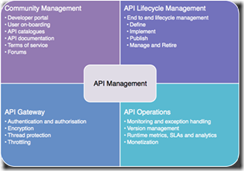
API management is the discipline that governs the software development lifecycle of APIs. It defines the tools and processes needed to build, publish and operate APIs including the management of the community of developers around it. Read the complete article here.


SOA & BPM Partner Community

For regular information on Oracle SOA Suite become a member in the SOA & BPM Partner Community for registration please visit www.oracle.com/goto/emea/soa (OPN account required) If you need support with your account please contact the Oracle Partner Business Center.

Blog Twitter LinkedIn image[7][2][2][2] Facebook clip_image002[8][4][2][2][2] Wiki

Technorati Tags: SOA Community,Oracle SOA,Oracle BPM,OPN,Jürgen Kress
Podcast Show Notes: Oracle API Management Implementation by Bob Rhubart-Oracle


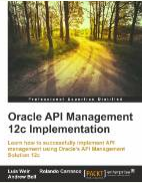
clip_image001This 4-part OTN ArchBeat Podcast brings together the authors of the upcoming Packt Publishing book Oracle API Management 12c Implementation for a discussion of what has changed in Enterprise IT to make APIs so important, and what architects and developers need to know to take advantage.

  • Listen to Part 1: APIs have been around forever. So why has API Management become so important?
  • Listen to Part 2: API management and service management are two different things. it’s important to understand the differences.
  • Listen to Part 3: What API developers need to know in order to take advantage of the growing market for APIs.
  • Listen to Part 4: The authors of Oracle API Management 12c Implementation talk about what they know now that they didn’t know when they started work on the book.
Additional Resources

Suggest a topic or panelists for an OTN ArchBeat Podcast.

SOA & BPM Partner Community

For regular information on Oracle SOA Suite become a member in the SOA & BPM Partner Community for registration please visit www.oracle.com/goto/emea/soa (OPN account required) If you need support with your account please contact the Oracle Partner Business Center.

Blog Twitter LinkedIn image[7][2][2][2] Facebook clip_image002[8][4][2][2][2] Wiki

Technorati Tags: SOA Community,Oracle SOA,Oracle BPM,OPN,Jürgen Kress
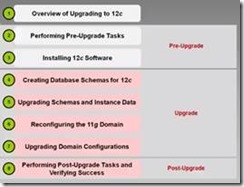
Upgrading Oracle SOA Suite to 12c Videos

clip_image002

SOA & BPM Partner Community

For regular information on Oracle SOA Suite become a member in the SOA & BPM Partner Community for registration please visit www.oracle.com/goto/emea/soa (OPN account required) If you need support with your account please contact the Oracle Partner Business Center.

Blog Twitter LinkedIn image[7][2][2][2] Facebook clip_image002[8][4][2][2][2] Wiki

Technorati Tags: SOA Community,Oracle SOA,Oracle BPM,OPN,Jürgen Kress
Top tweets SOA Partner Community – March 2016

image

Send your tweets @soacommunity #soaCommunity and follow us at http://twitter.com/soacommunity. Make sure you share your content with the community!

SOA & BPM Partner Community

For regular information on Oracle SOA Suite become a member in the SOA & BPM Partner Community for registration please visit www.oracle.com/goto/emea/soa (OPN account required) If you need support with your account please contact the Oracle Partner Business Center.

Blog Twitter LinkedIn image[7][2][2][2] Facebook clip_image002[8][4][2][2][2] Wiki

Technorati Tags: twitter,SOA Community,Oracle SOA,Oracle BPM,OPN,Jürgen Kress

Microservices and the Integration Platform by Robert Wunderlich


clip_image002In case you have not already heard of microservices, yet another evolution is upon us in the world of software development. A microservice is the antonym of the monolith and is a relatively new name for some concepts that have been around for some time. Microservices push us further toward the dream of decoupling with a promise of simpler, easier and cheaper services that are more reusable. As we get started, you can find a great primer on microservices through Martin Fowler’s blog at http://martinfowler.com/articles/microservices.html

Before I continue, I should point out that I am the Product Manager for Oracle Service Bus and that may cause you to wonder why I would be talking about microservices. As a matter of fact, Martin Fowler in his blog states “The microservice community favours an alternatitive approach: Smart endpoints and dumb pipes”. Others position microservices as an alternative to SOA even going as far as saying that microservices can be SOA done the right way.

You might think that as a product manager for an enterprise service bus product, I might be inclined to defend my product against this movement, but I don’t think that is necessary. I think this is not an either-or question, but rather a hybrid approach to integration and service delivery is a more realistic direction to take. Quite simply we will need to leverage microservices, and SOA and we can learn and apply principles from both.

In this post, I’ll very briefly discuss the evolution from the monolith to services. I’ll compare and contrast SOA and microservices, mainly because of how monolithic elements have grown in SOA over the years. I’ll point out some of the pain-points of both SOA and microservices and will conclude with how choosing a hybrid approach can realize the benefit of both SOA and microservices while helping to reduce the pain-points.

Our long journey in software development began with the mega-monolith, the mainframe. From the very beginning, business rapidly came up with new requirements for software and the need to bring new features to production faster continues to grow every day. In the early days, when mainframes ruled, the change cycles were extremely long.

An example of this comes from very large insurance company that I worked for. Just to make a small change in their claims processing system would take from months, up to a year or longer, and would be exceptionally expensive to complete. That change never happened because even though it would have helped the “human workflow”, it was just too expensive to implement. In those days of the mega-monolith, human users simply had to adapt to the machine even if it was not the most efficient approach, rather than to incur the cost of changing the system.

Our approach has evolved quite a bit since the early days of the mainframe. We determined that rather than change a large monolith, we could make incremental changes and integrate systems together in order to support business processes more rapidly. From the early integration patterns, we progressed to Service Oriented Architecture (SOA).

Over the years however, we have witnessed SOA implementations that have taken on a more monolithic approach so some observers have associated SOA itself as being monolithic.

I do believe that there is a place for monoliths and it is important for the practitioner to strike a balance of when to use a monolithic approach, and when to use a microservice approach. While we may be more familiar with SOA, let’s discuss some of the characteristics of MSA.

Microservice Architecture (MSA) is mostly an organizational approach to developing and delivering discrete functionality that is highly de-coupled. If anything is tightly coupled, it is the functions of development and operations which we will talk more about shortly. Read the complete article here.

SOA & BPM Partner Community

For regular information on Oracle SOA Suite become a member in the SOA & BPM Partner Community for registration please visit www.oracle.com/goto/emea/soa (OPN account required) If you need support with your account please contact the Oracle Partner Business Center.

Blog Twitter LinkedIn image[7][2][2][2] Facebook clip_image002[8][4][2][2][2] Wiki

Technorati Tags: SOA Community,Oracle SOA,Oracle BPM,OPN,Jürgen Kress

Best Cloud Integration Solution


clip_image002The cloud has enabled a range of capabilities such as big data analytics, unlimited capacity for storage, and a range of other on-demand services.

But how do companies move their data quickly, efficiently and securely between clouds and on-premises systems? Cloud integration solutions offer the answer, integrating data between disparate cloud and on-premises platforms.

Cloud integration offers a variety of advantages over other methods such as accessing personal data in real-time on any device, allowing scalability for a growing number of users, and maintaining constant data integrity.

According to a recent survey underwritten by Oracle in May (“2015 IOUG Data Integration Cloud Survey”), a majority of enterprises believe data integration is a key requirement of their cloud plans. Those leveraging data integration within cloud environments report they are seeing faster data movement to target applications, as well as reduced costs, and increased agility.

HERE ARE THE WINNERS OF THE 2015 DBTA READERS’ CHOICE AWARDS FOR BEST CLOUD INTEGRATION SOLUTION

Winner:

Oracle Cloud Integration

Read the complete article here.

SOA & BPM Partner Community

For regular information on Oracle SOA Suite become a member in the SOA & BPM Partner Community for registration please visit www.oracle.com/goto/emea/soa (OPN account required) If you need support with your account please contact the Oracle Partner Business Center.

Blog Twitter LinkedIn image[7][2][2][2] Facebook clip_image002[8][4][2][2][2] Wiki

Technorati Tags: SOA Community,Oracle SOA,Oracle BPM,OPN,Jürgen Kress

Five Best Practices for Platform as a Service Success


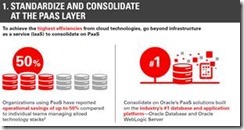
clip_image002Research firm IDC estimates that the market for platform as a service (PaaS) solutions will have a compound annual growth rate (CAGR) of 30 percent and reach $14 billion by 2017.1 PaaS provides application runtime, database, integration, messaging, and other services in the cloud, accelerating application development and reducing infrastructure acquisition and maintenance costs.

Here are five best practices for maximizing the business value of your PaaS solutions. Get the free paper here.

SOA & BPM Partner Community

For regular information on Oracle SOA Suite become a member in the SOA & BPM Partner Community for registration please visit www.oracle.com/goto/emea/soa (OPN account required) If you need support with your account please contact the Oracle Partner Business Center.

Blog Twitter LinkedIn image[7][2][2][2] Facebook clip_image002[8][4][2][2][2] Wiki

Technorati Tags: SOA Community,Oracle SOA,Oracle BPM,OPN,Jürgen Kress

2 Min Tech Tips at Oracle OpenWorld: Are You Ready for Your Close-Up?


clip_image002At last year’s Oracle OpenWorld I had more fun than should be allowed by law recording 2 Minute Tech Tip videos with about two dozen community members — about twice the number I had originally scheduled. People just kept showing up! And that number doesn’t include the Tech Tip videos I recorded in the weeks leading up to OOW14, featuring people who were speaking at the event and wanted to help promote their sessions by distilling their presentations into key take-aways.

This year I’ll be at it again — with better gear and a sleeker format for the finished videos. So if you’ll be at OOW15 and have 120 seconds worth of insight an expertise you’d like to share with the world, I want you on my schedule.

I also want to hear from any OOW15 session presenters who want to promote their sessions in advance with a 2 Minute Tech Tip. Leave a comment below or contact me via Twitter @OTNArchBeat so we can work out the details

SOA & BPM Partner Community

For regular information on Oracle SOA Suite become a member in the SOA & BPM Partner Community for registration please visit www.oracle.com/goto/emea/soa (OPN account required) If you need support with your account please contact the Oracle Partner Business Center.

Blog Twitter LinkedIn image[7][2][2][2] Facebook clip_image002[8][4][2][2][2] Wiki

Technorati Tags: SOA Community,Oracle SOA,Oracle BPM,OPN,Jürgen Kress