Fusion HCM Cloud Bulk Integration Automation by Jack Desai


Introduction

clip_image002Fusion HCM Cloud provides a comprehensive set of tools, templates, and pre-packaged integration to cover various scenarios using modern and efficient technologies. One of the patterns is the bulk integration to load and extract data to/from cloud. The inbound tool is the File Based data loader (FBL) evolving into HCM Data Loaders (HDL). HDL supports data migration for full HR, incremental load to support co-existence with Oracle Applications such as E-Business Suite (EBS) and PeopleSoft (PSFT). It also provides the ability to bulk load into configured flexfields. HCM Extracts is an outbound integration tool that let’s you choose data, gathers and archives it. This archived raw data is converted into a desired format and delivered to supported channels recipients.

HCM cloud implements Oracle WebCenter Content, a component of Fusion Middleware, to store and secure data files for both inbound and outbound bulk integration patterns. This post focuses on how to automate data file transfer with WebCenter Content to initiate the loader. The same APIs will be used to download data file from the WebCenter Content delivered through the extract process.

WebCenter Content replaces SSH File Transfer Protocol (SFTP) server in the cloud as a content repository in Fusion HCM starting with Release 7+. There are several ways of importing and exporting content to and from Fusion Applications such as:

  • Upload using “File Import and Export” UI from home page navigation: Navigator > Tools
  • Upload using WebCenter Content Document Transfer Utility
  • Upload programmatically via Java Code or Web Service API

This post provides an introduction, with working sample code, on how to programmatically export content from Fusion Applications to automate the outbound integration process to other applications in the cloud or on-premise. A Service Oriented Architecture (SOA) composite is implemented to demonstrate the concept.

Main Article

Fusion Applications Security in WebCenter Content

The content in WebCenter Content is secured through users, roles, privileges and accounts. The user could be any valid user with a role such as “Integration Specialist.” The role may have privileges such as read, write and delete. The accounts are predefined by each application. For example, HCM uses /hcm/dataloader/import and /hcm/dataloader/export respectively.

Let’s review the inbound and outbound batch integration flows.

Inbound Flow

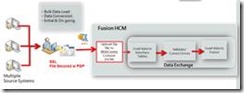
This is a typical Inbound FBL process flow: Read the complete article here.

SOA & BPM Partner Community

For regular information on Oracle SOA Suite become a member in the SOA & BPM Partner Community for registration please visit www.oracle.com/goto/emea/soa (OPN account required) If you need support with your account please contact the Oracle Partner Business Center.

Blog Twitter LinkedIn image[7][2][2][2] Facebook clip_image002[8][4][2][2][2] Wiki

Managed File Transfer (MFT) free hands-on workshops September USA

Oracle Managed File Transfer (Oracle MFT) enables secure file exchange and management with internal departments and external partners. It protects against inadvertent access to unsecured files at every step in the end-to-end transfer of files. It is easy to use especially for non technical staff so you can leverage more resources to manage the transfer of files. The built in extensive reporting capabilities allow you to get quick status of a file transfer and resubmit it as required.

This FREE hands-on workshop covers all the capabilities you need to build robust, reliable and agile managed file transfers.

Sept 10th &11th at Redwood Shores, CA

Sept 17th  and 18th  at Reston, VA

clip_image002

SOA & BPM Partner Community

For regular information on Oracle SOA Suite become a member in the SOA & BPM Partner Community for registration please visit www.oracle.com/goto/emea/soa (OPN account required) If you need support with your account please contact the Oracle Partner Business Center.

Blog Twitter LinkedIn image[7][2][2][2] Facebook clip_image002[8][4][2][2][2] Wiki

Fusion HCM Integration by Kiran Mundy


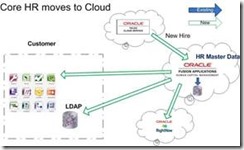
clip_image002Because of frequent questions from HCM customers on how they can use BPEL to integrate with Fusion HCM, I’ve put together the details here

Your orchestration layer is the software [such as Oracle’s SOA BPEL or BPM Studio] you currently already use, to wire together Fusion HCM Loader/Extract programs to other apps.

SOA/BPEL
Companies already using SOA/BPEL can just add Fusion HCM into the mix.
Steps to accomplish this are below:.

INBOUND TO FUSION HCM

  1. BPEL’s "File Adapter" to read the data in.
  2. BPEL’s Transform Activity with Domain Value Maps to transform the data.
  3. You need to get the UCM Service exposed externally (In Rel10 it will be exposed, but on Rel9, you’ll need to do the following):
    1. File an SR requesting Fusion HCM to perform a Key Exchange – Aside from allowing you to send "encrypted" files into Fusion, this step will also result in the UCM Service being exposed externally.
      • Ensure you file the SR under Oracle Cloud Global Human Resources Cloud Service.
      • Choose Hosting Services – Application -> Encryption Key Exchange
  4. Use BPEL to Invoke the UCM Soap Service to write the File into UCM.
  1. Invoke the HCM Loader Programs passing them the encryption parameter along with other required parameters.
    • FBL wsdl is the following form: https:// <Hostname>/LoaderIntegrationService?WSDL
    • HDL wsdl is the following form: https:// <Hostname>/hcmCommonDataLoader/HCMDataLoader?wsdl
  2. Find out which user privileges you must assign to the users who call these web services in OER: https://fusionappsoer.oracle.com
  3. Sample Payloads for the above services are available here. [You can enter comments into the sample payloads doc if you find any issues].
  4. Later when REST Services are available (Release 9 Patch Bundle 6 under "controlled availability" most likely), for your lighter weight inbound integrations, such as Fusion/Taleo, you will have the option to switch #3/4/5 to a REST service call to create/update the employee in Fusion. NOTE: Cco-existence scenarios should continue to use batch loaders because:
    • Performance Reasons – services won’t perform as well under heavy loads
    • The breadth of data needed for co-existence isn’t covered (or intended to be covered) by the REST Services.

OUTBOUND FROM FUSION HCM Read the complete article here

SOA & BPM Partner Community

For regular information on Oracle SOA Suite become a member in the SOA & BPM Partner Community for registration please visit www.oracle.com/goto/emea/soa (OPN account required) If you need support with your account please contact the Oracle Partner Business Center.

Blog Twitter LinkedIn image[7][2][2][2] Facebook clip_image002[8][4][2][2][2] Wiki

Finally My PaaS4SaaS Workshop Blog by Debra Lilley


clip_image002I know this posting is a bit late but at the end of January I took part in a proof of concept workshop for PaaS4Sass and it’s been a rollercoaster ride ever since.

When I was thinking about moving to Certus one of the things that attracted me was there intent to write extensions for Oracle’s CloudApplications using the just announced PaaS4SaaS solution.

I attended Oracle Open World with an open mind and trying to learn as much as I could about the solutions. The Larry Ellison demo was really impressive but then Oracle has always been a brilliant marketing company.

I came back to UK and set about validating what was available, some of the components Database and Java Cloud had been available for a while but I wanted or would want to also use the Process and Integration Cloud offerings.

As regular readers of this blog will know, I am an OracleApplications User Experience advocate and am very committed to the user experience work that goes into Oracle Cloud Applications. Extensions delivered by Certus will have this same user experience and I made this video on the half of Certus.

The user experience team have been given funding by Thomas Kurian who is personally committed to making PaaS4SaaS work, to carry out a number of proof of concept workshops with Oracle partners. The UX team asked Certus to be part of this. Certus have not been a development company and so in the same way customers come to us because we are the best at implementing cloud applications we looked for a partner to help us with development, and weselected eProseed who have the same commitment to UX as we do.

The workshop took place in London at the end of January with four people from each of Oracle UX, eProceed and Certus taking part. We work through a use-case taken from an existing Application from one of our customers who is considering modernising this and moving it to the cloud. In three days we were able to build a working application and prove to ourselves that when the customer says, “go” we will be able to deliver what they need.

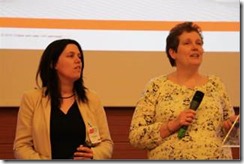
Oracle UX team have in their blog already covered the workshop and I have also written about it in the AppAdvantage blog I am a guest author for. The following month I took part in the Partner SOA Community Forum in Budapest when we had the opportunity to work with product management teams of both the Process and Integration Cloud offerings and further validate our approach, understanding the possibilities and the constraints. The UX team also had a stand there. I was very pleased on behalf off both Certus and eProceed to accept the first Community Cloud award. These awards are a bit like the Oscars and awarded to individuals Lonneke from eProseed and myself, however we had a similar thank you to all those involved in our acceptance speech. The Community Leader Jurgen Kress said: I awarded my first SOA Community Outstanding Contribution for Cloud to Debra Lilley of Certus Solutions and Lonneke Dikmanns of eProseed because they not only took on board the messaging of PaaS 4 SaaS from the last Oracle Open World, but also their collaboration between an Applications partner and a Middleware partner, sought out answers and training and with Oracle Development giving feedback and  validating their approach in this area. All good things but bringing that back to the community and sharing is the outstanding contribution. Read the complete article here.

SOA & BPM Partner Community

For regular information on Oracle SOA Suite become a member in the SOA & BPM Partner Community for registration please visit www.oracle.com/goto/emea/soa (OPN account required) If you need support with your account please contact the Oracle Partner Business Center.

Blog Twitter LinkedIn image[7][2][2][2] Facebook clip_image002[8][4][2][2][2] Wiki

How to fix java.io.InvalidClassException error when accessing Oracle ACM Case API via Jdeveloper by Vikram Bailur


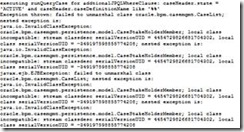
clip_image002Here is a quick and useful tip. This was an error I got when I was running a custom java client to query the Oracle Adaptive Case Management API.

From a sort-of related metalink on Oracle which says :

Although the problem couldn’t be recreated by the development team on demand, from the exception is clear that the root cause of the problem is the differnce of the version of the org.eclipse.persistence jar distributed with Oracle JDeveloper and Oracle WLS.

I figured this was something to do with the version of eclipselink libraries currently running on the soa server were different from Jdeveloper install.

In my JDeveloper project, I had some libraries and classpath pointing to my JDeveloper install and some others pointing to my SOA middleware home install for example. Read the complete article here.

SOA & BPM Partner Community

For regular information on Oracle SOA Suite become a member in the SOA & BPM Partner Community for registration please visit www.oracle.com/goto/emea/soa (OPN account required) If you need support with your account please contact the Oracle Partner Business Center.

Blog Twitter LinkedIn image[7][2][2][2] Facebook clip_image002[8][4][2][2][2] Wiki

Video on Team Collaboration Using Oracle BPM 12c PAM by Jaideep

clip_image002When teams work on an Oracle BPM project, they can use the Process Asset Manager (PAM) to collaborate on the project. Oracle BPM 12c PAM helps Process developers using BPM Studio (JDeveloper) to collaborate with analysts using the Oracle BPM Composer. Team members can ‘publish’ or ‘commit’ BPM artifacts into PAM and ‘check-out’ or ‘update’ BPM artifacts from PAM. The Oracle BPM 12c PAM also supports versioning functionality. It’s basically a subversion repository that is built into the product. It also includes support for Security and Access Control, Conflict Resolution, Diff and Merge, Reporting of business assets in the catalog and their history, and the ability to create project snapsots, so that you can revert back to a stable version of the project. Watch the video here.

SOA & BPM Partner Community

For regular information on Oracle SOA Suite become a member in the SOA & BPM Partner Community for registration please visit www.oracle.com/goto/emea/soa (OPN account required) If you need support with your account please contact the Oracle Partner Business Center.

Blog Twitter LinkedIn image[7][2][2][2] Facebook clip_image002[8][4][2][2][2] Wiki

Top tweets SOA Partner Community – August 2015

image

Send your tweets @soacommunity #soacommunity and follow us at http://twitter.com/soacommunity

All favorite tweets are published on our SOA Community Blog here! Make sure you share your content with the community!

SOA & BPM Partner Community

For regular information on Oracle SOA Suite become a member in the SOA & BPM Partner Community for registration please visit www.oracle.com/goto/emea/soa (OPN account required) If you need support with your account please contact the Oracle Partner Business Center.

Blog Twitter LinkedIn image[7][2][2][2] Facebook clip_image002[8][4][2][2][2] Wiki

Creating a simple BPM Manual Process by Waslley Souza

clip_image001

A Manual Process in Oracle BPM Suite 12c is a process that the user starts through a Human Task.
In this post we will create a BPM Process to add employees through a Human Task and generate a XML file through File Adapter.
Download the sample application: BpmHelloWorldApp.zip.

Create a new BPM Application, name it as BpmHelloWorldApp and click Finish.
Right-click the project name and choose New > BPMN 2.0 Process.
In the BPMN 2.0 Process Wizard, choose Manual Process, name it as AddEmployee and click Finish.

Our BPM application was created.
Before we start to model our process, we need to create a new user.
Start the WebLogic Server, go to Console and create the hrofficer user.

Read the complete article here.

SOA & BPM Partner Community

For regular information on Oracle SOA Suite become a member in the SOA & BPM Partner Community for registration please visit www.oracle.com/goto/emea/soa (OPN account required) If you need support with your account please contact the Oracle Partner Business Center.

Blog Twitter LinkedIn image[7][2][2][2] Facebook clip_image002[8][4][2][2][2] Wiki

Provisioning Oracle BPM Suite on Oracle Java Cloud Service free Tutorial


clip_image002This tutorial describes the process for extending an Oracle WebLogic Server domain on an Oracle Java Cloud Service instance with Oracle Business Process Management Suite (Oracle BPM Suite).

Oracle BPM Suite provides a complete set of tools that you can use to create, execute, and optimize business processes. Oracle Java Cloud Service enables you to use an Oracle WebLogic Server domain and set up your Oracle BPM Suite environment without worrying about the infrastructure or platform components. All Oracle Java Cloud Service instances are preconfigured to use your Oracle Database Cloud Service instance and an object storage container that you create in Oracle Storage Cloud Service.

Oracle Java Cloud Service provides a platform to develop and deploy business applications in the cloud. Oracle Java Cloud Service provides instant access to a cloud environment with Oracle WebLogic Server, integrated security, and database access.

What Do You Need?

To create a storage container, an Oracle Database Cloud Service instance and an Oracle Java Cloud Service instances, ensure that you have a subscription to each of the following:

  • Oracle Storage Cloud Service
  • Oracle Database Cloud Service (Database as a Service [DBaaS])
  • Oracle Java Cloud Service

For more information, see Getting Started with Oracle Cloud. Get the Tutorial here.

SOA & BPM Partner Community

For regular information on Oracle SOA Suite become a member in the SOA & BPM Partner Community for registration please visit www.oracle.com/goto/emea/soa (OPN account required) If you need support with your account please contact the Oracle Partner Business Center.

Blog Twitter LinkedIn image[7][2][2][2] Facebook clip_image002[8][4][2][2][2] Wiki

Video on Business Architecture in BPM 12c by Jaideep

clip_image002

BPM 12c has introduced the capability to create business architecture projects in BPM Composer. Business architecture models help you to take a top-down approach to discover, refine and create a more formal link between the organization’s business goals and BPM projects.

Oracle BPM Composer 12c has introduced the capability to create the following types of business architecture models

  • Enterprise Maps
  • Value Chain Models
  • Strategy Models

This is an introductory video on business architecture in Oracle BPM 12c. It’s an excerpt from one of our self paced Oracle BPM Training courses. Watch the video here.

SOA & BPM Partner Community

For regular information on Oracle SOA Suite become a member in the SOA & BPM Partner Community for registration please visit www.oracle.com/goto/emea/soa (OPN account required) If you need support with your account please contact the Oracle Partner Business Center.

Blog Twitter LinkedIn image[7][2][2][2] Facebook clip_image002[8][4][2][2][2] Wiki