Oracle Fusion Middleware Customer Reference Booklet

At our SOA Community Workspace (SOA Community membership required) you can find the Fusion Middleware Customer Reference Booklet. The booklet is a wonderful resource for sales, portfolio managers and architects to get new ideas clients. Make sure you use references within your sales process! Submit your reference to be written and published at the Oracle website!

We are at the dawn of a new age of information technology. For a very long time IT has struggled to cope with increase complexity while attempting to be responsive to the changing needs of business. Organizations are now embracing the promise of social, mobile, fast data, and cloud computing – in the hope of leveraging a whole new approach to running IT never imagined before. At Oracle, we have been working hard on making the advance – social, mobile, fast data, cloud technologies and avail it to our Oracle Fusion Middleware customers.

With over 120,000 customers, Oracle Fusion Middleware is the only middleware available from any vendor that provides a complete, open, and integrated approach across all middleware solutions including development tools, application servers, identity management, service integration, data integration, business process management, content management, business intelligence, and enterprise portals. Oracle offers the efficiency of working with a single, strategic partner for all of your middleware requirements, as well as the cost effectiveness of certified integrations with Oracle Database, Oracle Applications, and Oracle Engineered Systems. With market-leading and best-in-class offerings across every product line, Oracle Fusion Middleware can enable you to maximize the processes and applications that drive your business today and provide a foundation for innovation in the future.

I would like to invite you to review a selection of our customer references. These companies have realized significant benefits and we are confident that your company can also realize similar benefits with Oracle Fusion Middleware.

Amit Zavery, Vice President, Product Development, Oracle Fusion Middleware

SOA & BPM Partner Community

For regular information on Oracle SOA Suite become a member in the SOA & BPM Partner Community for registration please visit www.oracle.com/goto/emea/soa (OPN account required) If you need support with your account please contact the Oracle Partner Business Center.

Blog Twitter LinkedIn image[7][2][2][2] Facebook clip_image002[8][4][2][2][2] Wiki Mix Forum

Additional new content SOA & BPM Partner Community


Sales Briefing Fiscal Year 2014 go to market SOA & BPM

We want to make sure your sales and pre-sales A&C teams are trained like the Oracle middleware sales team. Therefore we would like to encourage you to read the Oracle internal middleware sales presentations. Please use the sales material in the spirit of our partnership. Please do not publish any information – all material is Oracle & Partner confidential. For customer presentations please use the external customer presentations at our Community Workspace! In addition to this you can find marketing kits for the key initiatives to run joint campaigns.

At our SOA Community Workspace (SOA Community membership required) you can find:

Each presentation includes sales plays (customer examples, discovery questions, competitive information and objective handling), market overview and product updates.

All this information is Oracle and Partner confidential!

SOA & BPM Partner Community

For regular information on Oracle SOA Suite become a member in the SOA & BPM Partner Community for registration please visit www.oracle.com/goto/emea/soa (OPN account required) If you need support with your account please contact the Oracle Partner Business Center.

Blog Twitter LinkedIn image[7][2][2][2] Facebook clip_image002[8][4][2][2][2] Wiki Mix Forum

SOA Governance 11g Implementation book by Luis Augusto Weir & Andrew Bell

This book will show the reader how to successfully implement SOA Governance using Oracle’s SOA Gov ernance Suite 11g based on practical examples and real world use cases.

This book is intended for Enterprise Architects, Solution Architects, Technical Architects and SOA consultants who want to successfully implement SOA Governance using the Oracle SOA Governance Suite of products. The book assumes that although the reader may have previous experience and/or exposure to the Oracle SOA Suite 11g, and may have general knowledge of SOA Governance, the reader doesn’t have practical experience implementing the Oracle SOA Governance Suite.

Oracle SOA Governance 11g Implementation: RAWKey Features:

  • Understanding SOA Governance, its key concepts, goals and objectives and how to implement these using the Oracle SOA Governance Suite.
  • Execute a SOA Maturity Assessment in order to capture the SOA Governance challenges specific to your organization.
  • Implement Oracle Enterprise Repository (OER) and Oracle Service Registry (OSR) to address your organisation’s SOA Governance Design-time and Runtime requirements.
  • Implement Runtime Governance using Oracle Web Service Manager (WSM) security policies and by leveraging Oracle Enterprise Manager’s (OEM) key management features.
  • Achieve close-loop governance by feeding OER with runtime operational metrics and enforcing service reuse in OER.

The book is available at Packt Looking for additional SOA books or You published a book feel free to add it to our publications wiki!

SOA & BPM Partner Community

For regular information on Oracle SOA Suite become a member in the SOA & BPM Partner Community for registration please visit www.oracle.com/goto/emea/soa (OPN account required) If you need support with your account please contact the Oracle Partner Business Center.

Blog Twitter LinkedIn image[7][2][2][2] Facebook clip_image002[8][4][2][2][2] Wiki Mix Forum

QA82 Analyzer – Automated Quality Assurance for Oracle SOA Suite Projects

The QA82 Analyzer enables the automation of quality analyses of service-oriented architectures using Oracle SOA Suite which, until now, had been performed manually. This includes automatically examining compliance with best practices and patterns and thus reducing the costs of quality assurance. Various technologies can be considered, such as WSDL, SCA, and BPMN. The QA82 Analyzer supports adaptation to individual requirements, such as company-specific standards and design guidelines.

In order to enable a seamless quality analysis integration into daily development, the QA82 Analyzer supports the integration into the Oracle JDeveloper. This allows interaction with the QA82 Analyzer without having to leave the familiar environment. With the help of corresponding plug-ins, the results of quality analyses and concrete revision suggestions can be viewed simultaneously. If a quality aspect is not ideal, developers can make use of the suggestions to make target- and quality-oriented revisions without detours.

SOA & BPM Partner Community

For regular information on Oracle SOA Suite become a member in the SOA & BPM Partner Community for registration please visit www.oracle.com/goto/emea/soa (OPN account required) If you need support with your account please contact the Oracle Partner Business Center.

Blog Twitter LinkedIn image[7][2][2][2] Facebook clip_image002[8][4][2][2][2] Wiki Mix Forum

SOA Suite Knowledge – Polyglot Service Implementation with Groovy by Alexander Suchier

Polyglot programming, defined most simply, is the use of multiple languages in software development. Implementing services on the SCA Container is already a intended polyglot development approach. Oracle SOA Suite have the SCA service implementation types of BPEL, Human Workflow, Mediator, Rule and Spring Components. These components are mixing the General-Purpose Language (GPL) Java with Domain-Specific Languages (DSL) like XSD, WSDL or Schematron. But Spring Components are also enabler of service implementations with other JVM GPL languages beside Java.image

In my opinion Neal Ford was absolutely right when he coined the term “Polyglot Programming” and predicts “Applications of the future will take advantage of the polyglot nature of the language world … The times of writing an application in a single general purpose language is over” already in 2006. In order to produce polyglot implementations you need environments where polyglot-ism is required or at least encouraged. Oracle SOA Suite is such a polyglot supporting environment and you are doing polyglot development all the time (e.g. XML, WSDL, SQL, Java). But also on the GPL side the developers or not limited on Java. SCA Spring Components are supported since Patch Set 2 and the Spring Framework supports dynamic languages since version 2 (BeanShell, JRuby and Groovy).

Groovy is a General-Purpose Dynamic Language and has the best and seamless integration with Java (beside Spring integration Groovy supports also direct and JSR 223 integration). Therefore, using Groovy has a low threshold for Java developers; it is easy because Groovy has a Java-like syntax. Most Java code is also syntactically valid Groovy. So it’s an iterative learning approach for Java developers switching to Groovy. My first contact with Groovy was at the JAX conference in 2008. It was a Groovy newbie session from Dierk König (well-known book author of "Groovy in Action"). And for the first time in a long while of Java programming I had an awakening and still addicting interest on this development language. Read the full article here.

SOA & BPM Partner Community

For regular information on Oracle SOA Suite become a member in the SOA & BPM Partner Community for registration please visit www.oracle.com/goto/emea/soa (OPN account required) If you need support with your account please contact the Oracle Partner Business Center.

Blog Twitter LinkedIn image[7][2][2][2] Facebook clip_image002[8][4][2][2][2] Wiki Mix Forum

Oracle SOA Suite for the Busy IT Professional by Frank Munz

Oracle SOA Suite IntroductionOracle SOA Suite is certainly the most comprehensive and also the most complex product of the classical WLS / OSB / SOA Suite stack. There are plenty of tools and other products tightly interwoven with SOA Suite:
It all starts with the installation where a supported database is required for the meta data repository. The necessary schema are created with the separate repository creation utility (RCU). Testing processes is done from Oracle Enterprise Manager. Finally developing BPEL processes requires JDeveloper as an IDE.

That is it to get started yet more complex projects often involve a Oracle Web Service Manager, and sometimes a repository and a registry.

The recipe below is part III of a series of introduction recipes covering Oracle Fusion Middleware. It’s reduced to the max and as buzzword free as it gets. It certainly doesn’t replace an in-depth training though.

… better read this first

For a better understanding make sure to read part I and II first:

Download the Oracle SOA Suite Introduction Recipe You can download the SOA Suite recipe as a PDF file from here. Enjoy!

More? This recipe is straight out of my book WebLogic Server 12c: Distinctive Recipes.

SOA & BPM Partner Community

For regular information on Oracle SOA Suite become a member in the SOA & BPM Partner Community for registration please visit www.oracle.com/goto/emea/soa (OPN account required) If you need support with your account please contact the Oracle Partner Business Center.

Blog Twitter LinkedIn image[7][2][2][2] Facebook clip_image002[8][4][2][2][2] Wiki Mix Forum

A-Team Chronicles

The A-Team is a central, outbound, highly technical team comprised of Enterprise Architects, Solution Specialists and Software Engineers within the Fusion Middleware Product Development Organization that works with customers and partners, worldwide, providing guidance on implementation best practices, architecture, troubleshooting and how best to use Oracle products to solve customer business needs.

The A-Team Chronicles website aggregates and organizes content produced by The A-Team members.

This content captures best practices, tips and tricks and guidance that the A-Team members gain from real-world experiences, working with customers and partners on implementation projects, through Architecture reviews, issue resolution and more.

A-Team Chronicles makes this content available, through short and to the point articles to all our customers and partners in a consistent, easy to find and organized way.

SOA & BPM Partner Community

For regular information on Oracle SOA Suite become a member in the SOA & BPM Partner Community for registration please visit www.oracle.com/goto/emea/soa (OPN account required) If you need support with your account please contact the Oracle Partner Business Center.

Blog Twitter LinkedIn image[7][2][2][2] Facebook clip_image002[8][4][2][2][2] Wiki Mix Forum

NEW – Business Rules Self-Study Course

A new self study course (Using Oracle Business Rules in BPEL) was recently posted to the Oracle Learning Library. This self-study course runs about 40 minutes. You can access it, at no charge, here.

This course leverages the vocabulary and concepts from the Introduction to Oracle Business Rules self-study as it discusses the configuration of the Oracle Business Rules service component, and the calling of the configured component from a BPEL process. It’s a follow-on to the Introduction to Oracle Business Rules self-study.

SOA & BPM Partner Community

For regular information on Oracle SOA Suite become a member in the SOA & BPM Partner Community for registration please visit www.oracle.com/goto/emea/soa (OPN account required) If you need support with your account please contact the Oracle Partner Business Center.

Blog Twitter LinkedIn image[7][2][2][2] Facebook clip_image002[8][4][2][2][2] Wiki Mix Forum

Verifying the Target by Anthony Reynolds

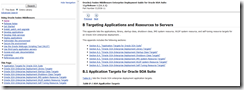
imageI just built a combined OSB, SOA/BPM, BAM clustered domain. The biggest hassle is validating that the resource targeting is correct.  There is a great appendix in the documentation that lists all the modules and resources with their associated targets.  The only problem is that the appendix is six pages of small print. I manually went through the first page, verifying my target, until I thought ‘there must be a better way of doing this’. So this blog post is the better way 🙂

WLST to the Rescue

WebLogic Scripting Tool allows us to query the MBeans and discover what resources are deployed and where they are targeted.  So I built a script that iterates over each of the following resource types and verifies that they are correctly targeted:

  • Applications
  • Libraries
  • Startup Classes
  • Shutdown Classes
  • JMS System Resources
  • WLDF System Resources

Source Data

To get the data to verify my domain against, I copied the tables from the documentation into a text file.  The copy ended up putting the resource on the first line and the targets on the second line.  Rather than reformat the data I just read the lines in pairs, storing the resource as a string and splitting apart the targets into a list of strings.  I then stored the data in a dictionary with the resource string as the key and the target list as the value.  The code to do this is shown below: Read the full article here.

SOA & BPM Partner Community

For regular information on Oracle SOA Suite become a member in the SOA & BPM Partner Community for registration please visit www.oracle.com/goto/emea/soa (OPN account required) If you need support with your account please contact the Oracle Partner Business Center.

Blog Twitter LinkedIn image[7][2][2][2] Facebook clip_image002[8][4][2][2][2] Wiki Mix Forum