Additional new content PaaS Partner Community

image

· How Developers Can Deliver Chatbots That Propel a Broader AI Strategy
Where should you begin with an intelligent chatbot project? There are four key challenges, says Oracle VP Suhas Uliyar, and they relate to channel complexity, machine learning, authentic dialogue, and enterprise integration. How to address each of the challenges.

· A Huge Utility Plugs In to Chatbots for Better Customer Connections Exelon, the US’s largest utility company by customer count, has created a chatbot that will soon let customers text Exelon a question such as "When’s my power bill due?" And it built the prototype in only two weeks.

· Oracle Works to Help Startups Succeed A new Oracle program connects startup companies with Oracle global customers to nurture an ecosystem of codevelopment and coinnovation among startups, customers, and Oracle. Why Oracle launched an Industry Innovation Advisors team.


PaaS Partner Community

For regular information on Oracle PaaS become a member in the SOA & BPM Partner Community for registration please visit www.oracle.com/goto/emea/soa (OPN account required) If you need support with your account please contact the Oracle Partner Business Center.

Blog Twitter LinkedIn image[7][2][2][2] Facebook clip_image002[8][4][2][2][2] Wiki

Technorati Tags: SOA Community,Oracle SOA,Oracle BPM,OPN,Jürgen Kress

The Cloud User Experience Rapid Development Kit

image

The Oracle Applications Cloud User Experience Rapid Development Kit (RDK) is a set of free resources that will help you learn faster, design simpler and build better.

Use the RDK to leverage the
PaaS for SaaS
advantage
.

New versions of the RDKs are now available. Read about the latest enhancements in this OAUX blog post

PaaS Partner Community

For regular information on Oracle PaaS become a member in the SOA & BPM Partner Community for registration please visit www.oracle.com/goto/emea/soa (OPN account required) If you need support with your account please contact the Oracle Partner Business Center.

Blog Twitter LinkedIn image[7][2][2][2] Facebook clip_image002[8][4][2][2][2] Wiki

Technorati Tags: SOA Community,Oracle SOA,Oracle BPM,OPN,Jürgen Kress

Cloud is driving IT transformation and Oracle innovation by: Eric Bezille

image

Today was again a very fully packed day at Oracle Open World. Starting with Mark Hurd, providing the vision of Oracle CEO on the global market and how Enterprises are forced to re-invent themselves or to face disintermediation, due to new comers leveraging the technologies to their benefits: doing the same thing but differently. Enterprise have to simplify and stop spending 80% of their IT budget to keep the light on. That’s where the Cloud model kicks in.

As Oracle we could not keep up if we were running Oracle Cloud like a traditional IT does, with multiple heterogeneous layers and vendors to integrate, patch and upgrade. The fact that we own all the stack from disk, to servers, to operating systems and even higher up with the Database and application stacks make a huge difference. We have one thing to manage, like Exadata to run the Oracle Database. That’s why Cloud is driving IT transformation and our innovation. (full video replay here).

This was clearly illustrated during Oracle Systems General Session, re-emphasis on the tight integration benefit of hardware and software, leading to unique optimizations, including one key aspect that was already touch on by Larry Ellision opening Keynote: Security (check here and here)… A new topics that is now also on CEO agenda.

And this tight integration is leading us to unique innovation capabilities helping us to scale, and you as well, as our technology is available in 3 deployments models. Again this was also demonstrated today with the launch of Exadata X7, applying in-memory technology in storage not to accelerate analytic but OLTP workloads: something pretty counter intuitive for pure hardware vendors of storage, but possible as soon as you combine hardware and software up to the Database layer. That makes a huge difference. Read the complete article here.


PaaS Partner Community

For regular information on Oracle PaaS become a member in the SOA & BPM Partner Community for registration please visit www.oracle.com/goto/emea/soa (OPN account required) If you need support with your account please contact the Oracle Partner Business Center.

Blog Twitter LinkedIn image[7][2][2][2] Facebook clip_image002[8][4][2][2][2] Wiki

Technorati Tags: SOA Community,Oracle SOA,Oracle BPM,OPN,Jürgen Kress

PaaS Partner YouTube Update August 2018

The August edition of the PaaS & Middleware Partner Update contains three topics:

• Blockchain Cloud Service

• Chatbot and Innovate SaaS hands-on training’s

• PaaS Community Webcast Robotics Process Automation

For regular updates please subscribe to our YouTube channel here. Thanks for your likes and sharing the video on YouTube and LinkedIn. For the latest PaaS Community information please visit our Community update wiki here (Community membership required).

For regular information on Oracle SOA Suite become a member in the SOA & BPM Partner Community for registration please visit www.oracle.com/goto/emea/soa (OPN account required) If you need support with your account please contact the Oracle Partner Business Center.

Blog Twitter LinkedIn image[7][2][2][2] Facebook clip_image002[8][4][2][2][2] Wiki

Technorati Tags: YouTube,SOA Community,Oracle SOA,Oracle BPM,Jürgen Kress,Middleware Update,Partner Update

My First Blockchain in the Oracle Cloud by Lonneke Dikmans

image

Being an integration person I am very interested in Blockchain architecture as an alternative for ‘traditional’ integration options like ‘Enterprise SOA’ and Centralized Master Data Management.

This blog will not discuss the architecture of blockchain, but describes how you can get started as a developer with blockchain using Oracle Cloud. It assumes you have an instance of Oracle Compute Cloud at your disposal and describes how to get started wth MultiChain.
I executed the following steps:

  1. Create two instances of Oracle Compute Cloud
  2. Install MultiChain
  3. Create the first chain
Create two instances of Oracle Compute Cloud

To show the concept of the block chain you need to create at least two nodes. In this case I created two instances of Oracle Compute Cloud Classic. Read the complete article here.

For more information please see the Blockchain Partner Resource Kit here.

PaaS Partner Community

For regular information on Oracle PaaS become a member in the SOA & BPM Partner Community for registration please visit www.oracle.com/goto/emea/soa (OPN account required) If you need support with your account please contact the Oracle Partner Business Center.

Blog Twitter LinkedIn image[7][2][2][2] Facebook clip_image002[8][4][2][2][2] Wiki

Technorati Tags: SOA Community,Oracle SOA,Oracle BPM,OPN,Jürgen Kress

Blockchain announcement by Joost Volker


imageOracle’s announcement of the new Blockchain Cloud Service at OOW17 was very well received by our customers, partners and analysts. This came shortly after the August announcement that Oracle has joined the Hyperledger project, which provided clear directions that Oracle embarks on open source collaboration, modular architecture, horizontal/cross-industry technology support, and support for enterprise needs. (see Oracle announcement: Oracle Cements Interest on Blockchain: Joins Hyperledger). The Hyperledger project is a global collaboration, hosted by The Linux Foundation, including leaders in finance, banking, IoT, supply chain, manufacturing and technology

Oracle Blockchain Cloud Service is a new offering that is part of Oracle’s comprehensive platform-as-a service, more particularly part of our modern Application Development portfolio. In alignment with Oracle PaaS strategy, each new service can be deployed in its own right to deploy for customer projects, but is very much designed to deliver best value add in combination with other Oracle PaaS, SaaS and on-premise Applications, leveraging our IaaS components and choice of deployment.

Two other key capabilities of Oracle Blockchain Cloud Services are the possibility to set up a turn-key sandbox environment for corporate IT developers and ISVs and the ease of on-boarding and connecting members and creating and supporting smart contracts. Both will enable you as a partners and your customers to kick off internal projects very easily and promote these to a production environment quickly and at scale.

To get you up to speed on blockchain, we would recommend the following article: What Is Blockchain Technology? A Step-by-Step Guide for Beginners. And visit the Blockchain pages on oracle.com for technical explanation and listing of different use cases.

Interested to learn more about Oracle Blockchain Cloud Service and what it could mean to your customers? Stay tuned as we will release more in-depth and technical documentation soon. For further information please contact:

  • Joost Volker, Director Cloud Platform for Connect & Extend, running Blockchain Incubation Programme
  • Thrasos Thrasyvoulou, Business Development Dir, Cloud Platform for Application Development

For more information please see the Blockchain Partner Resource Kit here.

PaaS Partner Community

For regular information on Oracle PaaS become a member in the SOA & BPM Partner Community for registration please visit www.oracle.com/goto/emea/soa (OPN account required) If you need support with your account please contact the Oracle Partner Business Center.

Blog Twitter LinkedIn image[7][2][2][2] Facebook clip_image002[8][4][2][2][2] Wiki

Technorati Tags: SOA Community,Oracle SOA,Oracle BPM,OPN,Jürgen Kress
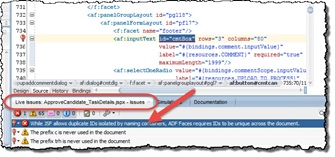
Oracle BPM 12.2.1 ADF Auto-Generation Issue Solutions by Dan Atwood

image 

Others may disagree, but I am a fan of creating the first cut of ADF forms for Oracle BPM using the human task’s auto-generation feature.  While this worked well in previous releases, in 12.2.1.1, 12.2.1.2 and 12.2.1.3 small manual edits are now needed to eliminate the errors on the generated form.

There are now two types of errors caused by 12.2.1.x auto-generation – edAttTy errors and duplicate ID errors.

Patches

While this blog describes the manual edits you can make to the auto-generated .jspx files to correct the issues:

  • If you are on 12.2.1.1, you can request a backport against bug 24683218 and then apply the patch provided.  Until this patch is provided, continue to manually edit the generated .jspx files as described below.
  • If you are on 12.2.1.2, you can apply patch 25333619 to prevent auto-generation errors from occurring.
  • If you are on 12.2.1.3, you should only get the "duplicate ID" errors described below.  I have not tried it yet, but Support suggested applying patch 26317255 to prevent these auto-generation errors from occurring.  If this does not work, manually edit the generated .jspx files as described below.
edAttTy Errors

The first type of error on the generated page causes "Referenced id edAttTy does not exist" errors throughout the form:

Although customer support document Doc ID 2192543.1 describes the issue, this describes how the forms can be fixed. 

1. In JDeveloper, click the Source tab at the lower left corner of the form that has the error. Read the complete article here.

PaaS Partner Community

For regular information on Oracle PaaS become a member in the SOA & BPM Partner Community for registration please visit www.oracle.com/goto/emea/soa (OPN account required) If you need support with your account please contact the Oracle Partner Business Center.

Blog Twitter LinkedIn image[7][2][2][2] Facebook clip_image002[8][4][2][2][2] Wiki

Technorati Tags: SOA Community,Oracle SOA,Oracle BPM,OPN,Jürgen Kress
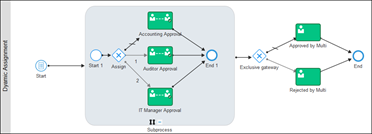
Using a Multi-Instance Subprocess as a Complex Gateway in Oracle PCS by Dan Atwood

image

To speed the time it takes for a work item instance to flow through a process, copies of the instance can be sent to people in multiple roles simultaneously in the Oracle Integration Cloud Process Cloud Service (PCS).  Someone in each of the roles can then approve or reject the work item instance.  The challenge comes when an early release from all of the parallel copies is desired when anyone in any of the roles rejects their instance and the original work item instance should then continue in the process.

The Business Process Model and Notation (BPMN) has a complex gateway artifact with this process pattern in mind. When needed, the complex gateway’s early release capability makes it one of the most powerful tools process modelers have today when designing executable BPMN processes.  Currently, PCS does not support complex gateways. Because its functionality often needed, this blog describes how to duplicate its functionality when modeling processes using PCS.

Recently added to PCS in May 2017, I recommend that the use of a multi-instance subprocess to do this because:

  • One of the multi-instance subprocess activity’s options is to send work item instances to people in multiple roles simultaneously
  • Each person in a role can approve or reject the work item instances sent to them
  • If one person rejects the instance, an early release can occur by defining a termination condition in its properties and the original instance can then leave the multi-instance subprocess
  • If a rejection occurs, all of the other copies can automatically be removed from the other role queues

Antonis Antoniou has written an excellent blog on the PCS multi-instance subprocess.  This expands the scope of what he wrote a little to include how to assign the instances spawned to people in different roles, and shows how to cause an early release occur when a one person rejects their copy of the instance. Read the complete article here.

PaaS Partner Community

For regular information on Oracle PaaS become a member in the SOA & BPM Partner Community for registration please visit www.oracle.com/goto/emea/soa (OPN account required) If you need support with your account please contact the Oracle Partner Business Center.

Blog Twitter LinkedIn image[7][2][2][2] Facebook clip_image002[8][4][2][2][2] Wiki

Technorati Tags: SOA Community,Oracle SOA,Oracle BPM,OPN,Jürgen Kress
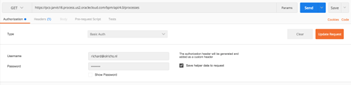
Jarvis Pizzeria: Using the REST interface to start a Process by Richard Olrichs & Marcel van de Glind

image

In the previous blog, we already explained how you can start your process from a SOAP interface. It is also possible to do this with a REST call. For this you need to find out a couple of things about your process after which you can do a post on the Oracle API to start the process. You can use any REST client you want, in this example we use Postman.

First of all, you need to query the process definitions API. This can be found by putting /bpm/api/4.0/process-definitions after the baseUrl, in our example: Read the complete article here.

PaaS Partner Community

For regular information on Oracle PaaS become a member in the SOA & BPM Partner Community for registration please visit www.oracle.com/goto/emea/soa (OPN account required) If you need support with your account please contact the Oracle Partner Business Center.

Blog Twitter LinkedIn image[7][2][2][2] Facebook clip_image002[8][4][2][2][2] Wiki

Technorati Tags: SOA Community,Oracle SOA,Oracle BPM,OPN,Jürgen Kress
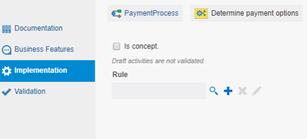
Jarvis Pizzeria: Deployment and using the workspace by Richard Olrichs & Marcel van de Glind

image

Having played around with all the features PCS has to offer it is now time to see some action. In this blog we will show you how to deploy your application, start the application and see how it behaves within the workspace.

But first of all, we need to have a application that is ready to deploy. In other words, our minimal deployable product consists of an application without any errors. Pressing the validate button in the top-right corner will tell you the current state of the implementation.

Unfortunately, we ran into a bunch of errors! Mostly due to missing implementations of service calls. The good thing however is the “Fix” link.

In contrast to JDeveloper, clicking the “Fix”-link will bring you directly to the – in this scenario – properties screen to fix the issue. Oops, we forgot to select a ruleset for our business rule activity. Read the complete article here.

PaaS Partner Community

For regular information on Oracle PaaS become a member in the SOA & BPM Partner Community for registration please visit www.oracle.com/goto/emea/soa (OPN account required) If you need support with your account please contact the Oracle Partner Business Center.

Blog Twitter LinkedIn image[7][2][2][2] Facebook clip_image002[8][4][2][2][2] Wiki

Technorati Tags: SOA Community,Oracle SOA,Oracle BPM,OPN,Jürgen Kress