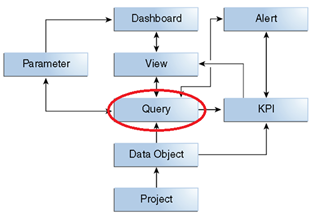
BAM Queries by Marcel van de Glind

image

In my previous two blogs, I have made a start with the study of the BAM components. I have started with the Data Objects (BAM Data Objecten, BAM Calculated Fields). In this post I will talk about Queries.

From the Oracle Documentation:
A business query or query is a request for data that matches specified conditions. A query can fetch from a data object once, on a schedule, or continuously.

A Flat SQL Query is a simple table of data fields and their values. You select the data object and then select the data fields.

  • I will use this type, among other things, to show the number of days a task is open.

A Group SQL Query query is an analysis of one or more numeric data fields, called measures, grouped by non-numeric data fields called dimensions. For example, a group SQL query might analyze cases grouped by department. You select the data object and then select the measures and dimensions.

  • I will use this type also multiple times. For example to show Today’s Task Summary.

A Tree Model Query, written in SQL, is an analysis of one or more measures grouped by a hierarchy of dimensions. For example, a tree model query might analyze cases grouped by Judicial system, Department, Team and Employee. You select the data object and then select the measures and a hierarchy.

SOA & BPM Partner Community

For regular information on Oracle SOA Suite become a member in the SOA & BPM Partner Community for registration please visit www.oracle.com/goto/emea/soa (OPN account required) If you need support with your account please contact the Oracle Partner Business Center.

Blog Twitter LinkedIn image[7][2][2][2] Facebook clip_image002[8][4][2][2][2] Wiki

Technorati Tags: SOA Community,Oracle SOA,Oracle BPM,OPN,Jürgen Kress
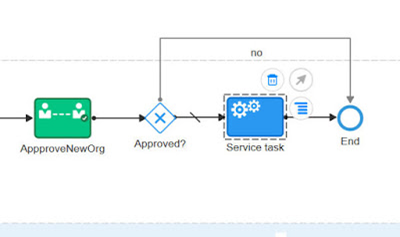
Are MicroServices the Death of BPM and Case Management? By Jan Kettenis


When reading about MicroServices you could get the impression that orchestrated business processes or even case management applications will soon become legacy. I seriously doubt that, considering the challenges you will face with creating a landscape of MicroServices that will be able to support some of the characteristics that gave birth to BPM and Case Management in the first place. Also, Martin Fowler’s primary guideline concerning MicroServices is "don’t even consider MicroServices unless you have a system that’s too complex to manage as a monolith". In the following I discuss the issues you might face with Business Process and Case Management in a pure MicroServices architecture. My conclusion being that MicroServices will not be the death of BPMN or Case Management. On the contrary, it probably is going to help delivering on some of their promises we so far seem not always be able to deliver upon.
Update 23-03-2017: you may also be interested to learn that Netflix (one of the examples you will always find when people point to a successful MicroService implementation) found the need for a Netflix Conductor: a microservices orchestrator.

Business Processes and Cases Are Not MicroServices

Let’s face it, BPM is about (stateful) orchestration. MicroServices are supposed to be stateless, and its business capability should not depend on others to complete its work, which makes it like the opposite. In BPMN the order in which activities are executed is prescribed or ‘orchestrated’ as we say, by ‘flows’ that go from one point to another. Read the complete article here.

SOA & BPM Partner Community

For regular information on Oracle SOA Suite become a member in the SOA & BPM Partner Community for registration please visit www.oracle.com/goto/emea/soa (OPN account required) If you need support with your account please contact the Oracle Partner Business Center.

Blog Twitter LinkedIn image[7][2][2][2] Facebook clip_image002[8][4][2][2][2] Wiki

Technorati Tags: SOA Community,Oracle SOA,Oracle BPM,OPN,Jürgen Kress

PCS Correlation and PCS calling ICS by Niall Commiskey

image

Nice new feature in PCS. from the docs…

Correlations enable business processes to communicate with each other based on the state of an instance. The state of all the process data objects in a process defines the state of the instance.

When you define a correlation for a business process, you can identify an instance in another process based on the instance state and then send a message to that specific instance.

For example, you can use correlations to communicate a sales process with the corresponding shipping and mailing processes. When the customer confirms an order, the shipping process sends a message to the shipping and mailing processes using a correlation that defines that it uses the order ID to locate the instances in both processes. Read the complete article here.

SOA & BPM Partner Community

For regular information on Oracle SOA Suite become a member in the SOA & BPM Partner Community for registration please visit www.oracle.com/goto/emea/soa (OPN account required) If you need support with your account please contact the Oracle Partner Business Center.

Blog Twitter LinkedIn image[7][2][2][2] Facebook clip_image002[8][4][2][2][2] Wiki

Technorati Tags: SOA Community,Oracle SOA,Oracle BPM,OPN,Jürgen Kress
Instance Archiving and Purging in Oracle Process Cloud Service by Antonis Antoniou

image

Archiving and purging your process instances systematically can improve drastically the performance of your processes. This task has been simplified in Oracle Process Cloud Service that gives you the option to run archives on demand or automate this task via scheduled jobs.

All archived instances (data) are stored in the Oracle Cloud Storage Service that is bundled with your Oracle Process Cloud Service. Archived instances are compressed in a zip file and once an archive task is processed, you will receive an email that will contain the link to the zip file that you can click on it to download the archived instances.

Purge will remove the BPM runtime information. Purge runs as a separate job and runs directly on the database. So when you configure archiving and purging, then two separate jobs will be executed independently of each other. So let’s see how you can schedule instance archiving and purging.

Configuring instance archiving and purging is an administrative task, therefore from the Oracle Process Cloud Service home page click on the “Configure” banner to go to the application settings. Read the complete article here.

SOA & BPM Partner Community

For regular information on Oracle SOA Suite become a member in the SOA & BPM Partner Community for registration please visit www.oracle.com/goto/emea/soa (OPN account required) If you need support with your account please contact the Oracle Partner Business Center.

Blog Twitter LinkedIn image[7][2][2][2] Facebook clip_image002[8][4][2][2][2] Wiki

Technorati Tags: SOA Community,Oracle SOA,Oracle BPM,OPN,Jürgen Kress
An IoT Asset Monitoring Experience

image

Boost your supply chain effectiveness by quickly blending powerful insights from IoT devices with business applications to create next-generation services. Watch the video here.

SOA & BPM Partner Community

For regular information on Oracle SOA Suite become a member in the SOA & BPM Partner Community for registration please visit www.oracle.com/goto/emea/soa (OPN account required) If you need support with your account please contact the Oracle Partner Business Center.

Blog Twitter LinkedIn image[7][2][2][2] Facebook clip_image002[8][4][2][2][2] Wiki

Technorati Tags: SOA Community,Oracle SOA,Oracle BPM,OPN,Jürgen Kress
IoT in 2017: Things as Apps, Low Power Networks, Edge Computing, and More by Bob Rhubart


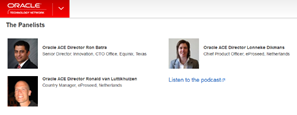
imageThe Internet of Things continues to generate its share of buzz in the world of enterprise IT. But what’s happening beyond the buzz? What impact is IoT having in the real world? How is it shaping the future of enterprise IT?

This program explores those and other IoT questions from the perspectives of three IT professionals who are no strangers to IoT projects.

This program was recorded on January 9, 2017. Listen to the podcast here.

Additional Resources

SOA & BPM Partner Community

For regular information on Oracle SOA Suite become a member in the SOA & BPM Partner Community for registration please visit www.oracle.com/goto/emea/soa (OPN account required) If you need support with your account please contact the Oracle Partner Business Center.

Blog Twitter LinkedIn image[7][2][2][2] Facebook clip_image002[8][4][2][2][2] Wiki

Technorati Tags: SOA Community,Oracle SOA,Oracle BPM,OPN,Jürgen Kress
My private Corner – Merry Christmas

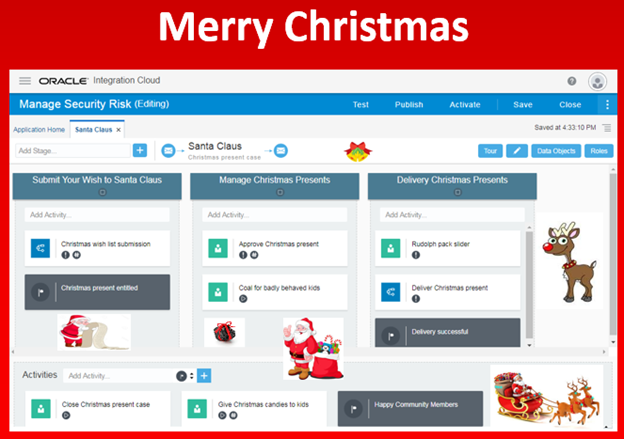
Since a few years we create a special Christmas card for the community. In 2015 we started with a Christmas delivery process implemented in Oracle Process Cloud Service. Last year multiple SaaS services have been integrated by drag and drop to process the Christmas presents. This year Santa Claus handles the Christmas wish list as a dynamic case. Make sure you submit your wish list, and Santa Claus as Rudolph to bring you the PaaS Forum tickets! #jkwc

image

SOA & BPM Partner Community

For regular information on Oracle SOA Suite become a member in the SOA & BPM Partner Community for registration please visit www.oracle.com/goto/emea/soa (OPN account required) If you need support with your account please contact the Oracle Partner Business Center.

Blog Twitter LinkedIn image[7][2][2][2] Facebook clip_image002[8][4][2][2][2] Wiki

Technorati Tags: SOA Community,Oracle SOA,Oracle BPM,OPN,Jürgen Kress

Handle locked rows by DB Adapters for distributed Polling technologies in OSB 12c by Chris Laurente

image

In this post, we will learn some ways to handle a database row that is locked by a Database Adapter with Distributed polling capablity in OSB 12c. There we go:

Introduction

Sometimes, when we work with Database adapters with distributed polling we are struggling to update the same polled row in the respective pipeline because, basically, the polled row is locked with the option “FOR UPDATE SKIP LOCKED” and it will be released when the process finishes or if an error occurs. But, what happen if we want to update the same polled row, let see for example the status description of the process or some error messages. So, I would like to show you some ways to handle these cases.

1.- Using JMS resources

If we could handle more resources like for example Topics or queues then we would be able to send the polled row to these resources and process them after the poller was released, so it would be useful if we want to release the polled row as soon as we want.

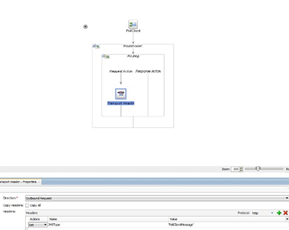
In this case we will create a topic and we will specify the Messaging request as the request of the DB Poller, the column to read and write is called POLLER_READ from 0(READY) to 1(DONE). Read the complete article here.

SOA & BPM Partner Community

For regular information on Oracle SOA Suite become a member in the SOA & BPM Partner Community for registration please visit www.oracle.com/goto/emea/soa (OPN account required) If you need support with your account please contact the Oracle Partner Business Center.

Blog Twitter LinkedIn image[7][2][2][2] Facebook clip_image002[8][4][2][2][2] Wiki

Technorati Tags: SOA Community,Oracle SOA,Oracle BPM,OPN,Jürgen Kress

Asynchronous Web Services With Oracle SOA Suite by Pavel Samolysov

image

The top web services based approaches for asynchronous interactions among enterprise applications are described in the article. The common used during Oracle SOA Suite leveraging method that based on a callback service and the WS-Addressing specification is shown. A number of examples of asynchronous web service creation and client generation using the JDeveloper IDE are considered.

Introduction

Time to time, when we as architects integrate some enterprise applications, asynchronous communication has be to taken into account. Asynchronous communication means a service consumer isn’t blocked for an response from a service provider, it just gets an acknowledge and continue doing it’s work. There are two popular approaches to implement asynchronous communication among web services:

  • polling refers to actively sampling the status of a being processed request by a service consumer as a synchronous activity.
  • callback refers to a method provided by a service consumer. When the service provider have accomplished the operation processing, it calls the consumer. In this approach, the service consumer simultaneously works like a callback methods service provider as well. Read the complete article here.

SOA & BPM Partner Community

For regular information on Oracle SOA Suite become a member in the SOA & BPM Partner Community for registration please visit www.oracle.com/goto/emea/soa (OPN account required) If you need support with your account please contact the Oracle Partner Business Center.

Blog Twitter LinkedIn image[7][2][2][2] Facebook clip_image002[8][4][2][2][2] Wiki

Technorati Tags: SOA Community,Oracle SOA,Oracle BPM,OPN,Jürgen Kress
Packt eBooks $5

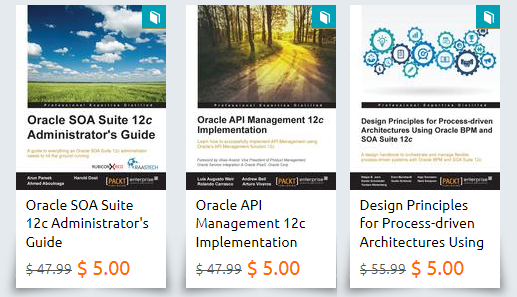
Packt is offering eBooks for $5.  Become an Oracle PaaS & Middleware expert and get your Christmas present today. For details please visit the Packt website here.


image

image

Get your Oracle Packt eBook here

Find Oracle SOA books here and Oracle BPM books here.

SOA & BPM Partner Community

For regular information on Oracle SOA Suite become a member in the SOA & BPM Partner Community for registration please visit www.oracle.com/goto/emea/soa (OPN account required) If you need support with your account please contact the Oracle Partner Business Center.

Blog Twitter LinkedIn image[7][2][2][2] Facebook clip_image002[8][4][2][2][2] Wiki

Technorati Tags: SOA Community,Oracle SOA,Oracle BPM,OPN,Jürgen Kress