Use Global Variables and Data Stitch to log request payloads by Thomas Hora

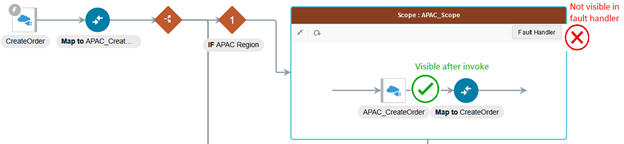
imageIn this blog, we will look at 2 new Integration features Global Variables, and Data Stitch.  Data Stitch allows us to make assignments to complex type variables.  We will show how the features can be leveraged to log invoke request payloads in case of fault.

Prerequisite

Enable following features:

  • oic.ics.console.integration.stitch-action
  • oic.ics.console.integration.complex-variables

To enable feature flags – Refer to Blog Enabling Feature Flags in Oracle Integration

The minimum Oracle Integration version required for the feature is 200113.1400.33493

Use case: 

When invoke fails, we want to log the request payload.  Currently, request payloads are visible after the invoke, but not visible inside the fault handlers.

Solution:

We will create a Global Variable based on the request payload.  Global Variables are visible anywhere in the integration, including fault handlers. Read the complete article here.

PaaS Partner Community

For regular information on Oracle PaaS become a member in the PaaS (Integration & Process) Partner Community please register here.

clip_image003 Blog clip_image005 Twitter clip_image004 LinkedIn image[7][2][2][2] Facebook clip_image002[8][4][2][2][2] Wiki

Technorati Tags: SOA Community,Oracle SOA,Oracle BPM,OPN,Jürgen Kress
PaaS (Process & Integration) Partner Community Newsletter July 2020

Dear PaaS Partner Community,

Thanks for your excellent contribution to make the Oracle Cloud Platform business a huge success. Recently Oracle announced the fiscal year 20 results, with Cloud Services and License Support revenues up 3% to $27,4 billion USD. In Q4 ERP cloud revenue, was up 32% year-over-year (YoY) and HCM cloud revenue, up 27% YoY. Your opportunity to innovate, extend and integrate SaaS based on the Oracle cloud platform.

Your partner contribution is key to growth and cloud utilization. So let’s get started in the new fiscal year and continue this cloud success. Please join our Connect, Innovate & Extend SaaS Partner Kickoff Webcast July 9th, 2020.

With the new fiscal year the latest certification Oracle Cloud Platform Application Integration 2020 Specialist | 1Z0-1042-20 is available. To prepare you for the certification we offer a series of free online integration bootcamps for Brazil, India, Asia and the US.

Thanks to the community for sharing all the integration articles: Empower your Business Users with Integration Insight & OIC June 2020 release UI updates & Oracle SOA Suite for Oracle Cloud Infrastructure – PAID”, available now on Oracle Marketplace. & Oracle Integration Cloud HCM adapter & Slack Adapter for OIC & OIC Integration: ServiceNow and Twilio Integration for Voice and SMS Notifications & OIC –> Evernote Adapter & Integration Monitoring and Scheduling pages – Progressive Web App UI Experience & OIC and Netsuite –> Custom fields revisited & HCM Data loader in Oracle Integration & OIC –> Netsuite Asynchronous Request Processing & Testing REST trigger-based Integrations in OIC Console & Global Variables and Data Stitch in Oracle Integration & Recursive calls in Oracle Integration Flows (Scenario: Paginated API calls for large Data Sets) & Data Stitch: Append and Assign for repeating elements & Data Stitch: Repeating element path does not have a predicate for selecting 1 instance – Warning & Use of correlation sets in SOA Suite.

In the process & innovation section Jan’s article describes how you can propagate the identity within a business process. Often business processes include attached files like pictures and documents, Bogdan describes attachments they can be integrated.

Watch Lonneke Dikmans, eProseed: Leveraging Oracle Cloud to realize a digital municipality. We want to promote also your customer success, submit your story via the customer reference program.

For a short summery of our monthly key information watch the PaaS Partner Updates on YouTube. The July edition highlights the new sales plays and virtual developer Meetups. This month’s community webcast will we our annual kickoff webcast with Suhas Uliyar. Please join Connect, Innovate & Extend SaaS Partner Kickoff Webcast on July 9th, 2020.

Want to publish your best practice article & news in the next community newsletter? Please feel free to send it via Twitter @soaCommunity #PaaSCommunity.

To read the newsletter please visit www.tinyurl.com/PaaSNewsJuly2020

Please like and share the newsletter at Twitter and LinkedIn

PaaS Newsletter July 2020

PaaS Partner Community

For regular information on Oracle PaaS become a member in the PaaS (Integration & Process) Partner Community please register here.

clip_image003 Blog clip_image005 Twitter clip_image004 LinkedIn image[7][2][2][2] Facebook clip_image002[8][4][2][2][2] Wiki

Technorati Tags: newsletter,SOA Community newsletter,SOA Community,Oracle,OPN,Jürgen Kress

My private Corner – Goodbye to an old friend

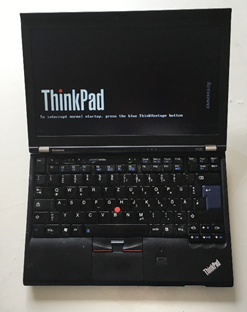
imageFor year’s I used an X220 ThinkPad. It was a great companion on hundreds of business trips. On it’s excellent keyboard I wrote most of the community newsletters. The model was launched in 2011, during the years I piped it with 16 GB RAM and two SSD drives. Which where a great help to run demos and trainings based on virtual box. The raise of cloud computing gave it’s CPU a second spring. With mandatory move to Windows 10 it’s time to say goodbye to a good friend – thanks for the great service!

PaaS Partner Community

For regular information on Oracle PaaS become a member in the PaaS (Integration & Process) Partner Community please register here.

clip_image003 Blog clip_image005 Twitter clip_image004 LinkedIn image[7][2][2][2] Facebook clip_image002[8][4][2][2][2] Wiki

Technorati Tags: SOA Community,Oracle SOA,Oracle BPM,OPN,Jürgen Kress
Additional new content PaaS Partner Community

image

Digital Transformation: We’ve Faced the Same Challenges at Oracle The hardest part of a digital transformation is often not the computers or software, but “the entire rethinking of how to operate in a modern global environment,” says Oracle CEO Safra Catz, who spoke at the recent Oracle OpenWorld Europe in London. But these transformations can lead to better customer understanding, financial decisions, and operations. At Oracle, by using the company’s own cloud-based applications and infrastructure, “things that would take weeks, like supply chain planning, now take an hour,” Catz says.

Data Science Is a Team Sport. Up Your Game Oracle built its new Oracle Cloud Data Science Platform to make it easier for data science teams to collaboratively build, train, and deploy machine-learning models. The goal: “To increase the success of data science projects,” says Oracle’s Greg Pavlik, by adding capabilities such as shared projects, model catalogs, team security policies, and reproducibility and auditability features. What else does it deliver?

Top 10 Strategic CIO Priorities for 2020 First on the list: Accelerate the pace of innovation. CIOs need to see the broad shift to the cloud, including autonomous technologies, as freeing their IT organizations to spend more time and money on developing customer-wowing, market-share-expanding, products and services—and less time and money on system maintenance, tuning, security, and upgrades. What’s next?

Oracle Builds on Cloud Momentum with Five New Regions Worldwide To run critical systems in the cloud, Oracle customers need fully independent cloud regions for disaster recovery purposes. That’s why Oracle has committed to having 36 cloud regions available by the end of 2020. Just this month, the company announced local regions in Saudi Arabia, Australia, Japan, Canada, and the Netherlands, all open for business and available in the Oracle Cloud Console.

Video: Introducing Oracle Cloud Free Tier

PaaS Partner Community

For regular information on Oracle PaaS become a member in the PaaS (Integration & Process) Partner Community please register here.

clip_image003 Blog clip_image005 Twitter clip_image004 LinkedIn image[7][2][2][2] Facebook clip_image002[8][4][2][2][2] Wiki

Technorati Tags: SOA Community,Oracle SOA,Oracle BPM,OPN,Jürgen Kress

Managing Oracle Process Cloud Service (PCS) Application by Ankur Jain

image

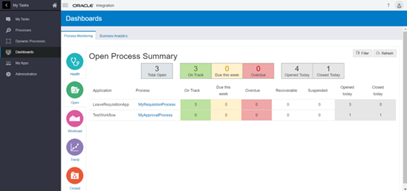
Managing Oracle Process Cloud Service application includes assigning roles to users or groups to initiate the process, approve/reject the assigned task etc.

Roles assigned to end users define their permissions, such as task assignment and whether they can start an application.

By default, roles get created for each swimlane defined in an application’s processes.

Some important link which might help you to extend your knowledge

Web Application in Oracle Visual Builder

Parent Child relationship in Oracle Visual Builder

Dependent/Cascading List Of Values (LOV) in VBCS

Default Roles of PCS application

Process Owner: Users assigned this role can view process activity history, take actions (such as approve or reject), alter process flow, and view form data for applications they own. Process owners typically manage activated business processes and use metric analysis tools such as dashboards to monitor business processes and alter task flow as needed.

Process Reviewer: Users assigned this role can view tracking and process activity history and view or add comments, attachments, or documents for the specified application. Process reviewers cannot take actions on tasks or alter task flow.

Analytics Reviewer: Users assigned this role can create and view business analytics dashboards associated with the specified application. Read the complete article here.

PaaS Partner Community

For regular information on Oracle PaaS become a member in the PaaS (Integration & Process) Partner Community please register here.

clip_image003 Blog clip_image005 Twitter clip_image004 LinkedIn image[7][2][2][2] Facebook clip_image002[8][4][2][2][2] Wiki

Technorati Tags: SOA Community,Oracle SOA,Oracle BPM,OPN,Jürgen Kress
OCI: When and How to Create an Integration to Call a Service from a Process? By Jan Kettenis

image

With the Oracle Integration Cloud, when you have to call a service from a Process you can choose to call an external service directly or you can put an Integration in between. This article gives some directives why you may want to do the latter, and how to prevent a pitfall that is easy to step in to.

To call a service you have to import the WSDL with it’s XSD’s. With that Business Types are auto-generated for all complexTypes in that XSD. Recently I was refactoring a case where this resulted in some 220 (!) Business Types being generated from 1 single external service, of which only a few were actually used. Granted, it concerned a service with a very complex interface, but for some reason all the external SOAP services we have to consume are moderate to very complex and easily generate 50+ Business Types. Not only that, they also use relatively long namespaces. Can you imagine what will happen when you have to call 5 of these services from the same Process application! You barely can see the forest from the trees, and you may find it pretty difficult to identify the correct Business Type to use for your request. The following example shows the selection list showing the types to chose from when creating a data object for one of the most simple cases we have. Read the complete article here.

PaaS Partner Community

For regular information on Oracle PaaS become a member in the PaaS (Integration & Process) Partner Community please register here.

clip_image003 Blog clip_image005 Twitter clip_image004 LinkedIn image[7][2][2][2] Facebook clip_image002[8][4][2][2][2] Wiki

Technorati Tags: SOA Community,Oracle SOA,Oracle BPM,OPN,Jürgen Kress

PaaS Partner YouTube Update July 2020

The July video includes three topics:

• Sales kits to integrate Apps & modernize Apps
• Virtual developer Meetups
• Kickoff Webcasts for PaaS & SaaS partners community

For regular updates please subscribe to our YouTube channel here. Thanks for your likes and sharing the video on YouTube and LinkedIn. For the latest PaaS Community information please visit our Community update wiki here (Community membership required).

PaaS Partner Community

For regular information on Oracle PaaS become a member in the PaaS (Integration & Process) Partner Community please register here.

clip_image003 Blog clip_image005 Twitter clip_image004 LinkedIn image[7][2][2][2] Facebook clip_image002[8][4][2][2][2] Wiki

Technorati Tags: YouTube,SOA Community,Oracle SOA,Oracle BPM,Jürgen Kress,Middleware Update,Partner Update

Unable to create an error notification rule in Oracle SOA Suite 12.2.1? Patch 26088894 is not the fix by Ahmed Aboulnaga

imageOn Oracle SOA Suite 12.2.1.0.0, when we tried to create an error notification rule to alert on failed ESS scheduled jobs, we experienced an issue where the dropdown was not showing any schedules. Unfortunately, the solution to apply patch 26088894 does not work.

Patch 26088894

Patch 26088894 is a zero downtime ESS patch and applicable for Oracle SOA Suite versions 12.1.3, 12.2.1, 12.2.1.1, and 12.2.1.2.

It addresses the issue of the Adapter Schedule generating a Null Error on the GUI, which may appear to be the issue we experienced, but it is not.

Problem: Error Notification Rule Issue

  1. Log in to the EM Console
  2. Navigate to Scheduling Services > Job Request > Define Schedules
  3. Create a schedule called "Ahmed_Job_10Minutes"
  4. Navigate to SOA > soa-infra (soa_server1) > SOA Infrastructure > Error Notification Rules
  5. Click on Create

When trying to create an error notification rule, you can see that the Schedule dropdown box is empty, preventing us from being able to create a rule. Read the complete article here.

PaaS Partner Community

For regular information on Oracle PaaS become a member in the PaaS (Integration & Process) Partner Community please register here.

clip_image003 Blog clip_image005 Twitter clip_image004 LinkedIn image[7][2][2][2] Facebook clip_image002[8][4][2][2][2] Wiki

Technorati Tags: SOA Community,Oracle SOA,Oracle BPM,OPN,Jürgen Kress

The magic of correlations in SOA, BPM and Oracle Integration Cloud– Virtual Developer Meetup July 6th 2020

Join us for a Virtual Developer Meetup July 6th 2020DeveloperMeetupsVirtual Summer 2020

OIC and especially the process part share a lot with the BPM Suite and BPM sits on top of SOA Suite. So they share a lot of features. Some features are obvious. Others less obvious. Some lesser obvious similarities might be of interest even in the Cloud environment. Today I want to highlight one of those that are in the process-engine from the very first release of Oracle BPEL: correlations. Why is this such a distinctive feature, what can we do with it and how do we implement it?

Presenter:
Martien van den Akker
Senior Consultant
Darwin IT

Schedule:

For details please visit the registration page here.

Oracle Developer Meetups in Europe: Find a local Meetup Group

PaaS Partner Community

For regular information on Oracle PaaS become a member in the PaaS (Integration & Process) Partner Community please register here.

clip_image003 Blog clip_image005 Twitter clip_image004 LinkedIn image[7][2][2][2] Facebook clip_image002[8][4][2][2][2] Wiki

Technorati Tags: SOA Community,Oracle SOA,Oracle BPM,OPN,Jürgen Kress

Get XML Document from SOA Infra table by Martien van den Akker

image

Today I’m investigating a problem in an interaction between Siebel and SOASuite. I needed to find a set of correlated messages, where BPEL expects only one message but gets 2 from Siebel.

To get all the messages that are related to two flows that run parallel based on the same message exchange.
The thing is that of course you want to see the contents of the message in the xml_document. This attribute is a BLOB that contains the parsed document from oracle xml classes. You need the oracle classes to serialize it to a String representation of the document. I found this nice solution from Michael Heyn.
In 12c this did not work right a way. First I had to rename the class to SOAXMLDocument, because I got a Java compilation error complaining that XMLDocument already was in use. I think it conflicts with the imported oracle.xml.parser.v2.XMLDocument class. Renaming it was the simple solution.
Another thing is that in SOA Suite 12c, the documents are apparent. Read the complete article here.

PaaS Partner Community

For regular information on Oracle PaaS become a member in the PaaS (Integration & Process) Partner Community please register here.

clip_image003 Blog clip_image005 Twitter clip_image004 LinkedIn image[7][2][2][2] Facebook clip_image002[8][4][2][2][2] Wiki

Technorati Tags: SOA Community,Oracle SOA,Oracle BPM,OPN,Jürgen Kress