Bug: Typed One Way Pipeline in Oracle Service Bus / OSB 12.2.1 by Frank Munz

clip_image002


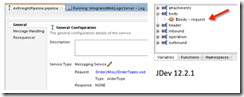
When creating a Service Bus pipeline in JDeveloper 12.2.1 for Oracle Service Bus 12.2.1, based on a typed, one-way business service (either one way WSDL based, or Messaging Service with XML request and XSD type with reply NONE business service) the pipeline won’t correctly use the request message type. It’s annoying because you cannot easily create expressions based on the request type, such as drilling open the $body variable, e.g. for an Order containing a shipping ID. All that is displayed within the pipeline is $body.

This happens although the pipeline configuration displays the correct XSD, eg. OrderType.xsd and the correct Type, eg. OrderType.

I am quite surprised because this is not a very unusual use case. Anyway I couldn’t find a work around for JDeveloper 12.2.1 (let me know if you know one!). Interestingly, testing a proxy service based on the business service works all right (so maybe the bug slipped in when the pipeline construct was separated from the proxy service? just guessing.)

It is possible to work with the good old Service Bus web console /sbconsole. There everything is fine, i.e. the correct structure of the request message is displayed. The working Service Bus console is another indication that the way JDeveloper does it is broken. Read the complete article here.

SOA & BPM Partner Community

For regular information on Oracle SOA Suite become a member in the SOA & BPM Partner Community for registration please visit www.oracle.com/goto/emea/soa (OPN account required) If you need support with your account please contact the Oracle Partner Business Center.

Blog Twitter LinkedIn image[7][2][2][2] Facebook clip_image002[8][4][2][2][2] Wiki

Export and Import Oracle BAM Projects by Waslley Souza

clip_image001


In the real world, you’ll create your Oracle BAM projects in a development environment, and when all is well, you will export it to a test or production environment. Export and import actions are easy to perform using BAMCommand command-line utility.

In this post, we will learn how to export Oracle BAM projects from a source environment and then import it to a target environment.
Download the sample application: BlogProject.zip.

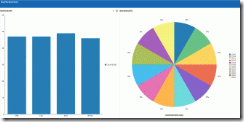
I created an Oracle BAM project called Blog that has Data Object, Business Query, Business Views and Dashboard.

First of all, edit the BAMCommand configuration file, defining the information about the source environment.
It is located at <FMW_HOME>/soa/bam/bin/BAMCommandConfig.xml.

Now you can execute the BAMCommand command-line utility to export your BAM project artifacts.
I could export all Oracle BAM objects in the system, but I have other projects and I just want to export the project called Blog. Read the complete article here.

SOA & BPM Partner Community

For regular information on Oracle SOA Suite become a member in the SOA & BPM Partner Community for registration please visit www.oracle.com/goto/emea/soa (OPN account required) If you need support with your account please contact the Oracle Partner Business Center.

Blog Twitter LinkedIn image[7][2][2][2] Facebook clip_image002[8][4][2][2][2] Wiki

Connecting Stream Explorer and BAM by Waslley Souza

clip_image001


When you are working with Oracle Stream Explorer and you need analytical data about the events, the easiest way is using Oracle BAM. The connection between the Oracle Stream Explorer and Oracle BAM is simple to create. In this post we will learn how to do this connection using JMS.

This is the structure of my CSV file.

In the Oracle Stream Explorer, go to the Exploration that you want to use.
Click Configure a Target.

Complete the form with information about your BAM server and click Finish.

This is the necessary setting in Oracle Stream Explorer.
Now, go to Oracle WebLogic Server and navigate to JMS Modules.

Click BAMJMSSystemResource, and then click New.
Create a new Queue with the same information you entered in Oracle Stream Explorer and click Next. Read the complete article here.

SOA & BPM Partner Community

For regular information on Oracle SOA Suite become a member in the SOA & BPM Partner Community for registration please visit www.oracle.com/goto/emea/soa (OPN account required) If you need support with your account please contact the Oracle Partner Business Center.

Blog Twitter LinkedIn image[7][2][2][2] Facebook clip_image002[8][4][2][2][2] Wiki

Matt Brasier for Oracle Technology Network – Monitoring Oracle SOA Suite

clip_image002Matt Brasier, C2B2 Head of Consulting and the co-author of the Oracle SOA Suite 11g Performance Tuning Cookbook (Packt Publishing) discusses Oracle SOA Suite monitoring in this 2 Minute Oracle Technology Network Tech Tip recorded at the UKOUG Tech15 Conference. Watch the video here.

SOA & BPM Partner Community

For regular information on Oracle SOA Suite become a member in the SOA & BPM Partner Community for registration please visit www.oracle.com/goto/emea/soa (OPN account required) If you need support with your account please contact the Oracle Partner Business Center.

Blog Twitter LinkedIn image[7][2][2][2] Facebook clip_image002[8][4][2][2][2] Wiki

Resiliency: Circuit Breaker

clip_image002

Circuit Breaker is a new resiliency feature in 12.2.1 that helps to simplify operations and ensure system stability when downstream endpoints become unavailable.

This post is meant to be a quick introduction to this new feature so you can start testing it out.

Circuit Breaker overview

Circuit Breaker enables you to configure the system to automatically suspend upstream endpoints when a downstream system is down or unreachable from a SOA composite. This prevents faults from building up in the server and relieves you from having to bulk-recover faulted instances. The upstream endpoints are automatically resumed after the downstream endpoint comes back up.

The circuit breaker feature works by monitoring downstream system failures and after x number of failures over y minutes (where x and y are configurable) any upstream web service, subscriber, or adapter where the failed messages originated from will be suspended.  For adapters and subscribers the messages will not be lost but will not be processed until the downstream system comes back up. Web Service requests will be rejected and it is up to the client program to handle these failures.

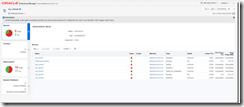
Suspended services will show up in the EM dashboard (below),  by clicking on the "Suspended since …" link another dialog will pop up that will allow you to jump to the error in the Error Hospital and/or re-enable the service. 

Once a service is suspended messages are allowed to "trickle" through periodically in order to test the downstream system.  If the downstream invocation succeeds then the upstream service is resumed.

Configuration

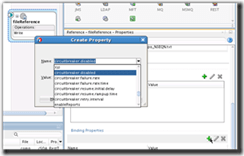
Circuit Breaker can be configured globally and overridden at the downstream endpoint. There may be situations where you don’t want downstream failures to cause services to be suspended, in this case you would disable the circuit breaker at the endpoint level, it is also possible to override the number of failures and failure window at the endpoint level. Conversely you can disable globally and enable at the endpoint level.  It is also possible to set the circuit breaker properties on an endpoint when designing the composite in JDev.

Global configuration

To display the configuration dialog go to SOA Infrastructure -> SOA Administration -> Resiliency Configuration. Read the complete article here.

SOA & BPM Partner Community

For regular information on Oracle SOA Suite become a member in the SOA & BPM Partner Community for registration please visit www.oracle.com/goto/emea/soa (OPN account required) If you need support with your account please contact the Oracle Partner Business Center.

Blog Twitter LinkedIn image[7][2][2][2] Facebook clip_image002[8][4][2][2][2] Wiki

What is SOA 12c ? by Tutorial Diary

clip_image002


Oracle SOA Suite 12c is new version of SOA Suite tool from Oracle. Oracle has introduced lot of new features in this new version. This new version is based upon 4 themes as show below. First two themes (Developer productivity and Industrial SOA) comes as outcome of user/developers feedback and other two themes (Mobile and Cloud) introduced as per industry trend.

SOA 12c Themes

Developer Productivity

This theme is outcome of the community that currently using SOA Suite 11g. Oracle has introduced couple of improvements in this version based upon the feedback from that community. As the name suggest, this theme helps developer to improve their productivity and that comes from the new features introduced.

Industrial SOA

This theme is also a outcome of the community that currently using SOA Suite 11g. Oracle has introduced couple of improvements in this version based upon the feedback from that community.

Mobile & Cloud

These themes has been introduced by seeing current industry trend. Currently everyone talking about mobile & cloud enablement that comes under these themes.

Major Enhancements in SOA 12c

Below are the major enhancements done in this new version (SOA 12c).

• Earlier Service Bus is separate tool from SOA Suite tool and we use to have Eclipse as IDE for service bus development. In this 12c version, Service Bus become part of SOA 12c only i.e. we can do Service Bus development using JDeveloper only, there is no need to use Eclipse anymore.
• As Service Bus become part of SOA 12c so all the adapters becomes accessible to Service Bus also.
• ESS (Enterprise Service Scheduler) is new component introduced in this version that provide scheduling capabilities.
• 1 Single Installer has been introduced that can used to install all the components like Database, Weblogic, SOA Suite, Service Bus etc.
• MFT (Managed File Transfer) has been introduced that does not come by default with SOA 12c but this can be downloaded as separate package that helps to do file transfer.
• Free License for developer on single machine. Read the complete article here.

SOA & BPM Partner Community

For regular information on Oracle SOA Suite become a member in the SOA & BPM Partner Community for registration please visit www.oracle.com/goto/emea/soa (OPN account required) If you need support with your account please contact the Oracle Partner Business Center.

Blog Twitter LinkedIn image[7][2][2][2] Facebook clip_image002[8][4][2][2][2] Wiki

What about to upgrade to Oracle SOA Suite 12.2.1? by Rolando Carrasco

clip_image001

This is my last post of the year.
Strangely this was the year with less posts here in Oracle Radio. And not only that, but I started to do it in English.
Since 2007 I’ve been feeding this blog in Spanish, but for some specific posts I just decided to do it in English to get to a greater audience.
So what about to upgrade to Oracle SOA Site 12.2.1? Is the name of this post.
For the last 7 weeks or so I’ve been upgrading, together with one of my colleagues, around 5 domains of SOA Suite 12.1.3 to 12.2.1. It’s been quite an effort, because those very same domains, were upgraded from 11.1.1.7, so there is a lot of history in them.
They’ve been serving a large SOA implementation, a mission critical implementation that is part of the core for this institution. So the challenge was an important one.
To fail and not be able to rollback was not an option, the maintenance window for the production environment was not that large.
But I insist: what about upgrading it? Does it really work? Is it well documented? Why doing so? 
Well, it is definitely documented by Oracle. It really works. That is the reality. Doing this must be something to have in mind for anyone using 12.1.3.x, I really encourage you to do it. Do not hesitate to do it. It will give you much more stability to your SOA platform.
If you are using Oracle BAM 12c, then this is something you need to do, a lot of bugs were solved with this upgrade. Same thing with BPM. The UI has changed for the ADF ALTA version, which is very clean and even elegant, I would say:
If you are already using Oracle Cloud products, this will be very familiar for you. Oracle Enterprise Manger – Fusion Middleware Control has been always an slow UI. Now is not the exception, but seems to be little less slow. But it is definitive much more intuitive and easy to use, take a look at this: Read the complete article here.

SOA & BPM Partner Community

For regular information on Oracle SOA Suite become a member in the SOA & BPM Partner Community for registration please visit www.oracle.com/goto/emea/soa (OPN account required) If you need support with your account please contact the Oracle Partner Business Center.

Blog Twitter LinkedIn image[7][2][2][2] Facebook clip_image002[8][4][2][2][2] Wiki

I don’t like the Mediator by Luc Gorissen

clip_image002

Ok, so there you have it: I just don’t like the Mediator. I don’t really know why. But now that it’s in the open, let’s discuss it.

I often see a pattern where a composite with a synchronous operation is implemented with a Mediator and BPEL component:

I think that in most of these cases, it would be better to either leave out the Mediator component completely. Or replace it with a BPEL component that is run transient, i.e. in-memory.

This article discusses some of the aspects around using a Mediator.

We need to discuss…

Some of the reasons to avoid a Mediator:

  • It adds another ‘technology’ to your developer’s skillset
  • It adds more tasks for system administration
  • It’s bad for performance

Arguments in favor of using the Mediator:

  • One end-point for a composite with multiple operations
  • One external interface hides composite-internal changes

Let’s go.

Yet another developer skill

As developer has to learn a lot when trying to master the SOA Suite completely. Learning all the aspects of BPEL is already a big task. And the Mediator is yet another skill. Arguably, not a big skill. Even more, developers are often inclined to say ‘ah … not hard at all’. But … are you as a developer familiar with all the features of Mediators? Like the resequencing rules? The routing rules priorities? When to specify sequential and parallel execution?

I like simple things.

More tasks for system administration

Like for the developer, the Mediator also introduces new topics for the system administrator: purging and tuning.

Both should not be a big issue, as enough information is available on how to handle them . But … does your system administrator know that there is a Mediator engine that needs to be tuned? Just challenge your system administrators to have a look at  Mediator tuning and ask them how they handled it.

Performance

At the beginning of the article, it was argued that a Mediator with synchronous operation(s) can be replaced with a BPEL component. That BPEL component can then be made transient, i.e. it will run in memory. That would save the DB access by the Mediator engine. Read the complete article here.

SOA & BPM Partner Community

For regular information on Oracle SOA Suite become a member in the SOA & BPM Partner Community for registration please visit www.oracle.com/goto/emea/soa (OPN account required) If you need support with your account please contact the Oracle Partner Business Center.

Blog Twitter LinkedIn image[7][2][2][2] Facebook clip_image002[8][4][2][2][2] Wiki

How to find purgeable instances in SOA/BPM 12c by Derek Kam


clip_image002If you are familiar with SOA/BPM 11g purging, after you have upgraded/implemented SOA/BPM 12c, you will not be able to use most of the SQL for 11g to determine the purgeable instances.  This is because SOA/BPM 12c is no longer using composite_instance table for composite instance tracking.

In SOA/BPM 12c, a common component is used to track the state associated with a business flow and report audit information.  This design will reduce the instance tracking data generated and stored in the database, and improve purge performance by minimizing the number of tables that need to be accessed.  Component instance state will no longer be stored in individual table for instance tracking purpose, the overall flow state will be stored in SCA_FLOW_INSTANCE table.

In SCA_FLOW_INSTANCE table, the “active_component_instances” column keeps track of how many component instances are still in a running/active state. These are the instances in one of the following states:

  • RUNNING
  • SUSPENDED
  • MIGRATING
  • WAITING_ON_HUMAN_INTERVENTION

When the “active_component_instances” value reaches 0, this indicates that the Flow is no longer executing. There is another column called “recoverable_faults”, this column keeps track of how many faults can be recovered. This information together with the “active_component_instances” is used to determine whether the Flow can be purged or not.

The SCA_FLOW_ASSOC table is used to record the association between the original Flow that creates the BPEL component instance and the correlated Flow. The SCA_FLOW_ASSOC table is used by the purge logic to ensure that all correlated Flows are purged together when none of the flow is in an active state.

Another important thing to take note: if you create a SOAINFRA schema with LARGE database profile, all transactional tables will be created with range-partition. If you decide to run the SOA purging with the purge script either manually by running the stored procedure or by using auto purge function which can be configured in Oracle Enterprise Manager Fusion Middleware Control, you will need to set the purge_partitioned_component => true (default is false), otherwise the purge logic will skip all partitioned tables when the purge script run and no flow instance will be purged.  You will be able to find all the partition tables in your SOAINFRA schema by using the following SQL: ?select table_name from user_tables where partitioned = ‘YES’;

You can use the following sample PL/SQL to determine whether the SCA_FLOW_INSTANCE has been partitioned and the number of purgeable flow instances in your SOAINFRA schema. Please read the complete article here.

SOA & BPM Partner Community

For regular information on Oracle SOA Suite become a member in the SOA & BPM Partner Community for registration please visit www.oracle.com/goto/emea/soa (OPN account required) If you need support with your account please contact the Oracle Partner Business Center.

Blog Twitter LinkedIn image[7][2][2][2] Facebook clip_image002[8][4][2][2][2] Wiki

Dramatically reduce SOA Suite 11g startup time by cleaning the MDS by Maarten Smeets

clip_image002

SOA Suite can sometimes be a bit slow to start. This is especially the case when there are a lot of composites to load. Customers using different versions of composites can benefit from undeploying non-default revisions of processes which do not have any running instances (see for example here). Undeployment in most cases is an asynchronous process which does not give feedback. It can partially fail without you noticing (apparently not an atomic transaction). This sometimes leaves composite remains; parts of the composite which are still loaded at startup but are not visible from the Enterprise Manager. Removing these can dramatically reduce server startup time. Especially in an environment which has been used for some time and environments with many versions of composites. Reducing the time required to get the soa-infra application fully up and running is of course mostly relevant for 11g SOA installations and less for 12.1.3 (which does some lazy loading) and 12.2.1 (which supports parallel deployments, also during server start-up).

In this article I’ll demonstrate how these left-over composite parts can be identified and removed on an 11.1.1.7 SOA environment. First try this procedure on a development or test environment before executing it in production! Using this method is entirely at your own risk. Only try it if you understand what you are doing. If something breaks, tell me so I can update this article. Thanks!

Please mind that these actions, although they help with the start time and memory usage of your SOA environment, have less impact on run-time performance than for example purging of instances and reducing the amount of deployed composites (or tweaking datasources, soa-infra database, JVM, etc).

Cleaning

What is a composite in the MDS?

WebLogic Server first brings up its Managed SOA server. After this managed server is up and RUNNING, the soa-infra application is started. After the soa-infra application is started, the composites are loaded from the MDS and put in memory. Read the complete article here.

SOA & BPM Partner Community

For regular information on Oracle SOA Suite become a member in the SOA & BPM Partner Community for registration please visit www.oracle.com/goto/emea/soa (OPN account required) If you need support with your account please contact the Oracle Partner Business Center.

Blog Twitter LinkedIn image[7][2][2][2] Facebook clip_image002[8][4][2][2][2] Wiki