Integrate Oracle SOA Healthcare and Oracle SOA Suite back-end composites across segregated domains by Bruno Neves Alves

clip_image001When implementing a composite with JDeveloper, one of the available adapters – since early versions of the 11g release of Oracle SOA Suite – is the Healthcare Adapter. This adapter allows to connect, both as exposed service (inbound) and as reference (outbound), to an Oracle SOA Suite for Healthcare Integration (SSHI) installation enabling document trading with other applications in the healthcare ecosystem.

The SSHI is mostly used for  HL7 documents exchange between back-end healthcare solutions and its satellite applications. However, in some other cases, SSHI is even implemented as a hub for document exchange, connecting heterogeneous healthcare applications.

The Healthcare adapter comes in two integration type flavors:

  • Default – in memory integration;
  • JMS – integration based on AQ or JMS queues.

The first one, based in memory, allows the SSHI application to integrate with the composites through the Healthcare Adapter using the JVM memory – what makes the integration quite efficient and fast – however, with one limitation: both SSHI and the SOA composites have to be deployed in the same domain.

Now, one of the best practices that should be taken in consideration when architecturing a large scale integration platform with SSHI and SOA Suite is to deploy the SSHI and the SOA back-end composite application in separated domains, favoring:

  • Tuning and configuration – domain configuration isolation is key to reach the sweet spot in such implementation. The domain where the composites are being deployed will likely demand different configuration compared with the SSHI dedicated one. This segregation will allow to apply different tuning strategies to one another.
  • Database partitioning – The fact that the SSHI and back-end composite application are persisting into separated SOA_INFRA schemas promotes separated database grow management strategies. This empowers an adequate data partitioning and purging strategies for each of the domains.

As explained, for an in memory integration, both domains needs to rely over the same JVM, therefore, separating the domains will presuppose two separated JVMs leaving the Default options as unusable.

This article demonstrates how the JMS integration can be implemented between SSHI and the back-end application available from two separated domains.
For questions of demonstrability it will follow a simplistic SSHI as a hub implementation. Because of that, the article additionally covers all the necessary steps to implement the integration scenario between two healthcare MLLP endpoints through a composite back-end.

Ingredients
  • 2 separated SOA Suite domains with cross domain authentication active
  • 1 inbound Weblogic JMS queue and connection factory
  • 1 outbound Weblogic JMS  queue and connection factory
  • 1 composite with two Healthcare Adapters, one as exposed service and another one as reference
  • 1 SSHI MLLP inbound endpoint
  • 1 SSHI MLLP outbound endpoint
  • 1 “Send to Internal” Internal Delivery Channel
  • 1 “Receive from Internal” Internal Delivery Channel

Read the complete article series here Part 1 and Part 2 and Part 3


SOA & BPM Partner Community

For regular information on Oracle SOA Suite become a member in the SOA & BPM Partner Community for registration please visit www.oracle.com/goto/emea/soa (OPN account required) If you need support with your account please contact the Oracle Partner Business Center.

Blog Twitter LinkedIn image[7][2][2][2] Facebook clip_image002[8][4][2][2][2] Wiki

HCM Atom Feed Subscriber using SOA Cloud Service by Jack Desai


clip_image002Introduction

HCM Atom feeds provide notifications of Oracle Fusion Human Capital Management (HCM) events and are tightly integrated with REST services. When an event occurs in Oracle Fusion HCM, the corresponding Atom feed is delivered automatically to the Atom server. The feed contains details of the REST resource on which the event occurred. Subscribers who consume these Atom feeds use the REST resources to retrieve additional information about the resource.

For more information on Atom, please refer to this.

This post focuses on consuming and processing HCM Atom feeds using Oracle Service Oriented Architecture (SOA) Cloud Service. Oracle SOA Cloud Service provides a PaaS computing platform solution for running Oracle SOA Suite, Oracle Service Bus, and Oracle API Manager in the cloud. For more information on SOA Cloud Service, please refer this.

Oracle SOA is the industry’s most complete and unified application integration and SOA solution. It transforms complex application integration into agile and re-usable service-based connectivity to speed time to market, respond faster to business requirements, and lower costs.. SOA facilitates the development of enterprise applications as modular business web services that can be easily integrated and reused, creating a truly flexible, adaptable IT infrastructure.

For more information on getting started with Oracle SOA, please refer this. For developing SOA applications using SOA Suite, please refer this.

Main Article

Atom feeds enable you to keep track of any changes made to feed-enabled resources in Oracle HCM Cloud. For any updates that may be of interest for downstream applications, such as new hire, terminations, employee transfers and promotions, Oracle HCM Cloud publishes Atom feeds. Your application will be able to read these feeds and take appropriate action.

Atom Publishing Protocol (AtomPub) allows software applications to subscribe to changes that occur on REST resources through published feeds. Updates are published when changes occur to feed-enabled resources in Oracle HCM Cloud. These are the following primary Atom feeds:

Employee Feeds

New hire
Termination
Employee update

Assignment creation, update, and end date

Work Structures Feeds (Creation, update, and end date)

Organizations
Jobs
Positions
Grades
Locations

The above feeds can be consumed programmatically. In this post, Node.js is implemented as one of the solutions consuming “Employee New Hire” feeds, but design and development is similar for all the supported objects in HCM. Read the complete article here.

SOA & BPM Partner Community

For regular information on Oracle SOA Suite become a member in the SOA & BPM Partner Community for registration please visit www.oracle.com/goto/emea/soa (OPN account required) If you need support with your account please contact the Oracle Partner Business Center.

Blog Twitter LinkedIn image[7][2][2][2] Facebook clip_image002[8][4][2][2][2] Wiki

Deploying to the SOA Cloud Service by Greg Draheim Overview


clip_image001On Monday night we obtained access to the SOA Cloud Service here at Flexagon, where we hope to use it for on-demand capacity.  One of our goals with FlexDeploy is to make it easy to move components from one environment or instance to another, enabling a true “lift-and-shift” into the cloud.  Since the SOA Cloud Service is built on top of the same underlying Oracle infrastructure, configuring it as a FlexDeploy target is a breeze.

In this blog article, I will cover how to deploy a set of projects that are currently used on-premise into this new SOA Cloud Service.

Adding a SOA Cloud instance to FlexDeploy

To deploy our composites we had a few steps to complete:

· Added the required datasource and outbound connection pool entries

· Created the SOA partition we deploy to (“order”)

· Created customization and configuration plans for the new environment

· Added the new endpoint and instance to FlexDeploy

· Deployed the composites and OSB components into the SOA Cloud Service instance

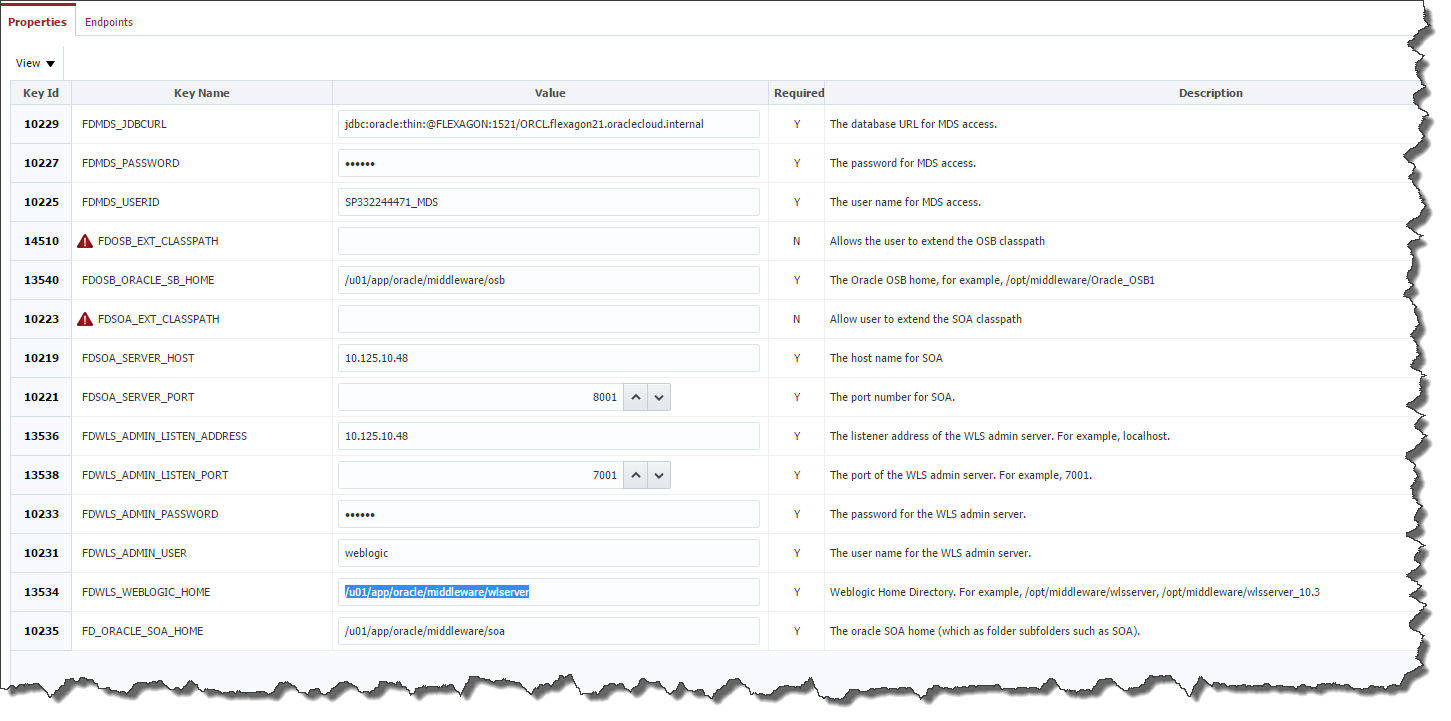
The screen below is the configuration screen for the SOA Cloud instance in FlexDeploy. This one configuration page handles the instance specific configuration. 

Click image to enlarge.

As an interesting note, the instance of FlexDeploy above is running on the Java Cloud Service.

Executing the Deploy

I have a FlexDeploy application that contains 5 projects I plan to deploy:

· PackAndShipService (SOA Composite)

· ProcessOrder (SOA Composite)

· SBOrderEBS (OSB Project)

Read the complete article here.

SOA & BPM Partner Community

For regular information on Oracle SOA Suite become a member in the SOA & BPM Partner Community for registration please visit www.oracle.com/goto/emea/soa (OPN account required) If you need support with your account please contact the Oracle Partner Business Center.

Blog Twitter LinkedIn image[7][2][2][2] Facebook clip_image002[8][4][2][2][2] Wiki

IoT Webcast May 26th 2016

imageOver the past year billions more smart devices have been deployed by Enterprises as they begin the journey to transform themselves. Knowing where to start is one of the biggest challenges faced by any Enterprise. That’s why we have created our unique Oracle IoT Discovery Workshop which is helping Enterprises, like yours, to not only formulate effective IoT strategies but then bring them to life.
Join us at our exclusive briefing webcast that will provide detailed information about the complimentary Oracle IoT Discovery Workshop offer.

This webcast will provide insight into our complimentary workshop offering:

  1. Why should your company invest in IoT?
  2. How do you identify prioritized areas of investment?
  3. What are the key priorities and use cases that help deliver quick ROI?
  4. How can this plan become reality?

Schedule: May 26th 2016 17.00 CET

For details please visit the registration page here.

SOA & BPM Partner Community

For regular information on Oracle SOA Suite become a member in the SOA & BPM Partner Community for registration please visit www.oracle.com/goto/emea/soa (OPN account required) If you need support with your account please contact the Oracle Partner Business Center.

Blog Twitter LinkedIn image[7][2][2][2] Facebook clip_image002[8][4][2][2][2] Wiki

Blurr the cloud lining with NetSuite: Introducing NetSuite Cloud Adapter on Oracle Integration Cloud Service by Rajesh Kalra


clip_image001NetSuite is a leading SaaS business software suite for ERP/financials, eCommerce, and order management. NetSuite cloud applications are commonly used by many mid-market and enterprise level companies, to streamline operations and provide real time visibility for better and faster decisions.

Oracle has introduced an all new NetSuite cloud adapter, in the latest release of its iPaaS –Integration Cloud Service (ICS). This new addition to the catalog of cloud adapters provides agility for NetSuite integrations, and enables organizations to access NetSuite content across business flows quickly and seamlessly.

The NetSuite cloud adapter provides rich and intuitive design time capabilities viz. functional categories of objects to select the business object(s) for integration, besides delivering the elevated user experience common to all cloud adapters.

Now Sales teams at any company can leverage the ICS iPaaS solution to build a lead-to-cash process from any SaaS based CRM (Oracle Sales Cloud or Salesforce.com) to NetSuite, creating quotes/orders in real time, thus eliminating manual order entry. They can access latest financial information, order status, or product availability via the NetSuite cloud adapter, and slash financial close. Read the complete article here.

SOA & BPM Partner Community

For regular information on Oracle SOA Suite become a member in the SOA & BPM Partner Community for registration please visit www.oracle.com/goto/emea/soa (OPN account required) If you need support with your account please contact the Oracle Partner Business Center.

Blog Twitter LinkedIn image[7][2][2][2] Facebook clip_image002[8][4][2][2][2] Wiki

Digital Innovation Demands Hybrid Integration by Carol Hildebrand


clip_image002I thought cloud computing would do away with acronym-laden technologies such as service-oriented architecture (SOA). Can’t you just sign up for applications run in a public cloud?

You can, but what happens when you want to integrate that shiny new cloud app with your existing applications and data? That integration has its own term—hybrid cloud—and for most enterprises, it’s the new norm. More than 65% of enterprise IT organizations will commit to hybrid cloud technologies before 2016, according to International Data Corporation.

Meanwhile, everyone from marketing to HR to product development is screaming for better information flow between departments, and they don’t care where the apps reside. That also requires smooth integration of cloud and legacy applications and data, which, as you will see, leads us back to SOA. Read the complete article here.

SOA & BPM Partner Community

For regular information on Oracle SOA Suite become a member in the SOA & BPM Partner Community for registration please visit www.oracle.com/goto/emea/soa (OPN account required) If you need support with your account please contact the Oracle Partner Business Center.

Blog Twitter LinkedIn image[7][2][2][2] Facebook clip_image002[8][4][2][2][2] Wiki

SOA 12.2.1 New Feature – End to End JSON and Javascript Example by Krishna Hanumantharao


clip_image002SOA 12.2.1 provides support for end-to-end JSON and Javascript. We don’t have do internal mapping between XML and JSON as in 12.1.3.

As part of this post, let us implement a simple REST service to demonstrate this new feature – End to End JSON with Javascript.

Let us create a very simple SOA Composite which exposes a JSON based REST interface, manipulates the values using Javascript and calls an external JSON based service.

Rest Service

External JSON Service Setup

For external JSON based REST service let us use a  dummy Read the complete article here.

SOA & BPM Partner Community

For regular information on Oracle SOA Suite become a member in the SOA & BPM Partner Community for registration please visit www.oracle.com/goto/emea/soa (OPN account required) If you need support with your account please contact the Oracle Partner Business Center.

Blog Twitter LinkedIn image[7][2][2][2] Facebook clip_image002[8][4][2][2][2] Wiki

SOA 12.2.1 – Awesome features! by Rama Rimmalapudi


Here is a quick overview of some of the new features of Oracle SOA 12.2.1 that we are excited about. We are looking forward to using the new features with our customers; they will provide significant benefits!

Integration Workload Statistics in EM

Workload metrics are very useful for high volume implementations. BPEL 10g had some of these metrics and they were not available in SOA 11g. Now we can search and view these metrics in EM. Workload metrics help in planning capacity of SOA servers. One suggestion to Oracle: it would be nice be able to monitor these metrics and alert by setting thresholds. Here are the few useful metrics:

  • Internal Queue metrics
  • BPEL Activity metrics
  • Service/Reference/Wire metrics
  • CPU and Memory for specific time
  • Dehydration metrics

Resiliency: Circuit Breaker

Failing instances consume resources and slows down SOA servers. This was problem in prior releases if you have failing instances due to external services issues etc. This enhancement allows you to monitor and suspend upstream services and then resume them after period of time that you configured. This helps in eliminating system outages due to one or more bad services. Note that Circuit Breaker is not enabled by default.

Several other things that I like about this feature:

  • We can enable this feature globally or at service level
  • Alerts can be sent when endpoint suspended.

Composite instance patching

Another excellent feature is modifying a composite without redeploying, so that pending instances can use updated service using patch artifact (SCA-INF/patch.xml). It creates sparse patch archive. WLST commands are available to validate and apply (deploy) the patch. This feature is only supported in production mode with database based MDS.

SOA in-memory

This is another useful feature for high volume implementations, which uses a coherence cache and configurable write-behind thread to defer DB writes for completed instances. Note that EM only reads from Database, not from coherence cache. Read the complete article here.

SOA & BPM Partner Community

For regular information on Oracle SOA Suite become a member in the SOA & BPM Partner Community for registration please visit www.oracle.com/goto/emea/soa (OPN account required) If you need support with your account please contact the Oracle Partner Business Center.

Blog Twitter LinkedIn image[7][2][2][2] Facebook clip_image002[8][4][2][2][2] Wiki

New Oracle Fusion Middleware 12c (12.2.1.0.0) Released!! by Bruno Neves Alves


The version 12.2.1 is officially and finally out! Check what’s new:
Oracle B2B
Moving B2B Agreement from a Test to a Production Environment – Test to production (T2P) process is now simpler with the use of configuration plans to change the endpoints

  • Enabling AS4–Based Message Exchange – Applicability Statement 4 (AS4) standard is now supported!
  • Message Flow Throttling – Oracle B2B can pause, or throttle, the endpoint to publish messages
  • Securing Messages with PGP – Oracle B2B and Healthcare support message level security using PGP

Oracle SSHI (Soa Suite for Healthcare Integration)
Cloning Endpoints – As possible with B2B agreements, its now possible to clone SSHI endpoints

  • Synchronous Request/Reply over MLLP – Request/reply communication between two MLLP endpoints is not facilitated by the introduction of the sync communication feature at the endpoint configuration 
  • Message Flow Throttling – same as B2B
  • Securing Messages with PGP – Same as B2B

Oracle SOA Suite (BPEL, Mediator, Business Rules and Human Workflow)
Support for patching running composite instances – Enabling the patching of running instances of a composite and recover faulted instances after patching

  • Support for In-Memory SOA Using In-Memory SOA – Improve System Performance executing short living processes only in memory

Read the complete article here.

SOA & BPM Partner Community

For regular information on Oracle SOA Suite become a member in the SOA & BPM Partner Community for registration please visit www.oracle.com/goto/emea/soa (OPN account required) If you need support with your account please contact the Oracle Partner Business Center.

Blog Twitter LinkedIn image[7][2][2][2] Facebook clip_image002[8][4][2][2][2] Wiki

SOA Suite 12.2.1: Failure resiliency by Marcel van de Glind

clip_image002

Adjust the situation that from a business process various service endpoints are invoked, where one of them is shown unstable behavior. The unstable service is regularly for short and sometimes long time not available. This may result in a large number of instances end in the error hospital. At the time that the endpoint is not available, resources are used to process instances which will not end successfully. Failure resiliency solution helps to avoid this situation. The failure resiliency solution is to suspend upstream inbound adapters, or EDN subscriptions, or web services. In the case of web services, clients are given errors right away. In the case of EDN and Adapters, messages wait in directory/queue/topic etc. until the endpoint is resumed.

IWS can also help in this situation (see also my IWS blog). Use IWS to examine what happened at various points in the business process to analyze the behavior.

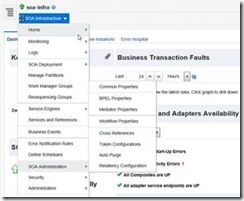
By default, failure resiliency is switched off. Zo to start using it, the first step is to enable failure resiliency. You can enable it globally (as shown below). Each downstream endpoint inherits this configuration, but you can override it for an endpoint. Read the complete article here.

SOA & BPM Partner Community

For regular information on Oracle SOA Suite become a member in the SOA & BPM Partner Community for registration please visit www.oracle.com/goto/emea/soa (OPN account required) If you need support with your account please contact the Oracle Partner Business Center.

Blog Twitter LinkedIn image[7][2][2][2] Facebook clip_image002[8][4][2][2][2] Wiki

Technorati Tags: