Oracle Implementation Certifications

image

Enablement and certification are key to cloud success. At the Oracle Competence Center and Online Learning Library partners can attend free on-line classes and certifications. Additional we offer the latest implementation exams ($245 or free vouchers) for:

· Oracle Cloud Platform Application Integration 2020 Specialist | 1Z0-1042-20

· Oracle Cloud Platform Digital Assistant 2020 Specialist | 1Z0-1071-20

· Oracle Cloud Platform Application Development 2019 Associate I 1Z0-1043

· Oracle Cloud Platform Enterprise Analytics 2019 Associate | 1Z0-1041

· Oracle Cloud Platform Content and Experience 2019 Associate | 1Z0-1040

PaaS Partner Community

For regular information on Oracle PaaS become a member in the PaaS (Integration & Process) Partner Community please register here.

clip_image003 Blog clip_image005 Twitter clip_image004 LinkedIn image[7][2][2][2] Facebook clip_image002[8][4][2][2][2] Wiki

Technorati Tags: SOA Community,Oracle SOA,Oracle BPM,OPN,Jürgen Kress

Announcing CMMN Method and Style by Bruce Silver

image

Those familiar with my past writings may be surprised that I have written a book on the Case Management Model and Notation (CMMN) standard, because when CMMN was launched in 2014, I was unenthusiastic and vocal about it.  Business process modeling already had a standard – BPMN 2.0 – that was widely adopted by both business and technical modelers.  Why did we now need a different one?  CMMN’s creators maintained that it was necessary because there are many kinds of processes that BPMN is unable to handle.  Although BPMN could have been tweaked to handle them, those tweaks never happened.  In my opinion, they never will; the BPMN 2.0 spec appears to be forever frozen in stone.

Actually, CMMN’s backers have a valid point.  BPMN does have limitations, and in my BPMN Method and Style training we discuss them.  Those limitations mostly stem from the fact that BPMN’s conception of a process is quite narrow, much narrower in fact than that of BPM Architecture and most other areas of business process management.  For example, many of the “processes” listed in APQC’s Process Classification Framework are not what BPMN would call processes, and many cannot be modeled in BPMN at all.  CMMN, on the other hand, could handle them.  That’s reason number one for my change of heart.  Instead of describing the logic procedurally – following a defined sequence of steps – CMMN logic is declarative, each case element independently defining its own prerequisite conditions.  That gives it great flexibility, but makes the logic harder to communicate clearly. Get the book here. For additional BPM books please see the wiki here.

PaaS Partner Community

For regular information on Oracle PaaS become a member in the PaaS (Integration & Process) Partner Community please register here.

clip_image003 Blog clip_image005 Twitter clip_image004 LinkedIn image[7][2][2][2] Facebook clip_image002[8][4][2][2][2] Wiki

Technorati Tags: SOA Community,Oracle SOA,Oracle BPM,OPN,Jürgen Kress
Oracle Integration Cloud Process Coverage of BPMN 2.0_Standard

image

How the Oracle Integration Cloud Process module supports the OMG BPM2.0 Standard.

This document provides an overview of how Oracle integration Cloud release 20.1.1 supports the BPMN2.0 standard, as defined by the OMG. It is intended solely to help you assess the business benefits of the solution.

This white paper presents in what capacity Oracle Integration Cloud’s Process module supports the OMG BPMN 2.0 Process modeling and execution standard, an accepted standard in the industry of Workflow and Business Process management, further referred as "the OMG document". This white paper is correct as of January 2020, knowing that technology evolves, some elements described here may become erroneous in the future. The OMG document is over 500 pages long, and we have made a synthesis of the key concepts, as they are summarized in Table 7.1 and table 7.2 of the OMG document. These tables define a collection of elements that are summarized here below. It should be noted that arithmetic provides only a short-sighted perspective. Just counting the number of items supported will only give a superficial view of how well Oracle Integration Cloud’s Process module supports the OMG standard. Going a level deeper, one will need to take into account the relative weight of each element, in order to ponder how efficient the tool can be. Within that frame of thought, it can safely be said that an extremely vast majority of business cases can be thoroughly implemented using this solution, as several hundreds, if not thousands, of customers have already done. Get the document here (community membership required).

PaaS Partner Community

For regular information on Oracle PaaS become a member in the PaaS (Integration & Process) Partner Community please register here.

clip_image003 Blog clip_image005 Twitter clip_image004 LinkedIn image[7][2][2][2] Facebook clip_image002[8][4][2][2][2] Wiki

Technorati Tags: SOA Community,Oracle SOA,Oracle BPM,OPN,Jürgen Kress

OIC: How to Find Human Task by Correlation and How to Abort a Parallel Task by Jan Kettenis

image

This article explains how you can find an instance of a Human Task of process instance in the Oracle Integration Cloud (OIC) without knowing its task number, and how you can use that for example to withdraw a parallel task. You can use the same mechanism for other use cases as well, like to get a specific task instance for a specific process instance in a custom Workspace, etc.

When a Human Task is scheduled in a process there is no out-of-the-box way for the process instance to “know” its task number, because scheduling a task concerns an asynchronous call (so you don’t get an immediate response with the task number). So, although the task number is visible in the process flow trace (as shown below), the process instance itself does not know it.

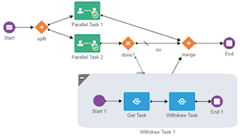
The sample process below has two parallel tasks. The outcome of Parallel Task 2 is either CONTINUE or DONE. When DONE, Parallel Task 1 must be withdrawn. I will use this as a use case to illustrate how setting some “correlation id” on a task can be used to achieve that.

For those of you who remember the on-premise BPM Suite may be aware of the Update Task activity you could use to do just that, but such an activity does not exist in OIC. Instead you will have to use the PUT operation of the /ic/api/process/v1/tasks/{id} API. But as you can see this requires an id, which is the task number that you don’t have. To get that you can use the GET operation on /ic/api/process/v1/tasks first. However, there can be many instances of the same process, implying many instances of the Parallel Task 1, so how to find that one you are looking for? Read the complete article here.

PaaS Partner Community

For regular information on Oracle PaaS become a member in the PaaS (Integration & Process) Partner Community please register here.

clip_image003 Blog clip_image005 Twitter clip_image004 LinkedIn image[7][2][2][2] Facebook clip_image002[8][4][2][2][2] Wiki

Technorati Tags: SOA Community,Oracle SOA,Oracle BPM,OPN,Jürgen Kress

Task Actions in Email Notification in Oracle Process Cloud Service by Ankur Jain

image

The video will describe how to send task action in email notifications in Oracle Process Cloud. Along with this, you would see how the remainder will be sent if the action has not been taken. Watch the video here.

PaaS Partner Community

For regular information on Oracle PaaS become a member in the PaaS (Integration & Process) Partner Community please register here.

clip_image003 Blog clip_image005 Twitter clip_image004 LinkedIn image[7][2][2][2] Facebook clip_image002[8][4][2][2][2] Wiki

Technorati Tags: SOA Community,Oracle SOA,Oracle BPM,OPN,Jürgen Kress

Boost Your WebForm Productivity with our New Expression Builder Features by Nicolas Damonte

image

We’re introducing several new Oracle Integration improvements we hope will markedly boost your web form expression productivity.

These enhancements are an example of our ongoing efforts to address your feedback!

Expression Editor Redesign

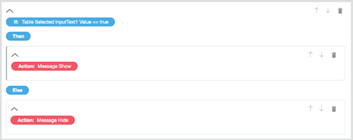
We’ve redesigned the form expression editor to make it easier to build and keep track of event logic. The expression editor content is now cleaner, more compact, and easier to understand. Many of the changes were made in response to feedback from customers and the User Assistance team. For example, function variables are now aligned, and expression summaries are now clearly differentiated from input fields. Read the complete article here.

PaaS Partner Community

For regular information on Oracle PaaS become a member in the PaaS (Integration & Process) Partner Community please register here.

clip_image003 Blog clip_image005 Twitter clip_image004 LinkedIn image[7][2][2][2] Facebook clip_image002[8][4][2][2][2] Wiki

Technorati Tags: SOA Community,Oracle SOA,Oracle BPM,OPN,Jürgen Kress
Integration, Process & Insight – Netsuite Data Sync Use Case by Niall Commiskey

image
Introduction

OIC is a toolkit – 4 main tools –
Integration – connect your apps
Process – intelligent human workflows – can be used to extend apps or for your own custom processes.
Insight – analyze what’s going on in Integration and Process, but this from a business user perspective. More details below.
Visual Builder – create net new apps on top of your apis.
For those who haven’t seen Insight before – the OraDocs provide the following succinct description of what it offers. Integration Insight in Oracle Integration provides a business-friendly experience, allowing users to model, collect, and monitor business-level metrics using web-based dashboards. Integration Insight works with business processes that are implemented using the Integrations or Processes features in Oracle Integration. At a high level, Integration Insight provides:
• A web-based interface to:
– Model business processes, including milestones
– Map models to a business processes implementation
– Monitor business progress through dashboards
• Efficient workflow requiring no development effort and minimal impact to runtime.
• Advanced analytics presented in both preconfigured and custom dashboards.

The following example leverages 3 of the OIC tools – Integration, Process and Insight in the context of a Netsuite data synchronisation use case. Please see my previous post here, for details of leveraging Visual Builder on top of Netsuite.

Integration

Let’s begin the with the integration that implements the data sync use case –
Commiskey Inc. uses SFDC for CRM and Netsuite for ERP. The company needs to ensure that customers and contacts are synced between the 2 SaaS apps. Read the complete article here.

PaaS Partner Community

For regular information on Oracle PaaS become a member in the PaaS (Integration & Process) Partner Community please register here.

clip_image003 Blog clip_image005 Twitter clip_image004 LinkedIn image[7][2][2][2] Facebook clip_image002[8][4][2][2][2] Wiki

Technorati Tags: SOA Community,Oracle SOA,Oracle BPM,OPN,Jürgen Kress
Hands-on Digital Modernization by Chris Peytier

image

This hands-on, instructor-led workshop supplements live presentations and demos in order to give you a concrete experience of using some of our solutions. No expertise or previous experience is required.

This lab will show you how to create a process application, use the Process
WebForm tool to modify GUI forms as well as understand the basics of a process
flow. It will also allow you to bind your process to an integration in order to
realize the power of having both Integration and Process in the same solution

The objectives of this lab are to:

1. Make you more familiar with the basic components of a process application.

2. Study and understand the features of WebForm, the GUI tool built-in the
Process component.

3. Understand the basics of BPMN.

4. Understand the concept of QuickStart

5. Learn how to leverage an integration. Get the free training material here.

PaaS Partner Community

For regular information on Oracle PaaS become a member in the PaaS (Integration & Process) Partner Community please register here.

clip_image003 Blog clip_image005 Twitter clip_image004 LinkedIn image[7][2][2][2] Facebook clip_image002[8][4][2][2][2] Wiki

Technorati Tags: SOA Community,Oracle SOA,Oracle BPM,OPN,Jürgen Kress
Machine Learning in Digital Process Automation — Part III by Ralf Mueller

image

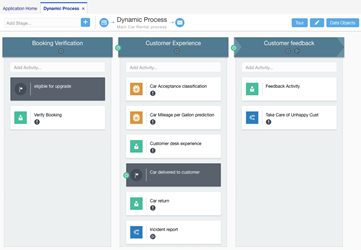
A lot has happened since the publishing of Part II of this article series. Autonomous Data Warehouse (ADW) has advanced and on the process side we’re working on a truly multi-tenant, OCI native offering. As part of this, we’re re-architecting parts of the Machine Learning capabilities for Digital Process Automation and we will talk about this in a later article. In this article though, we’d like to demonstrate how ADW and Oracle REST Data Services can be used today for the consumption of Machine Learning models in Business Processes or any other component that supports RESTful Services.

Use Case

For this article we’re considering a Rental Car Use Case. We pick this use case for various reasons:

· Renting a car is well understood by many people, almost all of us went through some great or miserable experience while renting a car.

· We have a great formal description of the case in the form of EU Rent, which was originally developed as a challenge for Business Rules implementations.

· Quite incidentally, there are two public data sets available that we could use for Machine Learning
– A Car Evaluation data set for the prediction of the car safety. This can be used to build classification models for the prediction of the safety of a car.
– A Car Mileage per Gallon (MPG) data set for the prediction of the mileage per gallon of a car. This data set can be used to build regression models. Reda the complete article here. Read the complete article here.

PaaS Partner Community

For regular information on Oracle PaaS become a member in the PaaS (Integration & Process) Partner Community please register here.

clip_image003 Blog clip_image005 Twitter clip_image004 LinkedIn image[7][2][2][2] Facebook clip_image002[8][4][2][2][2] Wiki

Technorati Tags: SOA Community,Oracle SOA,Oracle BPM,OPN,Jürgen Kress
Boost Your WebForm Productivity with our New Expression Builder Features by Nicolas Damonte, and Kalyn Chang

image

We’re introducing several new Oracle Integration improvements we hope will markedly boost your web form expression productivity.

These enhancements are an example of our ongoing efforts to address your feedback!

Expression Editor Redesign

We’ve redesigned the form expression editor to make it easier to build and keep track of event logic. The expression editor content is now cleaner, more compact, and easier to understand. Many of the changes were made in response to feedback from customers and the User Assistance team. For example, function variables are now aligned, and expression summaries are now clearly differentiated from input fields.

To see the new expression editor in action simply follow these steps:

1. Open a Form.

2. Add an Input Text control to the Form canvas.

3. Click on the Input Text.

4. Add any event from the General Properties panel. Read the complete article here.

PaaS Partner Community

For regular information on Oracle PaaS become a member in the PaaS (Integration & Process) Partner Community please register here.

clip_image003 Blog clip_image005 Twitter clip_image004 LinkedIn image[7][2][2][2] Facebook clip_image002[8][4][2][2][2] Wiki

Technorati Tags: SOA Community,Oracle SOA,Oracle BPM,OPN,Jürgen Kress