Part 1 – Oracle BPM 12c Process Invoke Database by Dan Atwood

image

Part 1 – Create a WebLogic JNDI Database Connection

This explains how the WebLogic JNDI connection to a database schema is created.  In the next two posts, you will see how the Database Adapter can use this connection once it has been created.  This simply describes the steps that are necessary to configure the JNDI connection initially. 

Components exposed in a SOA application can be exposed as a service, and a call to the database is no exception.  In order to invoke the database from a BPM process, it first has to be exposed as a service.

First, a datasource needs to be created.  You need the database schema’s datasource configured to create the JNDI connection information needed to access it. If all you want to do is to access the data from ADF, this is all you would need. 

Where the database adapter comes into play, however, is when your project’s composite needs to access it as a service (e.g., when a composite’s Mediator needs to connect to the database adapter). In the fourth part of this series, the Database Adapter SOA component will be dragged into the External References column of your composite diagram. For this to succeed at runtime, the datasource’s JNDI connection to the datasource has to first be added to the database adapter’s DBAdapter deployment.  This will be done in part 3 of this series.

This example uses the HR schema that comes that is preinstalled with the Oracle XE 11g or 12c SE database, but these same steps could be used to expose other database schemas. 

1. Open the WebLogic Console (e.g., http://localhost:7001/console), and log in.

2. In this step, the source of the data is configured as a datasource to the SOA infrastructure.  This datasource provides the connection to the actual underlying data provider.  Configure the JDBC Datasource in the WebLogic by selecting Services -> Data Sources. Read the complete article here.

Dealing with Dates and Times in Oracle Process Cloud Service by Sebastien Wiertz

image

Introduction

Oracle Process Cloud Service (PCS) is great! You can build process-based applications in two shakes of a lamb’s tail, much quicker than most Low Code platforms in the market. Of course, you can’t, or at least shouldn’t, develop any “normal” master-detail CRUD application with Oracle Process Cloud Service. If you need this kind of applications perhaps Oracle Application Builder Cloud Service will suit you better, but for process-centric applications, it’s a hard to beat tool.

As you may know, Oracle also has an on-premise product, called Oracle BPM, which features a similar codebase, but it features a more advanced and complex UI and it takes a bit more time to produce a similar application.

Oracle PCS really shines for its simplicity and ease of use, because the UI was streamlined and is much more focused. However, all this optimization and streamlining led to decisions to simplify the UI and some features present in Oracle BPM are not present in Oracle PCS. Most of them we won’t really need except for 1% of all our application needs, but a few are a more common necessity. The capacity to use functions to manage and operate dates and times fit this last set.

Oracle BPM allows you to manipulate dates using several options, with Data Associations and Script tasks perhaps being the most common. In Oracle PCS, the Data Associations don’t allow you manipulate dates nor retrieve the current Date / Time, and script tasks plain and simply are not available.

It’s possible to create services that do whatever we need to do with dates and then call them in Oracle PCS, but sometimes we want a more direct approach.

The Use Case

Let’s consider the following case:

We have a simple approval process with 3 steps. Every time there’s a response to a task, we want to record which response was and at which date and time it was made. We also want to show this information to the user, in the task web form, and we want that the whole process takes a calculated amount of time as the most, with it automatically finishing up after that amount.

Something a bit like this: Read the complete article here.

Web Forms in Oracle Process Cloud Service by Antonis Antoniou

image

The September 2016 release introduced an entirely new web forms functionality called “Web Forms”, an alternative to its existing Frevvo web forms with the latter being renamed to “Basic Forms”. The new “Web Forms” functionality is more business user-friendly, promoting important development principles like multiple views, re-use, branding, list of values and fetching data using REST connections.

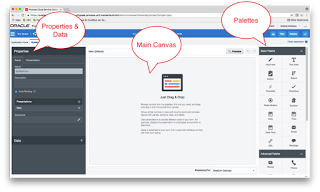
The new “Web Forms” group its functionality into three areas; the left area which includes the “Properties” section and the “Data” section, the right area that includes the palettes (basic, advanced, forms and business types) and the main area which is the drawing canvas.

Using drag and drop gestures you can design your form using any components from all four palettes. The “Basic Palette” includes basic components like the input text, button, checklist, radio button, date, etc. while the “Advanced Palette” includes components like image, video, section, tab, table, etc.

You can also use the “Forms Palette” to re-use previously created forms or you can use the “Business Type Palette” to create a user interface using a “data-first” approach (Oracle Process Cloud Service will automatically create a form using the data definitions of the business type). Read the complete article here.

Implementing Case Management Patterns using Oracle Process Cloud Service (PCS) by Jose Rodrigues

image

Hi everyone and welcome to the second part of our article on implementing Case Management (CM) patterns with Oracle Process Cloud Service (PCS).

On the first part, we learned a bit about the concepts around Case Management and we (barely) started a process on PCS. We’ll use this process now as a container to implement the ad-hoc nature patterns.

The First Rule of Fight Club

“We do NOT try to implement Case Management on PCS!” – That’s the first rule. What we will do is implement a small subset of behaviors, which will offer some of the advantages of Case Management.

The second rule is that we have two buddies that can help us in this quest: Database Cloud Service (DBCS) and Integration Cloud Service (ICS). Some of the behaviors will need a bit of persistence, which implies placing a lot of case metadata in some control tables, hence the DBCS, with the ICS being used to handle all integrations. ICS may not be necessary but makes integration easy as peach. Use them extensively!

As we’re trying to “hammer a screw”, things will not be pretty. This is a workaround. Please take it as a way to implement these behaviors.

Regarding the first rule, the set of behaviors which we’re going to implement is the following:

  • Ad-hoc Task and Process Invocation
  • Milestone and Stage Trigger/Set
  • Event Listeners

Let’s Start

So, last time we created a message based process

Again, the process must be created with messages events, as these will allow it to be called by other cases in an asynchronous way.

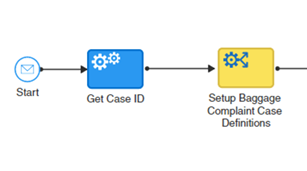
The first thing we do is get a case ID. This ID should come from another system (for instance, a database) and will be used to guarantee correlation between all elements of the case. We’ll get into to that further ahead.

Then, what we typically do is set up a business rule (decision table) or a database table, in which we predefine some configurations, such as Overall Process SLA, Milestone SLA’s, etc… This will allow you to change the way a process/case behaves, without actually having to change the process model. Read the complete article here.

Forceview Takes Business Ideas to Automation in Minutes

image

Patrick ten Broeke, Forceview’s Creative Analysis Officer, shares how Oracle Process Cloud powers agile engagement with business experts to cut time to value from months to minutes. Watch the video here.

The Curious Case of Missing Port Type in Oracle PCS by Arun Pareek

image

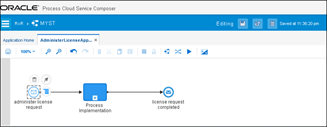
I was recently working on a simple process in PCS for a license approval flow. Given the purists that I am, I began by defining definitions for the various message based activities used in the process flow. The process was an asynchronous process with a few intermediate events. A simplified snippet is shown here for visualization.

In order to implement the above process, I created a service definition (WSDL) with the following schematic. As you can notice, there is a portType for accepting requests into the process (fc.myst.bp.TestDrive) and a callback portType for sending messages out of the process (fc.myst.bp.TestDrive.CallBack). Each of the portTypes have operations for catch and throw messages respectively.

Creating a service definition is considered a best practice as it will not lead to multiple definitions created by the process when generating interfaces from message based implementations. So instead of using “Define Interface” we tend to use “Use Interface“. Read the complete article here


Oracle Process Cloud Service – Decision Model Notation part 2 by Lykle Thijssen

image

In my previous blog, I showed how to get started with Decision Model Notation (DMN) in Oracle Process Cloud Service and how to create a simple Decision Table. Picking up from there, we will now look into creating If-Then-Else rules, which should also be familiar to people who know Oracle’s old Business Rules. We will also create a service and call it from a process.

Creating an If Then Else Decision

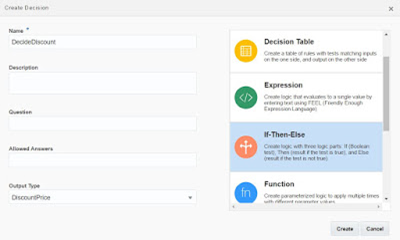
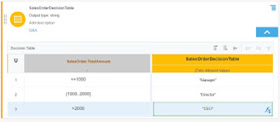
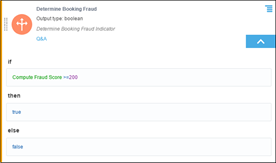
As Input, I have created a TotalAmount object, which is the total amount of a Sales Order. Based on this TotalAmount, we are going to calculate a Discount Price, for which I have created a DiscountPrice type to make the service interface a bit prettier than just ‘output’. To create an If-Then-Else rule, just click the + button next to Decisions, enter a name and set the output type to string, number or any other type, in this case DiscountPrice.

Now, Oracle will have created a rule for you, in which you only need to fill in the "if", "then" and "else". Since you’ve already decided your output object, we will not use that one in the expression, which is different from the old Oracle Business Rules. So just enter the value that you want for this object and you’ll be fine. You can also create nested expressions, as shown below: Read the complete article here.

Oracle Process Cloud Service – Decision Model Notation part 1 by Lykle Thijssen

image

Recently, Oracle Process Cloud Service (PCS) has made another major step forward through the addition of a whole new way of dealing with business rules. This brand new Decision Model Notation (DMN) feature is developed seperate from the actual processes and deployed as a microservice, so your decision models can be reused and everything is nicely loosely coupled. I like it.
What I also like about DMN is that it’s much more (business) user friendly than the rule engine from Oracle SOA Suite, which was used until now. While it was performing well and somewhat agreeable for technical users, business users were often lost and leaving the business rule modelling to developers. With this new DMN feature, this is no longer necessary. Business users will be able to do much more, if not everything, themselves and actually enjoy the experience!
I’ve decided to write a series of blogs about the different types of decision models that can be created and how to use them. But first we need to turn it on.

Getting Started

When you’re in the home screen, click on your login name in the top-right corner and choose ‘Administration’. On the Admin page, go to ‘UI Customization’ and tick ‘Enable DMN in Composer’, then Save. Read the complete article here.

Uncovering Booking Fraud with Oracle Process Cloud Service (PCS) and Decision Model Notation (DMN) by Arun Pareek

image

In a previous blog post, I wrote about the new Decision Modeling capability introduced in Oracle Process Cloud Service. The earlier post provided an introduction to DMN and a usage scenario along with a working prototype.

The decision modeling and notation standard released by OMG is a very powerful framework providing an implementation and modeling specification for solving many complex operational and strategic decision in an organization. In this second blog post of the series, I will put the DMN engine in Oracle PCS through a litmus test by implementing a complex decision modeling use case.

To make matters more interesting, I have now selected a decision modelling scenario published as an open challenge in the Decision Management Community in February. The solution shared in this post has been accepted and validated by the community moderator.

The modeling approach shared in this blog is based on the principle of “Inherent Simplicity” which says that every situation, no matter how complex it initially looks, is exceedingly simple. I chose this use case as it shows how principles of decision modeling can allow us to break a layered problem into simpler and easy to implement fragments. Read the complete article here.

Streamline your Oracle PCS Process Models with Decision Model Notation by Arun Pareek

image 

Introduction to DMN and Feature Preview

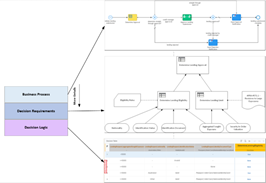
With the latest release of the Process Cloud Service (17.1.3), Oracle has released a preview version of its much awaited Decision Model and Notation (DMN) engine. The DMN standard provides a powerful meta-model, notation and semantics for modeling of operational decision and business rules. It is a critical addition in the process, case and decision modeling framework providing an open standard for modeling the data and logic associated within a process.

The notation standard aims at defining requirements and decision logic for manual and automated decision-making by representing a complete, executable model which can either be used independently or in conjunction with a business process. Similar to BPMN, it aims to support designing of decision models, providing guided operational decision and potentially automation of operational decisions. A combination of process and decision modeling simplifies business processes by eliminating and replacing sections of a process model with a decision model. The decision logic of the process model is captured as a separate, yet linked, model. By focusing on decisions and processes independently the requirements process is more focused. A decision-driven process acts on the outcome of the evaluation of decision logic in several possible ways, including: Read the complete article here.