bpmNEXT: Boost Business Process Agility with DMN, by Eduardo Chiocconi


image

Watch the video here.

Free Training On-demand – Oracle SOA Suite 12c and Oracle BPM 12C Implementation Specialists Boot Camps in February and April 2018


image

Oracle SOA Suite 12c Implementation Specialists Oracle Business Process Management 12C

Feb 19, 2018 – Mar 16, 2018 or

Apr 02, 2018 – Apr 27, 2018

Feb 19, 2018 – Mar 16, 2018 or

Apr 02, 2018 – Apr 27, 2018

What will we cover?
Oracle SOA Suite 12c is the latest version of the industry’s most complete and unified application integration and SOA solution. With simplified cloud, mobile, on premises and Internet of Things (IoT) integration capabilities, all within a single platform, Oracle SOA Suite 12c delivers faster time to integration, increased productivity and lower TCO.
The Oracle SOA Suite 12c Implementation Boot Camp provides relevant insight to current and prospective SOA implementers and for those companies interested on becoming Oracle SOA Suite 12c Specialized. Participants will learn how to develop and implement solutions using SOA Suite 12c that will drive their customer organizations run more effectively and efficiently.
Learn To:

  • Create, deploy, and manage cross-application process orchestration with BPEL Process Manager
  • Describe tasks for users or groups to perform with Human Task Service
  • Define and modify business logic without programming by using Business Rules
  • Create dashboards, alerts, and reports in real time with no coding using Business Activity Monitoring (BAM)
  • Implement SOA Services with Web Services Manager
  • Manage and monitor integration flow with Enterprise Manager
  • Use Adapters to connect to enterprise applications
  • Convert complex point-to-point application integration into simplified, agile, and reusable shared service application infrastructure with Service Bus

What will we cover?
This boot camp is an ideal starting point for an implementer who is planning to learn Oracle BPM Suite 12c and use it on BPM projects. The course provides a combination of lecture segments that present conceptual and feature background and hands-on labs that provide practice with the tooling.
It introduces process developers to Oracle BPM Suite 12c. It covers the key concepts, features and processes needed to begin using the design-time and run-time capabilities on BPM projects. Throughout the training, you will benefit from hands-on exercises based upon two case studies. At the conclusion of the course, you should feel comfortable to start using BPM Suite 12c for process modeling, simulation, analytics, business rules and human workflow.
Learn To:

  • Use BPMN modeling notation to document business process
  • Simulate a process model to identify bottlenecks
  • Create business rules that condition flow through a model
  • Develop a sophisticated human workflow task routing
  • Define key performance metrics
  • Build a dashboard containing charts that show key performance metrics
For details please visit the registration pages

Feb 19, 2018 – Mar 16, 2018 or

Apr 02, 2018 – Apr 27, 2018

For details please visit the registration pages

Feb 19, 2018 – Mar 16, 2018 or

Apr 02, 2018 – Apr 27, 2018

For additional training please see the community training calendar (membership required).

BAM KPIs by Marcel van de Glind

image

Next I my BAM Series, a post about BAM KPIs.

First the theory from the oracle documentation

Understanding KPIs

There are two major types of performance indicators: outcome metrics and driver metrics. Outcome metrics, sometimes called lagging indicators, measure business activity that a strategy is designed to achieve, such as return rate per month or average call processing time for the last moving hour. Driver metrics, sometimes called leading indicators, measure business activity that influences the outcome metrics.

KPIs are outcome metrics that compare performance measures to specific business goals that roll up into larger organizational strategies requiring monitoring, improvement, and evaluation. KPI values vary with time, have targets to determine performance status, include dimensions to allow for more specific analysis, and can be compared over time for trending purposes and to identify performance patterns. Read the complete article here

SOA & BPM Partner Community

For regular information on Oracle SOA Suite become a member in the SOA & BPM Partner Community for registration please visit www.oracle.com/goto/emea/soa (OPN account required) If you need support with your account please contact the Oracle Partner Business Center.

Blog Twitter LinkedIn image[7][2][2][2] Facebook clip_image002[8][4][2][2][2] Wiki

Technorati Tags: SOA Community,Oracle SOA,Oracle BPM,OPN,Jürgen Kress

BAM Views by Marcel van de Glind

image

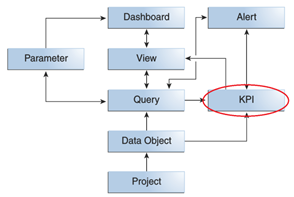
After the Queries and KPIs I will continue with the next topic. Business Views or shortly just Views.

As usual I first start with a piece of theory from the oracle documentation.

A business view is a visual representation of data fetched by a business query or one or more KPIs. In most views, numeric data fields, called measures, are grouped by non-numeric data fields, called dimensions. For example, lawsuit costs, a measure, can be grouped by department, a dimension. An aggregation is a computation based on multiple values in a data field, such as a sum or average.

Oracle BAM uses various view types:

  • Graph Views
  • Chart Views
  • Table Views
  • Gauge Views
  • Geo Map View
  • Treemap View
  • KPI Watchlist View

Area Chart, Bar Chart, Horizontal Bar Chart, Line Chart, Pie Chart, Combo Chart, Scatter Chart, and Bubble Chart views are collectively called chart views. There are corresponding graph view variations of each of these views.

Some graph views are switchable. They can be changed to a compatible type. Provided that queries are compatible, some views are switchable with each other. These are Area, Bar, Horizontal Bar, Line, Pie, and Combo views. Gauge views are switchable within the category.
You can format views in many ways, changing colors, fonts, labels, thresholds, and other properties. Read the complete article here.

SOA & BPM Partner Community

For regular information on Oracle SOA Suite become a member in the SOA & BPM Partner Community for registration please visit www.oracle.com/goto/emea/soa (OPN account required) If you need support with your account please contact the Oracle Partner Business Center.

Blog Twitter LinkedIn image[7][2][2][2] Facebook clip_image002[8][4][2][2][2] Wiki

Technorati Tags: SOA Community,Oracle SOA,Oracle BPM,OPN,Jürgen Kress
BPM BAC Subversion Server refusing connections by Martien van den Akker

image

These days I work on setting up several development lifecycle environments for BPM, SOA and OSB. What means that we setup servers for Development and test, culminating eventually in supporting the setup of the acceptance and production servers.
Since we want to have development resemble production as much as possible, we installed a dual-node clustered BPM environment, including BAM. However, since it is development, we have the two Managed Servers per cluster on the same phsyical (actually virtual) host.
In 12c BPM introduced a new component the Process Asset Manager, as described here. But installing BPM on a dual node cluster on a single node, will give problems with the underlying BAC/Subversion Component.
Errors you could encounter in the logs are for example: Read the complete article here.

SOA & BPM Partner Community

For regular information on Oracle SOA Suite become a member in the SOA & BPM Partner Community for registration please visit www.oracle.com/goto/emea/soa (OPN account required) If you need support with your account please contact the Oracle Partner Business Center.

Blog Twitter LinkedIn image[7][2][2][2] Facebook clip_image002[8][4][2][2][2] Wiki

Technorati Tags: SOA Community,Oracle SOA,Oracle BPM,OPN,Jürgen Kress
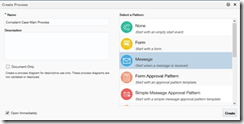
Case Management Patterns using Oracle Process Cloud Service by Jose Rodrigues

image

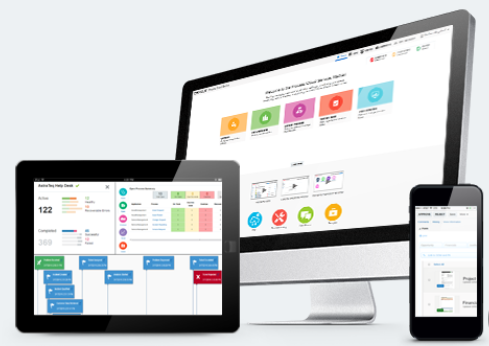
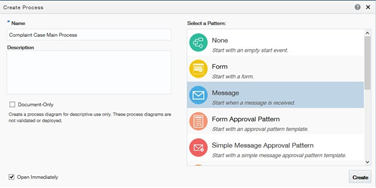
Hi and welcome to a new article on Oracle Process Cloud Service (PCS).

This time, we’re going to address some use patterns that may seem difficult to implement using PCS, and tackle the need for unstructured parts of the process, which is to say, parts of the process that can’t be previously modelled because, well… we don’t know how they’ll turn out.

Take for instance a complaint to your customer service department. You’ll never know, in advance, what kind of complain it will be, or if you need one, two, five or fifty interactions with the customer, or if you need to get approval from department A or B to try and compensate the customer, or even if any legal action will be needed with a supplier of yours, after they failed to compensate the complainer in due time.

So, you see, there are some elements that may render part of your process impossible to predict, at least in terms of activity sequence. You know that these may take place at some point in time in the process, but you can’t plan ahead and model the exact activity sequence (“A” will happen after “B”).

To handle this type of less structured processes (I don’t like the term “Unstructured”, because they have a structure), there’s a discipline called “Case Management” (CM). CM handles the choreography of this type of processes, called Cases, guaranteeing that the activities that are part of the process are executed at the right time and when conditions permit it.

For the remainder of the article, please consider the terms “Case” and “Process” as interchangeable, the term “Less structured Process” as equivalent to Case, and the term “Structured Process” as equivalent to a predefined flow-controlled Process (BPMN process or equivalent).

The main idea behind CM is that instead of the process model determining the next action to be taken, it’s the worker who, actually decides what should be the next best action to perform in each situation, using his experience.

This is not to say that the worker can just do any activity at any time. Typically, there are specific business rules that enable or disable a given activity based on the current data and events associated with a specific process. However, these rules can be as tight or as flexible as we may need.

Case Management Patterns

The idea of the article is to give you the tools you need to implement Case Management patterns using Oracle PCS. This is not to implement Case Management in PCS, but just some case management behavioral patterns. Parts of what is “Case Management” will not be addressed in any way, but things like Ad-hoc process/task calls will, and this is sufficient for most needs. Read the complete article here.


SOA & BPM Partner Community

For regular information on Oracle SOA Suite become a member in the SOA & BPM Partner Community for registration please visit www.oracle.com/goto/emea/soa (OPN account required) If you need support with your account please contact the Oracle Partner Business Center.

Blog Twitter LinkedIn image[7][2][2][2] Facebook clip_image002[8][4][2][2][2] Wiki

Technorati Tags: SOA Community,Oracle SOA,Oracle BPM,OPN,Jürgen Kress
Process Cloud hands-on lab January 25th 2018 Netherlands

image

Samenvatting

Op deze avond zal Richard Olrichs de begeleiding verzorgen van een Hands on Lab van Oracle Process Cloud. Het cloud product van Oracle waarin processen gemodelleerd kunnen worden. In een korte presentatie en demo worden de contouren van het product geschetst waarna de deelnemers zelf aan de slag kunnen gaan met het product. Er zal keuze zijn uit een verschillend aantal tutorials waarbij de deelnemers zelf kunnen kiezen welke onderdelen het meest aansprekend zijn en welke tutorials gevolgd worden.

Inhoud

Op deze avond zal Richard Olrichs de begeleiding verzorgen van een Hands on Lab van Oracle Process Cloud. Het cloud product van Oracle waarin processen gemodelleerd kunnen worden. In een korte presentatie en demo worden de contouren van het product geschetst waarna de deelnemers zelf aan de slag kunnen gaan met het product.

Er zal keuze zijn uit een verschillend aantal tutorials waarbij de deelnemers zelf kunnen kiezen welke onderdelen het meest aansprekend zijn en welke tutorials gevolgd worden.

Hiervoor is uiteraard het meenemen van een laptop vereist. Tevens wordt aangeraden voorafgaand aan de sessie een eigen ‘Free Trial’ aan te vragen van de Process Cloud. Dit kan via deze link. Op de trial kunnen ook na deze avond de verschillende tutorials afgemaakt worden, mocht daar interesse in zijn.

Doelgroep

Iedereen die geïnteresseerd is in Oracle Cloud Producten.

Trainingsduur

3 uren

Kosten

geen kosten aan verbonden


For details please visit the registration page here

PaaS Partner Community

For regular information on Oracle SOA Suite become a member in the SOA & BPM Partner Community for registration please visit www.oracle.com/goto/emea/soa (OPN account required) If you need support with your account please contact the Oracle Partner Business Center.

Blog Twitter LinkedIn image[7][2][2][2] Facebook clip_image002[8][4][2][2][2] Wiki

Technorati Tags: YouTube,SOA Community,Oracle SOA,Oracle BPM,Jürgen Kress,Middleware Update,Partner Update

Rubicon Red deploys Oracle BPM Suite 12c for tier-1 Aussie financial institution by Hafizah Osman

image

Brisbane-based consulting and managed services provider, Rubicon Red, has inked an agreement with a tier-1 financial institution in Australia, to deploy Oracle’s technology for the company.

This “major go-live” was aimed at transforming the lending fulfillment process and workflow for managing business banking landing for this tier-1 financial company, which Rubicon Red declined to name.

Other terms of the agreement were also undisclosed.

Rubicon Red, founded in 2009, is a platinum level member of Oracle PartnerNetwork (OPN), with focus on Cloud, DevOps and 12c migration.

Oracle is its primary vendor partner, but the company also deals with other technologies with automation capabilities, such as AWS and Puppet.

Rubicon Red CEO, John Deeb, said the new system means business banking customers can potentially get the green light on their loan approvals of up to three times faster.

The financial institution was looking to improve on a number of its business metrics, including the time taken to approve loans, and being “close partners with Oracle” led to the making of this deal, Deeb told ARN. Read the complete article here.

SOA & BPM Partner Community

For regular information on Oracle SOA Suite become a member in the SOA & BPM Partner Community for registration please visit www.oracle.com/goto/emea/soa (OPN account required) If you need support with your account please contact the Oracle Partner Business Center.

Blog Twitter LinkedIn image[7][2][2][2] Facebook clip_image002[8][4][2][2][2] Wiki

Technorati Tags: SOA Community,Oracle SOA,Oracle BPM,OPN,Jürgen Kress

Oracle BPM: Hiding Faults from BPM? Don’t use Service Activity! Jan Kettenis

image

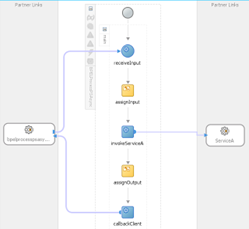
In the following I explain how you can hide faults from BPM by not using (synchronous) Service activities, but (asynchronous) Send/Receive activities instead.

When calling services from a BPM process, you should think about where you want faults to show up and to be handled. This is specifically of interest when you have some integration layer between your BPM processes and external services that you call to abstract the external services from the BPM process. Let’s call this layer the Service Layer. I have seen such a layer in various formats, ranging from a Reusable Subprocess, a BPEL process in the same composite as the BPM process, or a BPEL process in a separate composite, or instead of BPEL a Mediator. You may have such a layer to hide technical details from the business process, to cover some sort of custom exception handling, or to hide the message format from these external services from the BPM process (or a combination of all that). The latter might be because you don’t have the luxury to do message transformation in a service bus.

In case the BPM process calls the Service Layer through a (synchronous) Service activity and that fails, then this will result in the main BPM instance to get into an errored state, and you will have to handle the error in the BPM process. This behavior might be exactly what you wanted to prevent with the Service Layer, for example because the Service call is in a parallel flow and you want to be sure that the fault does not impact processing of the other, parallel threads. Read the complete article here.

SOA & BPM Partner Community

For regular information on Oracle SOA Suite become a member in the SOA & BPM Partner Community for registration please visit www.oracle.com/goto/emea/soa (OPN account required) If you need support with your account please contact the Oracle Partner Business Center.

Blog Twitter LinkedIn image[7][2][2][2] Facebook clip_image002[8][4][2][2][2] Wiki

Technorati Tags: SOA Community,Oracle SOA,Oracle BPM,OPN,Jürgen Kress
BAM Queries by Marcel van de Glind

image

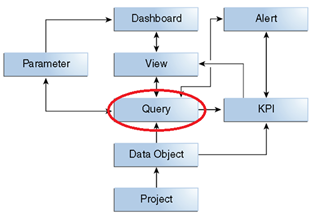
In my previous two blogs, I have made a start with the study of the BAM components. I have started with the Data Objects (BAM Data Objecten, BAM Calculated Fields). In this post I will talk about Queries.

From the Oracle Documentation:
A business query or query is a request for data that matches specified conditions. A query can fetch from a data object once, on a schedule, or continuously.

A Flat SQL Query is a simple table of data fields and their values. You select the data object and then select the data fields.

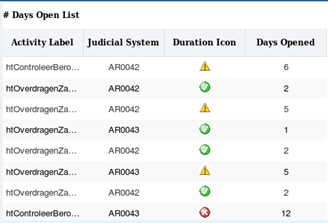
  • I will use this type, among other things, to show the number of days a task is open.

A Group SQL Query query is an analysis of one or more numeric data fields, called measures, grouped by non-numeric data fields called dimensions. For example, a group SQL query might analyze cases grouped by department. You select the data object and then select the measures and dimensions.

  • I will use this type also multiple times. For example to show Today’s Task Summary.

A Tree Model Query, written in SQL, is an analysis of one or more measures grouped by a hierarchy of dimensions. For example, a tree model query might analyze cases grouped by Judicial system, Department, Team and Employee. You select the data object and then select the measures and a hierarchy.

SOA & BPM Partner Community

For regular information on Oracle SOA Suite become a member in the SOA & BPM Partner Community for registration please visit www.oracle.com/goto/emea/soa (OPN account required) If you need support with your account please contact the Oracle Partner Business Center.

Blog Twitter LinkedIn image[7][2][2][2] Facebook clip_image002[8][4][2][2][2] Wiki

Technorati Tags: SOA Community,Oracle SOA,Oracle BPM,OPN,Jürgen Kress