Oracle Autonomous Transaction Processing Adapter in OIC by Ankur Jain

image

The Oracle Autonomous Transaction Processing Adapter enables you to integrate the Oracle Autonomous Transaction Processing database with Oracle Integration through use of direct connectivity. Use the Oracle Autonomous Transaction Processing Adapter to execute SQL queries or stored procedures in the Oracle database.

In this article, we are going to explain capabilities of ATP adapter and how to connect to Autonomous Transaction Process(ATP) in Oracle Integration Cloud(OIC) using OOTB Oracle ATP adapter.

In my earlier article, I have explained how to provision the Autonomous Transaction Process(ATP) instance. Kindly see the article, before you go ahead in this article.

Capabilities of Oracle Autonomous Transaction Processing Adapter
  • Support for using direct connectivity to connect to the Oracle Autonomous Transaction Processing database in place of using the on-premises connectivity agent.
  • Support for invocation of stored procedures in the Oracle database
  • Support for non-JDBC (PL/SQL record and PL/SQL table) datatypes in outbound invocations of stored procedures
  • Support for execution of DML statements and SQL queries: Select, Insert, Update, and Delete. Read the complete article here.

PaaS Partner Community

For regular information on Oracle PaaS become a member in the PaaS (Integration & Process) Partner Community please register here.

clip_image003 Blog clip_image005 Twitter clip_image004 LinkedIn image[7][2][2][2] Facebook clip_image002[8][4][2][2][2] Wiki

Technorati Tags: SOA Community,Oracle SOA,Oracle BPM,OPN,Jürgen Kress
Calling JD Edwards Orchestrations from Oracle Integration: Quickly and Easily by Prakash Masand

imageBackground

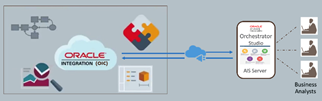
JD Edwards orchestrations empowers army of citizen developers/business analyst resources to design business applications REST APIs without writing a single line of code. JD Edwards orchestrations exposes business process steps tied together graphically through the robust semantics of REST standards. JD Edwards orchestrations are great way to simplify, integrate and automate repeated tasks through digital technologies. JD Edwards orchestrations are executed at AIS Server however they are designed via a tool called as Orchestrator studio, with JD Edwards tools release 9.2.4.0, Orchestrator studio is also part of AIS Server that further simplifies deployment of Orchestrator studio. Orchestrator studio is a low code, no code tool that allows business analyst to leverage their knowledge of business applications and create the flow using series of application tasks/steps and expose them as a REST end point. As JD Edwards AIS/Orchestrations are gaining traction & momentum, it has become tool of choice for JD Edwards customers who are looking to Integrate JD Edwards with Cloud SaaS applications, PaaS services or any other on premise applications.

Sample Use Case

Consider you want to return all sales orders that are at a particular state lets say 540 i.e. Print Pick in JD Edwards Sales Order application. This means you need an REST end point that takes Sales Order state as an input with default being 540, and return in response array of JD Edwards sales orders. This information can be consumed to update any other third party applications with the state of the orders, or can be simply consumed from process application to show the list of the orders.

Basic Ingredients
  1. JD Edwards Installation with below components (Latest and great EnterpriseOne Tools Release is recommended, with least being 9.2.1.x).
    1. Orchestrator Studio
    2. AIS Server. Read the complete article here.

PaaS Partner Community

For regular information on Oracle PaaS become a member in the PaaS (Integration & Process) Partner Community please register here.

clip_image003 Blog clip_image005 Twitter clip_image004 LinkedIn image[7][2][2][2] Facebook clip_image002[8][4][2][2][2] Wiki

Technorati Tags: SOA Community,Oracle SOA,Oracle BPM,OPN,Jürgen Kress
Oracle Integration now available on Oracle Cloud Infrastructure Gen 2 by Niall Commiskey

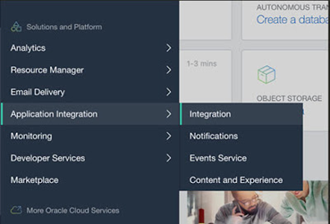
imageSince last week, new Oracle Cloud accounts can create OIC instances on OCI Gen2.

This is available in the following data center regions –

Other Data Centers to follow. The step by step creation instructions are available here. So what does Gen2 give me? I will go into more details in a future post – but, to begin with –

1. OCI Gen2  Compartments – create your OIC instance in your own compartment for administrative Lifecycle Mgt isolation.

2. OOTB integration with OCI services such as Events, Functions, Streaming and Notification.

3. OIC integration in OCI One Console Read the complete article here.

PaaS Partner Community

For regular information on Oracle PaaS become a member in the PaaS (Integration & Process) Partner Community please register here.

clip_image003 Blog clip_image005 Twitter clip_image004 LinkedIn image[7][2][2][2] Facebook clip_image002[8][4][2][2][2] Wiki

Technorati Tags: SOA Community,Oracle SOA,Oracle BPM,OPN,Jürgen Kress
Why did Ovum name Oracle a leader in Hybrid Integration Platforms and why is it important? By Daryl Eicher

image

Integration is the lifeblood of today’s digital
economy…

Looking for practical ways to accelerate your digital business development? Do you have a mix of SaaS and on-premises business systems from multiple vendors? What would it mean to your application modernization and transformation projects if you could cut your time to connect and extend any application from months to minutes? That’s what Oracle Integration has done for thousands of connected businesses like yours.

Ovum named Oracle a leader in the hybrid integration platform market based on several key differentiators:

  • Uniform UX

"Oracle offers a uniform UX across various products of this middleware portfolio, something which many of its competitors have struggled to offer."

  • Intelligent Automation

"Oracle exploits ML capabilities for providing recommendations at various stages of the design, testing, and deployment cycle…"

PaaS Partner Community

For regular information on Oracle PaaS become a member in the PaaS (Integration & Process) Partner Community please register here.

clip_image003 Blog clip_image005 Twitter clip_image004 LinkedIn image[7][2][2][2] Facebook clip_image002[8][4][2][2][2] Wiki

Technorati Tags: SOA Community,Oracle SOA,Oracle BPM,OPN,Jürgen Kress

Help Wanted: How A Grocer Finds Workers Willing To ‘Do It All’ With A Smile by Linda Currey

imageTo work in Britain’s Co-op food stores, employees have to do a little bit of everything during any given shift. To keep the Co-op convenience stores and neighborhood markets running smoothly, staffers may accept deliveries, unpack boxes of groceries, flowers, and household items, stock the shelves, clean up spills, or run the registers, all while welcoming customers. New hires need the qualifications to do it all.

Workers restock shelves in one of Britain’s Co-op food stores. “It’s hard work,” says Yvonne Foster, head of resourcing services for the Co-op. It’s hard work for Foster and her team as well, who need to recruit and retain the company’s 65,000 employees across the United Kingdom.

The Co-op is as interesting as the people it’s trying to recruit. In business since 1844, it is owned by its 4.6 million members, who get a 5% discount in the shops, as well as access to Co-op offerings for insurance, healthcare, and funeral services. Read the complete article here.
SaaS partners  who want to learn more about integration please see the starter kit here.

PaaS Partner Community

For regular information on Oracle PaaS become a member in the PaaS (Integration & Process) Partner Community please register here.

clip_image003 Blog clip_image005 Twitter clip_image004 LinkedIn image[7][2][2][2] Facebook clip_image002[8][4][2][2][2] Wiki

Technorati Tags: SOA Community,Oracle SOA,Oracle BPM,OPN,Jürgen Kress

Additional new content PaaS Partner Community

· Textron’s Speedy Launch to the Cloud “It was a whirlwind,” says Kelli Gudz, Textron’s senior finance systems manager, recalling how the American industrial conglomerate moved from an ERP system that was more than 20 years old to Oracle Financials Cloud in just 14 weeks. “When Oracle told us that that time frame was the standard, we were like, ‘Really? This can’t be done.’” But it could, and even better: Textron’s corporate office was able to stay operational during the change.

· Customer Snapshot: The Story Behind the ‘World’s Best Coffee’ Learn about illycaffè founder’s “moment of pure intuition” that led to today’s modern espresso machine, and an Italian company making magic under pressure in today’s global economy.

· Five Ways the Cloud Changes the Game for College Developers With the new Always Free service, more students are learning to use the latest database features and computing power. One ambitious student project called for a robust database environment, recalls Brendan Tierney, a lecturer at Technological University Dublin. “And within five minutes, I had everyone working in Oracle Autonomous Database.” Four more payoffs.

· Try Early Access to Cloud Native API Gateway and Logging

· On-Demand Events: Oracle Code Online & On-Demand Labs: Oracle Cloud Adventure & Cloud Test Drive Hands-on Labs & Oracle Cloud Hands-on Labs & Jump-Start 20-Minute Hands-on Labs

· 5 Highlights from Larry Ellison at Oracle OpenWorld Here are highlights from the keynotes and Q&A session by Oracle Executive Chairman and Chief Technology Officer Ellison.

· Oracle OpenWorld: A Vision to Disrupt the Cloud Oracle is shifting to a new generation of cloud and data management solutions.

PaaS Partner Community

For regular information on Oracle PaaS become a member in the PaaS (Integration & Process) Partner Community please register here.

clip_image003 Blog clip_image005 Twitter clip_image004 LinkedIn image[7][2][2][2] Facebook clip_image002[8][4][2][2][2] Wiki

Technorati Tags: SOA Community,Oracle SOA,Oracle BPM,OPN,Jürgen Kress

Microprocess Considerations by Jan Kettenis

image

In this article I discuss some considerations when applying the Microprocess Architecture, and how those can impact the design of the process.
As pointed out in the article about the Microprocess Architecture, one should carefully consider if this is the right architecture for the process application to create. Considering the implications (for example one single business process can end up comprising multiple process applications) it should not be considered to be a "one-size fits all" kind of architecture.
Guidelines that can help you to determine if and where is a fit, are the following:

  1. Do process instances have a longer time span during which one must be able to migrate it (in one way or another) to a newer version?
  2. Is the process expected to change often, implying multiple versions will be active at the same time?
  3. Does it concern a complex business process, where business functions can be executed isolated from each other?

Are multiple business units involved in the flow? Read the complete article here

PaaS Partner Community

For regular information on Oracle PaaS become a member in the PaaS (Integration & Process) Partner Community please register here.

clip_image003 Blog clip_image005 Twitter clip_image004 LinkedIn image[7][2][2][2] Facebook clip_image002[8][4][2][2][2] Wiki

Technorati Tags: SOA Community,Oracle SOA,Oracle BPM,OPN,Jürgen Kress
Jarvis Pizzeria:ORDS-CRUD Generator by Marcel van de Glind

imageThe Auto REST feature allows you to quickly set up REST services on your ORDS enabled database. This feature allows users wanting to quickly enable database objects and run basic queries. Users wanting more complex operations will need the Full REST development setup.

In order to use the Auto REST functionality, only a few actions are required. Although the amount of work when using the Full REST option is not too bad, it is still considerably more than with Auto REST.

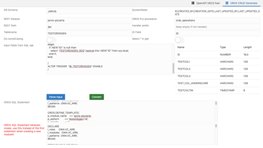
To reduce the effort difference between Auto REST and Full REST, fellow Jarvis owner Rick has developed an ORDS-CRUD generator. With the help of this tool it is possible to generate CRUD templates for REST enabled resources (e.g. an address table).

The tool is available in a VBCS and a JSFiddle variant. Read the complete article here.

PaaS Partner Community

For regular information on Oracle PaaS become a member in the PaaS (Integration & Process) Partner Community please register here.

clip_image003 Blog clip_image005 Twitter clip_image004 LinkedIn image[7][2][2][2] Facebook clip_image002[8][4][2][2][2] Wiki

Technorati Tags: SOA Community,Oracle SOA,Oracle BPM,OPN,Jürgen Kress
Jarvis Pizzeria: How to manage Masterdata of a DM (part 1) by Marcel van de Glind

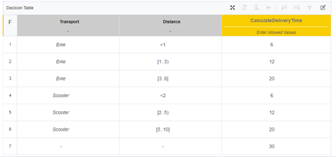
imageWe have implemented the decision table below in a Decision Model (see Using a DM in PCS) and we have made the Decision Model accessible through an integration (see Using a DM in ICS). But now let’s look at the data in this table.

Suppose that it turns out that deliveries by scooter at distances above 5 Km turn out to be faster than expected (because this is usually outside built-up areas, where there is less traffic).

For this we have to adjust the CalculateDeliveryTime in line 6 of the table from 20 to e.g. 18. Once this is done we must activate a new snapshot. Because the integration of the previous blog refers to the LATEST snaphot version, no further adjustments are needed. The Decision integration can be used unchanged.

Changing the CalculateDeliveryTime, but also the Distance range are data where we can imagine that they will change regularly. The question is whether we want to reactivate the Decision for each adjustment?

If the answer to this question is “No”, we must see if this can be done differently. Is there an alternative? “Yes” there is. We will explain that further in the remainder of this blog.

The first thing we do is take a closer look at the decision table. Read the complete article here.

PaaS Partner Community

For regular information on Oracle PaaS become a member in the PaaS (Integration & Process) Partner Community please register here.

clip_image003 Blog clip_image005 Twitter clip_image004 LinkedIn image[7][2][2][2] Facebook clip_image002[8][4][2][2][2] Wiki

Technorati Tags: SOA Community,Oracle SOA,Oracle BPM,OPN,Jürgen Kress
Jarvis Pizzeria: Using a DM in ICS by Marcel van de Glind

image

In This blog is a follow up of Using a DM in PCS, but can also be read as a separate item. The previous blog we showed how to embed a Decision in PCS. We described how the hard-coded relationship between a Decision and Process (PCS) can be prevented by using an ICS integration. In this blog we describe step by step how this integration can be developed.

ICS Integration

The integration can be divided into the following steps:

  1. Get the endpoint of the Decision Service
  2. Create the invoke Connector
  3. Create the Integration
  4. Activate the Integration
  5. Test the Integration (using postman)
  6. PCS adjustment to invoke the Integration

Get the endpoint of the Decision Service

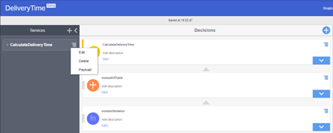
We start by making the Decision available in ICS by defining a connector for it. For this we must first determine the REST endpoint of the Decision. Todo this follow the steps below:

    • Open the Decision. Then select the operation that you want to access under Services. In this case, calculateDeliveryTime.
    • Then select the option ‘Payload’ from the hamburger menu.
    • Read the complete article here.

PaaS Partner Community

For regular information on Oracle PaaS become a member in the PaaS (Integration & Process) Partner Community please register here.

clip_image003 Blog clip_image005 Twitter clip_image004 LinkedIn image[7][2][2][2] Facebook clip_image002[8][4][2][2][2] Wiki

Technorati Tags: SOA Community,Oracle SOA,Oracle BPM,OPN,Jürgen Kress