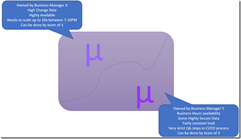
When the Cracks Begin to Show On Designing Microservices by Lucas Jellema

image

No one has achieved success with microservices just by talking about them. Unfortunately, many organizations spend a lot of time on exactly that, debating how to approach microservices. It is as though there is one perfect approach to designing and working with microservices that needs only be uncovered. In actual fact, there is no such definitive solution; even if there were, it would hold true only until changes in the organization, business objectives, technology frameworks and regulations made adjustments necessary.

It is tempting—just as it was a decade ago with SOA Web Services—to spend a lot of time and energy on identifying microservices. Creating an exhaustive overview of all microservices, defining the exact scope and interface of each, is not feasible and is not a smart investment of time. It would be a lot of work, and that work would never be complete. The definition of microservices is not an end in itself and giving in to this temptation represents a serious risk. Microservices are an instrument for achieving sustained business agility in a changing world of functional and non-functional requirements and evolving technical, political, economic, and legal parameters. Microservices cannot be defined once and for all, and they should not have to be. As architects and developers we are agile and flexible. We embrace change in all aspects of our IT organizations.

Here’s another organizational risk familiar from the SOA era: starting with an exclusive focus on the technology for implementing microservices and on the microservices platform, the underlying platform for eventually running the microservices (that do not even exist yet and for which no requirements are yet known). It is all too easy to spend time on this seemingly useful exercise and, after months of investigation and selection and architecting, to end up with an impractical, oversized and over-engineered platform – and no running microservices. Such discussions slow down the process of microservices adoption, obstruct the view of the essential challenges, and set up an organization for disappointing results (if not outright frustration).

A third category of risk is to just start building microservices without a clear business need for or objective with a microservices architecture or, even worse, without really understanding what a microservices architecture entails from an organizational perspective. The operative keyword being overlooked: DevOps.

This article provides some insights and guidelines that can help propel teams of architects beyond discussions and into action. Perhaps it can also help establish some architecture guidelines, such as the importance of domain design.

What do we want to achieve with microservices?

When discussing microservices, we must remember what our objectives are. Microservices are not the objective; they are merely the means. Microservices are meant to help us with those objectives and if they do not do so, we neither need nor want them. Read the complete article here.


PaaS Partner Community

For regular information on Oracle PaaS become a member in the SOA & BPM Partner Community for registration please visit www.oracle.com/goto/emea/soa (OPN account required) If you need support with your account please contact the Oracle Partner Business Center.

clip_image003 Blog clip_image005 Twitter clip_image004 LinkedIn image[7][2][2][2] Facebook clip_image002[8][4][2][2][2] Wiki

Technorati Tags: SOA Community,Oracle SOA,Oracle BPM,OPN,Jürgen Kress

Free eBook Cloud Integration & API Management for dummies

image

Want simplify integration in the cloud? Monetize with API management and empower citizen developers? Get the free Cloud Integration & API Management eBook here.

Get the free eBook here.

PaaS Partner Community

For regular information on Oracle PaaS become a member in the SOA & BPM Partner Community for registration please visit www.oracle.com/goto/emea/soa (OPN account required) If you need support with your account please contact the Oracle Partner Business Center.

clip_image003 Blog clip_image005 Twitter clip_image004 LinkedIn image[7][2][2][2] Facebook clip_image002[8][4][2][2][2] Wiki

Technorati Tags: SOA Community,Oracle SOA,Oracle BPM,OPN,Jürgen Kress
Recursion in XSLT by Martien van den Akker

image

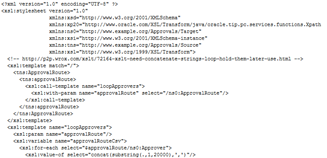
Last week I helped someone on the Oracle community forums with transforming a comma separated string to a list of elements. He needed this to process each element in BPM Suite, but it is a use case that can come around in SOA Suite or even in Oracle Integration Cloud.
You would think that you could do something like a for-each and trimming the element from the variable.

Recursion

One typical thing with XSLT is that variables are immutable. That means that you can declare a variable and assign a value to it, but you cannot change it. So it is not possible to assign a new value to a variable based on a substring of that same variable.
To circumvent this, you should implement a template that conditionally calls itself until an end-condition is met. This is a typical algorithm called recursion. Recursion is a way of implementing a function that calls itself, for example to calculate the faculty of a number. Recursion can help circumventing the immutability of variables, because with every call to the function you can pass (a) calculated and thus different value(s) through the parameter(s).
I wrote about this earlier, but last week a co-worker asked a similar question, but just the other way around: transforming a list into a comma separated string. So, apparently it’s time to write an article about it. Read the complete article here.


PaaS Partner Community

For regular information on Oracle PaaS become a member in the SOA & BPM Partner Community for registration please visit www.oracle.com/goto/emea/soa (OPN account required) If you need support with your account please contact the Oracle Partner Business Center.

clip_image003 Blog clip_image005 Twitter clip_image004 LinkedIn image[7][2][2][2] Facebook clip_image002[8][4][2][2][2] Wiki

Technorati Tags: SOA Community,Oracle SOA,Oracle BPM,OPN,Jürgen Kress
The power of Oracle Event Driven Architecture by Roger van de Kimmenade

image

Introduction

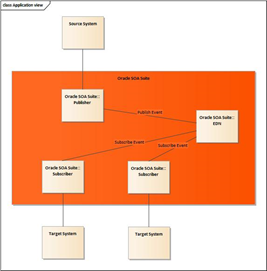
There is a lot of hype around Microservices and the use of events for implementing the choreography pattern. However this is nice for companies like Netflix and Twitter, but there are a lot of organisations still struggling with files and ESB like products. Also my current client uses an ESB namely the Oracle SOA Suite 12c for integrations. We cannot just throw away this ESB, but we can make use of the event mechanism built in. This blog describes the way we use the EDN (Event Delivery Network) component, that is used within SOA composites to throw events and to subscribe on events.

EDN

Oracle has a component that you can use to publish events and to subscribe on events within a SOA composite. Just use the invoke activity with the eventname and the content of the event. Within a composite you can subscribe on events and set filters. You can also configure “oneAndOnlyone” consistency property and indicate if you want a durable or non-durable subscriber. The EDN hides the underlying JMS provider, which can be changed (weblogic jms or OracleAQ). Separate Topics can be defined for each event or just use 1 topic for all events.

Notes:

  • Applications must always be abstracted by a corresponding SOA Composite. Applications should not use JMS directly
  • EDN cannot be used directly from within Oracle OSB
  • Read the complete article here.


PaaS Partner Community

For regular information on Oracle PaaS become a member in the SOA & BPM Partner Community for registration please visit www.oracle.com/goto/emea/soa (OPN account required) If you need support with your account please contact the Oracle Partner Business Center.

clip_image003 Blog clip_image005 Twitter clip_image004 LinkedIn image[7][2][2][2] Facebook clip_image002[8][4][2][2][2] Wiki

Technorati Tags: SOA Community,Oracle SOA,Oracle BPM,OPN,Jürgen Kress
Oracle Integration Cloud 19.2.3 Release – New Features by Niall Commiskey

image

The official doc describing the new features etc. is here

Some things that caught my eye –

Integration Improvements

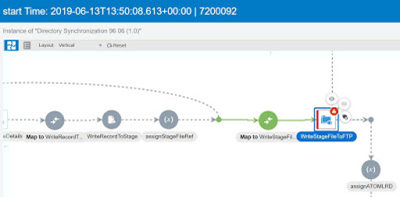
· Inline Activity Stream with timestamps –

· New Automation Anywhere adapter –

· Ability to edit a Schedule from the Integration design page

· Read the complete article here.


PaaS Partner Community

For regular information on Oracle PaaS become a member in the SOA & BPM Partner Community for registration please visit www.oracle.com/goto/emea/soa (OPN account required) If you need support with your account please contact the Oracle Partner Business Center.

clip_image003 Blog clip_image005 Twitter clip_image004 LinkedIn image[7][2][2][2] Facebook clip_image002[8][4][2][2][2] Wiki

Technorati Tags: SOA Community,Oracle SOA,Oracle BPM,OPN,Jürgen Kress
PaaS (Process & Integration) Partner Community Newsletter July 2019

Dear PaaS Partner Community

Want to increase the Oracle Cloud business? Create new service offerings and solutions for the Cloud? Watch the on-demand PaaS Overview Webcast. Martijn Vlek, Vice President Sales Cloud Native & Integration presents the latest PaaS sales plays, kits and how to get access to the Oracle Cloud platform. You as an Oracle partner can use the same content that we use to train the internal Oracle sales team. Each sales kit includes an elevator pitch, battle card, customer presentation in ppt format and references. Feel free to adopt the kits with your services offering. As a tip we recommend to distribute the battle cards in your sales team valets. Access the Oracle sales kits on sales central here.

Registration for the ninth edition of the PaaS Summer Camp is open. The training takes place August 26th-30th 2019 in Lisbon Portugal. For details please visit the registration page here.

imageThis month’s we start a new series to promote your partners customer success. Watch Luis Weir, CTO Capgemini how he disrupts financial industry clients with solutions based on the Oracle Cloud Platform. We want to promote your customer success! Have you implemented successful a solution based on the Oracle Cloud Platform? Submit your success story via the customer reference program.

The June edition of Oracle Integration Cloud 19.2.3 release includes new integration features like Inline Activity Stream with timestamps, New Automation Anywhere adapter and the ability to edit a Schedule from the Integration design page. New process features include Canvas changes, Common expression builder in Decision modeling editor, Conditional expressions in data association, Smart sentries in dynamic processes, Promote process application samples to the gallery for easy sharing and QuickStart Apps enhancements. Thanks to the community for sharing all the integration articles: How The Co-op Cut Time to Hire in Two Quarters & How to Capture EBS Business Event in Oracle Integration Cloud & Using Stage File Write operation(with opaque schema) to copy files & Securing files using PGP encryption (Part-1-Encryption): Oracle Integration & Securing files using PGP encryption (Part-2-Decryption): Oracle Integration & OIC – First Steps with the ATP adapter & How to create ZIP files: Oracle Integration Cloud & Migrating ICS to OIC & Custom time range filter for monitoring pages in OIC & How to Update Oracle SOA 11g Timeouts.

In the process & innovation section we published a blog post from Ankur how to develop a simple application from scratch and to enable notifications. The Blockchain team released an intelligent track and trace SaaS solution. Mario describes in an article the connection of Blockchain and IoT.

For a short summery of our key monthly information watch the PaaS Partner Updates on YouTube. The July edition highlights sales, marketing and enablement support for partners. This month’s community webcast will be a joint webcast with our partner Evosys to innovate, extend and integrate SaaS our monthly PaaS Partner Community Webcast – July 19th 2019.

To read the newsletter please visit www.tinyurl.com/PaaSNewsJuly2019 (OPN Account required).

Please like and share the newsletter at Twitter and LinkedIn

Jürgen Kress

Newsletter Logo 2017

PaaS Partner Adoption
Oracle EMEA
Tel. +49 89 1430 1479
E-Mail: juergen.kress@oracle.com
clip_image003Blog clip_image004LinkedIn clip_image005 Twitter

To become a member of the SOA Partner Community please register at http://www.oracle.com/goto/emea/soa (OPN account required) If you need support with your account please contact the Oracle Partner Business Center.

Blog clip_image005 Twitter clip_image004 LinkedIn image[7][2][2][2] Facebook clip_image002[8][4][2][2][2] Wiki

Technorati Tags: newsletter,SOA Community newsletter,SOA Community,Oracle,OPN,Jürgen Kress

Using Oracle BPEL Direct Bindings in Java by Mark Peterson

image

This blog contains best practices for interfacing Java to external systems through Oracle BPEL components. Java will often be used to integrated functionality within the SOA framework since the framework allows wiring of Java code in order to perform various operations during human task assignment, and execution, as an example. And since these Java classes are embedded in the framework, and these classes may need to pull data from databases, Active Directory, REST services, WSDLs, etc., what is the best way to do this? You guess it: Direct Bindings.

Why use direct bindings? First of all, a direct binding creates a simple RMI interface between Java code and a BPEL process. Besides the speed and efficiency one gets from RMI, using direct bindings leverages the capabilities already available within the SOA framework. There’s no need to go outside the SOA framework to get assignment data (in this example) from a database or other data source. Using SOA libraries, BPEL and SOA adapters everything needed is already available.

Note that our use case has to do with implementing a very specialized version of role or parameter-based team assignments. Another assignment strategy is give here for creating parametric roles using business rules. However there are many other use cases that can be applied that don’t have to do with assignments at all. Dynamic Bindings can and should be used whenever you want to interact with BPEL code from within Java.

Design by Interface First

The first step is to create an interface that will be used between the BPEL process and Java code. In this blog we will implement an interface that will be used to return a list of assignments for a given work team. The work team will be determined from the project the team is working on and other project properties such as the work area and activity type. The work team will contain a list of BPM application roles or a particular individual in a role. Read the complete article here.


PaaS Partner Community

For regular information on Oracle PaaS become a member in the SOA & BPM Partner Community for registration please visit www.oracle.com/goto/emea/soa (OPN account required) If you need support with your account please contact the Oracle Partner Business Center.

clip_image003 Blog clip_image005 Twitter clip_image004 LinkedIn image[7][2][2][2] Facebook clip_image002[8][4][2][2][2] Wiki

Technorati Tags: SOA Community,Oracle SOA,Oracle BPM,OPN,Jürgen Kress
Persisting of settings in a SOA Suite Enterprise Deployment by Martien van den Akker

image

About a year ago, at my previous customer, a co-worker and I encountered and described a persistence problem with setting the Global Tokens in SOA Suite.

What are Global Tokens again?

The problem with a middleware product as Oracle Service Bus, SOA Suite (and the same probably counts for MuleSoft, or any other integration tool) is that when you move an integration through the development lifecycle from development, to test, preproduction and production, you need to update the endpoints. When I have an integration with a (BPEL) Process that does a check-in of a document in WebCenter Content, for instance, then on the test environment it should do the check-in to another WCC server than on pre-production or production. We don’t want to have our test documents in production, do we?

To solve that, in OSB we have customization files, and in SOA Suite 11g and onwards, we use config plans. But, in 11g PatchSet 6 (11.1.1.7), SOA Suite introduced Global Tokens. That way you can create a token that refers to the WCC host, eg. ${wcc_url}, and use that as a reference in your binding properties.

These properties can be set using Enterprise Manager FMW Control 12c: Read the complete article here.


PaaS Partner Community

For regular information on Oracle PaaS become a member in the SOA & BPM Partner Community for registration please visit www.oracle.com/goto/emea/soa (OPN account required) If you need support with your account please contact the Oracle Partner Business Center.

clip_image003 Blog clip_image005 Twitter clip_image004 LinkedIn image[7][2][2][2] Facebook clip_image002[8][4][2][2][2] Wiki

Technorati Tags: SOA Community,Oracle SOA,Oracle BPM,OPN,Jürgen Kress

Performance of MFT Cloud Service (MFTCS) with File Storage Service (FSS) using a Hybrid Solution Architecture in Oracle Cloud Infrastructure (OCI) by Shub Lahiri

image

Executive Overview

MFT Cloud Service clusters in Oracle Cloud Infrastructure Classic (OCI-C) are provisioned with database file storage system (DBFS) for shared storage as discussed in one of our earlier blogs[1]. In Oracle Cloud Infrastructure (OCI), customers also have the option of using File Storage Service (FSS) for shared storage. FSS can be used for high throughput use cases where a large number of large files have to be processed within MFTCS. But this alternative of high performance comes at a cost of resiliency. The backup and recovery of the DBFS is automatically achieved by the backup of the database. Although, the backup and recovery recommendations for FSS are well-documented, the implementation has to be managed in a custom layer.

This blog shows the usage of FSS for shared storage in an MFTCS cluster but the same concepts can be applied to meet the shared storage requirements of SOACS as well.

This blog describes a way to setup a high-volume file transfer process within MFTCS in OCI, where files are received in embedded SFTP server and then transferred to a remote Object Storage endpoint in OCI-Classic within Oracle Public Cloud (OPC).

Solution Approach

Use Case Basic Requirements

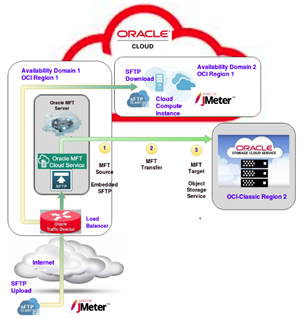
The overall use case can be described as follows and is also exemplified in Fig.2 below.

  • An external SFTP client sends multiple files of different sizes concurrently via SFTP to the embedded SFTP server running in MFT Cloud Service (MFTCS) within OCI.
  • MFT Server, upon receipt of the files, transfers it to an object file storage service in OCI-Classic domain URL.
  • As the MFT transfers are being executed, multiple concurrent file downloads are also processed by the SFTP server, embedded within MFTCS.
Solution Architecture

The configuration of MFT to receive files via SFTP has been discussed in one of my earlier blogs[2]. In that post, we had shown how MFT can receive files via its embedded SFTP server and save them in a local file system. In this article, we extend the use case by modifying the file system of the target endpoint to point to an object storage service endpoint within an OCI-Classic domain. The shared storage layer of DBFS is replaced with FSS. Apache jMeter is used to simulate the concurrent upload and download traffic volume, comprising of files in different sizes. Read the complete article here.


PaaS Partner Community

For regular information on Oracle PaaS become a member in the SOA & BPM Partner Community for registration please visit www.oracle.com/goto/emea/soa (OPN account required) If you need support with your account please contact the Oracle Partner Business Center.

clip_image003 Blog clip_image005 Twitter clip_image004 LinkedIn image[7][2][2][2] Facebook clip_image002[8][4][2][2][2] Wiki

Technorati Tags: SOA Community,Oracle SOA,Oracle BPM,OPN,Jürgen Kress

See how easily you switch your integration views by Arif Rafique

image

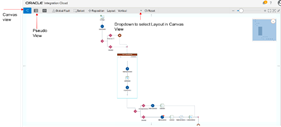
In OIC, we spend most of our time building the integration. Currently, when you view/edit the integration in editor, it shows the integration in vertical layout. Now, you can view/edit the integration in several ways:

· Canvas view

o Vertical: Displays the integration vertically.

o Horizontal: Displays the integration horizontally.

· Pseudo view: Displays the integration vertically with child nodes indented. Details about each node in the integration are displayed to the right.

In addition to the above, you can also view the integration outline style.You will need to enable "oic.ics.console.integration.layout" feature flag to enjoy this feature.

The above diagram shows how to select different views and how the integration looks like in vertical view layout.

Canvas view:

Canvas view allows you to select the layout. There are two options for the layout:

Vertical:

This is the default view mode of the integration. In this mode, the integration is shown vertically.

Horizontal:

While in Canvas view, you can switch the layout to Horizontal and the integration will be shown horizontally. Read the complete article here


PaaS Partner Community

For regular information on Oracle PaaS become a member in the SOA & BPM Partner Community for registration please visit www.oracle.com/goto/emea/soa (OPN account required) If you need support with your account please contact the Oracle Partner Business Center.

clip_image003 Blog clip_image005 Twitter clip_image004 LinkedIn image[7][2][2][2] Facebook clip_image002[8][4][2][2][2] Wiki

Technorati Tags: SOA Community,Oracle SOA,Oracle BPM,OPN,Jürgen Kress