Need help with your SOA Suite 12c project? Get support from the product management and A-Team!


Our global product management is happy to support you with your SOA Suite 12c customers, to make sure they go in production successful. If you like to participate in the program please contact Yogesh Sontakke. The program includes:
clip_image002Qualification requirement:

    • SOA Suite 12c upgrade or new development with go live within the next 6-8 months or earlier.
  • Categories:
    • Upgrade
    • Application Integration
    • Cloud
    • Mobile
    • MFT
    • OEP
    • B2B
  • What will the customer get:
    • Dedicated PM sponsor to reach out to for questions or issues
    • Regular calls with their sponsor to review progress
    • Any product issues will be escalated by Oracle engineering
    • Oracle product support will be notified of an strategic implementation and customer will receive heightened support when SRs are logged.
    • The Oracle A-Team can also be enlisted for "as needed" SOA Suite 12c support based on resource availability or, if required, a longer term engagement can be arranged
  • What do we need from the customer:
    • Customer agrees to be a SOA Suite 12c reference once they go live, e.g. reference video, case study, joint webinar
    • Customer will give Oracle permission to mention their name as SOA Suite 12c Strategic Implementer

If you like to participate in the program please contact Yogesh Sontakke

SOA & BPM Partner Community

For regular information on Oracle SOA Suite become a member in the SOA & BPM Partner Community for registration please visit www.oracle.com/goto/emea/soa (OPN account required) If you need support with your account please contact the Oracle Partner Business Center.

Blog Twitter LinkedIn image[7][2][2][2] Facebook clip_image002[8][4][2][2][2] Wiki

Reduce Operational Expense and Improve Performance With Platform Optimization – ondemand webcast

clip_image002

Grupo Farmacos is the leading distributor of medical equipment and medicine in Mexico, and services customers across the public and private sectors. In order to support its diverse business operations, the company built a high-performance virtualized infrastructure in the cloud.
Access this on demand webcast for an in-depth look at how Grupo Farmacos implemented Oracle’s engineered systems and middleware to:

  • Consolidate its architecture to control costs and improve IT efficiency
  • Support high-volume transactions and ensure high availability of critical Oracle applications
  • Leverage common, SOA-based integration architecture for Oracle and third-party applications

Register today for the webcast.

SOA & BPM Partner Community

For regular information on Oracle SOA Suite become a member in the SOA & BPM Partner Community for registration please visit www.oracle.com/goto/emea/soa (OPN account required) If you need support with your account please contact the Oracle Partner Business Center.

Blog Twitter LinkedIn image[7][2][2][2] Facebook clip_image002[8][4][2][2][2] Wiki

BPM / SOA 12c: Re-configure a compact domain to use a DB-based MDS instead of a File-based MDS by Sven Bernhardt, Danilo Schmiedel


clip_image001The Oracle SOA Suite and Oracle Business Process Management Suite offers different domain configuration types applicable for different use cases. For details check out the two guides: Installing SOA Suite and Business Process Management Suite Quick Start for Developers as well as Installing and Configuring Oracle SOA Suite and Business Process Management.


Default Domain

Standalone Domain

Compact Domain

Full Domain

Description

Integrated WebLogic Server from JDeveloper

Standalone Admin Server with SOA/BPM

Standalone Admin Server with SOA/BPM

Full installation with separate servers for SOA, OSB, BAM, Admin Server, etc.

Installed via

Quick Start distribution

Quick Start distribution

Quick Start distribution

FMW 12c Infrastructure +
FMW 12c SOA Suite and Business Process Management

Used for

Local development and debugging, especially for demos or evaluation purposes

Local development and debugging, especially for developers who want to use the Oracle Service Bus Design Time Console instead of JDeveloper

Local development with SOA components that are incompatible with JavaDB (ESS, MFT, B2B, Heathcare, BAM, ACM API)

All stages Development (shared), Integration, Test, Production

Repository

Pre-configured Java DB

Pre-configured Java DB

Oracle Database (please note that MDS and OWSM are file-based)

Oracle Database

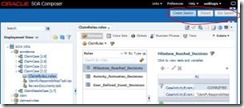
For all of the domain options which are installed via quickstart distributions, SOA and B2B use the MDS file system. This means that the edit function in SOA Composer is not supported and so Business Rules and Domain Value Maps cannot be changed during runtime & without a new deployment . For the development in our projects we very often use the compact domain. The change of business rules without re-deployment is quite important for us because we work a lot with Adaptive Case Management – and there Business Rules and live changes without re-deployment are a key benefit (which we also like to show in demos / POCs / etc.). Read the complete article here.

SOA & BPM Partner Community

For regular information on Oracle SOA Suite become a member in the SOA & BPM Partner Community for registration please visit www.oracle.com/goto/emea/soa (OPN account required) If you need support with your account please contact the Oracle Partner Business Center.

Blog Twitter LinkedIn image[7][2][2][2] Facebook clip_image002[8][4][2][2][2] Wiki

Embedded Systems and The Internet of Things – What’s Under the Hood? By Tom Angelucci

clip_image002

There is more mobile than smart phones and tablets. In this article from RTC Magazine, Oracle’s Tom Angelucci explores why "Java Embedded appears to be staking its claim as the preferred programming language businesses use to develop IoT applications."
Read the article.

SOA & BPM Partner Community

For regular information on Oracle SOA Suite become a member in the SOA & BPM Partner Community for registration please visit www.oracle.com/goto/emea/soa (OPN account required) If you need support with your account please contact the Oracle Partner Business Center.

Blog Twitter LinkedIn image[7][2][2][2] Facebook clip_image002[8][4][2][2][2] Wiki

Is Your Organization Prepared for IoT? by Subramanian Iyer

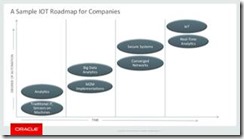
Even as IoT promises significant benefits for companies, it will involve major changes in the way they operate and do business.

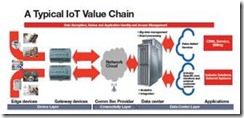
clip_image002Apart from the consumer industry, manufacturing, distribution, and healthcare are the industries that are expected to be most impacted by the Internet of Things (IoT). Organizations in these industries will need to reexamine their entire business models, realign their partner strategies, and rework their processes to continue being competitive in the new, IoT-enabled world.

The benefits of IoT include improvements in operating efficiencies, product safety, location tracking, and time to market as well as potential cost reductions in resource usage. In order to leverage the benefits of IoT, organizations need to understand which areas the deployment of IoT is impacting and how they will be impacted, and prepare accordingly.

People

The emergence of IoT requires people to adapt to changing data visualization. Connected devices will provide relevant users an unparalleled view of detailed data. Businesses will be able to predict requirements through the supply chain, and access to equipment efficiency data will mean lesser breakdowns and predictable outputs.

Action item: Upskill people so they can view, track, and analyze issues across multiple channels including their desktops, mobiles, tablets, and consoles.

In order to leverage the benefits of IoT, organizations need to understand which areas the deployment of IoT is impacting and how they will be impacted, and prepare accordingly.

Process

IoT will enable process optimizations like never before. As information flow becomes faster, decisions will be made more quickly, increasing the overall market responsiveness to situations. Environmental conditions will decide production lines in factories and queues for specialized machines in hospitals, streamlining processes to a significant extent.

Action item: Ensure processes and methodologies are constantly upgraded to enable faster decision-making as data and analyses come in faster than ever before.

Technology

Availability of analytical information and data visualization on mobile devices means that enterprise-level optimization activities will be possible from remote locations, allowing for entire supply chains to be made visible point-in-time. Cloud-based solutions will allow for data to be converted into usable information instantaneously, accelerating the agility of organizations.

Action Item: Ensure the enterprise is equipped with modern technology that can send the right information to the right people, wherever they are. Read the complete article here.

SOA & BPM Partner Community

For regular information on Oracle SOA Suite become a member in the SOA & BPM Partner Community for registration please visit www.oracle.com/goto/emea/soa (OPN account required) If you need support with your account please contact the Oracle Partner Business Center.

Blog Twitter LinkedIn image[7][2][2][2] Facebook clip_image002[8][4][2][2][2] Wiki

Internet of Things (IoT) 12c Demo update


clip_image002We updated our famous Malta IoT demo use-case with our fusion Middleware 12c solutions. At our SOA Community Workspace (SOA Community membership required) you can download the updated demo material:

· FMW IoT Workshop Lab Guide OOW 2014.docx

· raspian-3.10.25-armhf-Aug2014OOW.img

· IotServerVM-12c-OOW2014HOL.ova

For more IoT material please visit the SOA Community Workspace here.

SOA & BPM Partner Community

For regular information on Oracle SOA Suite become a member in the SOA & BPM Partner Community for registration please visit www.oracle.com/goto/emea/soa (OPN account required) If you need support with your account please contact the Oracle Partner Business Center.

Blog Twitter LinkedIn image[7][2][2][2] Facebook clip_image002[8][4][2][2][2] Wiki

B2B Event Queue Management for Emergency by Shub Lahiri


Executive Overview

clip_image002Many customers face a crisis in production system when, for some reason, they end up with several B2B messages stacked up in the system, that may not be of a high priority to be processed at that point in time. In other words, it would greatly help many customers if, in such critical situations, they had an option to flush the backed-up messages from the system for later resolution and simply continue with processing of the current messages.
A-Team has been involved with different customers worldwide helping them implement such a solution for emergency use. Without getting into too much technical details, a high-level approach for such a solution is discussed here. The methodology accomplishes two key tasks, that are of primary importance during an emergency crisis within a B2B production gateway:

  • Allows to flush the event queue while the gateway is down, so that the gateway can be brought up quickly
  • Introspect the messages created from the event queue for resubmission or rejection

The primary objective of this framework is to allow the B2B engine to come back up quickly after flushing the messages from the event queue. The recovery or resubmission of messages is usually reviewed manually by the operations and business teams off-line and takes a longer cycle to complete. But this should not affect the down-time of the production system after the fast removal of the messages from the event queue. The downtime, thus encountered, is only driven by the first task, as listed above.

Solution Approach

Overview

The solution consists of immediate cleanup of messages from the system. The entries will be stored in files. After the files are created, the gateway will be ready for normal processing without any impact of messages that were previously present in the system.
After the gateway is opened for normal business, the analysis of the file contents can be carried out, in parallel, to decide which messages will be resubmitted or discarded. This analysis can be done via scripts to extract relevant pieces of business data for the messages removed. The scripts are decoupled for various types of transient message data and built on basic query utilities. The basic building blocks for data introspection are typically custom scripts, that are created based on specific business needs for analysis.
The analysis will create 2 lists of message IDs – one for resubmission and the other for rejection. Existing command-line utilities can be invoked to resubmit the messages in a scripted loop with configurable delays in between the resubmissions. For rejection, there is typically no processing required. However, the list of IDs will be used to update the database to reflect a final state for the appropriate messages.

Tasks and Activities

The following sections describes the tasks in greater detail. Sections I and II cover the activities that need to be completed while the gateway is down. Sections III and IV include the post-mortem phase for analysis of messages removed from the system.
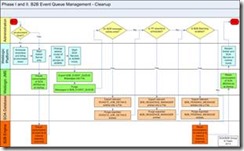
The flowchart below can be used as a reference for the critical cleanup tasks covered in Sections I and II.

I. Preparation of Environment Read the complete article here.

SOA & BPM Partner Community

For regular information on Oracle SOA Suite become a member in the SOA & BPM Partner Community for registration please visit www.oracle.com/goto/emea/soa (OPN account required) If you need support with your account please contact the Oracle Partner Business Center.

Blog Twitter LinkedIn image[7][2][2][2] Facebook clip_image002[8][4][2][2][2] Wiki

OSB12c: Errorhandling in REST by Martien van den Akker


clip_image002Yesterday, I had an OSB consulting day at a customer. We looked into a REST service that was to be extended with update functionality. Since calling an update service of an EIS (Enterprise Information System) can go wrong with all sorts of errors, it is important to be able to return a fault-message with the errors, jason format.
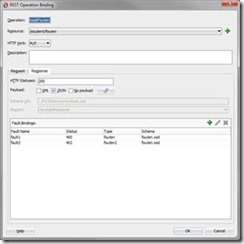
Now in OSB12c it’s very apparent how you define possible fault-messages and even how the should be formatted in JSON:

In this sample case we created a more or less simple xsd for faults (dutch: fouten). To test with different fault messages we simply duplicated the ‘fouten’ element in the xsd to ‘fouten2’. You can assign different HTTP-status codes to the different fault.
So this is configuration is pretty simple and straight forward. But it is not quite clear in the documents how you would return a specific fault within your error-handlers in the pipeline.
Internally OSB works not only ‘XML’-based but actually SOAP-based. So the trick in the end is to replace the body with a soap-fault message and the selection of the REST/JSON errormessage is done based on the structure of the document in the details-section of the SOAP-Fault. In the screen above, you would define for each fault message an xsd-element and apparently it validates the soap-fault-details content against each XSD defined, and the xsd against which the detail-content is valid points to the returned fault, with the corresponding HTTP Status.

Read the complete article here

SOA & BPM Partner Community

For regular information on Oracle SOA Suite become a member in the SOA & BPM Partner Community for registration please visit www.oracle.com/goto/emea/soa (OPN account required) If you need support with your account please contact the Oracle Partner Business Center.

Blog Twitter LinkedIn image[7][2][2][2] Facebook clip_image002[8][4][2][2][2] Wiki

Patching the Service Bus 12.1.3 unknown protocol deployment error by rubix


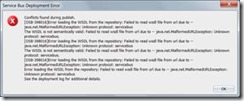
clip_image002If you (already) created your first Oracle Service Bus 12c application/project with SOAP webservices and tried to deploy it to your IntegratedWeblogic server you might be familiar with this error.

Lucky for us Oracle quickly released a solution on their support website and also various blogs picked it up and posted a solution. The earliest reference I found was posted by Link. The solution to your problem was either:

  • Add felix.service.urlhandlers=false to the Init properties of OSGi frameworks bac-svnserver-osgi-framework factory implementation class
  • Remove the default server as a target for the framework

This worked like a charm and I was able to play around with my 12c Service Bus. However since it was stated that the solution could result into problems with BPM on your domain I reminded myself that I wanted to dive deeper into this when I had the time.

Google helped me out, and I discovered this information on the Apache Felix framework website.

Felix installs the URL Handlers service by default. If you do not want this service you can disable it, by setting the felix.service.urlhandlers property to false in the config.properties file. It is not recommended to disable this, but the main reason for doing so it because the URL Handlers implementation invokes methods to set the singleton factories for URL stream and content handler factories. Assuming that you want to use URL Handlers service, you must configure it if you aren’t running on the standard Sun JRE.

The URL Handlers service extends the standard Java URL stream and content handler mechanism to work in an OSGi environment. The way that built-in URL protocol and content handlers are discovered is by probing packages for the appropriate classes to handle the protocol/content. ……….. The value of these properties is a list of “|” delimited package names to be searched for protocol and content handlers, respectively. See the Java documentation for stream and content handlers for more information.

So disabling the URL handler service is not recommended and you should be able to extend the list of package names used for handling content and protocols. So after poking around the world wide web I finally discovered that Oracle already released a document on this with Doc ID 1903573.1. Read the complete article here.

SOA & BPM Partner Community

For regular information on Oracle SOA Suite become a member in the SOA & BPM Partner Community for registration please visit www.oracle.com/goto/emea/soa (OPN account required) If you need support with your account please contact the Oracle Partner Business Center.

Blog Twitter LinkedIn image[7][2][2][2] Facebook clip_image002[8][4][2][2][2] Wiki

Service Bus 12c – Series of Articles by Siva


Published following series of articles related Service Bus 12c. Hopefully it helps the people who want to get hands dirty.

SOA & BPM Partner Community

For regular information on Oracle SOA Suite become a member in the SOA & BPM Partner Community for registration please visit www.oracle.com/goto/emea/soa (OPN account required) If you need support with your account please contact the Oracle Partner Business Center.

Blog Twitter LinkedIn image[7][2][2][2] Facebook clip_image002[8][4][2][2][2] Wiki