Upgrading from SOA Suite 10g and 11c to SOA Suite 12c by Ronald van Luttikhuizen

clip_image001

Get the presentation here.

SOA & BPM Partner Community

For regular information on Oracle SOA Suite become a member in the SOA & BPM Partner Community for registration please visit www.oracle.com/goto/emea/soa (OPN account required) If you need support with your account please contact the Oracle Partner Business Center.

Blog Twitter LinkedIn image[7][2][2][2] Facebook clip_image002[8][4][2][2][2] Wiki

Critical Patch Update Advisory includes SOA Suite & BPM Suite – January 2015

Oracle Critical Patch Update Advisory – January 2015

A Critical Patch Update (CPU) is a collection of patches for multiple security vulnerabilities. Critical Patch Update patches are usually cumulative, but each advisory describes only the security fixes added since the previous Critical Patch Update advisory. Thus, prior Critical Patch Update advisories should be reviewed for information regarding earlier published security fixes. Please refer to: Critical Patch Updates and Security Alerts for information about Oracle Security Advisories.

Affected Products and Versions include the following Fusion Middleware solutions:

Oracle Fusion Middleware, version(s) 10.1.3.5, 11.1.1.7, 11.1.2.1, 11.1.2.2, 12.1.2, 12.1.3
Oracle Access Manager, version(s) 11.1.1.5, 11.1.1.7, 11.1.2.1, 11.1.2.2
Oracle Adaptive Access Manager, version(s) 11.1.1.5, 11.1.1.7, 11.1.2.1, 11.1.2.2
Oracle BI Publisher, version(s) 10.1.3.4.2, 11.1.1.7
Oracle Business Intelligence Enterprise Edition, version(s) 10.1.3.4.2, 11.1.1.7
Oracle Containers for J2EE, version(s) 10.1.3.5
Oracle Directory Server Enterprise Edition, version(s) 7.0, 11.1.1.7
Oracle Exalogic Infrastructure, version(s) 2.0.6.2.0 (for all X2-2, X3-2, X4-2)
Oracle Forms, version(s) 11.1.1.7, 11.1.2.1, 11.1.2.2
Oracle GlassFish Server, version(s) 3.0.1, 3.1.2
Oracle HTTP Server, version(s) 10.1.3.5.0, 11.1.1.7.0, 12.1.2.0, 12.1.3.0
Oracle OpenSSO, version(s) 8.0 Update 2 Patch 5
Oracle Real-Time Decision Server, version(s) 11.1.1.7, RTD Platform 3.0.x
Oracle Reports Developer, version(s) 11.1.1.7, 11.1.2.2
Oracle SOA Suite, version(s) 11.1.1.7, 12.1.3.0
Oracle Waveset, version(s) 8.1.1
Oracle WebCenter Content, version(s) 11.1.1.8.0
Oracle WebLogic Portal, version(s) 10.0.1.0, 10.2.1.0, 10.3.6.0
Oracle WebLogic Server, version(s) 10.0.2.0, 10.3.6.0, 12.1.1.0, 12.1.2.0, 12.1.3.0

For more information please visit the OTN here.

Note: Patch 20333237  is currently only limited available, please contact myself if you need to get access.

SOA & BPM Partner Community

For regular information on Oracle SOA Suite become a member in the SOA & BPM Partner Community for registration please visit www.oracle.com/goto/emea/soa (OPN account required) If you need support with your account please contact the Oracle Partner Business Center.

Blog Twitter LinkedIn image[7][2][2][2] Facebook clip_image002[8][4][2][2][2] Wiki

IoT and the Modern Value Chain by Gaurav Palta and John Murphy

By implementing modern best practices and architecting a digital, IoT-driven supply chain, organizations will be able to realize a number of benefits.

Today’s modern consumers expect faster and more flexible fulfillment options that provide full visibility into product information, availability, and lead times. With billions of networked devices—from cell phones and laptops to equipment sensors and wearable technology—the opportunities for significant innovation are vast. But so are the possibilities for exposure to risk and inefficiencies. The business battleground is moving, and the value chain is at the forefront of success or failure.

clip_image001

Now, fast forward to 2020, there are 25-plus billion Internet of Things (IoT) devices and a “networked” economy approaching US$2 trillion. According to Bryan Tantzen, senior director of IoT at Cisco, “We have now crossed the chasm and people are waking up to the value at stake. Supply chain managers in particular are leveraging IoT to create a real-time supply chain where line operators take digital orders and integrate them immediately into production runs.”

To take advantage of the increasing deluge of data, commonly referred to as big data, businesses are replacing traditional methods with modern best practices. These practices are more focused on customers, enable faster and more responsive supply networks, inspire more profitable product innovation, and facilitate a more collaborative environment of empowered supply chain professionals.

By implementing modern best practices and architecting a digital, IoT-driven supply chain, organizations will be able to realize a number of benefits:

The business battleground is moving, and the value chain is at the forefront of success or
failure.

Increase focus on customers

As consumer-level information is captured by machine-to-machine communications, businesses can immediately analyze the data in multiple ways to create faster, more reliable, and more accurate forecasts so inventory and production levels are optimized. For example, in the not-so-distant future, sensors will be added to consumable items such as a gallon of milk. Milk producers will go beyond the shelves at retail outlets and into the homes of consumers to determine, in the short term, levels of consumption and, in the long term, patterns of consumption for individuals so they can better manage their supply chains and predict future demand and supply their retailers more efficiently. This level of detail was never before available. Read the complete article here.

SOA & BPM Partner Community

For regular information on Oracle SOA Suite become a member in the SOA & BPM Partner Community for registration please visit www.oracle.com/goto/emea/soa (OPN account required) If you need support with your account please contact the Oracle Partner Business Center.

Blog Twitter LinkedIn image[7][2][2][2] Facebook clip_image002[8][4][2][2][2] Wiki

WS-BPEL 2.0 Beginner’s Guide by Matjaz B. Juric & Denis Weerasiri

clip_image002
Design and develop WS-BPEL executable business processes using Oracle SOA Suite 12c

About This Book

  • Develop BPEL and SOA composite solutions with Oracle SOA Suite 12c and JDeveloper 12c
  • Understand Human interaction in BPEL and learn how to add human tasks to a BPEL processes
  • Automate business processes with WS-BPEL 2.0
  • Implement and develop compensation and compensation handlers in BPEL processes

Who This Book Is For

If you are a software architect, a designer, a software developer, an SOA and BPM architect, a project manager, or a business process analyst who is responsible for the design and development of business processes, composite applications, and BPM/SOA solutions, then this book is for you. You should have a clear grasp of general SOA concepts including business processes and web services, but no prior knowledge of the BPEL language is required.

Authors

Matjaz B. Juric

Matjaz B. Juric holds a PhD in Computer and Information Science. He is a full-time professor at the University of Ljubljana and the Head of the Cloud Computing and SOA Competency Centre (www.soa.si). Matjaz is an Oracle ACE Director, a Java Champion, and an IBM Champion. He has more than 20 years of work experience. He has authored/coauthored Do More with SOA Integration, WS-BPEL 2.0 for SOA Composite Applications, Oracle Fusion Middleware Patterns, Business Process Driven SOA using BPMN and BPEL, Business Process Execution Language for Web Services (English and French editions), BPEL Cookbook: Best Practices for SOA-based integration and composite applications development(awarded the best SOA book in 2007 by SOA World Journal), SOA Approach to Integration, all by Packt Publishing.

Denis Weerasiri

Denis Weerasiri is a Computer Science and Engineering student, pursuing his PhD at the University of New South Wales. Before this, he worked as a senior software engineer for WSO2, an open source SOA company. He obtained his BSc Engineering degree with first class honors in the year 2010 from the Department of Computer Science and Engineering, University of Moratuwa, Sri Lanka. His research interests are distributed systems, cloud resource configuration management, and business process management.

What You Will Learn

  • Design and develop BPEL 2.0 executable business processes
  • Become familiar with BPEL 2.0 activities and the most important usage scenarios
  • Learn how to invoke and orchestrate services, manipulate data and use variables
  • Implement conditions and loops, and recognize fault-handling capabilities to avoid unexpected states
  • Understand message exchange patterns and learn about asynchronous communication channels and dynamic parallel invocations
  • Learn about human interactions, human tasks, events and event handling, and compensations

For additional SOA Books please visit our wiki & Read the complete article here.

SOA & BPM Partner Community

For regular information on Oracle SOA Suite become a member in the SOA & BPM Partner Community for registration please visit www.oracle.com/goto/emea/soa (OPN account required) If you need support with your account please contact the Oracle Partner Business Center.

Blog Twitter LinkedIn image[7][2][2][2] Facebook clip_image002[8][4][2][2][2] Wiki

2 Minute Tech Tip: Tools for SOA Governance and API Management by Luis Weir

clip_image002

Watch the video here

SOA & BPM Partner Community

For regular information on Oracle SOA Suite become a member in the SOA & BPM Partner Community for registration please visit www.oracle.com/goto/emea/soa (OPN account required) If you need support with your account please contact the Oracle Partner Business Center.

Blog Twitter LinkedIn image[7][2][2][2] Facebook clip_image002[8][4][2][2][2] Wiki

Smart Combo – Cloud Integration Webcast January 26th 2015

clip_image002

Cloud Integration – Unified and Comprehensive Cloud and On-premise Integration Discover the Value for Partners

Simplify cloud integration with a unified and comprehensive solution to integrate disparate cloud and on-premise applications. Oracle cloud integration leverages Oracle Cloud services as well as components from Oracle’s SOA, BPM, and data integration technologies.

Speakers will be:
– Olivier Tordo, Channel Sales – Senior Director
– Richard Lefebvre, Director CRM Partner Programs EMEA
– Christian Patrascu, Director of Product Management – Oracle
– Yogesh Sontakke, Principal Product Manager

Details and registration: » 26 January – 2 PM CET (1 hour)

SOA & BPM Partner Community

For regular information on Oracle SOA Suite become a member in the SOA & BPM Partner Community for registration please visit www.oracle.com/goto/emea/soa (OPN account required) If you need support with your account please contact the Oracle Partner Business Center.

Blog Twitter LinkedIn image[7][2][2][2] Facebook clip_image002[8][4][2][2][2] Wiki

Cloud Adapter for Salesforce.com – Understanding What It Does & How You Benefit by ITC

Starting in the 1990’s it became standard operating procedure in all large and even mid-sized companies to use an ERP system  such as Oracle E-Business Suite to manage business processes like Order Management, Accounting System or Supply Chain Management, along with the complete sales and revenue cycle from quote-to-order and order-to-cash.

clip_image002However, as recently as only a half-decade ago, those same companies either ran CRM systems completely independently of those ERP solutions or they scarified high quality CRM functionally for a CRM alternative that was “good enough”  but integrated easily with Oracle.
However, this began to change at the beginning of the second decade of the 21st century, as companies began dropping their legacy systems and opting to move to SaaS-based CRM solutions such as SalesForce.com.  The attraction of solutions such as Salesforce.com is twofold: first, they offer best of breed functionality; second, the SaaS model makes them very attractive from a total cost of ownership perspective. 
However,  the downside that Oracle users face when they adopted a SaaS solution such as SalesForce.com was that it didn’t integrate with Oracle E-Business Suite. And this creates problems such as data silos, data scattering, data quality issues and other major inefficiencies related to business process execution. Maintaining your data also becomes a challenge, as data captured across your system must be duplicated to SalesForce.
To overcome these issues and take full advantage of Oracle EBS and SalesForce.com organizations need to achieve a seamless information flow between the two: they need to integrate them. This much has long been obvious. Read the complete article here.

SOA & BPM Partner Community

For regular information on Oracle SOA Suite become a member in the SOA & BPM Partner Community for registration please visit www.oracle.com/goto/emea/soa (OPN account required) If you need support with your account please contact the Oracle Partner Business Center.

Blog Twitter LinkedIn image[7][2][2][2] Facebook clip_image002[8][4][2][2][2] Wiki

SOA Suite 12c and the OPSS Keystore Service by Adam Desjardin


clip_image002When working with a colleague on a sample SOA 12c project recently I noticed a change in 12c that I had not seen mentioned anywhere yet.  In the sample project we were integrating with the Atlassian OnDemand service in order to provision users for Confluence and JIRA.  The integration is performed using a SOAP service over SSL.  In this situation, like at many of our customers, we needed to import additional trusted certificates into the trust store in order to make the service call over SSL.  At many of our customers this is an internal Root CA they use to sign their own certificates for internal use.

When looking at the default settings of the IntegratedServer in JDeveloper 12c we can now see below that it is configured by default to use the OPSS Keystore Service and not a JKS Trust Store.

You can see above that instead of a filesystem URI to a JKS file you now see a kss:// URI.  This URI shows that we are using the trust store called "trust" in the system strip of the Keystore Service.

The OPSS Keystore Service is meant to provide a single location for Keystores and Trust stores for all applications running within the Weblogic domain.  The only pre-requisite for using the service is that the JRF templates have been applied to your domain, which should be the case for any SOA 12c domain.

Using this service you can now manage all of your certificates through Fusion Middleware Control and WLST.  You can navigate to the Security -> Keystore menu under your domain in FMW Control as shown below. Read the complete article here.

SOA & BPM Partner Community

For regular information on Oracle SOA Suite become a member in the SOA & BPM Partner Community for registration please visit www.oracle.com/goto/emea/soa (OPN account required) If you need support with your account please contact the Oracle Partner Business Center.

Blog Twitter LinkedIn image[7][2][2][2] Facebook clip_image002[8][4][2][2][2] Wiki

SOA Suite 12c New Features: Creating SOA Project Templates for Reusing SOA Composite Designs by Joe Greenwald

clip_image002In SOA Suite 12c, we create application integrations and business processes designed as services composed of processing logic, data transformation and routing, dynamic business rules and human tasks in the form of XML-based metadata. The graphical representations of these services are created in JDeveloper using its graphical editors. Since these services are composed of individual, separately configurable components, we call this a composite service. Once deployed to and hosted by Oracle SOA Suite, this service looks and acts like any other web service to its clients.
It would be highly productive and desirable to be able to easily create templates for service designs that could be reused across teams and projects. Using quality designs and tested patterns as the starting point for new services speeds up development while also supporting widespread adoption of quality and standards in service design.

SOA Suite 12c automates creation and management of templates of service composites, as well as individual service components. The service project templates we create will be stored and managed in the file-based MDS, so they can easily be shared with other developers.
We have an existing service composite that we would like to clone or use as the basis of new service composite. Once we create the new service based on the template, we’ll be able to make modifications to it as needed.
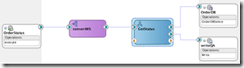
Here is the current Service:
The service exposes a web service entry point, OrderStatus whose interface is implemented by convertWS mediator. ConvertWS transforms the incoming message as needed and routes the message to be processed by GetStatus, a Business Process Execution Logic (BPEL)-based component. The BPEL process accesses the database through the database adapter, OrderDB, to check order status and then writes the status to a flat file via the file adapter, writeQA.

Read the complete article here

SOA & BPM Partner Community

For regular information on Oracle SOA Suite become a member in the SOA & BPM Partner Community for registration please visit www.oracle.com/goto/emea/soa (OPN account required) If you need support with your account please contact the Oracle Partner Business Center.

Blog Twitter LinkedIn image[7][2][2][2] Facebook clip_image002[8][4][2][2][2] Wiki

SOA Suite 11g and 12c: Determining composite dependencies to the level of operations by Maarten Smeets

clip_image001In large companies, often there are many services and dependencies between services. It is important to track service dependencies in order to for example estimate the impact of changes. Design documents or architecture views can be used for this but as everybody knows, there is often a gap between theory and practice (design and implementation).

In this blog post I provide code to determine dependencies between composites to the level of operation calls. In order to achieve this, I’ll parse the composite.xml files, JCA files (used by adapters) and also the BPEL and BPMN files in order to determine the operations. The script can be used for SOA Suite 11g and 12c composites.

The above picture shows different parts of which a composite is composed and how they are linked. The script first determines references. The references specify which external services are called. Then by using wires, the relevant components are determined. Based on the component type, specific logic is used to extract the operation. Not shown in this picture is how database dependencies can also be determined by the script by parsing the JCA files specified in the reference. If you’re in a hurry, you can go to the ‘Executing the script’ part directly and skip the explanation.

Composites

This blog will focus on composites (which can contain components like BPEL and BPM) using the shared SOA infrastructure and not on for example the Service Bus. Composites use the Software Component Architecture (http://www.oasis-opencsa.org/sca) to wire different components together in a consistent way. Oracle uses XML files to describe composites, components and references. These files can easily be parsed and correlated.

Introduction composite.xml

The main file describing a composite is the composite.xml file. Below is a small sample of a HelloWorld composite containing a single component, a BPEL process. Read the complete article here.

SOA & BPM Partner Community

For regular information on Oracle SOA Suite become a member in the SOA & BPM Partner Community for registration please visit www.oracle.com/goto/emea/soa (OPN account required) If you need support with your account please contact the Oracle Partner Business Center.

Blog Twitter LinkedIn image[7][2][2][2] Facebook clip_image002[8][4][2][2][2] Wiki