Microservices architectures – Thoughts from a SOA perspective by The Cattle Crew


clip_image002A frequently discussed topic these days is the Micorservices architectural paradigm. Discussions on various internet blogs and forums are showing the trend that proponents of this approach are not tired of emphasizing why Microservices are different to a holistic SOA approach, when dealing with breaking up or avoiding monolithic software architectures.

For this reason it’s time for the Cattle Crew team, to take a closer look on this arising architectural style and the corresponding discussions from a different perspective.

Microservices Architectures

Amongst others Martin Fowler published a blog about what is characteristic for Microservices and applications build on the foundation of this architectural style [1].  According to this and other blog posts (see also [2], [3]), the goal of a Microservices approach is to avoid software systems to become monolithic, inflexible and hardly manageable, by splitting a system into modular, lightweight and maximum cohesive services. Applications build on this architecture should ensure the agility regarding changes caused by changed business requirements, because affected services of an application can simply be adapted and be redeployed independently from other components.

Effectively a Microservice is a in itself cohesive, atomic application, which fulfills a dedicated purpose. Therefore it encapsulates all needed elements, e.g. UIs, logic components, may also have its own separated persistent store and may run in a separate JVM, to ensure as less impairment to other services as possible. Furthermore the implementation technologies for a specific service may vary. For each service the best-fitting technology should be used; there should be no restrictions regarding the used technologies.

To ensure consistency as well as compatibility with already existing components in case of changes and to guarantee seamless release management of changed components, a Continuous Delivery procedure is indispensable for succeeding. In addition the implementation efficiency benefits from the Microservices approach, because different components may be developed in parallel. Communication between the services, if needed, is done via lightweight protocols such as HTTP. Well defined interfaces are depicting the service contracts.

Where there is light, there is also shadow… Read the complete article here.

SOA & BPM Partner Community

For regular information on Oracle SOA Suite become a member in the SOA & BPM Partner Community for registration please visit www.oracle.com/goto/emea/soa (OPN account required) If you need support with your account please contact the Oracle Partner Business Center.

Blog Twitter LinkedIn image[7][2][2][2] Facebook clip_image002[8][4][2][2][2] Wiki

SOA 12c Encryption and Decryption of Sensitive Data By Vivek Garg

clip_image002Oracle SOA Suite is used for reliable transfer of information, it stores whole the message in SOA_INFRA schema. We can see incoming and outgoing messages in audit trail from EM console. That means user which has access to EM console can see all the messages coming and going through middleware, sometimes some of the information which is flowing through Oracle SOA Suite is very critical and SOA Suite user should not have access to see that critical piece of information. In this post we will discuss how to fulfill this requirement using Oracle SOA Suite.

In previous version of Oracle SOA Suite (11g) there were no out of box provision to encrypt and decrypt sensitive data so that user can’t see the data which is flowing through fusion but in current version of Oracle SOA Suite which is 12c, Oracle provided out of box functionality to encrypt specific fields in the message which is flowing through middleware. Below is sample encrypted message field.

In Oracle SOA 12c, encryption policy is used to encrypt and decrypt the message, message encryption happens at component binding that means message get encrypted before it come to component (BPEL or Mediator) and we see only encrypted message in audit trail. Message decryption happens at reference binding level that means message fields get decrypted before it is sent to target service/system. Read the complete article here.

SOA & BPM Partner Community

For regular information on Oracle SOA Suite become a member in the SOA & BPM Partner Community for registration please visit www.oracle.com/goto/emea/soa (OPN account required) If you need support with your account please contact the Oracle Partner Business Center.

Blog Twitter LinkedIn image[7][2][2][2] Facebook clip_image002[8][4][2][2][2] Wiki

Examine API integration trends in the enterprise by Mala Ramakrishnan

clip_image002API integration is attracting considerable interest from enterprise architects and is a hot topic at the Oracle OpenWorld Conference in San Francisco this week. We caught up with Mala Ramakrishnan, director of product marketing at Oracle, who provided her view on how API integration trends are affecting the enterprise.

What are some of the important trends in API integration tools that you see?

Mala Ramakrishnan: There is a move to broaden the development community beyond IT to include mobile application developers, non-IT line-of-business application developers and thrd-party application developers — mobile and on-premise[s]. Customers are expecting API management tools to offer community building so developers can collaborate on design and usability of APIs and improve the developer experience to discover, test and track their use of APIs. Read the complete article here.

SOA & BPM Partner Community

For regular information on Oracle SOA Suite become a member in the SOA & BPM Partner Community for registration please visit www.oracle.com/goto/emea/soa (OPN account required) If you need support with your account please contact the Oracle Partner Business Center.

Blog Twitter LinkedIn image[7][2][2][2] Facebook clip_image002[8][4][2][2][2] Wiki


Patching the Oracle Service Bus 12.1.3 unknown protocol deployment error by Jan van Zoggel

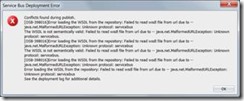
If you (already) created your first Oracle Service Bus 12c application/project with SOAP webservices and tried to deploy it to your IntegratedWeblogic server you might be familiar with this error.

clip_image002

Lucky for us Oracle quickly released a solution on their support website and also various blogs picked it up and posted a solution. The earliest reference I found was posted by Link. The solution to your problem was either:

  • Add felix.service.urlhandlers=false to the Init properties of OSGi frameworks bac-svnserver-osgi-framework factory implementation class
  • Remove the default server as a target for the framework

This worked like a charm and I was able to play around with my 12c Service Bus. However since it was stated that the solution could result into problems with BPM on your domain I reminded myself that I wanted to dive deeper into this when I had the time.

Google helped me out, and I discovered this information on the Apache Felix framework website.

Felix installs the URL Handlers service by default. If you do not want this service you can disable it, by setting the felix.service.urlhandlers property to false in the config.properties file. It is not recommended to disable this, but the main reason for doing so it because the URL Handlers implementation invokes methods to set the singleton factories for URL stream and content handler factories. Assuming that you want to use URL Handlers service, you must configure it if you aren’t running on the standard Sun JRE. Read the complete article here.

SOA & BPM Partner Community

For regular information on Oracle SOA Suite become a member in the SOA & BPM Partner Community for registration please visit www.oracle.com/goto/emea/soa (OPN account required) If you need support with your account please contact the Oracle Partner Business Center.

Blog Twitter LinkedIn image[7][2][2][2] Facebook clip_image002[8][4][2][2][2] Wiki

OpenWorld 2014 Middleware Summery

In case you did not attend OpenWorld 2014, make sure you watch the keynotes on-demand.

At our at our SOA Community Workspace (SOA Community membership required) we published Thomas Kurian Fusion Middleware keynote slides: OFM general session Thomas Kurian OOW 2014.pptx

clip_image001

Middleware General Session

Thomas Kurian, Executive Vice President, Product Development, Oracle

Watch Full-Length Keynote

clip_image002

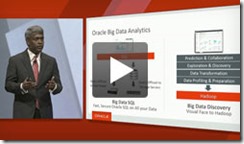
Cloud Services for the Modern Enterprise

Thomas Kurian, Executive Vice President, Product Development, Oracle

Watch Full-Length Keynote

clip_image003

Chairman’s Keynote

Larry Ellison, Executive Chairman and Chief Technology Officer, Oracle

Watch Full-Length Keynote

Thanks to all partners for attending Oracle Open World 2014 & making the conference a huge success . Thanks to all Oracle employees & specially product management & development for the exciting new solutions! Thanks to the 80+ attendees you join our Fusion Middleware Partner Community Reception Tuesday evening. Was great that see the community excited & meet Clemens a good old friend. We are looking for your Oracle Open World 2014 feedback, what did you like best? What are the best products? Send us your feedback at clip_image004Twitter @soacommunity #soacommunity. At our clip_image005Facebook page we posted some impressions – make sure you send us yours!

SOA & BPM Partner Community

For regular information on Oracle SOA Suite become a member in the SOA & BPM Partner Community for registration please visit www.oracle.com/goto/emea/soa (OPN account required) If you need support with your account please contact the Oracle Partner Business Center.

Blog Twitter LinkedIn image[7][2][2][2] Facebook clip_image002[8][4][2][2][2] Wiki

Enterprise Manager Cloud Control 12c: Best Practices for Middleware Management free on-demand training

clip_image002This self-paced course teaches you best practices when using Oracle Enterprise Manager Cloud Control 12c for managing your WebLogic and SOA applications and infrastructure. It consists of interactive lectures, videos, review sessions, and optional demonstrations.
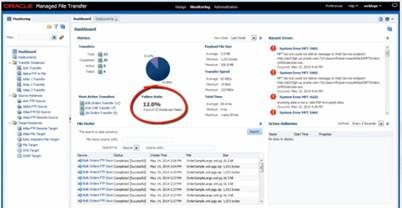
This course covers Enterprise Manager Cloud Control 12c licensed with the WebLogic Server Management Pack Enterprise Edition and the SOA Management Pack Enterprise Edition. Watch the training here.

SOA & BPM Partner Community

For regular information on Oracle SOA Suite become a member in the SOA & BPM Partner Community for registration please visit www.oracle.com/goto/emea/soa (OPN account required) If you need support with your account please contact the Oracle Partner Business Center.

Blog Twitter LinkedIn image[7][2][2][2] Facebook clip_image002[8][4][2][2][2] Wiki

Samples and Demos for Oracle Managed File Transfer

Managed File Transfer (MFT) is one of the SOA Suite 12c highlights make sure you demo it to your SOA customers!
Demos

MFT Tutorials

Custom Processing Action Samples
Download the MFT-Samples zip file to import and use the following custom processing actions samples

SOA & BPM Partner Community

For regular information on Oracle SOA Suite become a member in the SOA & BPM Partner Community for registration please visit www.oracle.com/goto/emea/soa (OPN account required) If you need support with your account please contact the Oracle Partner Business Center.

Blog Twitter LinkedIn image[7][2][2][2] Facebook clip_image002[8][4][2][2][2] Wiki

Closer look at the SOA 12c Feature: Oracle Managed File Transfer By Tshepo Madigage

clip_image002

The rapid growth of cloud-based applications in the enterprise, combined with organizations’ desire to integrate applications with mobile technologies, is dramatically increasing application integration complexity. To meet this challenge, Oracle introduced Oracle SOA Suite 12c, the latest version of the industry’s most complete and unified application integration and SOA solution. With simplified cloud, mobile, on-premises, and Internet of Things (IoT) integration capabilities, all within a single platform, Oracle SOA Suite 12c helps organizations speed time to integration, improve productivity, and lower TCO.

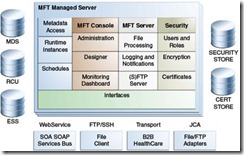
To extend its B2B solution capabilities with Oracle SOA Suite 12c, Oracle unveiled Oracle Managed File Transfer, an integrated solution that enables organizations to virtually eliminate file transfer complexities. This allows customers to load data securely into Oracle Cloud applications as well as third-party cloud or partner applications.

Oracle Managed File Transfer (Oracle MFT) enables secure file exchange and management with internal departments and external partners. It protects against inadvertent access to unsecured files at every step in the end-to-end transfer of files. It is easy to use especially for non technical staff so you can leverage more resources to manage the transfer of files. The extensive reporting capabilities allow you to get quick status of a file transfer and resubmit it as required. You can protect data in your DMZ by using the SSH/FTP reverse proxy. Read the complete article here

SOA & BPM Partner Community

For regular information on Oracle SOA Suite become a member in the SOA & BPM Partner Community for registration please visit www.oracle.com/goto/emea/soa (OPN account required) If you need support with your account please contact the Oracle Partner Business Center.

Blog Twitter LinkedIn image[7][2][2][2] Facebook clip_image002[8][4][2][2][2] Wiki

Multichannel enablement for Applications – hands-on workshop at OFM Forum 2015

image Agenda Highlights

74% consumers use at least 3 channels when interacting with an enterprise about customer service issues.

– Gartner

Multichannel Strategy Overview

Business scenario and demo walkthrough

  • Lab: Service Virtualization with Service Bus
  • Lab: Composite Portal with WebCenter Suite
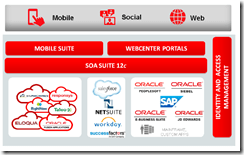
  • Lab: Mobile App Integration with Mobile Suite
  • Securing multi-channel experience with Oracle Identity & Access Mgmt Suite

For details please visit our registration page here.

SOA & BPM Partner Community

For regular information on Oracle SOA Suite become a member in the SOA & BPM Partner Community for registration please visit www.oracle.com/goto/emea/soa (OPN account required) If you need support with your account please contact the Oracle Partner Business Center.

Blog Twitter LinkedIn image[7][2][2][2] Facebook clip_image002[8][4][2][2][2] Wiki

SOA Suite 12c: The LDAP Adapter, a quick and easy tutorial by Maarten Smeets

clip_image001In enterprises, LDAP servers are often used to store user credentials and groups and share them among applications. Oracle SOA Suite 12c introduces a new technology adapter; the LDAPAdapter which allows easy integration with LDAP servers. In this blog post I will provide a quick and easy howto on installation of an LDAP server and browser (ApacheDS and Apache Directory Studio). I will also describe the configuration required to use the LDAPAdapter and provide an example BPEL process which allows creation of new users in the ApacheDS LDAP server by means of webservice calls.

Setting up the LDAP server

Installing an LDAP server

For this example I’ll use ApacheDS as LDAP server and Apache Directory Studio as LDAP browser. First download and install Apache Directory Studio from http://directory.apache.org/studio/. Next create an LDAP server. Click the LDAP server tab in the bottom left corner and click New Server. Read the complete article here.

SOA & BPM Partner Community

For regular information on Oracle SOA Suite become a member in the SOA & BPM Partner Community for registration please visit www.oracle.com/goto/emea/soa (OPN account required) If you need support with your account please contact the Oracle Partner Business Center.

Blog Twitter LinkedIn image[7][2][2][2] Facebook clip_image002[8][4][2][2][2] Wiki