SOA Suite 12c launch by the SOA Community

THANKS to all SOA Community Partners for the excellent SOA Suite 12c launch. It was an amazing 50 hours of an almost around the clock twitter storm! It was worth waiting a long time for the SOA Suite 12c release the first feedback is superb! Special thanks to the Amis team who publish a whole series – or a book of blog post about SOA Suite 12c!

We now have the opportunity to convert this SOA Suite 12c storm in joint business! Make use of our SOA Suite 12c launch event marketing campaign and run local launch events for your customers. Most of our customers use many different products from different vendors for integration. Different vendors for ESB, BPEL, governance, b2b, OEP, cloud integration, mobile integration….. You have the opportunity to consolidate them and make SOA Suite as their one and company wide solution. Make sure you get trained and let us know when your first customers go in production on SOA Suite 12c!

Here are some of the best quotes & tweets about SOA Suite 12c – THANKS to all partners & ACEs & product management! Jürgen

clip_image002clip_image003clip_image001clip_image006clip_image004 clip_image005clip_image008

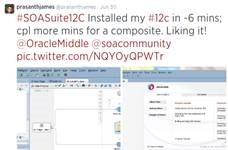
We had serious competition during the SOA Suite 12c launch! Congratulations to Prasanth James Who holds the current record for a SOA Suite 12c installation in 6 minutes! The challenge continues let us know if you are faster!

The SOA Community had also great fun during the SOA Suite 12c launch!

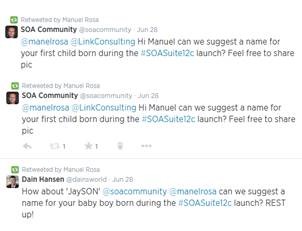
Manuel Rosa recruited a new member to the SOA Community – congratulations to your sun! He was born right during the SOA Suite 12c launch and Dain gave him the name “JaySON”

clip_image010

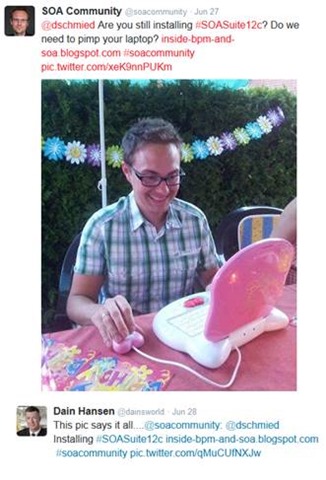
clip_image012Danilo Schmiedel proof the developer productivity by a quick SOA Suite 12c installation on his new laptop J

We want to promote your blog post send it via twitter @soacommunity or #soacommunity or post it at our http://www.facebook.com/soacommunity or contact me via linkedin.com/kress

Partner resource kits including ppt presentation, training and sales & marketing kits available at SOA http://tinyurl.com/soa12ckit  & BPM http://tinyurl.com/bpm12ckit

SOA & BPM Partner Community

For regular information on Oracle SOA Suite become a member in the SOA & BPM Partner Community for registration please visit www.oracle.com/goto/emea/soa (OPN account required) If you need support with your account please contact the Oracle Partner Business Center.

Blog Twitter LinkedIn image[7][2][2][2] Facebook clip_image002[8][4][2][2][2] Wiki

Technorati Tags: Amis,SOA Suite 12c,BPM Suite 12c,launch event,marketing,SOA Community,Oracle SOA,Oracle BPM,Community,OPN,Jürgen Kress


SOA Suite 12c & BPM Suite 12c launch event by Amis July 17th in Netherlands

imageSOA Suite 12c & BPM Suite 12c expands Oracle‘s leadership to be the most unified and comprehensive solution for simplifying cloud, mobile, and IoT Integration. Experience those new features of SOA Suite 12c & BPM Suite 12c on our launch events in 2014 hosted by Amis an Oracle Specialized Partner.

The Amis SOA Suite 12c & BPM Suite 12c Summit takes place on July 17th from 16:30 – 17:00 in Nieuwegein Netherlands. For details please visit the Amis registration page here.

Additional local SOA Suite 12c & BPM Suite 12c launch events by Oracle partners are posted here.

Additional resources for Oracle Customers:

imageAdditional resources for Oracle Partners:

SOA & BPM Partner Community

For regular information on Oracle SOA Suite become a member in the SOA & BPM Partner Community for registration please visit www.oracle.com/goto/emea/soa (OPN account required) If you need support with your account please contact the Oracle Partner Business Center.

Blog Twitter LinkedIn image[7][2][2][2] Facebook clip_image002[8][4][2][2][2] Wiki

Did you miss the Amis Oracle UX event in the Netherlands? Here are the slides of the Amis UX Event

1956743_624738347594941_642387630_o[1]TELL US YOUR MOBILE STRATEGY: Take our survey on mobile use and mobile strategy for business. Check the Voice of User Experience, or VoX, blog to see how you can share your perspective  about mobile use with Oracle’s Applications User Experience team. Please complete the survey before March 28.

USER EXPERIENCE SPECIALIST ROLE: We now have a UX Guided Learning Path live on the Oracle Partner Network. Oracle has just created a new User Experience Specialist role for Oracle Cloud Partners to better enable them to sell the Oracle Applications Cloud.  It is composed of a guided learning path targeted at sales and pre-sales roles to learn about Oracle’s investment in UX for cloud, and how to position the benefits.  The guided learning path and associated assessment is available online via OPN.
HARVARD TEAMS UP WITH UX DIRECT: Read about how OUAB member Harvard University uses UX Direct for their new PeopleSoft Campus Solutions  in this post on the VoX blog.  UX Direct helps partners and customers build in user experience best practices, using the same methods that the Oracle Applications User Experience team uses for Oracle software. Harvard is a member of the Oracle Usability Advisory Board (OUAB), which is also one of the Oracle Applications User Experience team’s programs.
DOING OUR HOMEWORK: Head to the Voice of User Experience, or VoX, blog for a post on how “New Oracle developers get a taste of Raspberry Pi.” By holding occasional hack days, Oracle’s own developers get a chance to play around with new, or new-to-them, technology and think about how to apply that technology to the business world and its users. Then check in at the AppsLab for a post on how some of the Oracle Applications User Experience developers applied Raspberry Pi for a project of their own in “New Robot Arm Hotness,” an example of how the innovation is always ongoing.
WEARABLE TECHNOLOGY USER EXPERIENCE: Check the Usable Apps blog for a new post about a wearables jam held recently for developers on the Oracle Applications User Experience team, where participants took their cue from Mickey Mouse, in “Learning to Build a Wearables User Experience from Mickey Mouse.” Hear more of the story (and check out author Ultan O’Broin’s fuzzy ears) in “It’s Not How You Wink, It’s How You Work,” on the User Assistance blog.
GAME-CHANGER FOR FINANCIALS DEPARTMENT: Oracle’s Ultan O’Broin takes a look at how Oracle Social Network can improve the user experience for financial applications users in “How to Chat Up an Accountant Safely: Social Networking in the Finance Department,” on the Usable Apps blog.

SOA & BPM Partner Community

For regular information on Oracle SOA Suite become a member in the SOA & BPM Partner Community for registration please visit www.oracle.com/goto/emea/soa (OPN account required) If you need support with your account please contact the Oracle Partner Business Center.

Blog Twitter LinkedIn image[7][2][2][2] Facebook clip_image002[8][4][2][2][2] Wiki

The key ingredients of an ACM case – the Hotel Booking Case in terms of adaptive case management by Amis

In a recent post I have introduced the key concepts in Adaptive Case Management (ACM). In the article you are reading now, I want to show an example of a specific case. This example should provide some clarity on exactly how the core aspects of a case are specified and how these provide the foundation for the case as it will be managed  by the ACM engine of choice (for example Oracle BPM Suite 11g).

The example I use – inspired by the surroundings of the Oracle Fusion Middleware Partner Community event on Malta (February 2014) – is a hotel. The scope of the case is the booking and stay of a guest or party of guests. The case starts with the potential guest enquiring after prices and availability. It can conclude in several ways – ranging from the guest having had a pleasant stay to either cancellation, no show or even no booking at all.

This article does not yet discuss the implementation of the case. It introduces the key components that should be produced during design phase of the case and that provide the ingredients for implementing the case as an ACM process.

Note: I am not striving for a complete case definition. I am sure many hotels would use different, more extensive case definitions. This article’s objective is only to provide an example to demonstrate the various constituents of an ACM case definition.

Milestones

The milestones identified in my fictitious hotel case are:

  • Booking made: possibly based upon the quote provided to the guest, a booking has been made
  • Booking cancelled
  • Cancellation deadline passed: a guest can cancel a booking up 24 hours before the arrival data; when that deadline has passed, the booking enters a new phase: the hotel starts making preparations and the guest has to pay now – even upon no-show or (late) cancellation; note: this is a special milestone, one that is brought about by passing of the time rather than by an event in the case
  • Guest Checked-in
  • Check-out performed
  • No-show declared
  • Guest Complaint received
  • Guest Complaint handled
  • Case Closed

Not all of these milestones will have to be reached in a case instance. In fact, several are mutually exclusive. Some may be revokable: even when the milestone has been reached, the case stakeholders can be decide that on second thoughts it is not reached after all (for example: after no-show was declared, the guest arrives or after the guest complaint as declared taken care of, the guest persists with the complaint).

Stakeholders

Various stakeholders can be associated with the case. Whether they will have direct to an automated system that orchestrates the case is not yet determined. However, each stakeholder may directly or indirectly influence the case. Some of these stakeholders are internal (from the viewpoint of the hotel) while others are considered external. Not all stakeholders listed have to be involved with every instance of the case. Read the complete article here.

SOA & BPM Partner Community

For regular information on Oracle SOA Suite become a member in the SOA & BPM Partner Community for registration please visit www.oracle.com/goto/emea/soa (OPN account required) If you need support with your account please contact the Oracle Partner Business Center.

Blog Twitter LinkedIn image[7][2][2][2] Facebook clip_image002[8][4][2][2][2] Wiki

ACM: organizing the chaos and flexing rigid process structures through adaptive case management by Lucas Jellema

My introduction into the world of adaptive case management (ACM) feels like a huge relief. Without having to give up the benefits from structure and organization, ACM allows me to cater for the reality of the world in terms of exceptions, variations and the responsibility of experts to make decisions. ACM is a way of organizing a process – although perhaps the word process could be replaced by flow or conversation or interaction or project or any cluster of activities with a clear start and end. This cluster is called a case. Examples of cases are all around us:

  • a tax payer’s yearly interaction with the tax authorities
  • a hotel booking & stay – an example of this case is described in this follow up article
  • a complaint procedure
  • an organization’s interactions with a potential new employee
  • a complex order
  • a court case – from initial filing of a suit until the final ruling and perhaps the appeal as well
  • a (regular) marketing event
  • a repair job on a car
  • my son’s birthday party

Note that some of these cases can be seen from different perspectives. The tax office will see the case differently from the citizen or the financial adviser. A court case can be seen from the perspective of the parties involved, the lawyers or the courthouse.  Maybe at some point these various parties might share a common unified case instance. For the moment the situation is likely to be that for a specific interaction, there may be multiple case instances, each one living in the ACM engine of a specific party.

ACM acknowledges the fact that even though all instances of a certain case type are similar, they can also be very different. Not just in the content of the case but also in the way it is executed. Depending on the situation, certain steps that are usually executed are sometimes by-passed or the order in which steps are executed is very different from the normal pattern – if there even is such a thing as the normal pattern. Instead of defining upfront for all instances of the process/interaction/project/case how it is to be executed, ACM takes the agile view of the world and embraces change and variation. Without giving up all semblance of organization and coordination.

ACM provides structure. A number of elements that (potentially) play a role in a [type of] case is defined at design time. These elements are used by the ACM engine to guides stakeholders at run time and to ensure that non-optional steps are taken and mandatory rules are followed. Even though may aspects of a case can be flexible and determined to large degree by case workers and the contents of a case, that does not mean that freedom rules supremely and no conditions apply at all.

Elements that define the case include:

  • the milestones that can be reached in a case,
  • the activities that can be executed over the course of the case,
  • data that is associated with the case; in addition to structured data, it is common to also have documents associated with a case instance (that may be structured for human actors, but are less so to the system)
  • stakeholders that are involved with the case and influence it in some way,
  • events that may occur over the lifetime of the case,
  • the possible outcomes of the case.

Read the complete article here.

SOA & BPM Partner Community

For regular information on Oracle SOA Suite become a member in the SOA & BPM Partner Community for registration please visit www.oracle.com/goto/emea/soa (OPN account required) If you need support with your account please contact the Oracle Partner Business Center.

Blog Twitter LinkedIn image[7][2][2][2] Facebook clip_image002[8][4][2][2][2] Wiki

Fusion Middleware Partner Community Awards 2014

Thanks for all the partners for the excellent contribution and on-going business! You are the key for the joint Fusion Middleware success. It becomes every year harder to choose the winners, due to all the excellent work and contributions.

The awarded partners have proven cutting edge projects with the latest Oracle technology and most important their contribution to the community like blogs, newsletters, conferences, papers, twitter, Linkedin and their participation in the partner advisory councils.

THANKS to the whole community and congratulation to the winners:

  • Amis
    Oracle SOA Community Award
    SOA Partner Community Award 2014
  • OPITZ Consulting
    BPM Partner Community Award 2014
  • Oracle Internal Award to Ritu Chhibber
    Oracle Partner Community Award – Oracle Contribution 2014
    The Oracle internal award also acknowledges the special contribution to the community. Ritu Chhibber publishes since years every month the newsletter you read. Ritu, as you could not come to Malta to receive it in person, when you read these lines THANKS for your great work!

SOA & BPM Partner Community

For regular information on Oracle SOA Suite become a member in the SOA & BPM Partner Community for registration please visit www.oracle.com/goto/emea/soa (OPN account required) If you need support with your account please contact the Oracle Partner Business Center.

Blog Twitter LinkedIn image[7][2][2][2] Facebook clip_image002[8][4][2][2][2] Wiki

Oracle OpenWorld 2013: First glimpses of the new SOA Suite 12c by Lucas Jellema

During this week’s Oracle OpenWorld Conference, we were given some sneak peeks into the short term future of the Oracle SOA Suite. During various roadmap sessions, on the demo grounds as well as in the keynote session by Thomas Kurian (the replay of which you can see here, new features were described and imagedemonstrated, allowing us to get a fairly good overview of what is going to come for SOA Suite – later in 2013 and sometime in 2014 (probably the first half of that year).

The SOA Suite plays an important part in the three themes Thomas Kurian set down for the Fusion Middleware suite of products: support for mobility, cloud and business user empowerment.

Some of the highlighted new aspects of Oracle SOA Suite are:

  • Adapters to connect from on-premise to in-the-cloud – specifically targeting SalesForce, RightNow and also providing an SDK to create custom integrations into the cloud (the first cloud adapters will be released on 11g, before the end of the year)
  • Mobile enablement by exposing RESTful services that communicate using JSON as well as adding the capability to call out to such services (12c functionality)
  • Enhanced functionality on Exalogic (of course it runs faster on Exalogic, up to 20 times)
  • Modular runtime with a lighter footprint.

A brief demonstration of the Cloud Adapter was given by Demed L’Her during said keynote. The next screenshot shows the Adapter wizard for the Cloud Adapter.

imageimage

It allows the developer to pick a specific operation for a specific business object exposed by RightNow (or SalesForce) (the adapter knows about the APIs exposed by RightNow and SalesForce):image

This next screenshot shows the adapter that is used in SOA Suite 12c to expose a RESTful service on top of an SCA Composite or a Service Bus service: Read the full article here.

SOA & BPM Partner Community

For regular information on Oracle SOA Suite become a member in the SOA & BPM Partner Community for registration please visit www.oracle.com/goto/emea/soa (OPN account required) If you need support with your account please contact the Oracle Partner Business Center.

Blog Twitter LinkedIn image[7][2][2][2] Facebook clip_image002[8][4][2][2][2] Wiki Mix Forum

SOA Suite definitive guide to: The UMS adapter (11.1.1.7) by Amis

This week Oracle released it sixth patchset (11.1.1.7) of the SOA Suite and it’s IDE JDeveloper. In this new release there are some small changes in the IDE, but there are also some mayor changes like two new adapters; healthcare and the UMS (User Messaging Service). This blog will look into the use of the UMS adapter as a inbound and outbound service in a SOA Composite. This adapter was already available as beta in PS5 but now it is an official adapter.

By using the UMS (User Messaging Service) adapter as an inbound service you can initiate a instance of a SOA composite by receiving a email message on one or more configured recipients. By using the UMS adapter as an outbound service you can send email messages to one or more recipients with an optional option to send data message as an attachment.

Scroll to: Inbound UMS adapter | Custom Java CallOut | Outbound UMS adapter | Server Configuration | Testing Adapter

Let’s get into the basics

There are two parts to this adapter; one is the implementation in your SOA composite and the second one is the configuration of the USM adapter that is deployed within Weblogic. The implementation uses inbound and outbound connection factories which need to be configured in Weblogic before the SOA Composite is deployed.

Let’s say the context of this example is to register new employees, created in the CRM system, to go through the SOA Suite to provision other systems. Changes made by one of these systems need to be pushed back to the CRM system. The CRM system can only be coupled via email.

Inbound UMS adapter

First we look into the implementation within the SOA Composite using JDeveloper 11.1.1.7.  For this example just create a new SOA project with an empty composite. Let’s start with the UMS adapter as an inbound service. In the composite editor drag the UMS adapter service adapter from the component palette to the exposed services swim lane. Read the full article here.

Drag UMS adapter to Exposed services

SOA & BPM Partner Community

For regular information on Oracle SOA Suite become a member in the SOA & BPM Partner Community for registration please visit www.oracle.com/goto/emea/soa (OPN account required) If you need support with your account please contact the Oracle Partner Business Center.

Blog Twitter LinkedIn image[7][2][2][2] Facebook clip_image002[8][4][2][2][2] Wiki Mix Forum

BPM 11g PS6 the support for Adaptive Case Management that Oracle has added to Oracle BPM Suite in this latest release means a breakthrough – Lucas Jellema, Amis

“Depending on the industry, organization and type of business process and its actors, a process can be iron clad and straightforward to capture in a BPMN definition. However, in many environments, the business process – or part of the process – is not fixed. Which steps are to be executed and in which order: it depends on the situation. Typically a an experienced professional makes the call as to how to proceed through the process – using predefined process activities and sub-process. This type of business process is indicated with the term ‘case imagemanagement’. The role of BPM and the BPM engine is somewhat different because in this approach each process instance can be in part a predefined flow and in part a sequence of activities determined by a knowledge worker or even by (real time decisions based on actions from) consumers. The support for Adaptive Case Management that Oracle has added to Oracle BPM Suite in this latest release means a breakthrough in the support for (partially) unstructured business processes. AMIS is very keen on using this feature for a wide range of organizations structuring, streamlining and optimizing their business processes.”

“The BPM Process Composer brings business users and analysts closer together with designers and developers of BPM processes. The browser based user interface of Process Composer shows the same information that the technical specialists work on. With the latest release of Oracle BPM 11g, the Process Composer allows users to simulate a business process – even before it has been fully implemented – in order to find bottlenecks and discover optimization opportunities. Improvements to the process – documentation, annotations as well as real process enhancements – can be made through the Process Composer. Two new features are especially interesting to AMIS and our customers: The new Process Player option allows users to validate, test and playback the business process in an easy way within the composer. Note that all process activities need not have been implemented yet to already play the process, ensuring that its design meets the business and customer needs. The new WebForms option in Process Composer allows the creation of simple and effective user interfaces for human tasks in the business process that do not require rich and complex pages leveraging data from backend data sources. This feature will facilitate the rapid prototyping of business processes including human-process interactions for example for quick decisions.” Lucas Jellema, Amis

clip_image003Blog clip_image004Twitter clip_image005LinkedIn

Read all first impressions from our BPM experts here & Download BPM PS6 here

Which partner to choose for your BPM Implementation?

You are looking for an partner who has successfully implemented BPM Suite 11g? Who has trained and certified experts? Make sure you choose an “Oracle Unified BPM Suite 11g Specialized Partner”! Oracle BPM Suite 11g Specialized partners who implemented BPM Suite 11g successfully and trained and certified their consultants. You can find your local Specialized partner at http://www.solutions.oracle.com/

SOA & BPM Partner Community

For regular information on Oracle SOA Suite become a member in the SOA & BPM Partner Community for registration please visit www.oracle.com/goto/emea/soa (OPN account required) If you need support with your account please contact the Oracle Partner Business Center.

Blog Twitter LinkedIn image[7][2][2][2][2][2][2][2] Facebook clip_image002[8][4][2][2][2][2][2][2][2] Wiki Mix Forum

Oracle SOA Suite 11g PS 5 introduces BPEL with conditional correlation for aggregation scenarios by AMIS

imageNot too long ago, one of my customers had the following requirement: a file with invoice-entries has to be processed each night; for all invoice entries for the same customer, we would like to start a single BPEL process instance that aggregates the entries and creates a single invoice. To process the entire file, one BPEL process instance needs to be created for every unique customer who has invoice entries in that file. Note however that the Inbound File Adapter knows nothing about the customers or about previously started process instances, it will simply invoke a BPEL process ‘service’ for each line it processes.

The figure illustrates the situation. Note however that the invoice entries need not be sorted, and could well look like this. Read the article here.

SOA & BPM Partner Community

For regular information on Oracle SOA Suite become a member in the SOA & BPM Partner Community for registration please visit  www.oracle.com/goto/emea/soa (OPN account required) If you need support with your account please contact the Oracle Partner Business Center.

Blog Twitter LinkedIn Mix Forum