Video – How to import a Visio model (or any other) into BPM 12c by Red Mavericks

clip_image002

Welcome to Red Maverick’s first video.

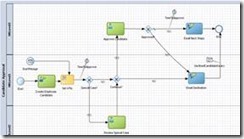
In this video, we’ll guide you on how to import an existing Visio BPMN model into Oracle BPM12c, using Process Composer.

Watch the video here.

SOA & BPM Partner Community

For regular information on Oracle SOA Suite become a member in the SOA & BPM Partner Community for registration please visit www.oracle.com/goto/emea/soa (OPN account required) If you need support with your account please contact the Oracle Partner Business Center.

Blog Twitter LinkedIn image[7][2][2][2] Facebook clip_image002[8][4][2][2][2] Wiki

How to withdraw tasks and handle them in Oracle BPM by Jan van Zoggel


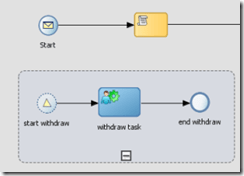
clip_image001If you want to withdraw a Human Task in Oracle BPM there are multiple options. This blog post will first show 3 options and then explain how to model your Oracle BPM process to anticipate on the result of a withdrawn task.

1. The BPM Workspace

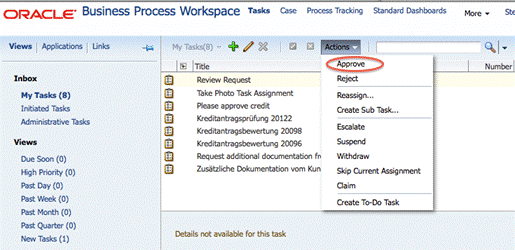
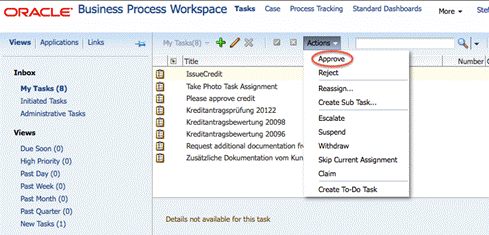
Using the default Oracle BPM WorkSpace to withdraw a task:

2. Using the TaskService

If you use a custom front-end (instead of the default Oracle BPM Workspace) you can use the Oracle SOA Suite TaskQueryService & TaskService to handle your tasks. In the TaskService there are operations named withdraw and withdrawTasks to either withdraw 1 or multiple tasks. The example below shows a withdrawTask operation request message. Read the complete article here.

SOA & BPM Partner Community

For regular information on Oracle SOA Suite become a member in the SOA & BPM Partner Community for registration please visit www.oracle.com/goto/emea/soa (OPN account required) If you need support with your account please contact the Oracle Partner Business Center.

Blog Twitter LinkedIn image[7][2][2][2] Facebook clip_image002[8][4][2][2][2] Wiki

BPM 12c – IT’s Tool of Choice for Citizen Developers? by Calista Bruce

clip_image002Over the last several years we have witnessed an increase in the number of Citizen Developers supporting business automation outside of the IT department. Gartner describe a Citizen Developer in their IT Glossary as…

A citizen developer is a user who creates new business applications for consumption by others using development and runtime environments sanctioned by corporate IT. In the past, end-user application development has typically been limited to single-user or workgroup solutions built with tools like Microsoft Excel and Access. However, today, end users can build departmental, enterprise and even public applications using shared services, fourth-generation language (4GL)-style development platforms and cloud computing services.

As the generation of baby boomers retire, they are being replaced by generations of workers who grew up with computers. These newer generations are comfortable working with technology in all its forms, at its simplest …word processing, spreadsheets and web pages. At its most complex, this technology can include mobile applications, and social media and collaboration tools.  As a result these individuals are more impatient and demanding in their expectation that automation should be available to support them and the business processes within their organization.

It is common that IT departments suffer from resource constraints, often limiting their ability to support projects to only those with the highest strategic alignment or return on investment. These constraints can leave a lot of automation opportunities on the table to the frustration of the business organization. Often this frustration results in Citizen Developers implementing solutions to bridge the gap between what IT can provide and what the business needs in order to function successfully. However, these “off the grid” solutions may expose the organization to risks including:

  • Security Lapses
  • Data Loss and Quality Issues
  • Poorly Designed Software

It makes sense that IT organizations help can reduce these risks by supporting and guiding the Citizen Developer community in their tool choice and development standards. By providing a managed development environment including best practice standards, IT can improve the quality of the deliverables being produced from within the business community. By providing a secure run time environment, IT can mitigate risks associated with critical data loss and security exposures. It is often the case that these “off grid” solutions become essential tools to the organization. When issues arise, ownership for support and future enhancements may need to be assumed by the IT department along with the associated resourcing burden. In order to minimize the impact of these downstream ownership changes IT needs to become be an engaged partner to the Citizen Developers. Read the complete article here.

SOA & BPM Partner Community

For regular information on Oracle SOA Suite become a member in the SOA & BPM Partner Community for registration please visit www.oracle.com/goto/emea/soa (OPN account required) If you need support with your account please contact the Oracle Partner Business Center.

Blog Twitter LinkedIn image[7][2][2][2] Facebook clip_image002[8][4][2][2][2] Wiki

Display Meaningful Instance Titles in the Process Tracking Tab by Dan Atwood


clip_image002This is an extract from AVIO’s new Oracle BPM 12c Developer Training and it explains how to show instance titles that are meaningful to the business in the Oracle BPM Workspace’s Process Tracking tab for Oracle BPM 11.1.1.7 and 12c.

The Process Tracking tab should be one of the Oracle BPM Workspace’s most useful features.  This is where end users in the Workspace can view instance audit trails, determine who and when the various people involved either approved or rejected work items, and it is where process owners can grab an instance in one activity and then move it to another activity in the process.

The primary limitation of the Process Tracking tab has always been that the instances listed have no meaningful business information.  Out of the box, instances are listed as "Instance #(some number) of (process name)".

As a result, it has been difficult for end users to relate the instances displayed in the Process Tracking tab with the actual work that they need to perform in the process. Read the complete article here.

SOA & BPM Partner Community

For regular information on Oracle SOA Suite become a member in the SOA & BPM Partner Community for registration please visit www.oracle.com/goto/emea/soa (OPN account required) If you need support with your account please contact the Oracle Partner Business Center.

Blog Twitter LinkedIn image[7][2][2][2] Facebook clip_image002[8][4][2][2][2] Wiki

Business Process Modelling and Business Activity Monitoring by Stefan Wörmcke


Objective

The objective of this exercise is make participants familiar how to prepare a BPM project for monitoring using BAM

Use Case Description

In this exercise participants will add measurements to a given BPM process:

Prepare BAM data structure

Open given BPM process

Enable BAM for the project

Create measurement indicators

Set measurement marks

Deploy process

Run process

Check BAM data objects

Prepare BAM data structure

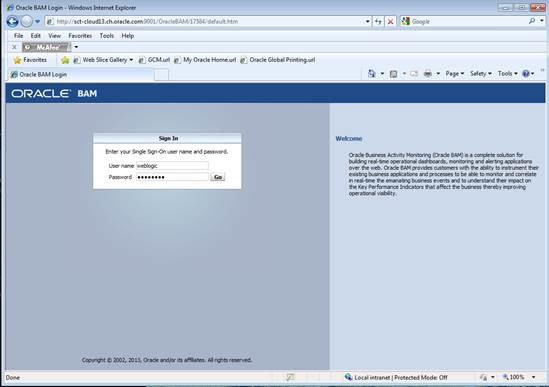
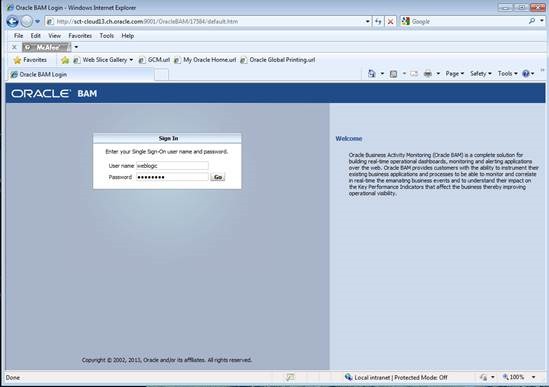
First step when using BAM is to organize the data you are gathering. For this you’ll have to log into BAM (http://hostname:9001/OracleBAM):
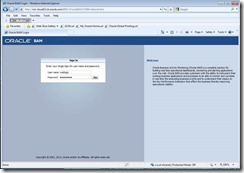
clip_image002

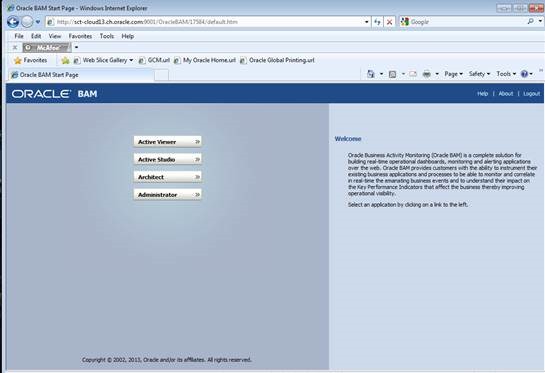
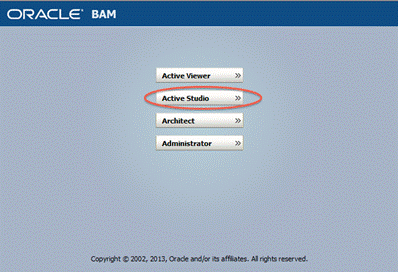
and from the menu choose the BAM architect:
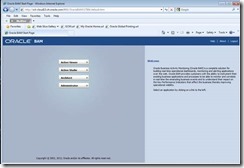
clip_image004

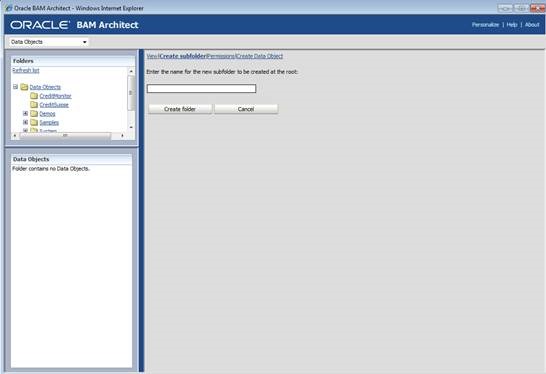
within the folder structure for data objects, create a new subfolder for storing your new data objects:
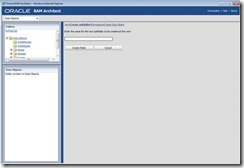
clip_image006

Open given BPM process

Your instructor should provide you with a file named “BAMTutorial.zip” Unzip the file and open the project using JDeveloper.

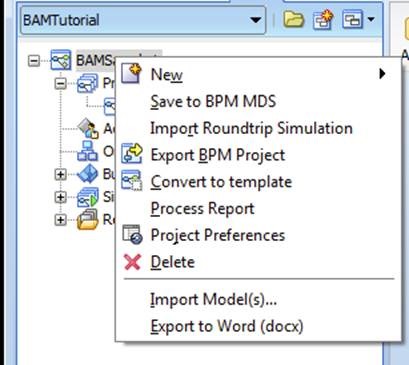
Select the project in the BPM navigation tree, and right click on the project to open project preferences:
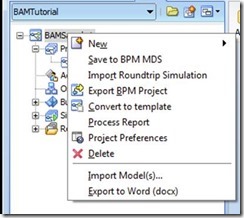
clip_image008

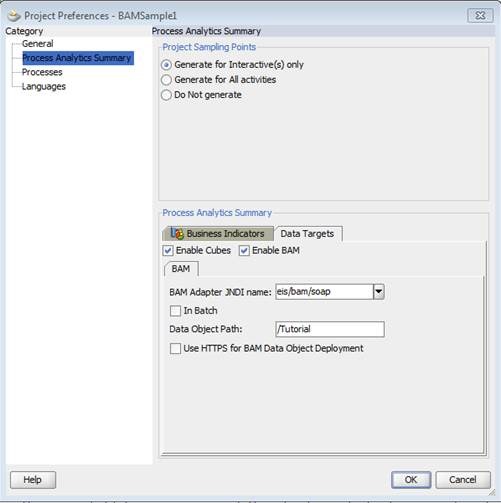
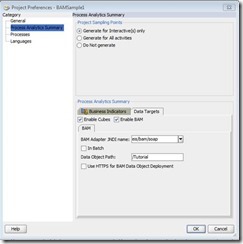
Select “Process Analytics Summary” on the left hand side and select the tab “Data Targets” below:
clip_image010

Here you have to check “Enable BAM” and enter the folder path you created in step 1.3

Click ok and your ready to deploy your project using BAM for monitoring!

Create Measurements Indicators

First step when using BAM in a process is to define what kind of data will be measured: you have to define business indicators. The basic indicators we use in this exercise are:

Dimensions: you use dimension to group data accordingly, e.g. grouping sales by region: North, East, South, West. If you base the dimension on numbers, you have to define ranges for grouping your data, like 0 – 1000, 1001 – 10000, etc.

Measurement: here you actually define the data you are interested in: quantity of ordered items, order total in USD, etc.

Counter: counter are somehow special in BPM: for each process instance their value will be 1 when set. Counters can be used for example to check which path of a process an instance was taken

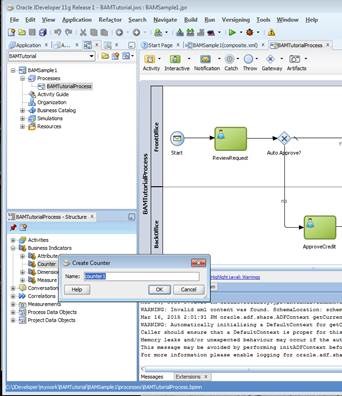
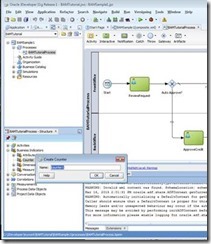
So for our demo process you will first create a counter: within the structure window of your process, expand “Business Indicators”, and right-click “counter” to create a new counter:
clip_image012

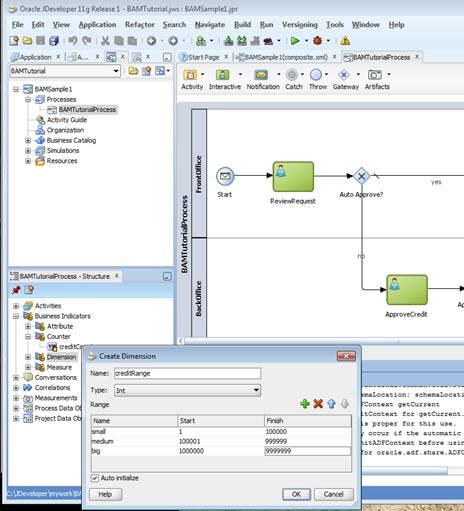
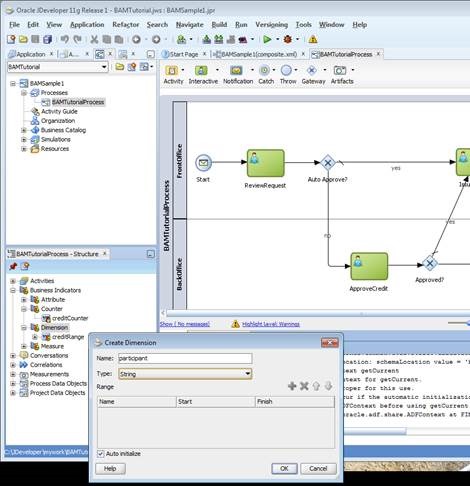
In the next step you’ll create two dimension:

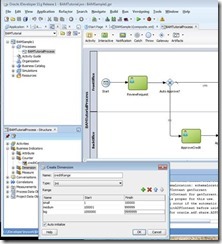
a dimension range (“credit range”):
clip_image014

as you can see here, for a numeric dimension you have to define ranges for the numbers you’re interested in

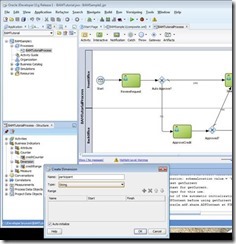
a dimension “Participant”:
clip_image016

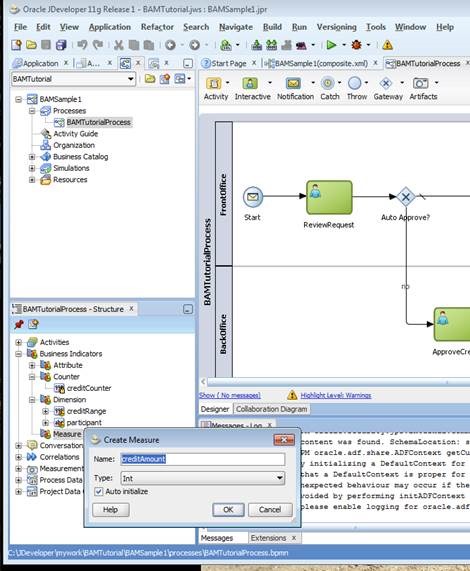
and finally you’ll create for measuring the amount within your process:
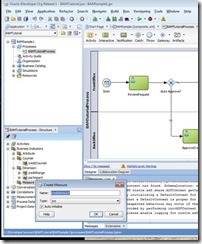
clip_image018

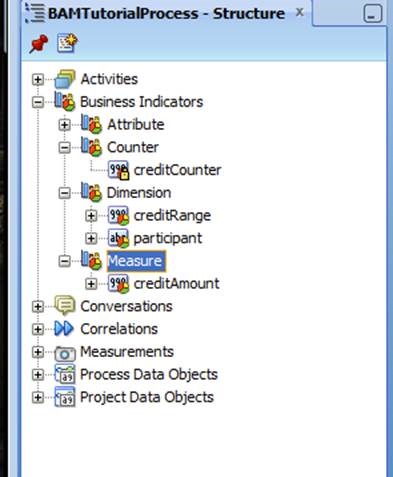
After completing each of the above steps, your list of business indicators should like this by now:
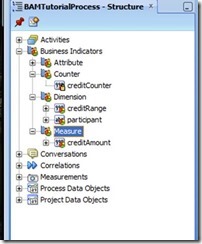
clip_image020

set measurement marks

As you have defined your indicators in the previous exercise, it’s now time set values when the process is executed.

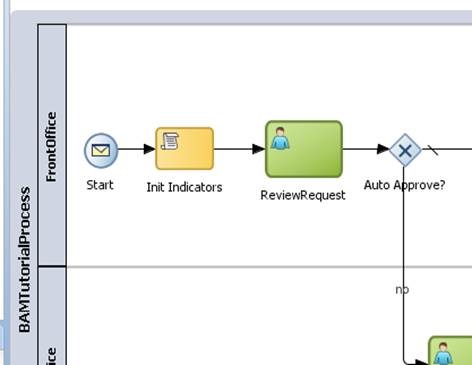
To set dimension, you will use a script task: from the pallet, drop a script task between the start node and “review request”, and call it “Init Indicators”:
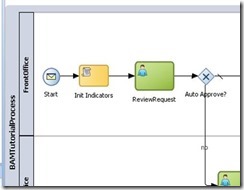
clip_image022

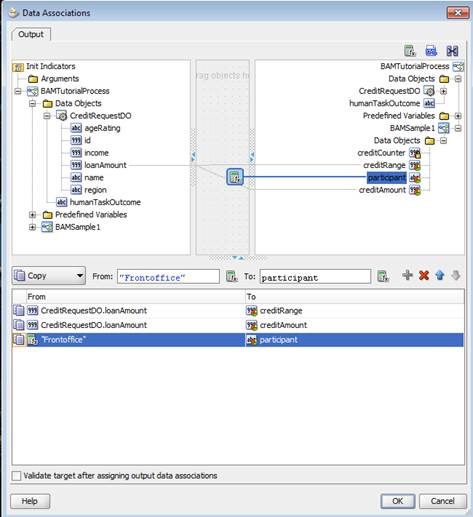
Double click the script task, got to implementation and set data associations:
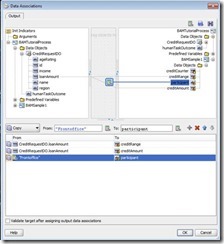
clip_image024

drag lines from left to right to do the associations:

drag a line from “loan amount” to “credit range” to set the dimension for the credit range

drag a line from “loan amount” to “credit amount” for setting the measurement for the credit amount

drop an expression on top of “participant” and assign the value “Frontoffice” to it. Although creating reports by human tasks is a standard measurement you’ll get when using BAM in a BPM process, this step is to demonstrate how to set various dimension you may want to use in future reports

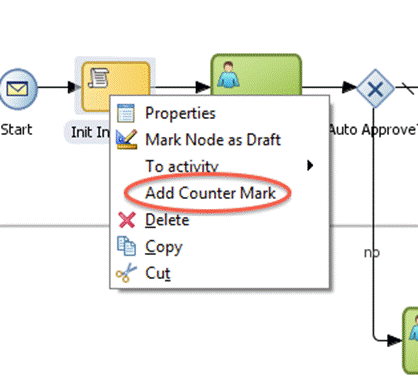
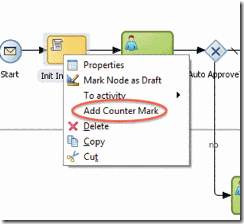
For setting counters, you will have to right click a flow object where you want to set the counter:
clip_image026

In the following dialog you will define which counter mark you want to set in this step.

Deploy the process

Deploying the process with BAM enabled is the same as deploying any other BPM process. The only difference is that you have to enable BAM in the project preferences before deployment.

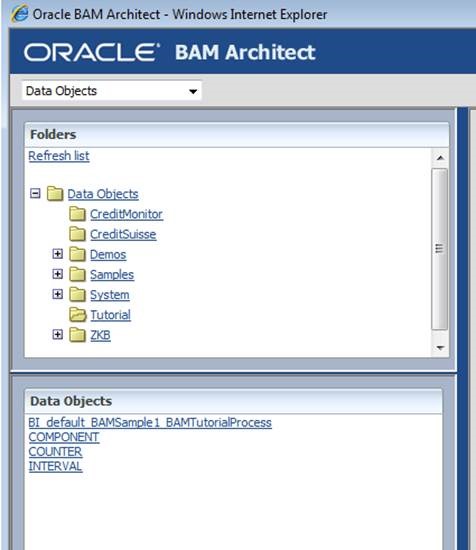
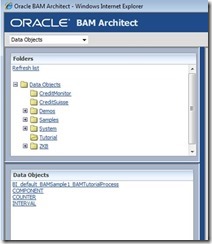
After successful deployment, log into BAM and start BAM Architect to verify that data objects for your process have been created:
clip_image028

Run the process

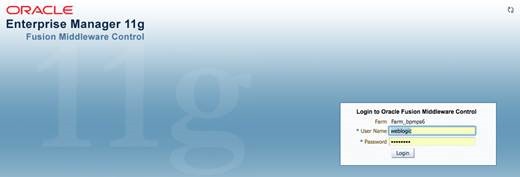
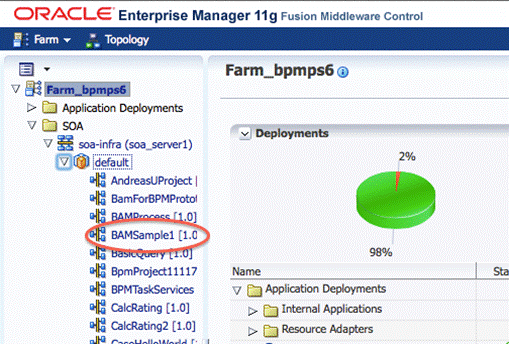
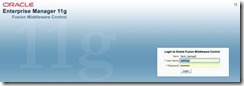
To check if data objects of BAM will be populated, you will have to run the process. You will use Enterprise Manager Fusion Control to test the process. Log into Enterprise Manager (EM), e.g. http://hostname:port/em:
clip_image030

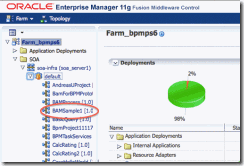
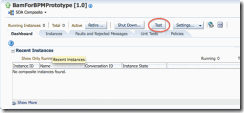
Select the BAMSample1 process in EM:

clip_image032

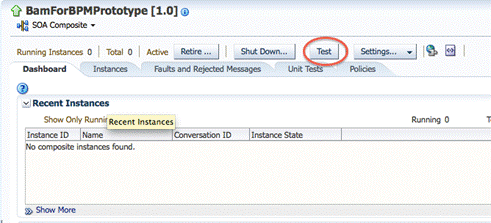
Cick on the TEST button for displaying the request form:
clip_image034

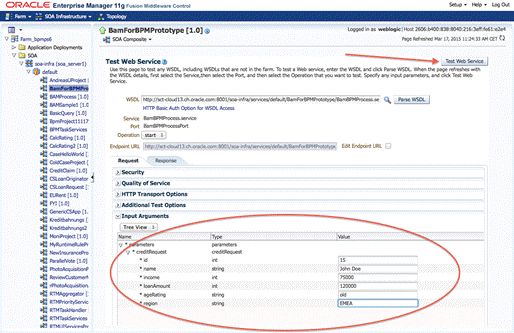
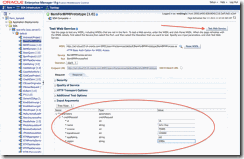
Enter some data for a credit request and start the process using “Test Web Service”:
clip_image036

This process consists of two human tasks which have to be fulfilled to finish the process. To ease testing, both activities should be assigned to the same user. This way you won’t have to login and out several times to finish the process.

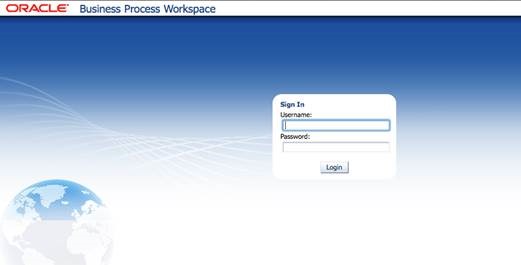
So log into BPM workspace (e.g. http://hostname:port/bpm/workspace) using the credentials of the user, to whom you assigned the human tasks:
clip_image038

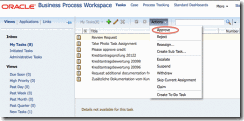
In your inbox, you’ll find the first assigned task “review request”:
clip_image040

Select the task in the list, click on “Actions” and approve it.

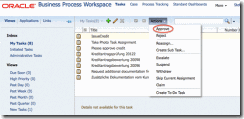
After approving the first task, you’ll find a second task in your inbox “Issue Credit”:
clip_image042

Like in the first part, do approve this task as well.

Now its time to check your data gathered by BAM. Start the BAM architect, and select the newly created Data Objects. Navigate around all data objects and observe the data.

Optional Exercise

Start the process several times with different data and different human tasks actions (approve or reject)

Add more business indicators to your project

Use the newly created business indicators in the project

Redeploy the project

Run the new version of the project and check the data objects

Objective

The objective of this exercise is make participants familiar how to create custom reports and dashboards

Use Case Description

In this exercise participants create a custom dashboard:

Create a dashboard

Add views to the dashboard

Format / change views

Doing a drill down into views

Learn about data objects

Create a dashboard

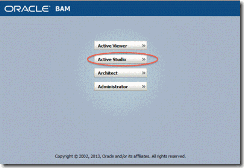
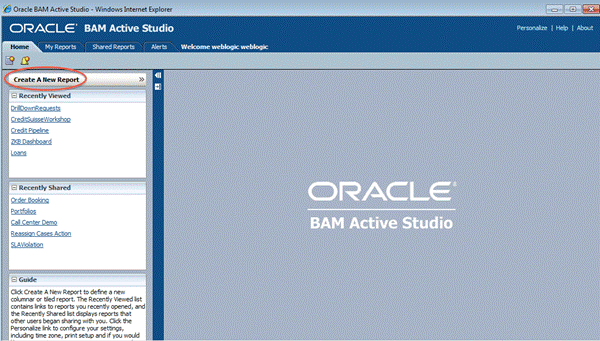
To create your first dashboard, you’ll have to log into BAM (http://hostname:9001/OracleBAM):
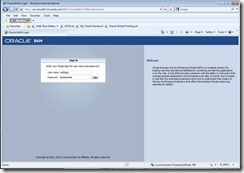
clip_image043

Then start active studio:

clip_image045

To create a new report, hit the button shown below:
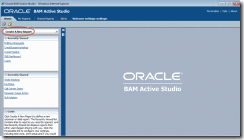
clip_image047

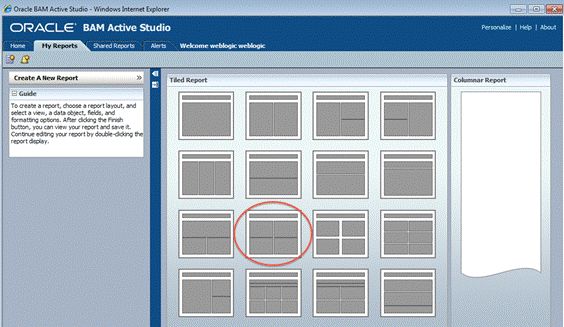
First you’ll have to choose the layout for your report, in our exercise we’ll choose a format with a title bar and 4 frames for the views we will insert later:
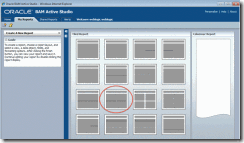
clip_image049

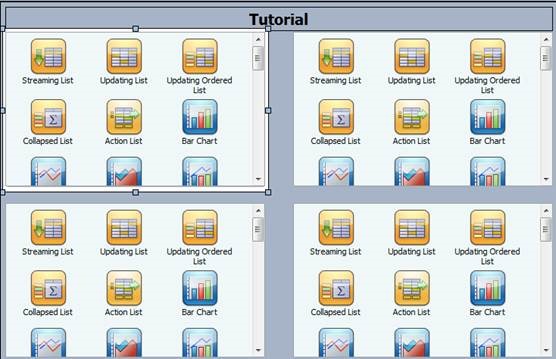
Click on the title bar to change the name of the title, for example: Tutorial

Within the 4 frames you’ll see icons for the various views for your report. “Streaming List, Bar Chart, Range Gauge,..” are all different kind of views you can create. You can also resize the frame of each view to fit your needs.

Start creating your first view by clicking on “Bar Chart” in the upper left frame:
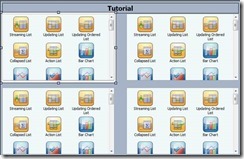
clip_image051

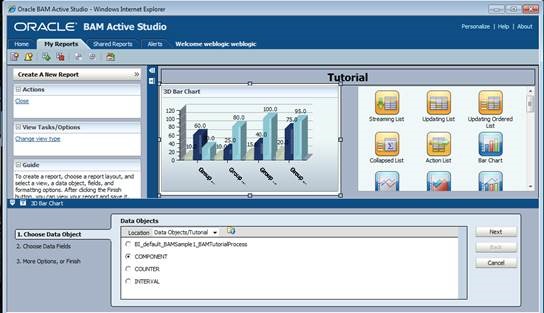
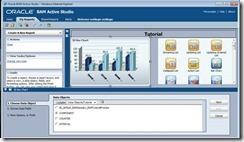
A wizard will start in the bottom guiding you through the definition of your view: data objects, data fields, formats, filters etc.

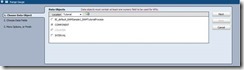
The first step is to define the data object for the report: navigate to the “Tutorial” folder and choose the “Component” data object, then click “Next”:
clip_image053

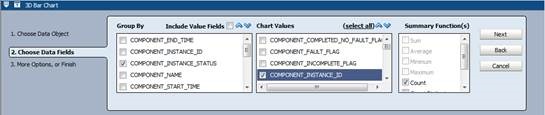
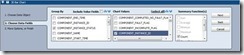
Next step is to define data fields and how we would like to group them: Choose “Component_Instance_Status” for grouping, and count the number of instances “Component_Instance_ID”:
clip_image055

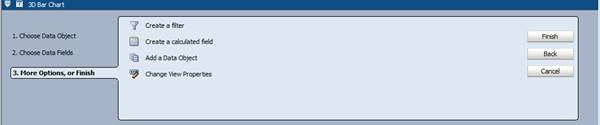
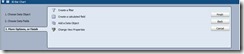
For this report, we don’t need e.g. a filter; finish your report by clicking the corresponding button:
clip_image057

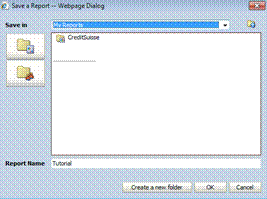
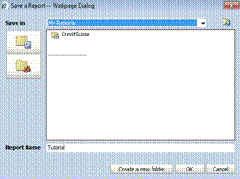
Before proceeding with the exercise, you should save your report. Hit “Save Report AS”, and create a new subfolder:
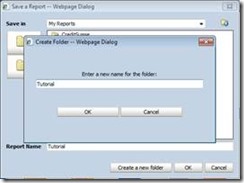
clip_image059

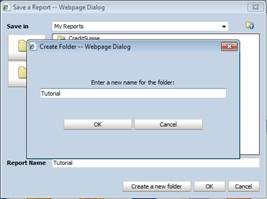
Enter e.g. “Tutorial” as the name for the subfolder:
clip_image061

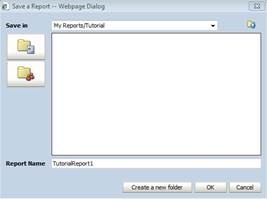
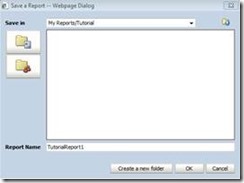
and finally give a name for your report and hit “Ok”:
clip_image063

Let’s recap what we have done so far:

We created a new report by clicking on the corresponding icon. Then we defined where the data is located we want to use for reporting. At this point it is beneficial to make yourself familiar with the underlying data object(s) for your report. Therefor you can start the “Architect” from the Oracle BAM Start menu. For further details refer to your training material from the first BAM workshop.

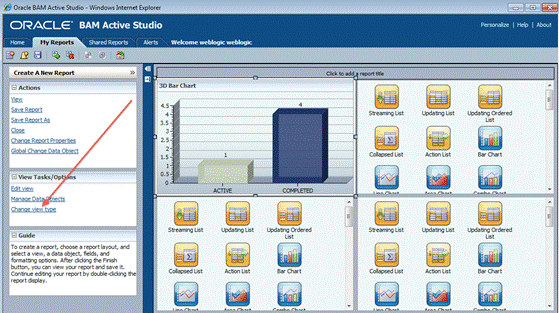
For the data we want to show in the report, we’ve chosen to count the number of process instances, and group them by “Component_Instance_Status” – but why? Every instance we see in Oracle BAM can only have two conditions:

active: the process instances was started, but did not finish yet

completed: the process has finished

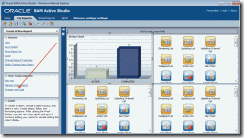
Now if we group the number of instances by status, BAM will count all instances with status “active”, and all instances with status “completed”. The result can be seen in our first view of our report:
clip_image065

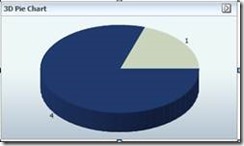
Next step is to change the view type: you will change the Bar Chart into a 3D Pie Chart. Therefor you will first click on “Change View Type” as illustrated in the screenshot above

And then choose the “3D Pie Chart” diagram:
clip_image067

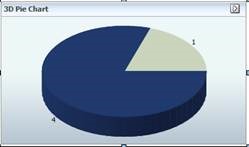
This will change the diagram into a 3D Pie Chart:
clip_image069

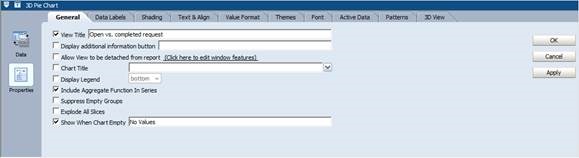
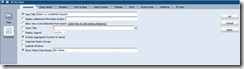
Double-click on the pie chart, and then choose “Properties” on the left hand side to change the title into “Open vs. completed request”:
clip_image071

Finally hit “OK” to apply your changes.

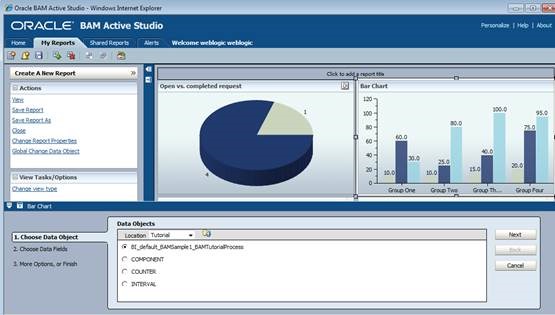
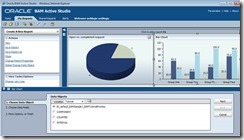
Now we will add another view. Therefor we will choose a “Bar Chart” in the upper right frame. The wizard will start, where you first define the underlying data object for the view, in our case “BI_default_BAMSample1_BAMTutorialProcess” (the actual name of the data object may vary, depending on the setup by your instructor):
clip_image073

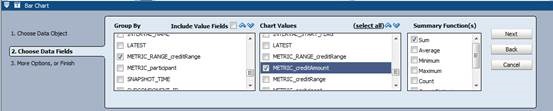
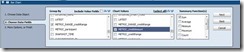
This time we will group our data by credit range, so we will display the sum of credit requests for each range:
clip_image075

ATTENTION: at this point you have to add a filter – why? Because each time a process instance will send payload data to BAM, a new entry will be generated. So if a process contains more than one measurement marks or invocation of BAM, one process instances will have multiple entries in the data object with the same payload.

Now in order to make sure you won’t sum up the same amount multiple times for one process instance, we have to make sure we summarize over the latest entry for an instance, therefor checking the “LATEST” flag.

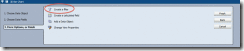
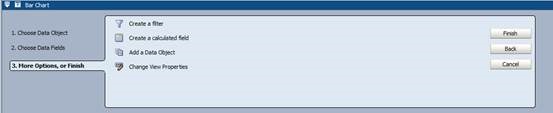
Click on “Create a filter”:
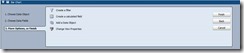
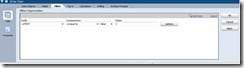
clip_image077

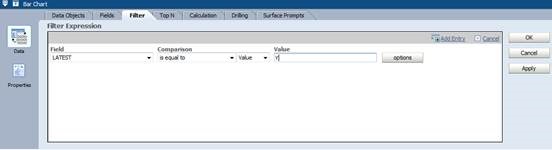
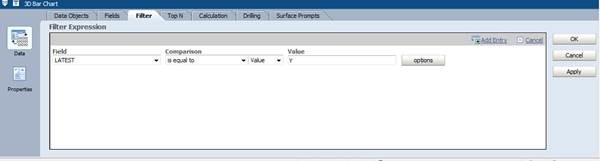
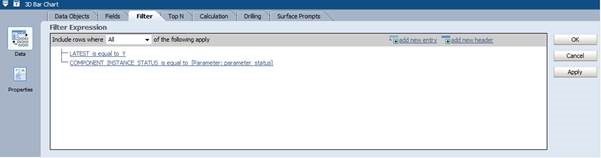
and then “Add Entry”. For the field, choose “LATEST”, set comparison to “is equal to” and enter “Y” as the value. When finished, hit “add entry” again:
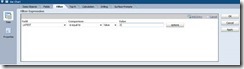
clip_image079

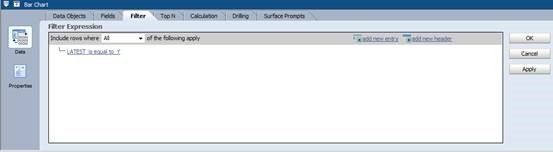
your resulting filter should look like this by now
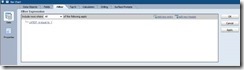
clip_image081

Click ok to finish your 2nd view.

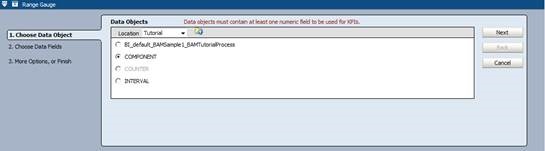
The third view (lower left corner) will be a range gauge. Select the range gauge icon:

clip_image083

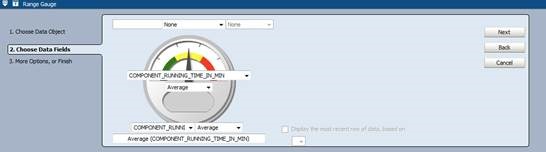
set the data object to “COMPONENT”:

clip_image085

select “Component_Running_Time_In_Min” in the middle of the gauge and in the bottom, and select “Average”:
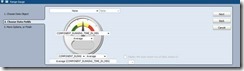
clip_image087

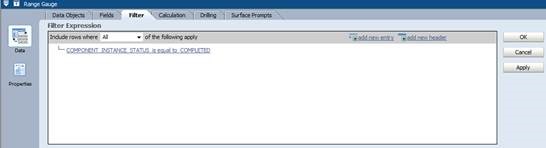
and filter for all instances, which are completed:
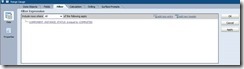
clip_image089

Click “Ok” to finish your settings.

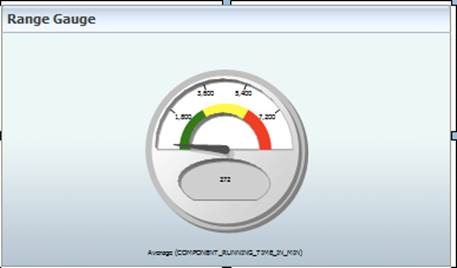
The resulting gauge may look like this (depending on the underlying data):
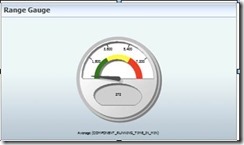
clip_image091

As you can see the scale doesn’t fit for our test data – the red area is around 7200 minutes, far too much for our purpose.

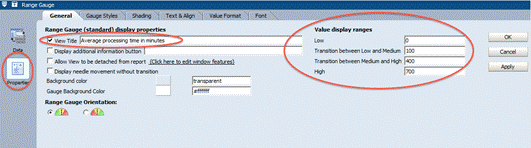
So we have to customize our green, yellow and read areas by customizing the low, medium and high ranges.

Double-click on the range gauge, select “Properties and set the values according to the screenshot below:
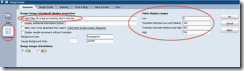
clip_image093

Depending on your test data, adapt values for the ranges accordingly, until you’re satisfied with the result.

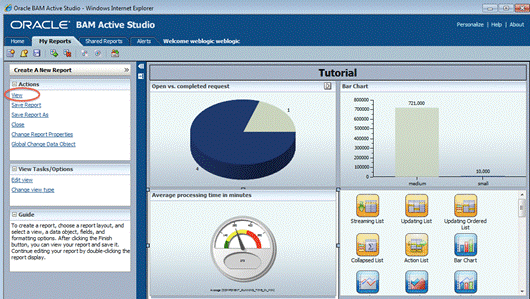
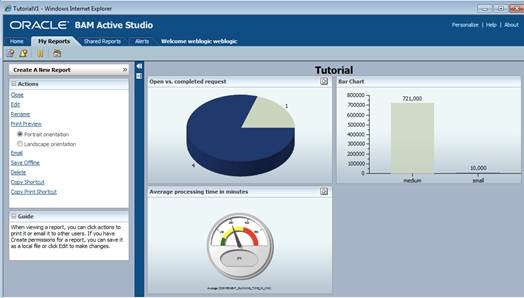
By now your report should look like the screenshot below. To exit the development mode and get a preview, click on “View”:
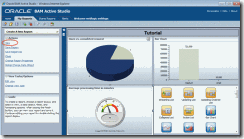
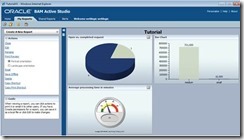
clip_image095

clip_image097

Optional Exercise – drill down

In order to do a drill down, we will first have to define a new report with exactly one view in it. Later this report will be exchange with the current view, from which you start your drill down.

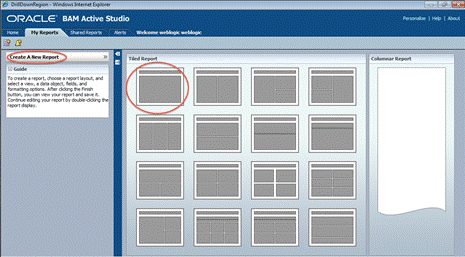
So let’s first start with creating a new report, selecting a template with one view:
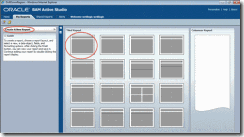
clip_image099

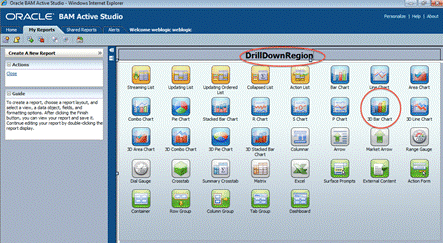
Change the name to “Drill Down”, and choose a “3D Bar Chart:
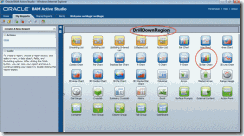
clip_image101

As data object, choose “BI_default_xx” (name depending on your data objects):
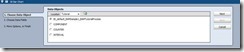
clip_image103

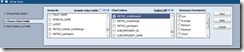
choose to group the sum of credit amounts by range:
clip_image105

and create a filter:

clip_image107

to only select the latest entry:

clip_image109

We will start the drilldown from our previously created report, from the “active vs. completed requests” view in the upper left corner.

Depending from which part of the view (active or completed) the user will start the drill down, we will have to pass this information to the report being called.

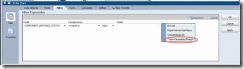
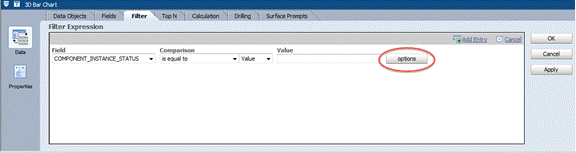
Therefor we will add another filter, the field we need here is “Component_Instances_Status”. To define the parameter, click on “Options”:
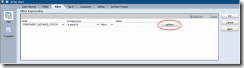
clip_image111

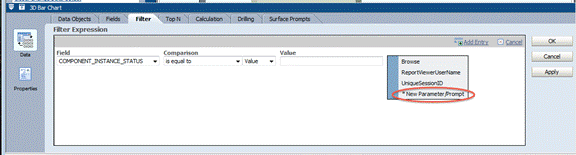
Choose “New Parameter Prompt”:

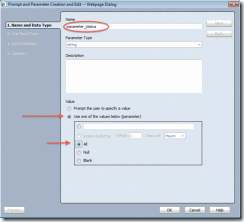
clip_image113

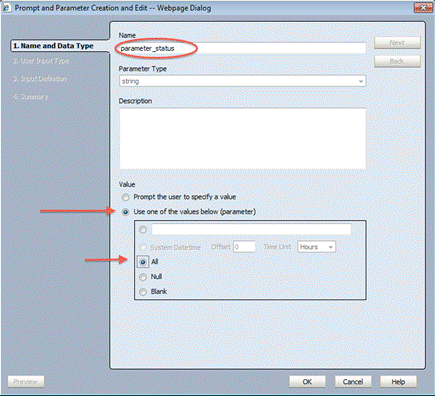
Give your parameter a meaningful name (e.g. “parameter_status”) , select “Use one of the values below (parameter) and then choose “All”:
clip_image115

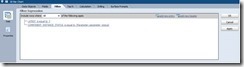
Now your filter should look like this:
clip_image117

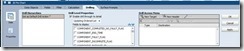
Now we can save the new report, and switch back to our first report. Edit the report, and double click the 3D Pie Chart in the upper left frame. Click on “Properties” and choose the tab “Drilling”.

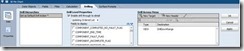
To define your Drilling Target (the new report), click on “New Target”:
clip_image119

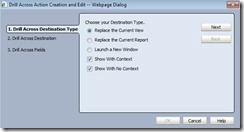
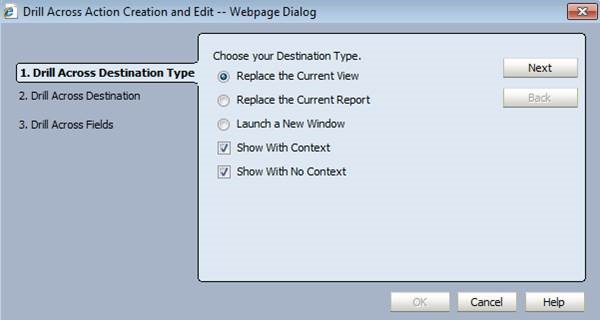
select “replace the current view”:

clip_image121

click on next

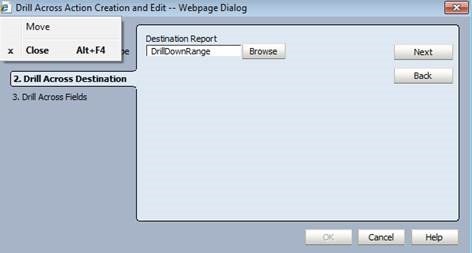
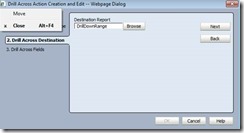
Clicke on “Browse” to select your new report”:
clip_image123

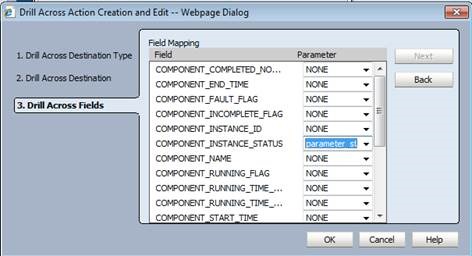
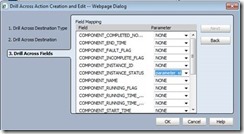
click next, and in the final page set the “Component_Instance_Status” to the newly created parameter (e.g. “parameter status”):
clip_image125

clip_image127

Stefan Wörmcke
Stefan Wörmcke is a Principal Sales Consultant at Oracle Switzerland focusing on SOA and BPM themes. Stefan started 15 years ago at Oracle Germany as a technical consultant for SQL and Java development, Oracle iStore (internet shop application), and application development using frameworks like Struts, Oracle ADF. As one of the first Middleware Sales Consultant for Oracle in Switzerland, he was covering the whole Oracle Middleware stack for some years, and is now focusing on BPM themes, helping customer enabling BPM initiatives throughout their organization. Architecture reviews, BPM best practices and hands-on workshops for customer and partner are just a few examples of Stefans’ activities to grow BPM adoption in Switzerland.

SOA & BPM Partner Community

For regular information on Oracle SOA Suite become a member in the SOA & BPM Partner Community for registration please visit www.oracle.com/goto/emea/soa (OPN account required) If you need support with your account please contact the Oracle Partner Business Center.

Blog Twitter LinkedIn image[7][2][2][2] Facebook clip_image002[8][4][2][2][2] Wiki

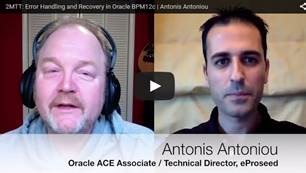
Video: Error Handling and Recovery in Oracle BPM12c | Antonis Antoniou by Bob Rhubart


clip_image002Oracle ACE Associate and eProseed Technical Director Antonis Antoniou puts the pedal to the metal with this tip on two new developer-centric error handling and recovery features in Oracle BPM12c. Watch the video here.

Antonis’s tip is based on his OTN technical article series:

SOA & BPM Partner Community

For regular information on Oracle SOA Suite become a member in the SOA & BPM Partner Community for registration please visit www.oracle.com/goto/emea/soa (OPN account required) If you need support with your account please contact the Oracle Partner Business Center.
Blog Twitter LinkedIn image[7][2][2][2] Facebook clip_image002[8][4][2][2][2] Wiki

BPM Suite 12.2.1 download

clip_image002

You want to download BPM Suite 12.2.1? But you only see BPM Suite 12.3.1 at the OTN page? Here is a little trick:

What’s new in Oracle BPM Suite Version 12.2.1 by Cesare Rotundo

Business Process Management (BPM) Suite 12.2.1 is a complete, unified platform that enables customers to deliver against their business process strategy, execution, and automation needs, from business architecture modeling to business and IT delivery of process solutions.
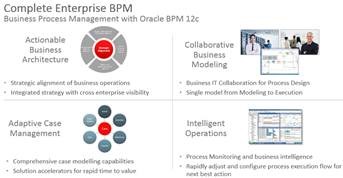
BPM 12c covers four key BPM functionality areas:

· Business Architecture: model starting at the highest (Level 0) level of process abstraction, using Enterprise Process Map, Value Chain Models, Strategy Models, with the ability to link to BPMN processes, as well as to generate an Enterprise KPI Heat Map, Documentation, and Process Reports.

· Collaborative Business Modeling: model specific processes using the BPMN 2.0 notation, offering both Business and IT the right tools for collaborating from modeling to execution.

· Adaptive Case Management: deliver true Case Management solutions than dynamically adapt to the business context, allowing knowledge workers to execute the actions in a set of best available presented to them

· Intelligent Operations: make available real-time Business Activity Monitoring analytics, allowing business real-time control of operational and historical conditions and to take immediate action thru activity-enabled dashboards

While Oracle BPM Suite version 12.1.3 has delivered completely new areas such as Business Architecture, version 12.2.1 makes this complete set of BPM functionality more easily consumable by external solutions and integrated with WebCenter 12c Content and Portal, jointly released with BPM.

REST API

BPM Suite 12.2.1 includes a full set of REST API that enable applications built with any technology to leverage BPM Suite as an engine for workflow management, service integration, and process orchestration. This model is particularly well suited when custom mobile apps need a process engine that offers full BPMN and ACM capabilities, and that delivers BAM dashboards to enable control, management, and continuous improvement of processes.

Specifically, version 12.2.1 adds more granular task control, whereas users of any application / mobile app linked to BPM Suite via REST can now execute and withdraw, escalate, approve, reject, etc. tasks managed in BPM Suite. BPM 12.2.1 has also extended the set of REST API that enable Case control (ACM).

Reusable User Interface Components

BPM Suite 12.2.1 includes user interface (UI) components that can be embedded in WebCenter Portal. These include Task List, where Portal users can access tasks assigned to them by BPM, and Application List, where Portal users can launch BPM applications for which they have been enabled. These BPM UIs can be imported as a Portal Resource Catalog, then embedded into any Portal page, and easily configured based on a set of most common parameters.

Alta User Experience

The User Experience for BPM Suite 12.2.1 is now available with the all-new Oracle Alta UI system, adopted by the most recent Oracle Cloud, on premise, and mobile applications.

Alta offers:

· Fully redesigned UI component set and interactions

· Fresh visual design complements modern layout approach

· UI conducive to responsive design techniques

· Native Mobile UI

For more information please visit the BPM page here & our community workspace here.

SOA & BPM Partner Community

For regular information on Oracle SOA Suite become a member in the SOA & BPM Partner Community for registration please visit www.oracle.com/goto/emea/soa (OPN account required) If you need support with your account please contact the Oracle Partner Business Center.

Blog Twitter LinkedIn image[7][2][2][2] Facebook clip_image002[8][4][2][2][2] Wiki

Getting Started with BPM: Free Oracle University Video Tutorials by Bob Rhubart

clip_image002

Want to sharpen your BPM skills? Settle in for an educational video binge these free tutorials from Oracle University:

Getting Started with BPM – Episode 1: BPMN Overview [40 minutes]
Meera Srinivasan, Director of Product Management for Oracle Business Process Management Suite, explains how Oracle BPM Suite uses BPMN models for process design and analysis. She then describes the four major groups of BPMN constructs: activities, gateways, events, and subprocesses.

Getting Started with BPM – Episode 2: BPM Composer and BPM Studio Overview [60 minutes]
Meera Srinivasan describes the main features of the two Oracle BPM modeling tools—Oracle BPM Composer and Oracle BPM Studio—in their 11g PS6 (11.1.17) releases. Then she highlights the significant changes in the new 12c (2.1.1.3) releases of each tool.

SOA & BPM Partner Community

For regular information on Oracle SOA Suite become a member in the SOA & BPM Partner Community for registration please visit www.oracle.com/goto/emea/soa (OPN account required) If you need support with your account please contact the Oracle Partner Business Center.

Blog Twitter LinkedIn image[7][2][2][2] Facebook clip_image002[8][4][2][2][2] Wiki

BPM Suite 12c Specialist certifications available free online training and free certification!


clip_image002Free online training including free online certification for BPM Suite 12c is now available.

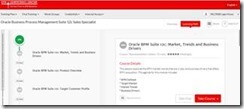
· Business Process Management Suite 12c Sales Specialist guided learning path is intended for sales representatives at partner organizations who specialize in selling and positioning Oracle BPM Suite 12c to their own customer base. The recommended online training sessions provide sales training solutions that equip the sales teams with high-level of product knowledge, market knowledge and selling strategies to help them achieve own revenue targets.

· Oracle Business Process Management Suite 12c Presales Specialist guided learning path is intended for sales engineers and presales consultants at partner organizations who specialize in selling and positioning Oracle BPM Suite 12c. The recommended online training sessions provide more in-depth information to help consultants as they support the sales process through demonstrations and prototypes.

SOA & BPM Partner Community

For regular information on Oracle SOA Suite become a member in the SOA & BPM Partner Community for registration please visit www.oracle.com/goto/emea/soa (OPN account required) If you need support with your account please contact the Oracle Partner Business Center.

Blog Twitter LinkedIn image[7][2][2][2] Facebook clip_image002[8][4][2][2][2] Wiki

Video on Using Force Commit for Non-Idempotent Activities in BPM 12c by Jaideep


clip_image002In BPM 11g it was not possible to explicitly ask the engine to dehydrate the bpm process instance state. The only way to do this was to model a timer catch event set to one second or longer. Oracle BPM 12c has introduced a new property for activities called ‘Force Commit after execution’ to enable us to do this. This video is an excerpt from one of our Oracle BPM Training courses which explains why this property is important especially when you have Non-Idempotent activities in your process.

If you like our videos and blogs, be sure to click on the buttons below to follow us on LinkedIn and Twitter so that you can get notified when we post new content. Read the complete article here.

SOA & BPM Partner Community

For regular information on Oracle SOA Suite become a member in the SOA & BPM Partner Community for registration please visit www.oracle.com/goto/emea/soa (OPN account required) If you need support with your account please contact the Oracle Partner Business Center.

Blog Twitter LinkedIn image[7][2][2][2] Facebook clip_image002[8][4][2][2][2] Wiki